
Petula Clark – Downtown
An evening pause: Performed live 1965.
Hat tip Judd Clark.
An evening pause: Performed live 1965.
Hat tip Judd Clark.
Courtesy of BtB’s stringer Jay, who has returned from a weeklong work trip in “the People’s Republic of California.” This post is also an open thread. I welcome my readers to post any comments or additional links relating to any space issues, even if unrelated to the links below.
That makes at least three constellations (including Starlink and OneWeb) in orbit ahead of and operational before Amazon has launched a single satelltie in its Kuiper constellation
Though I saw no announcement, they apparently got their launch licence from the Australian government.
According to the article, the core stage will not reach orbit and thus not make an uncontrolled re-entry, as the core stage of the more powerful Long March 5B varient does.
The communists might claim they think capitalism is bad and they are building a Marxist utopia, but the invisible hand of capitalism always rules.

The Nazi desecration of babies held hostage
by Hamas
Unless you have been badly educated at one of the so-called elite universities in the United States, Great Britain, or Europe, the genocidal goals of the terrorist organization of Hamas in Gaza are as plain as day. These murderous thugs not only admire Hitler and wish to finish his effort to wipe out all Jews, they demonstrated that blatant evil goal on October 7, 2024, killing more than a thousand men, women, and children, torturing and raping many women and children in the process. Hamas’ victims that day had committed only one crime: being Jewish and living near Gaza. Many were from the leftwing secular Israeli community, and had worked hard to build good will ties with many in Gaza. The Gazans, working for Hamas, used those ties to gather intelligence that was then used to murder these Jews.
Soon after the massacre, Hamas officials went on television to celebrate these vicious murders. Ghazi Hamad of the Hamas Political Bureau proudly said said that the slaughter on October 7th “is just the first time, and there will be a second, a third, a fourth.” When asked if his position called for the anniliation of Israel, he immediately answered “Yes, of course,” adding “No one should blame us for the things we do, on October 7, October 10, October million, everything we do is justified.”
So what does these goals tell us about the hoards of protesters now swarming on many of these same college campuses, screaming things like “Globalize the Intifa!” and “Kill the Zionists!”? The picture above tells us all we need to know. On October 7th Hamas not only killed more than a thousand, it kidnapped more than two hundred more to hold as hostages, many of whom were little childen and babies. When supporters of Israel began putting up these posters showing the actual hostages held and demanding their release, supporters of Hamas in America and elsewhere would routinely go around ripping those posters down. In the case of the poster above put up in London, they did worse, actually drawing Hilter mustaches on the faces of the babies.
On campuses now, these student protesters are daily telling us where they stand. They support Hamas unequivocally, and want it to survive to kill Jews. Like the Nazis in Germany, they work to harass and persecute any American Jews who happen to stroll by, sometimes acting to block their access to the university. In some cases they attack them violently.
» Read more
In the fall of 2023 officials of the European Union (EU) announced that they expected to release the Union’s own space law, that would regulate the individual space laws of all member nations. Since then the release of that law has been put back several times, and in early April its release was delayed until the summer, after the EU elections in June.
This article published today provides the likely reasons why it has been delayed. Apparently, individual members of the EU have objected to the law as interfering with their own space laws as well as imposing regulations they don’t want or need.
The EU Space Law will need to overcome several obstacles to become a functional and beneficial piece of legislation. Several EU Member States already have national space legislation and are actively engaged in space activities, while an increasing number are adopting domestic frameworks and expanding their presence in the space sector. In a heavily regulated environment, where countries have long established and enforced national laws, the practical implementation of a space law at the EU level may be contested.
The article then lists three reasons for these objections. First, the EU has no experience or stake in this matter. It launches nothing and thus can only pose an additional obstacle to the growing commercial space industries in member countries. Second, an EU space law is certainly going to conflict with the space laws of member countries. Third, this law’s implementation could significantly interfere with the legal timelines established by individual member countries.
The article also lists three reasons why the EU law might be good, but these reasons really can be summed up as attempting to justify the EU’s power grab over the space efforts of the member countries.
In the end, this analysis tells us that the EU’s power grab has been met by significant opposition behind the scenes, and could very well die because of that opposition. Germany, Italy, Spain, and more recently even France have begun to encourage the development of independent competing rocket companies, and all likely fear this EU space law will only get in the way.
Link here The details come from a presentation at a public meeting by Amit Kshatriya, Deputy Associate Administrator of NASA’s Moon to Mars program, with this the key takeaway:
Kshatriya then expanded the discussion beyond the next few Starship flights and talked about the required technologies for a fuel depot in orbit and the in-orbit capabilities needed to transfer fuel. “We need an instance of the ship that is essentially long, has the endurance to stay in orbit long enough for the sequence to work.
“So, we need a ship that has at least three to four weeks of endurance in orbit. That endurance is gained through augmented power system capability, augmented battery capacity, full insulation of the cryogenic systems, vacuum jacketing of all the lines, et cetera, to make sure that the cryogens that are being stored or are meant to be stored don’t boil off.”
The challenges of a cryogenic ship in orbit include the need to prevent boil-off from the stack. To facilitate the journey to the Moon’s surface, Starship will have to be refueled. For this, the company plans to refuel a depot in low-Earth orbit (LEO), which would be resupplied by several tanker Starships. The HLS Starship would then dock with this depot before departing for the Moon.
To prove this system will require a Starship test flight that lasts several weeks in orbit, to prove the capability needed for a lunar mission. It will also require a refueling mission that will require several Starship/Superheavy launches, one to put the fuel depot into orbit, several more to fuel that depot, and a final launch of Starship for its refueling and endurance test.
According to the update, SpaceX is still aiming to be ready of the upcoming fourth Superheavy/Starship demo orbital flight in the first two weeks. The NASA official claimed it would occur no later than the end of May. I see that as a confirmation that NASA really doesn’t expect the FAA to issue a launch permit when SpaceX is ready, and that the permit might not arrive in time for a May launch. This statement is meant to soften the blow when the launch finally gets delayed into June, or later.
Whether the many required later Starship launches as described above can get FAA approval quick enough to prove out this system soon enough to meet NASA’s 2026 present target date for its manned lunar landing seems very unlikely. Moreover, even if it does it will be a major challenge for SpaceX to meet this schedule.

Click for original image.

Click for original image.
The cool infrared image to the right, cropped, reduced, and sharpened to post here, was taken by the Webb Space Telescope and released today. The three pictures above provide the context, with the rectangle inside the rightmost image indicated the area covered by the close-up to the right.
Webb’s new images show part of the sky in the constellation Orion (The Hunter), in the western side of a dense region known as the Orion B molecular cloud. Rising from turbulent waves of dust and gas is the Horsehead Nebula, otherwise known as Barnard 33, which resides roughly 1,300 light-years away.
The nebula formed from a collapsing interstellar cloud of material, and glows because it is illuminated by a nearby hot star. The gas clouds surrounding the Horsehead have already dissipated, but the jutting pillar is made of thick clumps of material and therefore is harder to erode. Astronomers estimate that the Horsehead has about five million years left before it too disintegrates. Webb’s new view focuses on the illuminated edge of the top of the nebula’s distinctive dust and gas structure.
In the close-up, note the many distant tiny galaxies, both above the mane as well as glowing throught it.
March on bunny! SpaceX today successfully launched another 23 Starlink satellites, its Falcon 9 rocket lifting off from Cape Canaveral.
The first stage completed its thirteenth flight, landing on a drone ship in the Atlantic.
The leaders in the 2024 launch race:
44 SpaceX
17 China
6 Russia
5 Rocket Lab
American private enterprise now leads the rest of the world combined in successful launches 51 to 29, while SpaceX by itself still leads the rest of the world, including other American companies, 44 to 36.
SpaceX today successfully launched two satellites of Europe’s Galileo GPS-type satellite constellation, the first of a two-launch contract awarded to SpaceX when the Soyuz rocket was no longer available because of Russia’s invasion of the Ukraine and Arianespace’s Ariane-6 rocket was not yet operational.
The first stage completed its 20th flight, tying the record set by another booster only a few weeks ago. Because of the high orbit required by both satellites, that stage was not recovered, the first time SpaceX has expended a first stage since November 2022. SpaceX however also announced that the company is now working to upgrade its Falcon 9 first stages and fairings to fly as many as 40 missions. The two fairings also completed their fourth flight, which brought the total of fairings SpaceX has recovered to 200.
The leaders in the 2024 launch race:
43 SpaceX
17 China
6 Russia
5 Rocket Lab
American private enterprise now leads the rest of the world combined in successful launches 50 to 29, while SpaceX by itself still leads the rest of the world, including other American companies, 43 to 36.
The European Space Agency (ESA) this week did a major shake-up in the management and structure of its ClearSpace-1 space junk removal mission that had previously been awarded to the Swiss orbital tug startup Clearspace.
Moving forward OHB SE will take over the responsibility of leading the ClearSpace-1 consortium. The Bremen-based company will provide the satellite bus and will be in charge of system integration and launch. ClearSpace will be responsible for the close proximity and capture operations once the vehicle is in orbit.
In addition to the change in leadership, the mission’s target has also been adjusted, with ClearSpace-1 now expected to rendezvous and capture PROBA-1. The 94-kilogram ESA technology demonstrator was launched aboard an ISRO PSLV rocket in October 2001.
The original target, a payload adaptor from a 2013 Vega launch, had been hit by another piece of junk, damaging it and making it a much more difficult target to grab, using the four grapple arms of the Clearspace spacecraft. No timeline for when this revised mission will fly was announced.
The uncertainty of science: Scientists have long assumed that the molecule dimethyl sulfide (DMS) is an excellent biosignature of life, since it is only produced by life here on Earth. When they discovered it in the atmosphere of an exoplanet last year many thought, especially in the media, that it proved that life existed on that exoplanet.
A scientist who had worked on the Rosetta mission to the Comet 67P/C-G thought otherwise, that DMS was not a reliable biosignature and quickly proved it.
Just 1 day of data from Rosetta’s mass spectrometer, an instrument that can identify molecules by their specific weights, was enough for [Nora Hänni] and her colleagues to find DMS. She says lab experiments will now be needed to pin down exactly how DMS forms in space, where ultraviolet light and cosmic rays can power the synthesis of complex organic molecules. Another important question is whether comets could deliver significant amounts of DMS to a planet—and perhaps account for detections like the K2-18b claim. “If it impacted the atmosphere, it could contaminate the atmosphere of the planet,” Noack says, potentially complicating searches for alien life.
Like the fake news in 2020 that life was found in the atmosphere of Venus (it wasn’t), it is a big mistake to use the detection of one molecule to assume it is evidence of life on an alien world. The universe is far more complicated.
Embedded below the fold in two parts.
To listen to all of John Batchelor’s podcasts, go here.
» Read more
An evening pause: Or as the performer labeled this video, “If Sinatra played bass.”
Hat tip Cotour.

Amid the illegal protests by pro-Hamas anti-Semitic new Nazis on college campuses, a wider looks suggests some encouraging trends, though hard to spot amid the chaos promoted by these genocidal rioters, most of whom are students but led it appears by many outside agitators.
There is no question these college rioters are causing havoc as they spread fear and hatred on numerous college campuses, including Columbia, Harvard, MIT, Princeton, NYU, Cal Poly Humboldt, USC, and UT-Austin, to name jsut a few.
In every case the protesters arrived with tents and a definitive plan to illegally occupy part of the campus, using almost identical tactics of the Occupy Wall Street crowd in 2011. Very clearly they wanted to establish themselves in a prominent position on each campus, where they could daily interfere with campus life while harassing anyone they saw as either Jewish or a potential enemy. Their tactics also mimicked the actions of the 2020 BLM and Antifa rioters, not only acting to keep out Jewish students from campuses, but working together violently to exclude anyone they wanted excluded. Reporters were routinely blocked with banners, umbrellas, and their bodies. In at least one case these terrorists even attacked one reporter, stabbing her in the eye with the pole of a Palestinian flag.
There is also no question that these riots have the same ulterior motives that existed in 2020, to disrupt the upcoming November election so that the Democrats could win. Many of the 2020 riots were specifically aimed at Trump election rallies, often causing their cancellation. The riots also provided Democratic Party officials in many key swing states reasons to justify the arbitrary changing of election laws — done also in conjuntion with the COVID panic — to allow the illegal use of very insecure ballot measures, such as unsupervised drop boxes and the misuse of mail-in ballots.
The differences today from 2020 and 2011 however are quite significant, and suggest these violent tactics are no longer working, that the country is beginning to push back hard against such insurrectionist behavior.
The pushback
» Read more

Click for original image.
Cool image time! The picture to the right, cropped to post here, was taken on March 16, 2024 by the high resolution camera of Mars Reconnaissance Orbiter (MRO). It was released today as a captioned picture from MRO’s camera team. As noted in the caption, written by the camera’s principal investigator Alfred McEwen:
This image shows a field a sand dunes in the Martian springtime while the seasonal carbon dioxide frost is sublimating into the air. This sublimation process is not at all uniform, instead creating a pattern of dark spots.
In addition, the inter-dune areas are also striking, with bright frost persisting in the troughs of polygons. Our enhanced-color cutout is centered on a brownish-colored inter-dune area.
Each winter the carbon dioxide in the Martian atmosphere falls as snow, mantling the surface in the latitudes above 60 degrees with a clear coat of dry ice. When spring arrives the sunlight passes through the mantle to heat the ground below, which in turn causes the base of the dry ice mantle to sublimate into gas. When the pressure builds enough, the gas breaks through the mantle at its weak points, spewing out and bringing with it dust from below, which stains the mantle with the dark spots.
» Read more
The uncertainty of science: Using computer modeling some scientists now suggest that the nearby asteroid 2016 HO3, also known as Kamo’oalewa, that has a solar orbit that periodically flips around the Earth, came from an impact a million years ago that created the Giordano Bruno crater on the moon’s far side.
According to the simulations, it would have required an impactor of at least 1 kilometer (0.6 mile) in diameter to launch a large fragment like Kamo’oalewa beyond the moon’s gravitational pull. According to the group’s model, the impact would have dug up Kamo’oalewa from deep beneath the moon’s surface, leaving behind an impact crater larger than 10 to 20 kilometers (6-12 miles) in diameter. Additionally, the crater would have to be younger than the average lifetime for near-Earth objects, which spans about 10 million to 100 million years, a very short and recent period in the history of the solar system.
While the lunar surface is riddled with thousands of craters from impacts spanning the moon’s 4.5 billion year-history, only Giordano Bruno with its 14-mile diameter and estimated 4 million years of age fits the bill in terms of size and age, making it the most probable source of Kamo’oalewa’s origin. The team also showed that this scenario is feasible from an impact dynamics perspective.
To say that this conclusion is uncertain is an understatement of monumental proportions. However, the possibility is real. A Chinese asteroid mission, dubbed Tianwen-2, will likely found out, as it is planning to bring samples back from this asteroid by 2027.
Capitalism in space: France’s space agency CNES has now issued a request for commercial rocket companies to bid on leasing the launchpad formerly used by Russia to launch its Soyuz rocket from French Guiana.
The launchpad became available after the European Space Agency (ESA) broke off its partnerships with Russia in February 2022.
Following the cessation of Soyuz launches, it was agreed that ESA would transfer ownership of the site back to CNES under the provision that it would host two new launch systems. The first will be selected by CNES as part of its recently published call. The second will be selected by ESA as part of the agency’s launcher challenge, which was publically announced in late 2023.
According to the CNES call, prospective candidate vehicles will be required to be capable of deploying payloads of at least 1.5 tonnes into low Earth orbit. Additionally, a maiden flight from the launch site will need to be completed no later than 2027. This will drastically limit the potential bidders.
The article at the link lists three potential bidders, Rocket Factory Augsburg, Maiaspace, and Avio. The first two are rocket startups, having not yet launched a rocket. Avio is the lead contractor for Arianespace’s Vega family of rockets, so it already has experience with an operational rocket, though that rocket is presently grounded due to recent launch failures.
There are a number of other rocket startups in Europe, including PLD in Spain and Hyimpulse and Isar in Germany. The incentive to bid for this launchpad might encourage them to upgrade their rocket to meet the bidding requirements.
Click for original image.
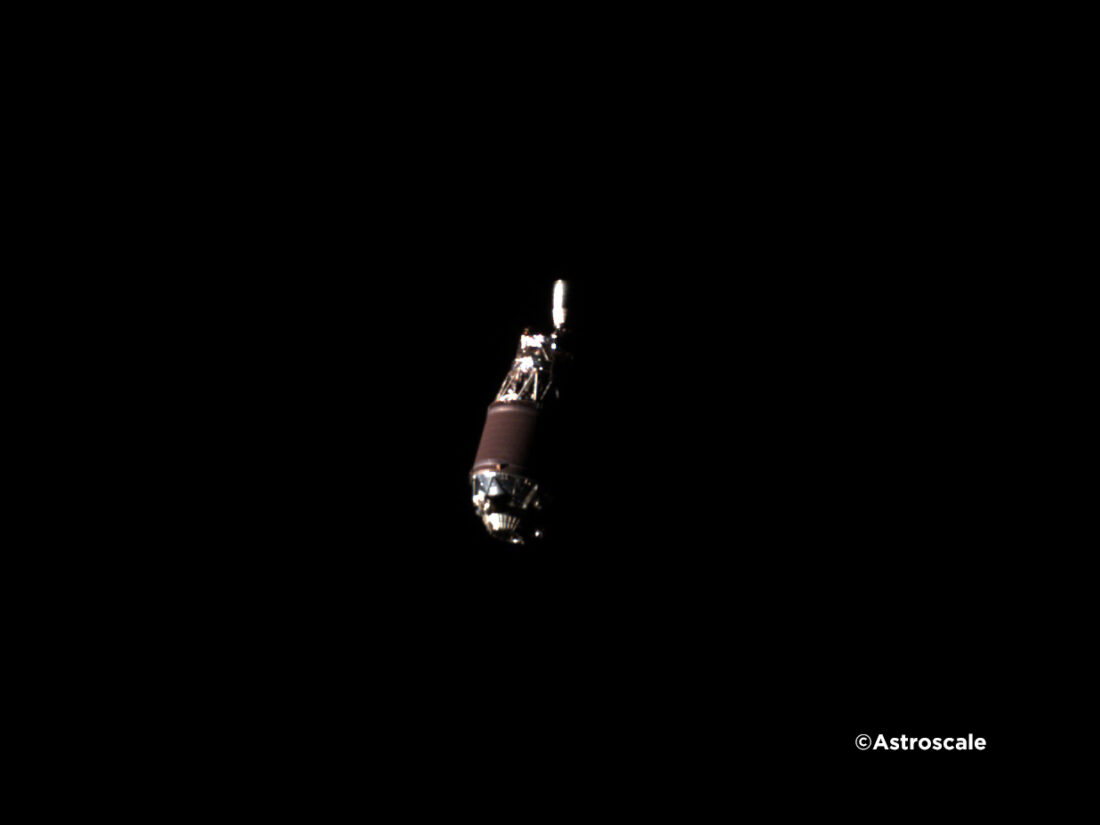
Capitalism in space: The Japanese orbital tug startup Astroscale today released an image its ADRAS-J spacecraft took of an abandoned rocket upper stage during rendezvous operations.
That image is to the right, cropped to post here. ADRAS-J’s mission is to test autonomous rendezvous and close proximity operations as well as obtain images of the stage in order to prepare for a second mission that will grab the abandoned stage with a robot arm and de-orbit it.
Both missions have been funded by Japan’s space agency JAXA. The mission however is unprecedented by that agency, in that it did not design the mission, but instead hired this private startup to do it, signaling that agency’s shift from being the designer, builder, and owner of such projects to becoming simply a customer. If successful, the mission will be the first to capture a very large piece of space junk and remove from orbit.
According to a presentation given by a NASA official at a conference in London yesterday, the first launch of Blue Origin’s New Glenn rocket is now targeting a September 29, 2024 launch.
In a presentation at a meeting of a planetary protection committee of the Committee on Space Research (COSPAR) in London April 24, Nick Benardini, NASA’s planetary protection officer, listed a Sept. 29 date for the launch of Escape and Plasma Acceleration and Dynamics Explorers (ESCAPADE) mission, a pair of smallsats that will go into orbit around Mars to measure the interaction of the planet’s magnetosphere with the solar wind.
NASA selected Blue Origin’s New Glenn rocket to launch ESCAPADE, awarding the company a $20 million task order through the agency’s Venture-Class Acquisition of Dedicated and Rideshare contract in February 2023 for the mission. The award at the time mentioned only a late 2024 launch, with the expectation that ESCAPADE would be on one of the first, if not the first, flight of the rocket.
Benardini mentioned ESCAPADE in his COSPAR presentation to discuss how the mission was complying with planetary protection requirements, intended to prevent any contamination of Mars, during the assembly of the spacecraft and launch preparations at Cape Canaveral. “They’re slated to be launching Sept. 29 with Blue Origin,” he said.
This is the first time any source at NASA or Blue Origin has revealed a specific launch date. The rocket was originally supposed to fly its first orbital test flight four years ago, but numerous delays, mostly related to the BE-4 engine used by the rocket’s first stage as well as decisions by the company’s former CEO, Bob Smith, to slow all development, pushed that launch back repeatedly. With Smith leaving late last year, the company has suddenly come back to life, with many indications that it was pushing for a launch this year.
Click for original image.
The Hubble Space Telescope has gone into safe mode, pausing science observations on April 23, 2024 when its computer detected problems with one of its three working gyroscopes.
This particular gyro caused Hubble to enter safe mode in November after returning similar faulty readings. The team is currently working to identify potential solutions. If necessary, the spacecraft can be re-configured to operate with only one gyro, with the other remaining gyro placed in reserve . The spacecraft had six new gyros installed during the fifth and final space shuttle servicing mission in 2009. To date, three of those gyros remain operational, including the gyro currently experiencing fluctuations. Hubble uses three gyros to maximize efficiency, but could continue to make science observations with only one gyro if required.
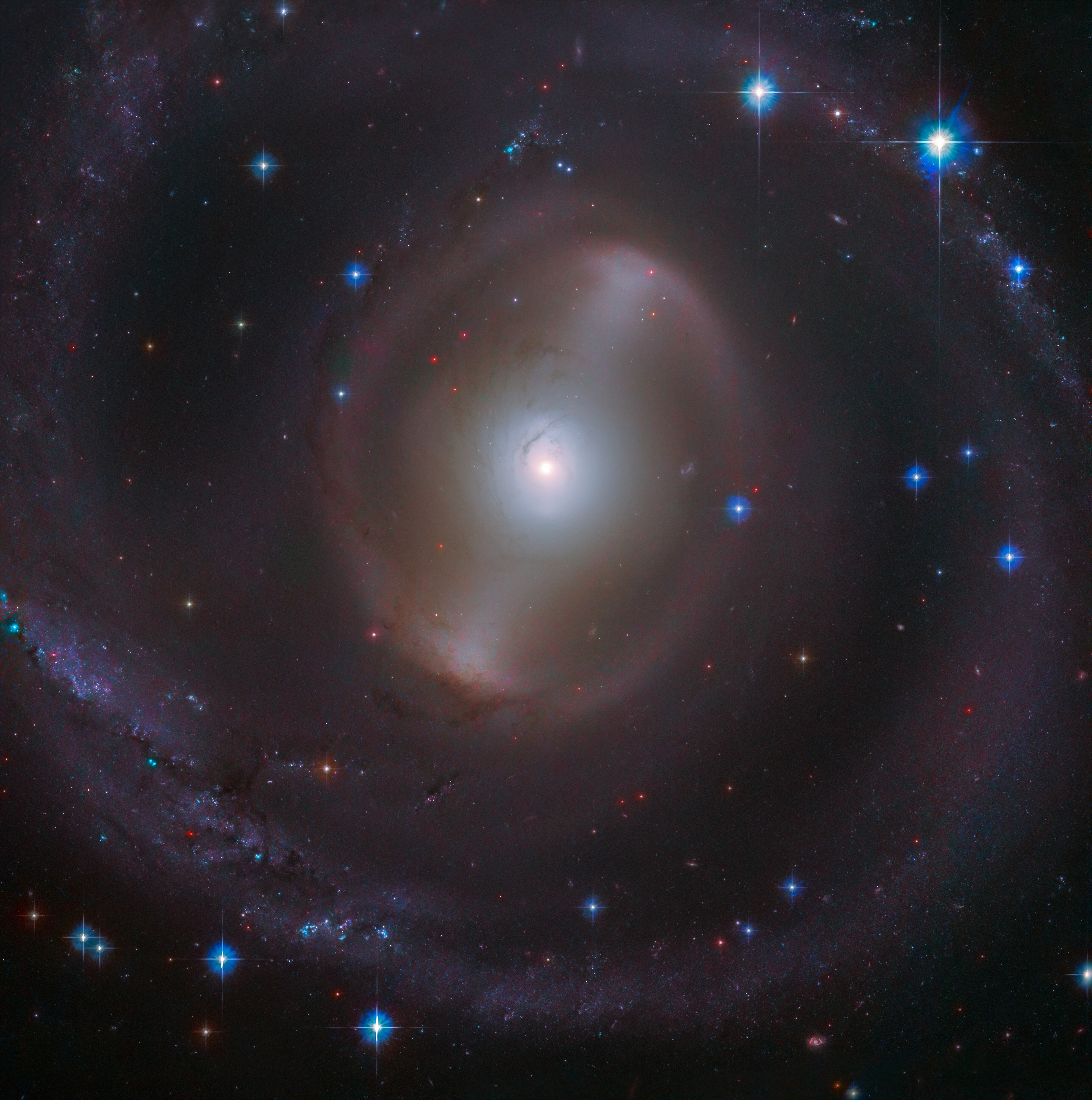
If they cannot recover that gyro and are forced to resume science operations in one-gyro mode, it will mean the end of sharp images such as the one to the right, released today of the barred galaxy NGC 2217, located about 65 million light years away. Three gyros stablize the telescope in all three dimensions. One gyro can stablize it, but not in all three dimensions. Sharpness will suffer. We will no longer have a fully capable general purpose optical telescope in orbit, no plans in the U.S. to replace it.
An evening pause: Hat tip Judd Clark, who gives this background, “Written by Billie Holiday, who first recorded it on April 20, 1939 on the Commodore label. Performed by Billie Holiday in 1957 in a television special, The Sound of Jazz.”