August 2, 2024 Zimmerman/Batchelor podcast
Embedded below the fold in two parts.
To listen to all of John Batchelor’s podcasts, go here.
» Read more
Embedded below the fold in two parts.
To listen to all of John Batchelor’s podcasts, go here.
» Read more
An evening pause: The music is called “Surprise Attack” by James Horner, and was written for the 1982 film, Star Trek: The Wrath of Khan. The action is produced by a Great Blue Heron at Sapsucker Woods, Ithaca, New York on July 20, 2024.
May your weekend activities be as successful.
Hat tip Ferris Akel.
Courtesy of BtB’s stringer Jay. This post is also an open thread. I welcome my readers to post any comments or additional links relating to any space issues, even if unrelated to the links below.
The article adds nothing specific or concrete, only a lot of mights and maybes and soons.
The press release indicates the launch will be on a ULA Vulcan rocket, but no date is revealed.
The guide says the company has launched a number of times, but those must have been suborbital tests. Its Zero orbital rocket is aiming for a 2025 first launch.
This pseudo-company has posted a variety of graphics in the past year, but there has been very little clear information about actual construction.
Weather remains the biggest concern, presently holding at a 50%.

The instruction manual of the left
According to an excellent report today at the website Campus Reform, charges against more than 300 pro-Hamas rioters that illegally occupied and damaged campuses at eleven different universities nationwide have been dropped by prosecutors.
The list is discouraging, to put it mildly:
The reasons why prosecutors have dropped these charges are manifold. In some cases (such as in California, Illinois, and New York), the prosecutors were partisan Democrats who approved of the riots, and thus acted to protect the rioters by dropping the charges. In several cases however the prosecutors expressed extreme unhappiness with their own action, stating that they did so reluctantly because they did not think they could win in court.
» Read more
Cool image time! The picture to the right, rotated, cropped, reduced, and sharpened to post here, was taken on April 11, 2024 by the high resolution camera on Mars Reconnaissance Orbiter (MRO). It shows a nice collection of what the scientists label “irregular ring structures,” interspersed with clusters of small mesas ranging in heights from 13 to 75 feet.
The location is at 27 degrees north latitude, so the presence of near surface ice, which might explain these strange rings, is less likely though not impossible. The stipled nature of the flat ground suggests that near surface ice might be here, resulting in sublimation of that ice and leaving behind a flat but rough surface.
The location however suggests another possibility, which though vastly different in some ways, is almost identical in others.
» Read more
Rocket Lab today successfully launched a commercial Earth observation satellite from the Japanese company Synspective, its Electron rocket lifting off from New Zealand.
This is the fifth launch of a contract of sixteen launches by Rocket Lab for Synspective.
The leaders in the 2024 launch race:
75 SpaceX
32 China
9 Rocket Lab
8 Russia
American private enterprise now leads the rest of the world combined in successful launches 89 to 48, while SpaceX by itself still leads the entire world combined, including American companies, 75 to 62.
It is noteworthy that Rocket Lab now has more launches in 2024 than Russia, and is maintaining a pace of more than one launch-per-month. The company had predicted doing 20 launches this year, which seems unlikely at this point, but not completely impossible. It however has now tied its 2022 record for most launches in a year, and is thus almost certainly guaranteed to smash it.
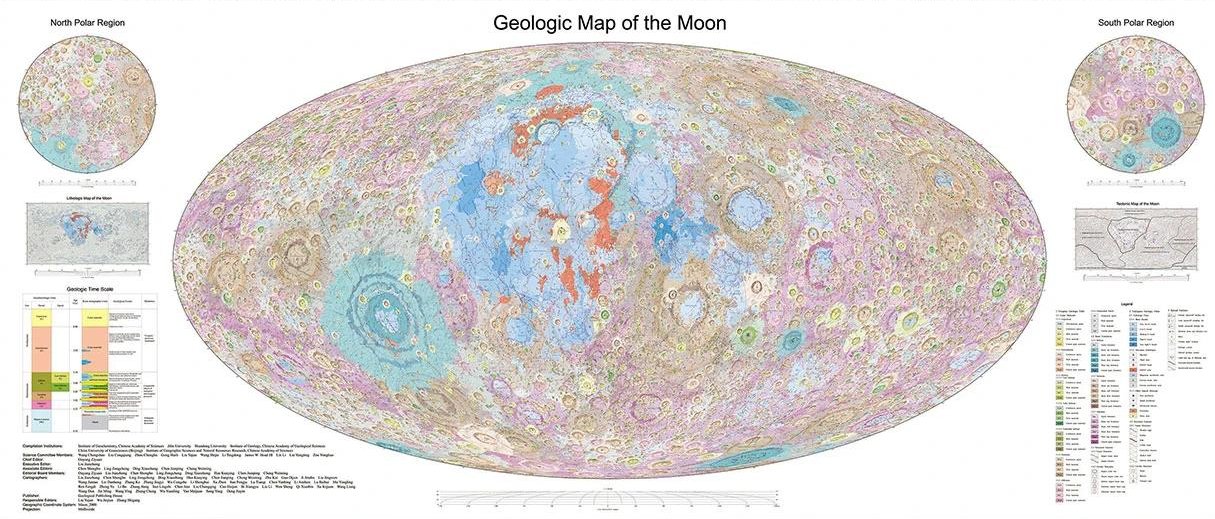
Chinese scientists analyzing one of the lunar samples brought back in 2021 by Chang’e-5 from the Moon’s near side have detected for the first time what they call “natural few-layered graphene.”
You can read the paper here. The samples from Chang’e-5 came from some of what are believed are some of the youngest lava on the Moon. This discovery confirms that conclusion. From the paper:
The identification of graphene in the core–shell structure suggests a bottom-up synthesis process rather than exfoliation, which generally involves a high-temperature catalytic reaction. Therefore, a formation mechanism of few-layer graphene and graphitic carbon is proposed here.
Volcanic eruption, a typical high-temperature process, occurred on the Moon. Lunar soil can be stirred up by solar wind and high-temperature plasma discharge can be generated on the Moon’s surface. … [T]he Fe-bearing mineral particles, such as olivine and pyroxene, in lunar soil might catalyse the conversion of carbon-containing gas molecules in the solar wind or polycyclic aromatic hydrocarbons into graphitic carbon of different thicknesses and morphologies on their surfaces, including few-layer graphene flakes and carbon shells.
These graphene flakes are likely to disappear over time, so its existence reinforces the belief that this lava is young.
Unlike too many American planetary scientists recently — who have repeatedly implied that finding anything even remotely related to life processes suggests the possibility of life on Venus and Mars — the Chinese scientists don’t make the additional absurd claim that finding carbon on the Moon suggests the existence of life. It doesn’t. Kudos to them for being good scientists.
As a result, expect American mainstream media to pay no attention to this result, despite its intriguing and unprecedented nature.

Australia’s commercial spaceports. Click for original map.
On July 23, 2024 the Australian government finalized its October 2023 agreement with the United States to allow U.S. rockets to launch from Australia soil, as well as allow Australian rocket startups to launch American satellites.
The agreement is mostly a boost for the three spaceports presently vying for business in Australia. Not only will this widen their customer base — with many international rocket startups looking for alternatives because of regulatory burdens elsewhere — it will allow any Australian rocket startups to sell their rockets to American satellite companies. At the moment there is only one such company, Gilmour, but this treaty will encourage investment in others.
This deal will also add impetus to the negotiations presently going on between SpaceX and Australia.
The company is reportedly in discussions with US and Australian authorities to bring down one of its rockets off Australia’s northwest coast and tow it into a yet-to-be-determined port for repatriation to the US. The talks follow a SpaceX Starship rocket making a controlled splashdown in the Indian Ocean in June. There are also reportedly tentative discussions about launching rockets from Australia or bringing them back directly onto Australian soil.
Using Australia as a launch site will not do much to relieve SpaceX of the red tape it has been struggling with from the federal bureaucracy, but it will provide it additional options for increasing its launch rate as well as the testing of Starship. It clearly wants to recover Starships as soon as possible for study, and having them brought to Australia quickly after splashdown would facilitate that effort.
After improvising an upper stage fix because the rocket’s Italian manufacturer, Avio, literally lost the stage’s tanks, Arianespace on July 31, 2024 finally scheduled the last Vega rocket launch, targeting a September 3, 2024 lift off from French Guiana.
The change to the upper stage was required after the company managed to lose two of its four propellant tanks. As the production line for the AVUM upper stage tanks had been shut down in anticipation of the rocket’s retirement, Avio was forced to find a way to instead utilize the larger propellant tanks from the Vega C AVUM+ upper stage. With this process now complete, the company has a clear path toward the rocket’s swan song.
This rocket has been replaced by the more powerful Vega-C. Control and ownership on future launches has also been shifted from Arianespace back to Avio as part of Europe’s transition from using a government-run launch monopoly (Ariancespace) to relying on multiple competitive and independent private companies.

Starliner docked to ISS.
Someone at NASA getting cold feet? According to a NASA posting today, the review that was supposed to happen this week to determine a return date for Starliner and its two-astronaut crew has been postponed until next week as engineers continue analzying the results of the recent thruster hot fire tests, both on the ground and on ISS.
The wording of this posting is intriguing, to say the least:
Teams are taking their time to analyze the results of recent docked hot-fire testing, finalize flight rationale for the spacecraft’s integrated propulsion system, and confirm system reliability ahead of Starliner’s return to Earth from the International Space Station.
Forward work for the team also includes finalizing the spacecraft’s undocking procedures and operational mitigations that could be used in flight, if needed, to build further confidence in the system. Meanwhile, Starliner ground and mission support teams are continuing to prepare for undocking by participating in integrated simulations with space station operations teams.
Following the completion of Starliner’s return planning, which is expected to continue into next week, more information will be shared about the agency’s return readiness review preparations and subsequent media briefing. As always, astronaut safety remains the top priority for both NASA and Boeing. [emphasis mine]
Up until this posting, I have been confidently predicting the two astronauts would return on Starliner. Now I am not so sure. It seems the data from the hot fire tests, especially the most recent tests on the Starliner capsule docked to ISS, was not as encouraging or did not confirm the conclusions drawn from the previous ground-based tests, and have required further analysis. This might not in the end make a difference, but the wording of this NASA’s press release, including the highlighted emphasis on astronaut safety, suggests NASA is at least considering the idea of bringing the astronauts home on a Dragon capsule.
China last night successfully launched what its state-run press merely labels as a “high-orbit internet satellite”, its Long March 3B rocket lifting off from its Xichange spaceport in southwest China.
No word on where the rocket’s lower stage and strap-on boosters, using very toxic hypergolic fuels, crashed inside China. Previous launches have had those booster crash near habitable area.
The leaders in the 2024 launch race:
75 SpaceX
32 China
8 Rocket Lab
8 Russia
American private enterprise still leads the rest of the world combined in successful launches 88 to 48, while SpaceX by itself still leads the entire world combined, including American companies, 75 to 61.
SpaceX tonight successfully launched another 23 Starlink satellites, its Falcon 9 rocket lifting off from the Kennedy Space Center in Florida.
The first stage completed its twelfth flight, landing on a drone ship in the Atlantic.
The leaders in the 2024 launch race:
75 SpaceX
31 China
8 Rocket Lab
8 Russia
American private enterprise now leads the rest of the world combined in successful launches 88 to 47, while SpaceX by itself still leads the entire world combined, including American companies, 75 to 60.