Gaia space telescope identifies more than 350 asteroids with candidate moons

Using the Gaia space telescope, astronomers have identified 352 asteroids that the data suggests have smaller satellite asteroids in orbit around them.

In its data release 3, Gaia precisely pinpointed the positions and motions of 150 000+ asteroids — so precisely that scientists could dig deeper and hunt for asteroids displaying the characteristic ‘wobble’ caused by the tug of an orbiting companion (the same mechanism as displayed here for a binary star). Gaia also gathered data on asteroid chemistry, compiling the largest ever collection of asteroid ‘reflectance spectra’ (light curves that reveal an object’s colour and composition).

These results need to be confirmed by direct observation, as this method does involve some assumptions and uncertainties. If these numbers are confirmed however it will give planetary scientists a better census on the percentage of asteroids with moons, which in turn can be used to create better models of the formation of the solar system as well as the evolution of asteroids over time. At the moment scientists predict about one out of every six asteroids will have a moon. This data suggests that number might be high.

0 comments

SpaceX sets August 26, 2024 as new launch date for Polaris Dawn private manned mission

Jared Isaacman
Jared Isaacman

According to a post on X yesterday, SpaceX has rescheduled the launch of the private Polaris Dawn manned orbital flight to August 26, 2024. The flight is financed entirely by billionaire Jared Isaacman, who will also command the mission (his second in space).

The mission will launch on a Falcon 9, with the Dragon Resilience spacecraft carrying four private astronauts. During the orbital flight the capsule will attempt to fly as high as 870 miles, the highest any human will have flown since the Apollo missions. It will then attempt the first spacewalks by a private citizen ever. They will open a hatch, and Isaacman will push himself outside.

The schedule change from July 31st is almost certainly due to the uncertainties surrounding the return of Starliner from ISS, which have also caused uncertainties in the launch date of SpaceX’s next manned mission to ISS. With only two launchpads in Florida for both missions (plus other required launches), a lot of juggling has been required.

0 comments

August 7, 2024 Quick space links

Courtesy of BtB’s stringer Jay. This post is also an open thread. I welcome my readers to post any comments or additional links relating to any space issues, even if unrelated to the links below.


  • Another relatively boring press release of an image from Europe’s Mars Expresss orbiter
  • I post so few images from Mars Express because Europe releases so few, and when they do, they don’t usually provide enough good information to understand what one is looking at. For example, this release never really tells us the global location of the picture, info that is crucial to understanding it. I could look it up, but the image itself is just not that interesting.


2 comments

Students win settlement against college for censoring their speech illegally

One poster that Clovis Community College tried to censor
One of the posters that Clovis Community College officials agreed to
“gladly” remove because it made some students “very uncomfortable.”

Bring a gun to a knife fight: Back in November 2021 three students at Clovis Community College who were also members of the college club for Young Americans for Freedom (YAF) got permission to put up posters on campus showing in detail the historic and documented horrors of communist rule worldwide. The picture to the right shows one such poster.

Soon thereafter some people supposedly complained that the posters made them “uncomfortable.” Despite the fact that everything in the posters is factually true, the then college president Lori Bennett ordered the posters torn down, claiming she did it because they weren’t specifically a “club announcement.

In August 2022 the students sued [pdf] with the help of the Foundation for Individual Rights and Expression (FIRE), noting that Bennett’s policy was not only inconsistent and arbitrarily, it was mostly used to block conservative political statements college administrators did not like.

The students have now won a settlement in court.
» Read more

9 comments

Another “what the heck?” image from Mars

What the heck is this?
Click for original image.

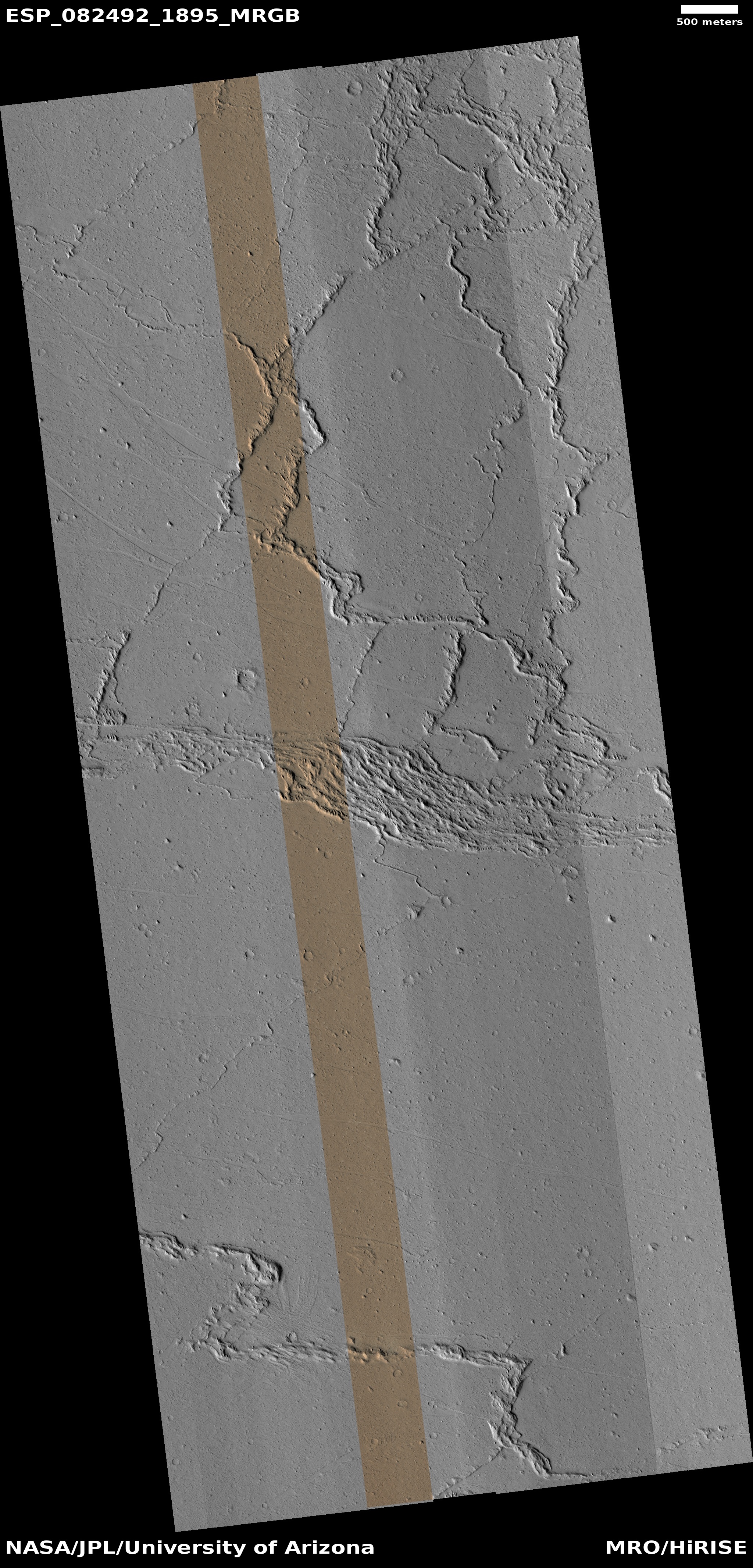
Cool image time! The picture to the right, cropped, reduced, and sharpened to post here, was taken on April 14, 2024 by the high resolution camera on Mars Reconnaissance Orbiter (MRO), and shows what the scientists simply label as “exposed crater floor materials.”

I label it as another one of my “what the heck?” images, showing features that in some ways defy understanding or explanation. The picture shows a small area of the floor of an unnamed 14-mile-wide crater, with its rim indicated. Though clearly visible in orbital photos, the crater is nonetheless heavily eroded and even appears partly buried, possibly by flood lava.

The complex floor features however are not anything usually seen in flood lava terrains. The terrain colored blue in the color strip likely indicates coarse material like sand or rocks or rough bedrock, while the reddish terrain suggests the surface is heavily coated with dust.
» Read more

3 comments

Firefly wins a 20-launch contract from L3Harris

The rocket startup Firefly has been awarded a new 20-launch contract from the aerospace company L3Harris, and is an add-on to an earlier three-launch contract signed in 2023.

The deal calls for two to four launches per year beginning in 2027. The launches will take place at Firefly’s launchpad at Vandenberg in California, and will likely be for mostly military or surveillance payloads.

It appears that Firefly is beginning to grab business from both SpaceX and Rocket Lab, a very healthy development. Its rocket’s capabilities falls somewhere in between both, so it has developed its own customer niche.

All will change of course when Rocket Lab’s larger Neutron rocket becomes operational.

Hat tip to BtB’s stringer Jay.

0 comments

NASA has decided to consider bringing Starliner down unmanned

Starliner docked to ISS
Starliner docked to ISS.

It appears that upper management at NASA has decided to force the agency to consider bringing Starliner down unmanned and extending the ISS mission of the two Starliner astronauts to a nine month mission.

The situation is definitely complicated, and no change as yet as been made. The schedule of dockings to ISS has been reconfigured to make this option possible. It appears this is the present plan:

First, they need to upgrade the software on Starliner for an unmanned mission. Apparently the present software on board is not satisfactory for an unmanned docking, even though a different Starliner has already done an unmanned docking last year. For this mission, the software relied on the astronauts to take over manually should there be an issue during undocking. In the previous unmanned demo, the software would react and prevent a problem. For reasons that make no sense, the software on the manned mission did not have this capability. Reinstalling this software will give them the option to send the two astronauts down on Dragon and returning Starliner unmanned.

Second, the next Dragon manned mission has been delayed until late September to allow time for these software upgrades, as well as give NASA and Boeing more time to analyze the situation and decide if a manned return on Starliner is possible. If they decide to not use Starliner, the Dragon capsule would come up to ISS with only two astronauts, and the two Starliner astronauts would then join them on their six month mission, coming home in the spring. For the Starliner astronauts Butch Wilmore and Suni Williams this would mean their mission will now be 8-9 months long, far longer than the original one-two week mission.

As to why these options are now being considered, it appears to me that both Boeing and NASA engineers were willing to return the astronauts on Starliner, but have been ordered to consider these options by higher ups. It appears that the last hot-fire thruster tests on ISS left everyone with some uncertainties about the situation. Engineers are fairly certain that the reasons some thrusters did not fire as planned during docking was because teflon seals expanded because of heat to block fuel flow. The problem is that these seals showed no problem at all in the most recent test on ISS. That difference creates some uncertainty as to whether they have really identified the cause of the problem. Imagine having an intermittent problem your car mechanic cannot constently make happen.

Because the thrusters did work as intended, Boeing and NASA seemed ready to return Starliner manned. In the agency review last week it appears others at the top were less sanguine (including Bill Nelson, NASA’s administrator), and demanded these new options be considered. Based on this speculation, it is almost certain Starliner will come home empty.

Whether this will have significant consequences remains uncertain. During the press briefing today, NASA officials said the agency might still certify Starliner for operational manned missions even if the capsule comes home unmanned.

21 comments

A supernova overpowers a spiral galaxy

A supernova overwhelms a small galaxy

Cool image time! The picture to the right, cropped, reduced, and sharpened to post here, was taken in early 2023 by the Hubble Space Telescope because a ground-based automated sky survey had detected a new supernovae in late 2022 in this galaxy. The spiral galaxy is dubbed LEDA 857074, and is interesting because of its bright central bar and dim and broken spiral arms.

That supernova is the bright spot inside the galaxy’s central bar. It is so bright that it almost looks like someone accidently pasted a white dot there using a graphics program. From the caption:

Astronomers have catalogued millions of galaxies, so while today tens of thousands of supernovae are detected annually, the chance that one is spotted in any particular galaxy is slim. We also do not know how actively LEDA 857074 is forming stars, and therefore how often it might host a supernova. This galaxy is therefore an unlikely and lucky target of Hubble, thanks to this supernova shining a spotlight on it! It now joins the ranks of many more famous celestial objects, with its own Hubble image.

The galaxy itself had been studied by almost no one until this supernova was discovered in it.

1 comment

Orbital tug startup Impulse Space increases the kinds of satellites it will offer rides to geosynchronous orbit

The orbital tug startup Impulse Space, founder by former SpaceX engineer Tom Mueller, has announced new plans to make it possible for its tugs to take more kinds of satellites to geosynchronous orbit.

First, the company is revising the design of its larger Helios tug, set to do its first commercial mission in 2027, to carry multiple satellites ranging in weight from 300 to 5000 kilograms. Second, it is upgrading its already-flown smaller Mira tug so that it can be attached to Helios and act as a secondary tug once Helios gets to geosynchronous orbit.

The first Mira demo mission, launched in November 2023, had some communications and software issues but was still considered an overall success. The next mission will fly later this year.

0 comments

European aerospace company Safran to open production facility in U.S.

The European aerospace company Safran, which presently partners with Airbus to build the Ariane-6 rocket, has announced that it will open a production facility in Colorado for manufacturing its electrical propulsion thrusters used by satellites.

The American facility will focus on U.S. government and commercial customers, with the French line focusing on customers in the rest of the world. “With this double manufacturing line, we are able to provide trust and confidence to both U.S. domestic, national programs as well as commercial programs,” he said.

The thrusters produced by the two lines will be identical other than the sourcing of components for its power processing unit. The units produced in the United States will use U.S. components while those made in France will use foreign components.

The thruster, called the EPS X00, or “X-hundred”, is a new design and is expected to launch on satellites beginning in 2026. This announcement lets American companies know it is available to them as well. Being built in the U.S. it avoids the strict State Department ITAR regulations that would make it difficult for Safran to sell its European-built thrusters to American satellite companies.

0 comments
1 76 77 78 79 80 191