
Cliff Richard – We Don’t Talk Anymore
An evening pause: Performed live 1979.
Hat tip Diane Zimmerman.
An evening pause: Performed live 1979.
Hat tip Diane Zimmerman.

Click for original image.
Cool image time! The picture to the right, cropped, reduced, and sharpened to post here, was taken on November 1, 2024 by the high resolution camera on Mars Reconnaissance Orbiter (MRO). Labeled simply as a “terrain sample,” it was likely not taken as part of any specific research project, but to fill a gap in the camera’s schedule in order to maintain its proper temperature. When the camera team does this they try to pick something interesting, and sometimes succeed.
I think they succeeded in this case. At first glance this appears to be a crater, but on closer inspection it is instead a small mound. The picture was taken in the winter, at the high latitude of 55 degrees north. The featureless white surface surrounding this dark mound is almost certainly the mantle of dry ice that falls as snow and covers the poles during the winter. If not that, it is then likely to be a water ice sheet that orbital data suggests covers much of Mars’ high latitudes.
» Read more
Democrats in Washington
In the past few weeks there have been a number of very entertaining essays describing the insane inability of Democrats to learn anything from their defeats in the 2024 elections. From the second link:
The Democratic Party just can’t help itself. For its own psychological reasons, it can’t move beyond the “denial” stage of grief. Doing so would jeopardize the party’s sense of purpose, identity, and ego. Right now, the “patient” cannot heal itself because it won’t accept the diagnosis.
Instead, it rejects it: Trump is Hitler! Musk is Hitler! MAGA is Hitler! I’m the only one defending democracy!
A sane, rational actor would take a step back and consider his own role in losing three branches of government, a majority of statehouses, and two-thirds of the Supreme Court. And then they’d develop a better product.
Fortunately for the GOP, they’re just not ready for that level of introspection. Not yet. (And probably not until it’s forced upon them.)
And so, the losing losers of the Democratic Party continue to lose. They can’t even counterpunch effectively, because they overreact to every feint. They’re so ridiculously undisciplined, they’re chasing shadows, following the champ around the ring like a puppy dog — eating a buffet of rights, jabs, and uppercuts. [emphasis in original]
All true, but if conservatives think this stupidity on the left will win Republicans the mid-term elections in ’26 and the next presidential election in ’28, they are fooling themselves. » Read more

Click for NASA’s original image.
Link here. Athena is scheduled for launch on February 26, 2025 on a SpaceX Falcon 9 rocket. The article is mostly focused on describing the Gracie hopper, which will attempt to hop into the permanent shadows inside a nearby crater.
Though no announcement has ever been made, it appears the landing site for this lander has been changed. Previously it had been targeting a ridge adjacent to Shackleton Crater, at the south pole and shown on the map to the right. That location however required a launch in January. The delay to February seems to have shifted the landing site.
If all goes to plan, Athena will land on a plateau just 100 miles (160 kilometers) from the moon’s south pole. This region is thought to be rich in water ice, and IM-2 will prospect for the precious resource with the help of some ride-along robots, including a pioneering hopper nicknamed Gracie.
Though I cannot find any specific information on where this location is, I strongly suspect it is the site that Intuitive Machines’ lander, Nova-C (also dubbed Odysseus), attempted to reach last year.
The yellow boxes on the map indicate NASA’s candidate landing zones for its Artemis-3 manned mission.
The Germany government has now allocated $897,000 to a private consortium of four companies to help finance its promised but delayed an off-shore launch platform.
The North Sea launch platform is being developed by the German Offshore Spaceport Alliance (GOSA), a joint venture formed in December 2020 by Tractebel DOC Offshore, MediaMobil, OHB, and Harren Shipping Services. The platform will be constructed on the 170-metre-long Combi Dock I vessel and will accommodate launchers with a mass of between 36 and 52 tonnes. A 2020 feasibility study stated that the development and operation of the North Sea launch platform would cost between €22 and €30 million over six years.
The consortium had first announced the project in 2023, with the first launch of several suborbital test rockets in 2024. Since then little has been heard of this project, with those launches never occurring.
If built as promised, this platform would accommodate rockets as large as the Falcon Heavy. Its goal, besides offering the platform to all rocket companies, is apparently to give German rocket startups the option of a German spaceport so they don’t have to depend on other countries.
Even as the Falklands government is demanding its money back from OneWeb for not activating its service on time, it appears the public on those islands has buying and using Starlink terminals, even though it is presently illegal to use it there.
The high level of Starlink usage sparked a successful petition backed by 70% of the island’s population. This petition demanded both a reduction of the £5,400 FIG VSAT licence fee and formal approval for Starlink’s operation in the Falkland Islands.
In response, a Starlink Select Committee – comprising all of the island’s MLAs – convened from July to October 2024. The committee formally endorsed the petition’s demands, and the proposal was subsequently forwarded to the Falkland Islands Government (FIG) for implementation. However, the effective date for this approval has now been delayed until April.
Because Sure International holds an exclusive monopoly telecommunications licence, Starlink’s use in the islands is currently illegal. Nonetheless, this restriction has not prevented the widespread installation of hundreds of Starlink terminals, which remain unlicensed.
Sure International apparently provides internet service though traditional land lines. The cost difference compared to Starlink is considerable, with Starlink being far cheaper and providing much faster speeds. Meanwhile, OneWeb has failed to deliver and is losing this business. By April expect Starlink to be approved.
Hat tip to BtB’s stringer Jay.
Embedded below the fold in two parts.
To listen to all of John Batchelor’s podcasts, go here.
» Read more
Rocket Lab today successfully launched five more internet of things satellites for the French company Kinéis, bringing its planned 25 satellite constellation to 20 satellites.
Rocket Lab has the contract to launch the entire constellation, and this was the fourth of five launches in that deal.
The 2025 launch race:
17 SpaceX
6 China
1 Blue Origin
1 India
1 Japan
1 Russia
1 Rocket Lab
SpaceX today successfully placed 21 more Starlink satellites in orbit, its Falcon 9 rocket lifting off from Cape Canaveral in Florida.
The first stage completed its seventeenth flight, landing on a drone ship in the Atlantic.
The 2025 launch race:
17 SpaceX
6 China
1 Blue Origin
1 India
1 Japan
1 Russia
New calculations have increased the chances that the recently discovered asteroid 2024 YR4 will hit the Earth in 2032 from 1.2% to 2.3%.
Ongoing observations from ground-based telescopes involved with the International Asteroid Warning Network will continue while the asteroid is still visible through April, after which it will be too faint to observe until around June 2028.
NASA’s James Webb Space Telescope will also observe the asteroid in March 2025 to better assess the asteroid’s size. Currently the asteroid is estimated to be 130-300 feet across.
There remains great uncertainty in these numbers. We will really not know for certain if the asteroid will hit us until its orbit is studied for the next few years. Moreover, its size and make-up is also not known precisely yet. It could be as large as 320 feet, or as small as 130 feet. If the larger size, it poses a much greater risk, though that risk shrinks again if it is a rubble-pile asteroid that will simply break apart upon hitting the atmosphere.
This is not something to take lightly. Though the asteroid is not a world-destroyer, it does have the ability to cause significant damage, depending on where it hits. As its arrival is not for eight years, there is even time to quickly put together an unmanned mission to study it. (In the past I would never said this, but the domination of private enterprise in our present competitive space industry makes many things possible that were impossible when NASA and the government ran everything.)
New details reported yesterday strongly suggest that the high altitude balloon company Space Perspective has been unable to find new investors and is on the verge of shutting.
In a February 5 email to stakeholders, Interim CEO Michael Savage provided the latest updates, shedding light on failed funding efforts, the company’s dire financial situation, and attempts to restructure its debt. The email also acknowledged the gravity of the challenges ahead, hinting at the possible closure of operations.
Savage’s email outlined efforts to secure funding, including meetings with investors Fortuna and Broadlight, both of whom ultimately declined to proceed. Savage explained that while there was initial interest, the company’s mounting debt and financial instability deterred further investment. “Both [investors] have expressed interest, but despite the current circumstances and since Nov./Dec. 2024, they feel that their LPs would not stomach the numbers,” Savage wrote.
The company has previously announced it was shifting operations out of the Cape Canaveral area to a location 90 miles north where costs were less as it searched for new investors. This new report suggests this move and the search have not worked and the company will soon go out of business.
ULA has decided to destack the Vulcan rocket it had planned as its first launch in 2025 (launching a military payload) and is now replacing it with one of its remaining Atlas-5 rockets to put the first batch of satellites for Amazon’s Kuiper internet constellation.
It appears the military is not ready to certify this launch after the second Vulcan launch in October 2024 experienced a problem with one of its strap-on boosters. The payload got to its proper orbit, but the loss of that booster’s nozzle appears to be an issue the military remains concerned about.
Rather than wait, ULA decided to switch to the Kuiper launch. The company wants to complete up to 20 launches in 2025, many of which are for Amazon using its last ten or so Atlas-5 rockets. When it can start commercial launches of Vulcan remains somewhat uncertain. The military has indicated it will make a final decision of certification in the spring, and has also said that first operational flight will follow soon after.
The expected real per launch cost of SLS and Orion
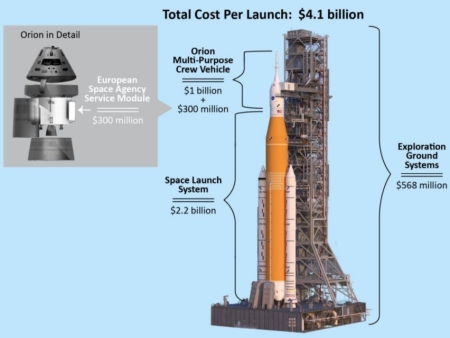
Boeing yesterday sent a notice out to its employees working on NASA’s SLS rocket that up 400 could be laid off due to “revisions to the Artemis program and cost expectations.”
Boeing SLS employees were informed Feb. 7 that the company was making preparations to cut up to 400 jobs from the program because of “revisions to the Artemis program and cost expectations.” The specific positions being considered for elimination were not announced but would account for a significant fraction of the overall SLS workforce at the company.
This is probably the most significant update from the entire SLS program since it was first proposed by George Bush Jr in 2004. All other announcements either told us there were going to be more delays, the cost was going up, or there were newly discovered technical problems caused by bad management or sloppy work. This announcement instead actually indicates that NASA management — under pressure from the new Trump administration — is finally addressing these failures after two decades.
In the past few months there have been many indications from the swamp in Washington that it is finally beginning to recognize the absurdity and stupidity of the whole SLS/Orion infrastructure, a realization I outlined in detail fourteen years ago, soon after the project was reshaped from the absurd and stupid Ares project under Bush Jr. to SLS/Orion under Obama.
It took however the arrival of Trump (changed himself from his first administration) to do it. Trump is doing what no president has done in our lifetimes, going through all federal programs and ripping them apart if they are failing to do what they promise. And he is doing it with full and amazingly enthusiastic support of the American people. No one cares that government employees are “crying.” Nor does anyone pay attention any longer to these sob stories, put out by the propaganda press. It have proven itself to be habitual liars whose only interest has been prop up the Washington swamp, and everyone now recognizes it.
Expect a major reshaping of NASA and its entire manned program. We will still be heading to the stars, but finally doing it.
An evening pause: Something to ponder over the weekend. The video only includes two short clips from this 1964 BBC show, and thus picks two that have ended up to be largely right. And though Clarke’s predictions were not all right, he hit the mark an incredibly high number of times.
Hat tip John Jossy.
"The only thing we can be sure of about the future, is that it will be absolutely fantastic."#OnThisDay 1917: Writer, futurist and inventor Arthur C Clarke was born.
In 1964, he appeared on Horizon and gave some astonishing predictions about the future. pic.twitter.com/ID0X7idWyy
— BBC Archive (@BBCArchive) December 16, 2023

Glacier country in the northern mid-latitudes of Mars

Cool image time! The picture to the right, rotated, cropped, reduced, and sharpened to post here, was taken on November 4, 2024 by the high resolution camera on Mars Reconnaissance Orbiter (MRO).
The science team labels the features in the lowland below the mesas “ribbed terrain.” To me it looks like peeling paint. What it is however is glacial material, a lot of it. The white dot on the overview map above marks the location, in the middle of the 2,000-mile-long mid-latitude strip in the northern hemisphere I label glacier country, because practically every high resolution image of this region shows glacial features like those on the right.
The mesa with the crater on top gives a clue on the geological history. This is chaos terrain, a region of random mesas cross-crossed with canyons and wide low plains, as shown in the inset. The entire surface was probably once at the same height as the top of that mesa with the crater. Over time glacial ice eroded away along fault lines. As that sublimation process continued, the fault lines widened to became canyons, then the flat plains, with the isolated mesas remaining between.
The “peeling paint” terrain is likely a layer of ice that is in the process of sublimating away.
Ars Technica today reported that because of continuing battery issues with the new Dragon manned capsule, SpaceX now plans to use the older Endurance Dragon capsule for the next manned launch to ISS and prevent further delays in bringing home the two Starliner astronauts.
NASA now believes the vehicle will not be ready for its debut launch until late April. Therefore, according to sources at the agency, NASA has decided to swap vehicles for Crew-10. The space agency has asked SpaceX to bring forward the C210 vehicle, which returned to Earth last March after completing the Crew-7 mission.
Known as Endurance, the spacecraft was next due to fly the private Axiom-4 mission to the space station later this spring. Sources said SpaceX is now working toward a no-earlier-than March 12 launch date for Crew-10 on Endurance. If this flight occurs on time—and the date is not certain, as it depends on other missions on SpaceX’s Falcon 9 manifest—the Crew-9 astronauts, including Wilmore and Williams, could fly home on March 19. They would have spent 286 days in space. Although not a record for a NASA human spaceflight, this would be far longer than their original mission, which was expected to last eight to 30 days.
The new capsule will then be used for Axiom’s fourth commercial flight to ISS, AX-4, presently scheduled for later in the spring.

Haven-1 with docked Dragon capsule
The space station startup Vast yesterday announced that it had revised its overall schedule, delaying the launch of its Haven-1 space module from August 2025 to May 2026.
Based on their testing program this delay had become increasingly expected. They have only now begu testing of the primary structure qualification article of this module, with it passing its first pressure tests. Vibration testing is still to come. This makes the August 2025 target date impossible.
The plan now is to begin construction of the actual module as soon as this testing is complete in about a month, with the primary structure ready in July. Integration and testing will then follow to be completed by March 2026.
The launch of Haven-1 on a Falcon 9 rocket is now targeting May 2026, with its 30-day four-person crewed mission to launch no earlier than the end of June 2026.
As the company notes,
Vast was founded in 2021. At the time, NASA had already launched the CLD program and awarded funding to [three] other [space station] companies. Recognizing the need for a leapfrog strategy, we developed Haven-1 to set us apart. When NASA selects its partner(s) to carry forward its low-Earth orbit (LEO) legacy, we will be the only company operating a crewed space station—one we designed, built, tested, and verified for safety entirely in-house.
…Every lesson learned from Haven-1 will be applied to our CLD Phase II proposal—Haven-2. No team will have more operational experience than Vast. No design will carry as much flight heritage. No company will be better positioned to deliver for NASA as fast—thanks to our work and over $1 billion investment in Haven-1 ahead of CLD Phase II.
This strategy all depends of course on getting Haven-1 launched as planned. Based on the company’s operations so far, the odds appear high that it will meet this new schedule. There are no guarantees however.
Courtesy of BtB’s stringer Jay, who’s real work has made it difficult to send links this week. I thank him for persevering anyway.
This post is also an open thread. I welcome my readers to post any comments or additional links relating to any space issues, even if unrelated to the links below.
An evening pause: Performed live 1992.
Hat tip Icepilot.
In what appears to be directly related to the new South African law that will force the redistribution of private land holdings based on race, SpaceX this week withdrew from a meeting to discuss South Africa’s plan to license Starlink operations.
According to an Icasa spokeswoman, SpaceX notified Icasa on Wednesday evening that it would no longer participate in the oral presentations. The company had already made a written submission, which has not been withdrawn. It’s not clear why SpaceX decided to withdraw from the hearings – the company couldn’t immediately be reached for comment.
The withdrawal by SpaceX follows a post by Musk on his social media platform X that asked President Cyril Ramaphosa why the country has what he called “openly racist ownership laws”.
It is not surprising Musk had the company cancel its plans. Musk has more and more been learning about the corrupt and racist policies of the left, and since South Africa has been ruled for several decades by communists who have now decided to impose DEI quotas on land ownership that require a percentage of white-owned land to be confiscated to give to blacks, he has probably decided there are better places than South Africa to provide Starlink services.