Voyager wins slot to fly tourist mission to ISS in 2028

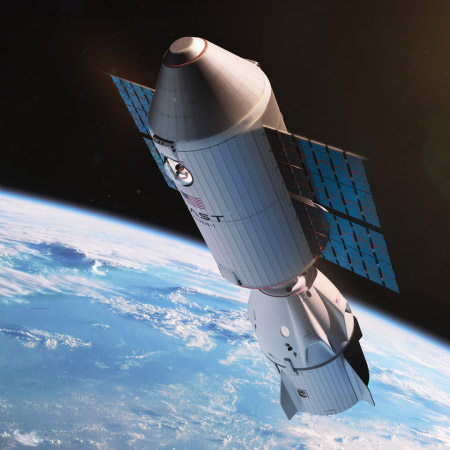
Starlab design as of December 2025

NASA today announced that it has awarded Voyager Technologies a slot to fly a tourist mission to ISS in 2028.

The mission, named VOYG-1, is expected to spend as many as 14 days aboard the space station. A specific launch date will depend on overall spacecraft traffic at the orbital outpost and other planning considerations.

Voyager will submit four proposed crew members to NASA and its international partners for review. Once approved and confirmed, they will train with NASA, international partners, and the launch provider for their flight.

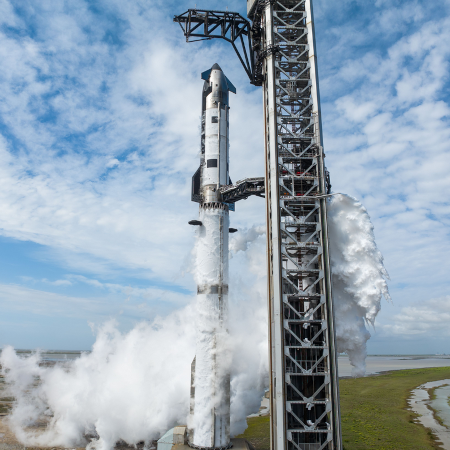
Voyager is the lead company in the consortium that is building the Starlab station, a single very large module to be launched on SpaceX’s Starship.

At this moment three of the five commercial stations that are developing private space stations — Axiom, Vast, and Voyager — now have deals to fly such missions to ISS. The two remaining likely didn’t pass muster with NASA, for different reasons. Max Space is a late comer to this competition, only declaring that it is building its own station this year. Orbital Reef, led by Blue Origin and Sierra Space, is apparently a dead project, with neither company doing anything to sell its project for the past year or so.

In my rankings below of the five American commercial space stations presently in development, the first three are essentially tied at this point.
» Read more

2 comments

Sweden’s space agency signs cooperative licensing agreement with the FAA

Proposed or active spaceports in North Europe

The Swedish Space Agency has signed a cooperative licensing agreement with the FAA to help facilitate orbital launches by American rocket companies from its Esrange spaceport.

While the Esrange Space Centre has been in operation since the 1960s, it has strictly been used for suborbital flights. In 2023, SSC Space, the commercial operator of the facility, inaugurated a new launch complex at Esrange to support orbital missions. While the facility has yet to host a launch, South Korea’s Perigee Aerospace and US launch provider Firefly Aerospace have both committed to using it in the future.

Sweden’s efforts to enable US rocket launches from Esrange took another step forward on 15 April 2026, as the Swedish National Space Agency signed an agreement with the FAA to coordinate the licensing of those missions. The agreement builds on a 2025 Technology Safeguards Agreement between the two countries, which laid the groundwork for US launch providers to export what the US government considers “advanced space technology” to Sweden.

Esrange’s interior location remains a problem, however. Any orbital launch is going to have to fly over other countries, either Finland, Russia, or Norway, and it remains unclear whether those countries will approve. Norway has already expressed opposition.

0 comments

A review of India’s government space program suggests it is behind schedule

India's space agency ISRO, as transparent as mud
India’s space agency ISRO.

Link here. The main take-away of the article is that the investigation into the two launch failures of ISRO’s PSLV rocket has stalled everything, including the planned two unmanned orbital test missions of its Gaganyaan capsule, needed before the actual manned mission can fly in early 2027. The first was originally supposed to fly in March, but has been delayed pending completion of the investigation of the PSLV failures.

That investigation however has stalled far more than just Gaganyaan:

The Indian Space Research Organisation (Isro), which had announced an aggressive manifest of 18 launches for 2026, has so far completed only one in the first four months of the year, and that mission [PSLV] ended in failure.

The article also notes a decline in ISRO’S transparency in recent months, a decline that bodes ill for the agency and its programs. I have noted this as well. When ISRO in February 2026 announced the next PSLV launch for this coming June, it released no information from its investigation of the previous two launch failures. If ISRO knows what went wrong, it wasn’t saying. All it has told us so far is that the cause of the two launch failures was for different reasons.

1 comment

A very interesting and revealing interview of NASA administrator Jared Issacman

Jared Isaacman
NASA administrator Jared Isaacman

Link here. I found this interview with NASA administrator Jared Issacman to be very informative and worth reading, especially in regards to his comments on the proposed cuts to NASA’s budget.

First, he admits right off the bat that the heat shield was his biggest concern during the Artemis-2 mission. He also took a swipe at past NASA management over this issue. After noting that the initial inspection of the Artemis-2 shield after recovery showed it experienced little serious damage, he added this: “All that aside, if you’re going to wait three and a half years between missions, just replace the heat shield.” In other words, after Artemis-1 NASA management dithered when it saw the damaged heat shield. It should have immediately moved to replace it.

As for the proposed Trump budget cuts and the opposition to those cuts by many in Congress, Issacman said this:

There’s a lot of passionate people out here [referring I think to the space industry and its advocates]. They can do incredible things, from a scientific perspective. I don’t know how many of them have ever pulled together a financial model, and driven execution on some of these things to say what should or shouldn’t be the right budget.

Now, all that said, of course, we will maximize every dollar that Congress affords to the agency. But it is not healthy, for the agency, to get in this mindset that we have to spend our way out of every problem. And I don’t think it’s good for the country to think we have to print our way out of every problem. [emphasis mine]

This is not the first time Isaacman has indicated he thinks NASA can survive these cuts, and in fact can do as well if not better by using what it gets more wisely. It is however the first time he has put NASA’s budget in the context of the entire federal budget, which is badly out of control. Isaacman does not want more money from Congress because he thinks it is bad for the nation to spend itself into debt. He thinks he has enough to do the job.

The entire interview is worth reading. It indicates a very practical and honest mindset. Everyone might not agree with every proposal Isaacman has put forth, but he is clearly approaching things from a very good place.

31 comments

DESI telescope completes its nominal mission, mapping more than 47 million galaxies

DESI map
Click for original image.

The Dark Energy Spectroscopic Instrument (DESI) on the Mayall 4-meter telescope at Kitt Peak in Arizona, in Arizona has now completed its initial five-year nominal mission, mapping more than 47 million galaxies to produce a rough 3D map of the universe.

By comparing how galaxies clustered in the past with their distribution today, researchers can trace dark energy’s influence over 11 billion years of cosmic history. Surprising results using DESI’s first three years of data hinted that dark energy, once thought to be a “cosmological constant,” might be evolving over time. With the full set of five years of data, researchers will have significantly more information to test whether that hint disappears or grows. If confirmed, it would mark a major shift in how we think about our Universe and its potential fate, which hinges on the balance between matter and dark energy.

The image to the right shows the map, with the blank areas to the left and right regions blocked by the Milky Way.

DESI will continue mapping for at least another three years, refining its data. I suspect when scientists begin analyzing this information they will find there are more than one way to interpret it.

1 comment

Amazon buys Globalstar satellite constellation

Amazon Leo logo

As part of an effort by Amazon to make its Leo internet constellation more competitive with SpaceX’s Starlink constellation, the company has just completed a deal for about $11 billion to acquire the Globalstar satellite constellation, which includes Globalstar’s partnership with Apple and its Iphones.

The Seattle-based company’s agreement to acquire the satellite operator behind Apple’s iPhone Emergency SOS feature promises to give it a new constellation of operating satellites, a key slice of mobile spectrum, and Apple as a flagship partner.

…Under a separate long-term agreement announced along with the deal, Amazon Leo will power satellite features on future iPhone and Apple Watch models, including Emergency SOS, messaging, Find My location sharing, and roadside assistance. Amazon will also continue supporting the Apple devices that already rely on Globalstar’s existing network.

In other words, Amazon’s Leo internet constellation is now primed to also provide extensive cell phone service, service that at the moment appears superior to the cell service that Starlink can offer.

Or not. Amazon is playing catch-up, with Starlink operational and owning the market with millions of signed-up customers. It needs to offer a superior product to convince people to eithe buy it or switch to it. This deal is part of that effort.

2 comments

Three launches today, two by SpaceX and one by China

The launch beat goes on! First, China launched eight satellites using its Kinetic-1 (Lijian-1) rocket, lifting off from its Jiuquan spaceport in northwest China. China’s state-run press provide no further information about the satellites, nor did it provide information about where the rocket’s lower stages crashed inside China.

Next, SpaceX completed two Starlink launches on opposite coasts. First it placed 29 Starlink satellites in orbit, its Falcon 9 rocket lifting off from Cape Canaveral Space Force Station in Florida. The first stage completed its 26th flight, 42 days after its previous flight, landing on a drone ship in the Atlantic.

The company then did its second launch of the day, placing 25 Starlink satellites into orbit, its Falcon 9 rocket lifting off from Vandenberg Space Force Base in California. The first stage completed its 21st flight, 45 days after its previous flight and landing on a drone ship in the Pacific.

The leaders in the 2026 launch race:

46 SpaceX
20 China
5 Rocket Lab
5 Russia

For the third straight year SpaceX continues to lead the entire world combined in total launches, 46 to 35.

2 comments

Firefly’s delays launch of its Eclipse rocket to 2027

Eclipse as of April 2026
Click for original image.

It appears that Firefly has delayed the first launch of its new more powerful Eclipse rocket — being built in partnership with Northrop Grumman — to 2027.

The company made no specific announcement, but in a tweet today touting the rocket’s “fresh look”, with no details, the company linked to its Eclipse webpage (in the first link above) that describes the rocket in detail. In the last paragraph adds that the first launch is now scheduled for “no earlier than 2027”, a delay from the 2026 launch date both companies were originally targeting.

This guarantees that SpaceX’s Falcon 9 is going to get more launch contracts taking Northrop Grumman’s Cygnus capsule to ISS.

Firefly says Eclipse is being built for re-usability, but the graphics of the rocket, as shown above, are puzzling in that they show grid fins but no landing legs.

7 comments

April 14, 2026 Quick space links

Courtesy of BtB’s stringer Jay. This post is also an open thread. I welcome my readers to post any comments or additional links relating to any space issues, even if unrelated to the links below.

Jay sent these to me when I didn’t have the wherewithal to post it. I am doing it now, a bit late.

  • Just released: NASA Moon Base User’s Guide [pdf]
    Unlike past NASA releases like this — which try to paint NASA as having all the answers — this short summary is largely focused on the “gaps” in engineering and equipment needed for the Moon base. Thus, it is a guide for the private sector: “This is what we need! If you build it we will buy it!”
20 comments

Space Force selects Blue Origin as possible lessor of “Sudden Flats” site at Vandenberg for future heavy lift rocket launches

Vandenberg Space Force Base

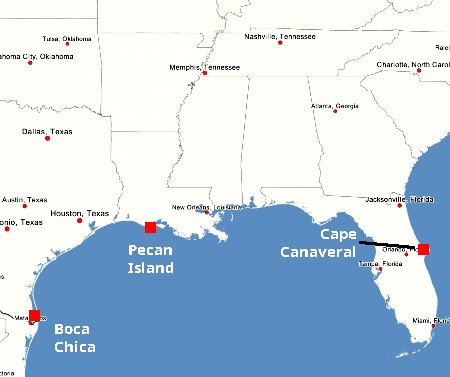
The Space Force has chosen Blue Origin to help develop the plans and possibly lease the “Sudden Flats” site — also dubbed Space Launch Complex-14 (SLC-14) — at Vandenberg Space Force Base in California for the launch of heavy lift commercial rockets.

The location is shown in the map to the right. The Space Force had requested proposals for developing the site in December 2025.

Respondents were evaluated based on technical capability, financial maturity and alignment with U.S. government requirements. The selection of Blue Origin reflects their ability to meet these criteria and contribute to the development of heavy or super-heavy launch capabilities at Vandenberg Space Force Base.

SLC-14 is considered the most viable site at [Vandenberg] for heavy and super-heavy launch operations due to its location.

Several crucial milestones must be achieved before any construction or launch activities can commence, to include safety assessments and an environmental impact analysis. The timeline for increased launch activity will depend on the completion of the safety and environmental analysis and subsequent infrastructure development.

I suspect that Blue Origin won this bid because SpaceX didn’t offer a proposal. It already has three launch sites for Starship/Superheavy, and probably decided it didn’t need this site.

Blue Origin meanwhile in November 2025 announced planned upgrades to its New Glenn rocket that would make it as powerful as NASA’s SLS rocket, but much cheaper because its first stage is reusable. The company is likely hoping to build that rocket, dubbed New Glenn 9×4 (based on the number of engines on the first and second stages respectively), and launch it from this site.

12 comments

Scientists: First data from Europe’s Proba-3 satellites suggest the Sun’s slow solar wind is faster and more chaotic than expected

Figure 4 showing variable speeds of slow solar wind
Click for original image.

The uncertainty of science: According to the first published paper [pdf] from Europe’s two Proba-3 satellites, scientists have found the slow solar wind that comes from the Sun is sometimes far faster than expected, and is also far more chaotic. From the second link above:

Just like wind on Earth, solar wind can be fast or slow, smooth or gusty. Fast solar wind usually flows in a smooth current from magnetic structures called coronal holes. In contrast, slow solar wind is variable and gusty, making understanding how it works more difficult.

Scientists think that slow solar wind is generated by the Sun’s magnetic field lines changing how they are connected, merging and separating again. This process pushes out blobs of plasma (electrically charged gas) in so-called ‘streamers’: large, bright rays in the corona.

…Previously, scientists found that close to the Sun’s surface, slow solar wind should have speeds around 100 km/s. Instead, Andrei’s team tracked some blobs of plasma moving at 250–500 km/s.

The graph to the right, Figure 4 in the paper, shows Proba-3’s tracking of a variety of these blobs. Not only did some move faster than expected (the arrows above the gray line marking earlier data), their speeds changed with time, with some actually speeding up.

The reason the Sun’s fast wind is relatively stable is that it emanates from magnetic structures dubbed coronal holes because the magnetic field lines there are is somewhat calm and stable. The slow wind meanwhile comes out through much more active and unstable regions of the magnetic field, with its field lines jumping about as well as connecting and unconnecting from the field’s structure in a chaotic manner.

This research suggests that the slow wind is chaotic and thus unpredictable, almost like the weather on Earth.

2 comments
1 20 21 22 23 24 74