
The first preliminary research into landing a Mars helicopter in the Starship landing zone
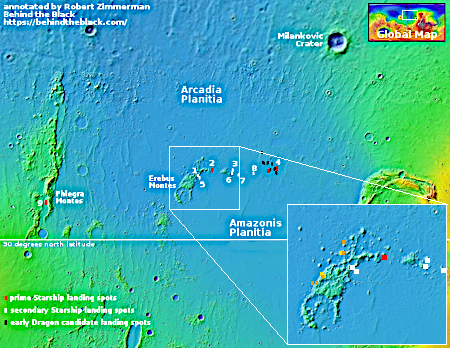
In early November 2025 I posted a cool image from Mars Reconnaissance Orbiter (MRO) that had the very provocative label “Characterize Possible Rotorcraft Landing Site”. While this was not the first such image taken by scientists using MRO to scout out potential landing zones for future Mars helicopter missions (see here and here), this particular image was one of several taken recently that were all within the candidate landing zone for SpaceX’s Starship spacecraft, focused specifically on the low Erebus mountain chain that sits within this part of Mars’ northern lowland plains.
In the January image download from MRO, I found another such image, taken on December 1, 2025. The map to the right shows that Starship candidate landing zone, with all the images taken for SpaceX indicated. The inset adds all the recent images taken for this “possible rotorcraft” mission, including the December image and the previous four (here, here, here, and here), with orange representing images already obtained and yellow those requested but pending.
I decided I needed to find out more, and tracked down the scientist who had requested the images, Eldar Dobrea of the Planetary Science Institute in Arizona. In response to my email, he explained:
This is part of an unfunded study that I have been performing with some colleagues in our spare time. Although there is great interest in the community in seeing future rotorcraft missions, there is no such mission on the horizon. This is the kind of work we tend to do a decade before anything else happens, in our spare time, in the interest of moving the idea forward.
…I am interested in the region as well, for the same reasons (access to water ice) [as SpaceX]. Unfortunately, the areas in this region are difficult to land, and mostly intransitable to a rover. I undertook a short study to identify locations where we could land, with the understanding that a rotorcraft, rather than a rover, would be the appropriate exploration platform in this region. Whereas Starship could certainly be a way to get a rotorcraft to Mars, it is in my mind not the preferred method given that they are still far from having the ability to land on Mars.
In a follow-up email, Dobrea confirmed that they have had no discussions with SpaceX so far. Their work is simply focused on finding a good site for future exploration, using a helicopter.
At the same time, Dobrea and his colleagues are also positioning themselves perfectly for when Starship begins flying and landing. They will have done the research, and I am sure there are people who worked on Ingenuity who will be eager to join them. SpaceX meanwhile will be getting ready to send Starships to Mars in great numbers (as shown in the table below), and will definitely want to include science research missions to help scout this landing zone.
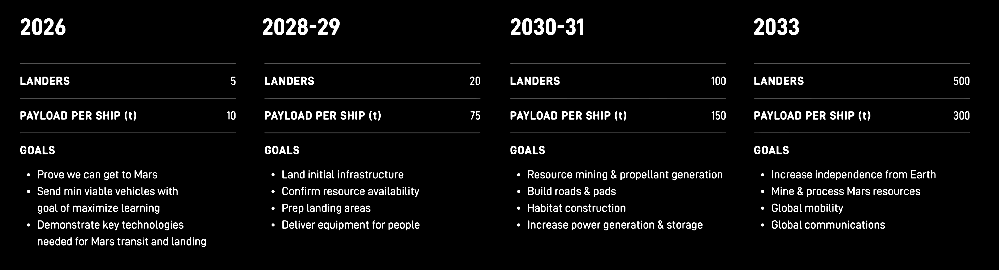
The Musk game plan for Mars exploration over the next few years.
This table comes from an Elon Musk presentation in May 2025. It is a typical Musk schedule, very aggressive and not likely to be met, but realistic enough to produce results that are only a little delayed. For example, though it is certain SpaceX will not send Starships to Mars in the 2026 launch window as hoped, the present pace of Starship development strongly says it will be able to do so in 2028-29. And if those missions are too preliminary and risky for Dobrea’s tastes, the ’30-31 window is only two years later.
Note also what Musk wants to do on those first Martian Starships: “Send min[imum] viable vehicles with goal of maximizing learning.” Seems to me that describes Dobrea’s rotorcraft mission quite nicely.
Thus, the moment when both groups will want to begin these discussions is really not that far off. If Dobrea and his team are not considering doing so at this time, they sure should consider doing so in the very near future.

On Christmas Eve 1968 three Americans became the first humans to visit another world. What they did to celebrate was unexpected and profound, and will be remembered throughout all human history. Genesis: the Story of Apollo 8, Robert Zimmerman's classic history of humanity's first journey to another world, tells that story, and it is now available as both an ebook and an audiobook, both with a foreword by Valerie Anders and a new introduction by Robert Zimmerman.
The print edition can be purchased at Amazon or from any other book seller. If you want an autographed copy the price is $60 for the hardback and $45 for the paperback, plus $8 shipping for each. Go here for purchasing details. The ebook is available everywhere for $5.99 (before discount) at amazon, or direct from my ebook publisher, ebookit. If you buy it from ebookit you don't support the big tech companies and the author gets a bigger cut much sooner.
The audiobook is also available at all these vendors, and is also free with a 30-day trial membership to Audible.
"Not simply about one mission, [Genesis] is also the history of America's quest for the moon... Zimmerman has done a masterful job of tying disparate events together into a solid account of one of America's greatest human triumphs."--San Antonio Express-News
Hmm… might a Mars helicopter itself clear a landing spot? Advantage Mars.
Robert’s expertise in geology comes to play here—are there types of outcrops such that there is very little dust/soil on the leeward side?
Put a chopper in a vertical cave with explosives.
Daisy Cutters were used in ‘Nam to create landing spots.
Starship crew access would be at ground level with it standing in a hole.
“”This is part of an unfunded study that I have been performing with some colleagues in our spare time.”” – Eldar Dobrea
Spare time!
Love it!
How does the Mars mission comport with the existing space “treaties” you wrote about in your book Conscious Choice? Any efforts to renegotiate the treaties?
Space fan 56: There has been no effort by anyone to renegotiate the Outer Space Treaty. In Trump’s first term it appeared he created the Artemis Accords for this purpose, but in his second term this appears to be a very low priority.
We were told Mars’ atmosphere is just 0,01% of earth’s forever. Gonna need some bigger helo blades, right? And the dust devils….
Facinating stuff. I wish I didn’t have to enlarge the article so I could read it without having to drag the screen left and right to the wide margins. Even typing this is on way to wide of margins. Smart article, but takes too much effort to read. Make you fonts in a larger size and set you margins so you don’t have to drag to screen.
Ron Lundmark: I’ve had complaints about some issues of the website format, but “wide margins” has never been one. The theme is designed to fit your screen. At least, that’s what it does on my computer. If I increase the font size, the end-of-line wraps changes to match.
What browser are you using?