
Yasuo Yamamoto – Making real soy sauce
An evening pause: This is how it is done, in the traditional manner.
Hat tip Cotour.
An evening pause: This is how it is done, in the traditional manner.
Hat tip Cotour.

The witch hunt against conservative lawyers accelerates.
Blacklists are back and the Democrats have got ’em: The two lawyers who recently won a major gun rights victory in the Supreme Court this week, invalidating the “may-issue” gun control laws in leftist states that prevented anyone from obtaining a gun license, have been blackballed by their law firm, Kirkland & Ellis, and forced to resign.
Former Solicitor General Paul Clement and Erin Murphy, a regular Supreme Court litigator, resigned from Kirkland & Ellis and announced they were opening their own shop in Washington, D.C. Clement has been a high-profile litigator of conservative causes since he left the administration of President George W. Bush. In 2011, he argued the Defense of Marriage Act on behalf of Republican lawmakers before the Supreme Court.
That case also caused Clement to resign from the firm King & Spalding following pressure from clients to drop the gay marriage case.
As reported at Politico:
» Read more

Click for full image.
Cool image time! The photo to the right, rotated, cropped, and reduced to post here, was taken by the high resolution camera on the Mars rover Perseverance on June 16, 2022, shortly after it began its first climb up from the generally flat floor of Jezero crater and onto the delta that once in the far past flowed through a gap into that crater.
I have rotated the image about 8.5 degrees to make horizontal the crater floor and the distant rim of the crater (barely visible through the atmosphere’s thick winter dust). This shows that the rover was then climbing what appears to be a relative low angle grade, hardly as challenging as the serious grades that Curiosity has been dealing with now for the past two years in the foothills of Mount Sharp. Nonetheless, Perseverance has begun climbing.
To see where the rover is see the overview map from the start of this week. Unfortunately, I have been unable to determine the direction of this photo. It could be looking west, south, or east, based on features inside Jezero Crater. I therefore cannot tell you the distance to the rim, which depending on the direction, could be from five to twenty-five miles away.
NASA officials today confirmed that they are satisfied with the results from this week’s incomplete dress rehearsal countdown of the SLS rocket, and are targeting a late August launch of SLS.
NASA officials have reviewed the data collected during the test run and decided that a leaky hydrogen valve was not significant enough to force a delay in the launch of Artemis I, an uncrewed mission planning to orbit the moon and return to Earth. It’s the first step toward putting humans back on the moon for the first time since Apollo 17 in 1972.
“The team is now ready to take the next step and prepare for launch,” said NASA’s deputy associate administrator Tom Whitmeyer.
NASA officials said they will roll the massive Space Launch System rocket back to the Vehicle Assembly Building, where the valve’s faulty seal will be replaced. Rollback is slated for Friday July 1, though weather concerns could push that back.
SLS won the five-plus year race with the Webb telescope on which would have the most delays and launch last. Now the race will be between SLS and SpaceX’s Starship/Superheavy. Which will launch first this summer? In a rational world, SLS should win hands down. It has been in development since 2004, while Starship only began design work in 2017.
This is not a rational world, however, and SLS’s long gestation had little to do with designing a rocket and everything to do with politics and a corrupt Congress and an incompetent NASA. The rocket that has come out of this is thus difficult to operate and incredibly cumbersome. Its components have also not been tested thoroughly.
SpaceX meanwhile has been designing and building its heavy-lift rocket with only one goal: the rocket must be efficient to operate.
I predict Starship will reach orbit first, though if it doesn’t it most likely will be because SpaceX finds it needs to do more ground tests and revisions, not because SLS has surged ahead. And regardless, Starship will likely fly many times in the next three years, while SLS will only get off the ground once.
More important, the chances of SLS and Orion working perfectly throughout that that lunar orbit mission seem almost impossible, based on track record during the past eighteen years of both programs. Expect some issues to crop up, first during the launch countdown, forcing several scrubs, and then during the mission itself. None might be mortal, but all will raise questions whether it would be wise to put humans on this rocket and capsule on its next flight, and attempt to take them to the Moon.
We’re here to help you: The auction of a tiny amount of Moon dust brought back by Apollo 11 and used in a post-flight experiment using German cockroaches has been canceled because NASA claimed ownership of that dust and demanded its return.
“NASA asserts legal ownership of the materials consisting of the Apollo 11 lunar dust experiment … based upon the information and documentation provided in the description of the lot and evidence regarding NASA’s contemporaneous contracting practices,” an attorney in NASA’s Office of the General Counsel wrote RR Auction in a letter on Wednesday, a week after first reaching out to the firm. “It is clear and undeniable that the materials consisting of the experiment are owned by NASA.”
The lot under contention comprises what remains from the late Marion Brooks’ research into the physiological effects of lunar material on Blattellas germanica, or German cockroaches. The insects had been fed moon dust by NASA scientists in the immediate aftermath of the 1969 Apollo 11 lunar landing mission. After no ill-effects were seen while astronauts Neil Armstrong, Buzz Aldrin and Michael Collins were held in quarantine, the (now dead) cockroaches were handed off to Brooks, an entomologist from the University of St. Paul, for more thorough study.
Included in the auction was a small vial of moon dust that Brooks’ had carefully extracted from the cockroaches’ corpses, as well as three of the remaining (dead) cockroaches and two boxes of tissue slides for microscopic study.
It appears the dust had been in the Brooks family possession for more than forty years, then sold by them at auction in 2010 for $10,000. Under standard adverse possession law, you lose ownership if you don’t claim that right after twenty years. It would thus seem that NASA’s claim is bogus.
But then, NASA as a government agency doesn’t believe the standard laws apply to it. It continues to demand that all Apollo lunar material belongs to it and be returned, no matter what the circumstances it was originally handed out by the agency and no matter how long ago.
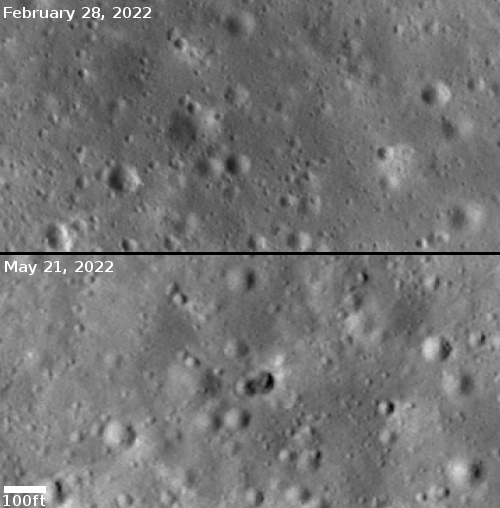
The science team for Lunar Reconnaissance Orbiter (LRO) today released images identifying the location on the Moon where a mystery rocket stage crashed in March 2022.
The image to the right shows the before and after LRO images, with the impact at the center of the second photo, showing as two superimposed craters. Since the sunlight in the second image come from the opposition direction as the first, the shadows in all previously existing craters are reversed.
Surprisingly the crater is actually two craters, an eastern crater [59 feet diameter] superimposed on a western crater [52 feet diameter]. The double crater was unexpected and may indicate that the rocket body had large masses at each end. Typically a spent rocket has mass concentrated at the motor end; the rest of the rocket stage mainly consists of an empty fuel tank. Since the origin of the rocket body remains uncertain, the double nature of the crater may help to indicate its identity.
No other rocket body impacts on the Moon created double craters. The four Apollo SIV-B craters were somewhat irregular in outline (Apollos 13, 14, 15, 17) and were substantially larger [>115 feet in diameter] than each of the double craters. The maximum width [95 feet] of the double crater of the mystery rocket body was near that of the S-IVBs.
Though the evidence strongly points to this stage being from China, that fact is not certain, and China denies that conclusion.
Regardless, the unexpected double nature of the impact only increases the mystery, as it suggests that rocket stage had a mass distribution different than past stages.
Capitalism in space: NASA officials revealed yesterday that it will not allow any Starship/Superheavy launches at SpaceX’s new Florida launchpad, at least for the moment, because of the threat a launchpad failure might have on the launchpad SpaceX uses to launch manned Falcon 9 missions to ISS.
The NASA statement said the agency “is responsible for ensuring SpaceX remains compliant with the requirements of the property agreement for the use of Launch Complex 39A.”
“These requirements include those related to construction, safety and environmental conditions,” the statement said. “At this time, NASA has only provided approval to build. Additional review for hazards, operational impacts and supportability will be required prior to a launch.”
The new Starship launchpad is 1,000 feet away from pad 39A, which is SpaceX’s manned Dragon launchpad. NASA management thinks this is too close. However, the managers have also not ruled out future launches, only that they wish to do a thorough review of the issue with SpaceX.
Because NASA and the federal government is also relying on Starship to land its astronauts on the Moon, it can’t block Starship flights outright. It could be however that this issue might shift Starship operations back to Boca Chica, after federal government opposition there forced SpaceX to shift more operations to Florida.
In other words, the government wants its cake and eat it to. Some factions within the Biden administration and the Washington bureaucracy want to block Starship, others want it to fly. The result is a tug-of war, with SpaceX in the middle.
Capitalism in space: According to one OneWeb official at a conference yesterday, the company now expects to resume launching its satellites on SpaceX and Indian rockets by the fourth quarter of this year and will complete its constellation by the second quarter of next year.
Launches were suspended when Russia refused to do a launch — and confiscated the 36 satellites — after Europe imposed sanctions in response to the Russian invasion of the Ukraine.
Speaking at the Fourth Summit for Space Sustainability by the Secure World Foundation and the U.K. Space Agency, Maurizio Vanotti, vice president of space infrastructure development and partnerships at OneWeb, said new launch agreements with SpaceX and NewSpace India Ltd. (NSIL) would allow the company to launch the remaining satellites of its first-generation system by the second quarter of 2023.
“Our plan is to be back on the launch pad in quarter four, after the summer, and to complete deployment of the constellation by quarter two next year,” he said. It will take several months after that final launch for the satellites to move to their operational orbits, he added. “We’re going to be in service with global coverage, 24/7, by the end of next year,” he said.
At present OneWeb has not revealed the breakdown of launches from the two companies.
An evening pause: Performed live, 2011, to the song, What A Wonderful World, sung by Louis Armstrong.
Hat tip Mike Nelson.
Capitalism in space: According to a tweet from Blue Origin on June 21, 2022, engineers have finally installed a flight-worthy engine on the test stand in Huntsville for static fire “commissioning” tests.
This is an engine that was supposed to be delivered to ULA for its new Vulcan rocket more than two years ago. With final engine tests only beginning now, it likely means the engine will not be delivered for at least several more months.
ULA will then have to install it in the rocket, and do its own fueling and static fire tests. All this suggests that a Vulcan launch before the end of this year is almost impossible.
When Blue Origin’s own New Glenn rocket will fly using the BE-4 is utterly unknown. ULA at least has built a full-scale test version of Vulcan and done launch countdown rehearsals in order to iron out issues with its launchpad and ground systems. Blue Origin has done none of this.

Bring a gun to a knife fight: When in December 2021, the University of Houston changed its anti-discrimination policy, broadening the definition so widely that almost anything anyone said could be defined as harassment, three conservative students obtained the help of the first amendment organization Speech First and sued. From their lawsuit [pdf]:
The Policy’s “[e]xamples of harassment” make clear that the Policy covers protected speech. Examples of harassment “include but are not limited to: epithets or slurs, negative stereotyping, threatening, intimidating, or hostile acts, denigrating jokes and display or circulation (including through email or virtual platforms) of written or graphic material in the learning, living, or working environment.”
Under the Policy, even “[m]inor verbal and nonverbal slights, snubs, annoyances, insults, or isolated incidents including, but not limited to microaggressions,” can constitute harassment if “such incidents keep happening over time and are targeting a Protected Class.” The Policy warns that “academic freedom and freedom of expression will not excuse behavior that constitutes a violation of the law or this Policy.” [emphasis mine]
In other words, according to the highlighted quote, the university’s anti-discrimination policy attempted to overide the First Amendment to the Constitution.
» Read more

Click for full image.

Click for full image.
In a press release today, the Curiosity science team provided a major update on the rover’s recent travels in the mountain foothills of Gale Crater.
First and foremost was the new information about the rover’s wheels, which was buried near the bottom of the release:
The rover’s aluminum wheels are … showing signs of wear. On June 4, the engineering team commanded Curiosity to take new pictures of its wheels – something it had been doing every 3,281 feet (1,000 meters) to check their overall health. The team discovered that the left middle wheel had damaged one of its grousers, the zig-zagging treads along Curiosity’s wheels. This particular wheel already had four broken grousers, so now five of its 19 grousers are broken.
The previously damaged grousers attracted attention online recently because some of the metal “skin” between them appears to have fallen out of the wheel in the past few months, leaving a gap.
The team has decided to increase its wheel imaging to every 1,640 feet (500 meters) – a return to the original cadence. A traction control algorithm had slowed wheel wear enough to justify increasing the distance between imaging.
From the first commercial launch of Blue Origin’s suborbital New Shepard spacecraft in 2021, the company has refused to reveal what its standard price is for a ticket.
Now, after five flights and fourteen passengers, one journalist has determined that the company does not appear to have a standard price, but instead determines its prices depending on who you are and what you can pay.
Blue Origin doesn’t advertise price information on its flight reservation page. Passengers say they have paid from zero to nearly $30 million. Industry insiders say Blue Origin’s ticket price is tailored to individual passengers based on a variety of factors.
“It’s not about money; it’s about who you are, your social capital, whether you align with their launch purposes. It’s kind of a package deal,” said Roman Chiporukha, cofounder of SpaceVIP, a platform that helps the wealthy book space trips, including Blue Origin’s. Blue Origin declined to discuss its pricing strategy. [emphasis mine]
How very socialist of Blue Origin, to treat people differently depending on such factors. Under this policy, people have paid from zero to $28 million per ticket.
The ticket policy itself is not illegal — as long as the price differences are not related to race, ethnicity, sex, or religion. It is just unseemly to consider a person’s wealth and status in determining a price.
In the past 24 hours both Europe and China successfully completed launches.
First Arianespace’s Ariane-5 rocket yesterday launched two commercial communications satellites, for Malaysia and India. With this flight the Ariane-5 rocket has only four flights to go before it is retired and replaced with ArianeGroup’s not-yet flown Ariane-6 rocket.
Then, China today used its Long March 2D rocket to launch three remote-sensing satellites.
The leaders in the 2022 launch race:
26 SpaceX
20 China
8 Russia
3 Rocket Lab
3 ULA
2 Europe (Arianespace)
The U.S. still leads China 35 to 20 in the national rankings, and the entire world combined 35 to 33.
Embedded below the fold in two parts.
To listen to all of John Batchelor’s podcasts, well worth your time, go here.
» Read more
An evening pause: Performed live 2011.
Hat tip Dan Morris.

Click for full image.
Cool image time! The photo to the right, rotated, cropped, and reduced to post here, was taken on November 22, 2021 by the high resolution camera on Mars Reconnaissance Orbiter (MRO). It shows what the science team labeled a sinuous ridge. Make sure you also look at the full image. The ridge goes on to the south, but then fades way as an almost perfect ramp, only to have another even more wiggly but thinner north-south ridge begin only a few feet to the west.
Sinuous ridges like this are found in many places on Mars. Almost always their origin is thought the result of a former river channel that became a ridge when the surrounding softer material eroded away.
That explanation however does not seem to work for this ridge. It has too many other inexplicable features. For example, note how the peak of the ridge smoothly transitions from sharp to flat-topped. It has a soft appearance that is strengthened by the gap near the top.
It is almost as if this ridge is a kind of elongated sand dune! And guess what: The overview map below gives that explanation some believability.
» Read more

Alexandra Schweitzer: a true momma grizzly
When parent Alexandra Schweitzer began challenging publicly the use of inappropriate sexual materials in the elementary schools in Oconomowoc Area School District (OASD) in Wisconsin, the school board made what appeared to be some minor superficial changes in its policy without really addressing her concerns.
Above all, school district officials would not confirm unequivocally that these materials — many of which advocated the queer agenda on gender — had been removed. Unsatisfied with this response, Schweitzer expanded her campaign.
After enrolling her children elsewhere, Alexandra continued to be an advocate and resource for local parents regarding their concerns. As President of No Left Turn in Education [NLTE]– Wisconsin, Schweitzer voiced her concerns, and those of district parents, in public forums and in testimony before the Wisconsin legislature.
Apparently, the school district did not like what she said in those public forums or in that testimony. It proceeded to hire an outside lawyer — using school funds — to send Schweitzer a cease-and-desist letter [pdf], threatening further legal action against her if she did not retract her statements and then shut up.
» Read more
Link here. The telescope, located in the Himalayas, is “an international collaboration between institutions in India, Belgium, Poland, Uzbekistan and Canada.”
The mirror works by rotating it so that its thin layer of liquid mercury forms a parabola.
The tradeoff is that the [telescope]is fixed in a single position, so it only observes one strip of the night sky as the Earth rotates below it. But since the telescope will be hyper-focused on just one area, it’s well-suited for spotting transient objects like supernovas and asteroids.
It appears the scientists will use it to study this same strip of sky over five years, hoping to detect changes in that time period.
This telescope is more a technology test than an actual observatory. Eventually the best place to put such a telescope — and much larger — will be on the Moon, and to do that requires some construction and testing beforehand.
The InSight science team has decided to continue to operate the lander’s seismometer through August rather than turning it off at the end of June, even though that longer use will drain InSight’s batteries sooner and kill the lander shortly thereafter.
The previous plan would have allowed the lander to survive through the end of the year, but would have meant no earthquake data would have been gathered after June.
To enable the seismometer to continue to run for as long as possible, the mission team is turning off InSight’s fault protection system. While this will enable the instrument to operate longer, it leaves the lander unprotected from sudden, unexpected events that ground controllers wouldn’t have time to respond to.
“The goal is to get scientific data all the way to the point where InSight can’t operate at all, rather than conserve energy and operate the lander with no science benefit,” said Chuck Scott, InSight’s project manager at NASA’s Jet Propulsion Laboratory in Southern California.
Apparently they have realized that it is now very unlikely that a dust devil will come by and clear the dust from InSight’s solar panels, so keeping the spacecraft alive longer — but getting no data — does not make sense.