Fires in Arizona: more than one

Though the news has rightly been making a very big deal about the out-of-control Wallow wildfire in eastern Arizona, it turns out that this is not the only serious wildfire in the state.

Friends in Arizona clued me in on this website, Inciweb, which lists all the fires both active and inactive in the U.S. Of the active fires, Wallow is by far the biggest at almost 400,000 acres. However, there are three other big fires in the Coronado National Forest on the Mexican border whose total acreage exceeds 200,000 acres. These particular fires have shut down all public access to Coronado.

It is believed by one of my local Arizona friends that these fires are probably linked to either the illegal drug or immigrant smuggling that passes along the forest’s trails, coming north from Mexico. (When I was out in Tucson in January we saw clear evidence of this smuggling on these trails during one hike in the Huachuca Montains, with a lot of trash scattered along the trail and in several adjacent rock shelters.)

2 comments

A press conference of my very own

This week the Space Telescope Science Institute in Baltimore, Maryland was holding a conference on the future research possibilities of the James Webb Space Telescope, and ended the conference with a writer’s workshop/press conference today.

Not surprisingly, there was not a lot of press interest. The Webb telescope is way behind schedule and over budget, and is not scheduled for launch until 2018. For most of the press, a press conference now on what Webb might someday do is really nothing more than a NASA sales pitch. Most reporters, including myself, don’t find these kinds of press conferences of much worth.

However, after thinking about it a bit, I decided to go, with the hope that I might be able to find out some more details about the state of the telescope’s construction.

To my astonishment, I discovered how little press interest there was, as it turned out I was the only journalist there! When the presentations ended, the whole workshop became an exercise in answering Bob Zimmerman’s questions about Webb and astronomy. I felt a bit embarrassed about this, but then decided the only stupid question is the one you don’t ask, and forged ahead. Moreover, the situation probably was far more embarrassing for the press people at the Institute then it was for me.
» Read more

3 comments

After a burst the Sun quiets down again

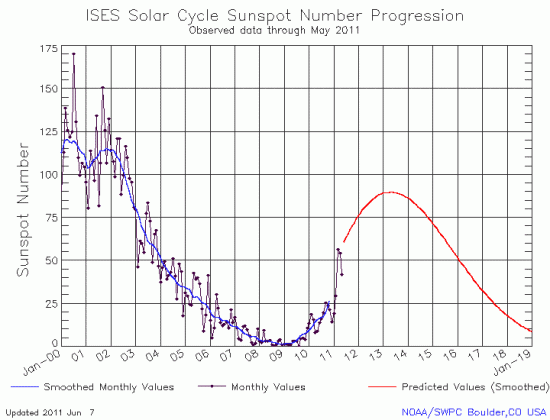
Time again for the monthly updated graph of the Sun’s solar cycle sunspot activity. Posted today by NOAA’s Space Weather Prediction Center, you can see the May results in the graph below.

After a three month steady rise in sunspot activity in January, February, and March, the numbers plummeted during April and May. Though the Sun remains active, with only one blank day since January 16, the pattern of activity as it ramps up to solar maximum continues to suggest that we are looking for the weakest solar maximum in two hundred years, as now predicted by solar scientists at the Marshall Space Flight Center.

Whether this weak maximum foreshadows another Maunder-like minimum, with no sunspots occurring for decades, remains unknown. Only time will tell. However, if such a thing should happen, it will be a marvelous opportunity for scientists to finally pin down precisely the actual influence of the Sun on the Earth’s climate. Up until now they can only guess at how much the Sun varies in brightness. Another Maunder Minimum will tell them.

May Sunspot activity

3 comments

The costs of space cargo

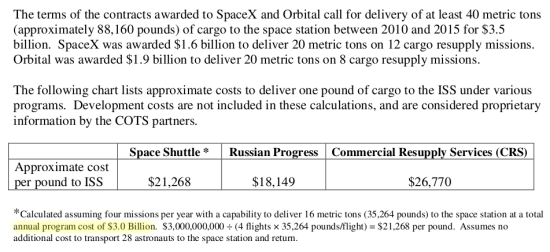
This week there was a bit of a political kerfuffle during House hearings over a House report [pdf] that stated that the cost per pound for launching cargo to ISS was much cheaper using the shuttle versus the new commercial companies under the COTS program. This is shown in this table from page 5 of the report:

House charter graph

The problem is that these numbers are a complete lie, as they are based on a yearly cost of $3 billion to operate the shuttle (highlighted in yellow). I have been following NASA budget battles now for decades, and the shuttle operational budget has never, ever been that low. Routinely, NASA figures the cost to operate the shuttle per year, regardless of number of flights, to be about $4 billion per year.
» Read more

7 comments

β€œWe stand for freedom.”

Kennedy's speech

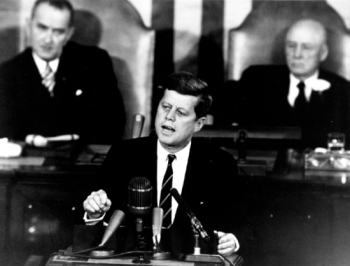
Fifty years ago today, John Kennedy stood before Congress and the nation and declared that the United States was going to the Moon. Amazingly, though this is by far the most remembered speech Kennedy ever gave, very few people remember why he gave the speech, and what he was actually trying to achieve by making it.

Above all, going to the Moon and exploring space was not his primary goal.

The Context

For Kennedy — whose presidential campaign included an aggressive anti-communist stance against the Soviet Union — the months before the speech had not gone well. Five weeks earlier, for instance, the CIA-led attempt to invade Cuba and overthrow Castro’s communist government had ended in total failure. When Kennedy refused to lend direct military support to the Bay of Pigs invasion, the 1,200 man rebel force was quickly overcome. “How could I have been so stupid as to let them go ahead?” Kennedy complained privately to his advisors.

In Berlin, the tensions between the East and the West were continuing to escalate, and would lead in only a few short months to Khrushchev’s decision to build the Berlin Wall, sealing off East Berlin and the citizens of East Germany from the rest of the world.

In the race to beat the Soviets in space, things were going badly as well. NASA had announced the United States’ intention to put the first man into space sometime in the spring of 1961. The agency hoped that this flight would prove that the leader of the capitalist world still dominated the fields of technology, science, and exploration.

Originally scheduled for a March 6, 1961 launch, the short fifteen minute sub-orbital flight was repeatedly delayed. The Mercury capsule’s first test flight in January, with a chimpanzee as test pilot, rose forty miles higher than intended, overshot its landing by a hundred and thirty miles, and when the capsule was recovered three hours later it had begun leaking and was actually sinking. Then in March another test of the Mercury capsule included the premature firing of the escape rocket on top of the capsule, the unplanned release of the backup parachutes during descent, and the discovery of dents on the capsule itself.

These difficulties caused NASA to postpone repeatedly its first manned mission. First the agency rescheduled the launch to late March. Then early April. Then mid-April. And then it was too late.
» Read more

4 comments

Want to go to an asteroid?

A paper published today on the Los Alamos astro-ph preprint website has taken a close look at identifying the best nearby asteroids ideal for mounting a manned mission. The conclusion: our survey of such asteroids is very incomplete (only 65 known), and due to their location in Earthlike orbits they are very difficult to study.

Ultra-low delta-v NEOs are not readily found. Their closely Earth-like orbits mean that most of the time they are in the daytime sky, as seen from the Earth, and so are effectively undetectable. As they approach within <1AU of the Earth they start to lie near quadrature, and so come into the dawn or dusk sky on Earth. The strong scattered sunlight background makes optical surveys toward the dawn or dusk much less sensitive and, in practice, surveys do not look in these directions, preferring to observe where the sky is dark, within 45 degrees, and at most 60 degrees, of the anti-Sun, opposition, direction. As a consequence the lowest delta-v NEOs are undercounted by current surveys, and the factor by which they are undercounted is not yet known.

The paper proposes building a dedicated unmanned infrared mission and placing it in a Venus-like orbit where it would be better placed to see these difficult but important objects.

1 comment

If you schedule a launch they will come

We arrived at Space View Park in Titusville at around 9 pm, bringing with us camp chairs, a softside cooler with food, cameras, tripods, and light jackets. I also brought a light fleece sleeping bag for additional warmth. Even though it was still twelve hours before launch, the entire shoreline was occupied by a line of people either sitting or lying on blankets or pads. Back from the water and under the trees there were more than a dozen small tents set up.

We found a spot where the line was only one deep and set up our chairs. In front of us were a group of Floridians who had never seen a launch up close, though they told us how they had often watched shuttle launches from their front door. As one of them said, “There won’t be many more chances to see this, so we decided we better come down.”

Also set up in the park under a tarp was a electronic setup with television feeds and speakers linked to NASA TV, run by the Space Walk of Fame Foundation, a volunteer organization that maintains Space View Park and the monuments to space that are on display there.

Christmas lights and VAB

Looking east out across the Indian River was Merritt Island, with the launchpad lit up like a Christmas tree eleven miles distant. To the right was the VAB.
» Read more

0 comments

The launch

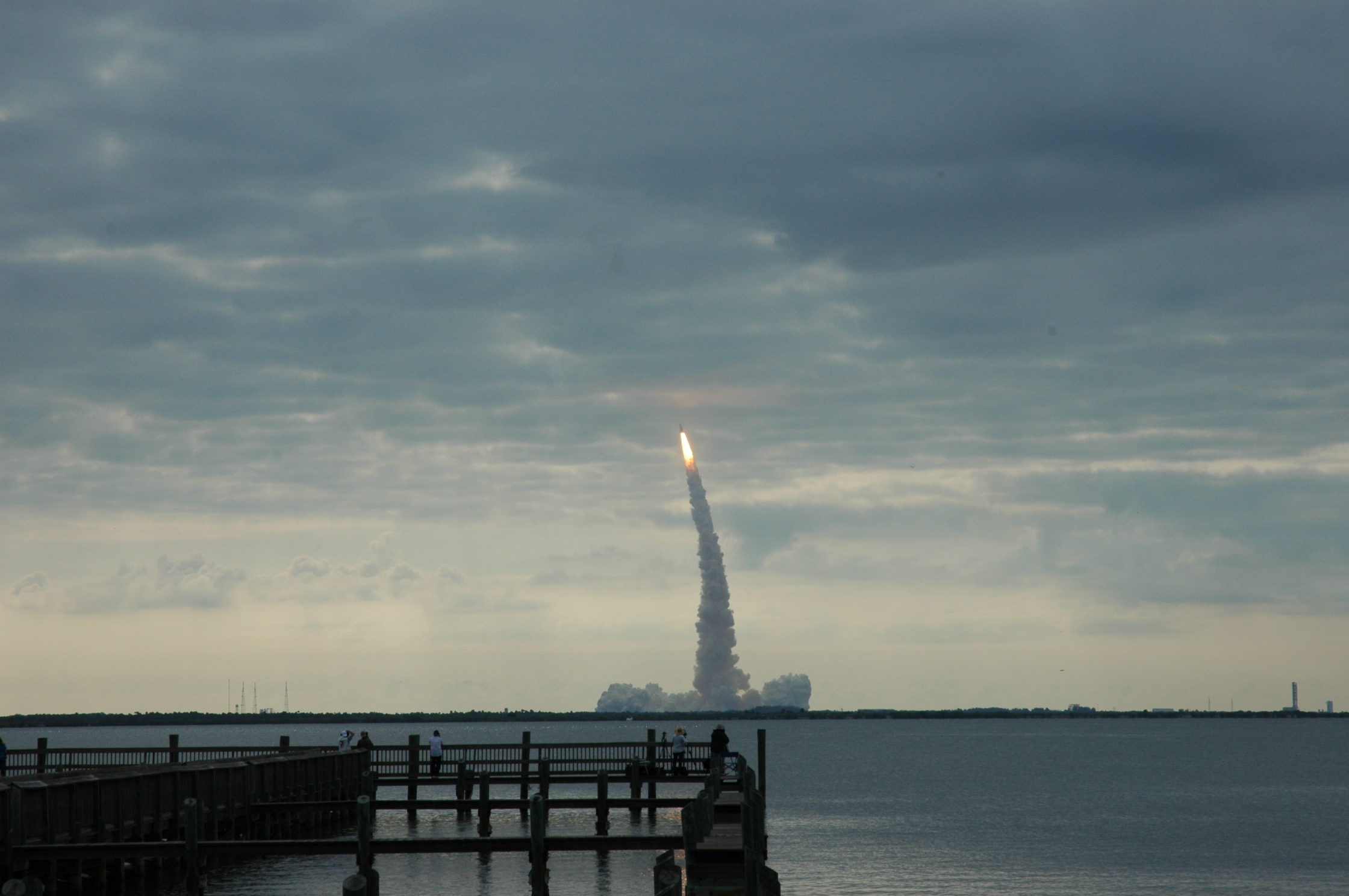
After fifty years of following space, I finally saw a big rocket launch today. Below is one of the pictures I took of Endeavour as it roared into the sky.

The experience was immensely satisfying, to put it mildly. Watching the shuttle rise up on a column of flame and smoke made me feel young again, my heart racing with excitement. Then Endeavour disappeared into the clouds, and we stood waiting for the roar of liftoff to travel the eleven miles to us. The long wait made this experience far different from what one sees on television. Then the rumble arrived, deep and low, but not as loud as I expected. One experienced launch-watcher explained that the low clouds and humidity might have muffled the sound. Bob Rose said that it was what he expected for this location, and that my expectations were based on those who experienced the launch from the press site at three miles. I think Bob is almost certainly right.

Later today I will put up a longer post, describing what it was like to stand among like-minded space nuts who had traveled from far and wide to see a crew of humans leave the Earth’s gravity and help trace a warm line of life across barren space.

Endeavour's launch

2 comments

At Space View Park

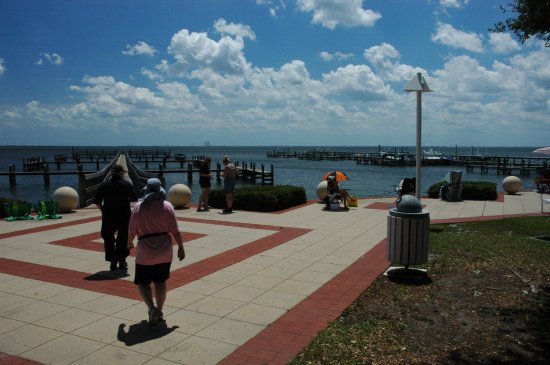
We have now set up at Space View Park in Titusville, Florida. The picture below shows what we found when we went by earlier today to scout out the location. As you can see, several people were already there. There were also people who had put up tents, as well as two food vendors.

The launchpad is the tiny spike visible on the horizon directly at the end of the pier. You can also see the VAB to the right.

Space View Park

0 comments

On the way to the Cape

As I write this I am sitting in the back seat of Bob & Brenda Rose’s minivan as we drive down to Florida for Monday’s shuttle launch. We plan to arrive at Space View Park in Titusville around 8 pm Sunday to claim a good location for seating, waiting, and watching the launch. We will be about 11 miles away, but this park is considered one of the better locations for the general public, with a clear view of the launchpad.

Stay tuned for more updates!

3 comments

The science remains uncertain

Two papers published this week by the American Geophysical Union once again indicate that the science of climate change remains exceedingly uncertain. More significantly, the models that try to predict the future of the Earth’s climate continue to appear unreliable, with such large margins of error that it is at this time foolish to make any policy based on their predictions.

diagram of Atlantic currents

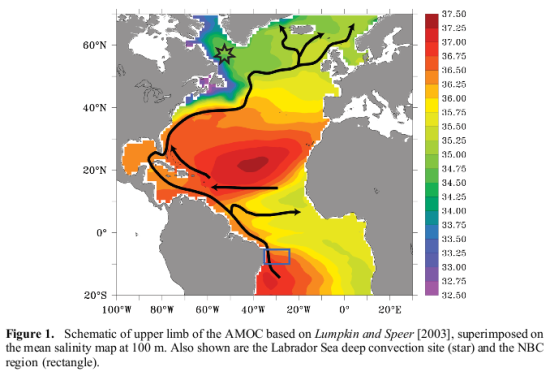
The first paper took a close look at the deep water currents in the Atlantic to see if it could track changes to what the authors’ call the Atlantic meridional overturning circulation (AMOC), more generally referred to as the Atlantic conveyor belt. This conveyor belt begins with the sinking of salty dense water in the northeast Atlantic off of Europe and Africa. The deep water current then travels south and into the Indian and Pacific Oceans where it comes to the surface only to flow back to the Atlantic, traveling north along the coast of North America as the Gulf Stream, bringing with it the warm temperatures that make Europe’s climate much warmer than its latitude would normally suggest.

According to most global warming models, higher temperatures should cause the glaciers in the Arctic and Greenland to melt, thereby pouring an increased amount of fresh water into the North Atlantic. This infusion of fresh water is then expected to lower the salinity and density of the Atlantic water, thus preventing it from sinking and thus acting to slow the conveyor belt, and possibly even causing it to shut down. The consequence would be no more Gulf Stream to warm the climate of Europe.

In other words: Disaster! Death! Destruction! All caused by global warming!

Unfortunately for these global warming models, the paper above found no trend at all. The conveyor belt is not slowing, as predicted. To quote the paper’s abstract:
» Read more

1 comment

Dark matter mysteries

Every year, as part of its educational and research mission, the Space Telescope and Science Institute in Baltimore, Maryland holds a science symposium that focuses one of the big questions of astronomy, inviting over a hundred scientists to come and give their individual perspectives on the state of the field.

This year’s symposium ended yesterday, and the subject was the mysteries of dark matter. Though I wasn’t able to attend the symposium itself, they held a workshop for journalists yesterday, which I did attend. (You can watch the webcast here.)

So, what is dark matter?

First of all, it isn’t dark energy. Dark energy is that mysterious unknown phenomenon that is causing — on vast scales of many billions of light years — the expansion of the universe to accelerate rather than decelerate. It has nothing to do with the question of dark matter.

Second, no one knows. All that scientists do know is that objects in the outer regions of galaxies as well as the galaxies themselves don’t move at the speeds and directions expected if their known mass and gravity were the only forces influencing them. In order to successfully plot their orbits and motions, astronomers have to add a gigantic halo of extra mass, which they have dubbed “dark matter” because it is unseen, undetected, and completely invisible.
» Read more

4 comments
1 118 119 120 121 122 139