The U.S. and the rising Russian space program

The Russians yesterday successfully launched their first space telescope since the fall of the Soviet Union. Here is a Google translation of a Russian article describing Spektr-R’s research goals:

[Spektr-R is] designed to study galaxies and quasars in the radio, the study of black holes and neutron stars in the Milky Way, as well as the regions immediately adjacent to the massive black holes. In addition, using the observatory, scientists expect to receive information about pulsars and the interstellar plasma. It is planned that the “Spektr-R” will work in orbit for at least 5 years.

Though this particular space telescope is probably not going to rewrite the science of astrophysics, its launch is historically significant. It indicates that Russia has just about recovered from the seventy-plus years of bankrupt communist rule that ended in 1990.
» Read more

2 comments

Wither the Arctic Icecap?

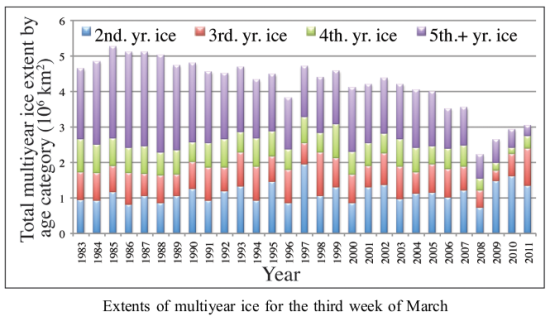
In a paper published today in Geophysical Research Letters, climate scientists have estimated the distribution and trends for the Arctic icecap from 1980 through March 2011. What they have found is a significant decline in older ice on top of an overall declining trend that showed a strong but partial recovery since 2008. The graph below, from the paper, illustrates clearly these trends.

Arctic Ice, 1980 - 2011

What this means for the icecap itself remains unclear. As the scientists themselves note in their conclusion:
» Read more

0 comments

Bad news for climate modelers

A new analysis of the orbits of Ceres and Vesta says that in a surprisingly short time those orbits become chaotic and therefore unpredictable. More significantly, those orbits interact with the Earth’s and also make its long term orbit chaotic and unpredictable. From the abstract:

Although small, Ceres and Vesta gravitationally interact together and with the other planets of the Solar System. Because of these interactions, they are continuously pulled or pushed slightly out of their initial orbit. Calculations show that, after some time, these effects do not average out. Consequently, the bodies leave their initial orbits and, more importantly, their orbits are chaotic, meaning that we cannot predict their positions. The two bodies also have a significant probability of impacting each other, estimated at 0.2% per billion year. Last but not least, Ceres and Vesta gravitationally interact with the Earth, whose orbit also becomes unpredictable after only 60 million years. This means that the Earth’s eccentricity, which affects the large climatic variations on its surface, cannot be traced back more than 60 million years ago. This is indeed bad news for Paleoclimate studies. [emphasis mine]

The scientists found that it became impossible to calculate the orbits of the two largest asteroids after only several ten thousand years. They also found that “numerous asteroids in the main belt will behave in the same way with . . . much more chaotic behavior than previously thought.” Worse, the possibility of collisions was far higher than ever thought. Ceres and Vesta have a 1 in 500 chance of colliding with each other every billion years, while other asteroids have chances as low as 1 in 1000.

The importance of this discovery, which still needs to be confirmed by other researchers, cannot be understated.
» Read more

1 comment

Another fuzzy Dawn image?

July 9 Vesta image

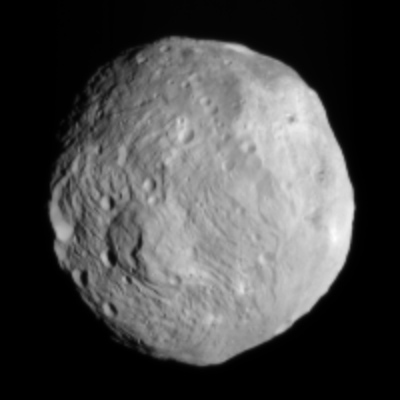
Another image of Vesta from Dawn has been released. This image was taken on July 9 from a distance of 26,000 miles away. It is definitely an improvement over the previous image, with more small details becoming visible. However, I once again wonder about the softness of the image. Look at the limb of the planet. It is soft against the black sky. This is not what one would expect from perfectly focused camera.

Dawn goes into orbit around Vesta next week. We sure learn then for sure if there is a problem with its camera, or whether I am merely being a bit too nervous.

4 comments

Being tone deaf is not a good way to fund a government space program

Yesterday the House appropriations committee’s released budget numbers that included no additional funds for commercial space, limiting the subsidies to $312 million, the same number as last year and significantly less than the $850 million requested by the Obama administration.

This is what I have thought might happen since last year. The tone deaf manner in which the Obama administration has implemented the private space subsidies is leaving all funding for NASA vulnerable.
» Read more

2 comments

NASA stalls, Texas lawmakers fume

The law is such an inconvenient thing: In a bipartisan effort, Texas lawmakers roast NASA administrator Charles Bolden for not meeting mandated Congressional deadlines for Congress’s personally designed rocket, the program-formerly-called-Constellation.

The heavy-lift rocket and capsule that Congress insists NASA build is a complete waste of money and nothing more than pork. It will never get built, mainly because Congress has given NASA less money and less time to build it than they did for Constellation under the Bush administration. Unfortunately, the reason they continue to require NASA to build it is to provide pork to their districts.

In a perfect world this funding would be cut now, especially considering the state of the federal debt.
» Read more

5 comments

Standing up for your rights with the police when they ask for id

If you have broken no laws, you are not required to show the police your id. Getting them to accept this legal fact is often quite difficult. It is even more difficult if you should approach them with a camera while openly carrying a gun, as this man does. Watch the video below to see he not only refuses to give them his id, he literally walks away in the end, leaving the two cops befuddled.

Some background on the video can be found here.

0 comments

The painful transition to private space

It appears that U.S. aerospace layoffs more than tripled in the first half of 2011.

The downsizing, prompted by cutbacks in defense and government contracts, jumped from 6,121 in the first six months of 2010 to 20,851 this year, based on planned layoffs announced by major employers.

Though I have always favored shutting down the government space agency and replacing it with privately-built rockets and spaceships, the manner in which this is being done now is disgraceful. George Bush declared the retirement of the shuttle seven years ago. Since then Congress, Bush, and Obama have all done an abominable job preparing the nation for that retirement.
» Read more

4 comments

More stupidity from the Center for Biological Diversity

The Center for Biological Diversity (CBD) today sued the Bureau of Land Management (BLM) in Colorado for allowing caving to take place at the annual convention of the National Speleological Society.

The CBD claims that human activity can spread white nose syndrome, the mysterious ailment that has been killing millions of bats across the eastern United States. To quote:

It is well documented that the fungus believed to cause white-nose syndrome, aptly named Geomyces destructans, can be spread on the clothes and gear of people visiting caves. Scientists strongly suspect that the disease is a recent import from Europe, likely transported by someone who visited a cave there and then came to North America.

To be blunt, this statement is an outright lie.
» Read more

7 comments

Why some space junk is impossible to track

This ISS status update, dated June 28, explains why the piece of space junk that flew past the station that day was such a surprise. (Hat tip to NASA engineer James Fincannon for pointing this out to me.)

Last night at ~6:00pm EDT, NASA Houston FTC (Flight Control Team) received notification of an upcoming โ€œred thresholdโ€ conjunction of the ISS with a piece of orbital debris (Object 82618, UNKNOWN), with a TCA (Time of Closest Approach) this morning at 8:08am EDT, – which was too late to begin planning for a DAM (Debris Avoidance Maneuver). Therefore, FTC and crew made preparations for crew sheltering in Soyuz 26S & 27S. PC (Probability of Collision) at last tracking fix (7:20am) remained in the Red box, at ~0.003, with a miss distance of 0.25 km radial, 0.375 km downtrack, 0.570 m crosstrack. The necessary reconfiguration procedures (USOS hatches closed, etc.) began 1.5 hrs before TCA (6:38am EDT), and the six crewmembers ingressed their Soyuz vehicles. At 8:08am the object cleared the ISS with no impact, and shortly thereafter the crew was given the Go for returning to the ISS. [The late notification occurred because of the high air resistance (drag) of the object (~175 times higher than ISS) which made its trajectory very sensitive to small errors in atmospheric density predictions at the current solar flux. Due to the high drag, there is no chance of a recurrence of Object 82618).] [emphasis mine]

In other words, the piece of junk was probably something like a piece of insulation, very light but with a large area, much like a sail. Thus, as it flies through the thin atmosphere at 200 to 400 miles altitude its velocity and direction can easily change, making it difficult, if not impossible, to predict its future trajectory.

The good news is that these same conditions mean that the orbit of the object will quickly decay (“due to high drag”) so that it poses no future threat to the station.

Unfortunately, there are many other objects like this in orbit, and they all pose a threat, mostly because of the difficulty of reliably predicting their orbits.

0 comments
1 116 117 118 119 120 139