The wimpy maximum continues

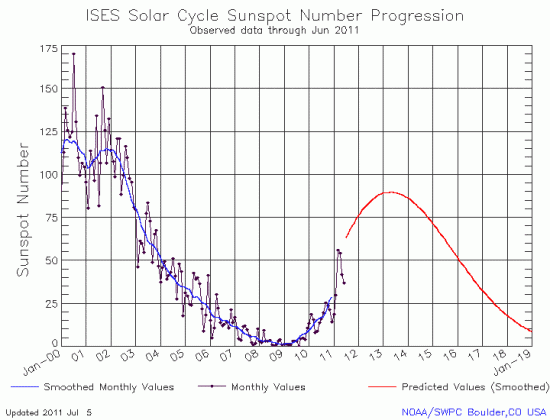
The monthly updated graph of the Sun’s solar cycle sunspot activity was released today by NOAA’s Space Weather Prediction Center. I have posted the June graph below.

For the third month in a row, there was a decline in sunspot activity. Though the sun is producing sunspots quite regularly and there hasn’t been a blank day since January 16, the numbers of sunspots continue to fall far below the predicted level of activity as indicated by the red line.

All this is no longer a surprise or unexpected. As the solar science community noted last month, they have now gathered enough data to convince them that the sun appears to be going quiet, and might even follow this very weak solar maximum — the weakest possibly in 200 years — with a decades-long period of no sunspots at all.

This graph, however, is very intriguing. Even with an expected weak solar minimum, the sun should be producing more sunspots each month, not less, as shown on the graph. This suggests that the most up-to-date predictions for the next solar maximum might still be too high.

The sunspot graph for June 2011

0 comments

Prime real estate

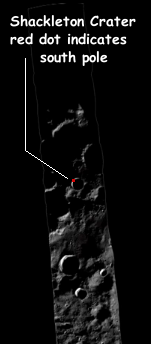
The south pole of the moon

Since the 1990s, scientists have suspected that water-ice might be hidden in the forever-dark floors of the polar craters on the Moon. If so, these locations become valuable real estate, as they not only would provide future settlers water for drinking, the water itself can be processed to provide oxygen and fuel.

Moreover, the high points near these craters, including the crater rims, are hoped to be high enough so that the sun would never set or be blocked by other mountains as it made its circuit low along the horizon each day. If such a place existed, solar panels could be mounted there to generate electricity continuously, even during the long 14-day lunar night.

Below the fold is a six minute video, produced from images taken by Lunar Reconnaissance Orbiter (LRO) from February 6, 2010 to February 6, 2011, in an effort to find out if such a place actually exists. It shows how the sunlight hits the south pole across an entire year.
» Read more

1 comment

Are we finally seeing a sea change in the war between the right and left?

This story today from what is generally considered a Democratic newspaper, suggests that the political debate has shifted strongly in favor of the Republicans and against Obama and the Democrats. From the Los Angeles Times: Deficit battle shaping up as GOP victory

Even as the political battle mounts over federal spending, the end result for federal policy is already visible โ€” and clearly favors Republican goals of deep spending cuts and drastically fewer government services.

President Obama entered the fray last week to insist that federal deficits can’t be reduced through spending reductions alone. Federal tax revenue also must rise as part of whatever deficit reduction package Congress approves this summer, he said.

Obama has been pushing to end a series of what he calls tax loopholes and tax breaks for the rich. But even if Obama were to gain all the tax-law changes he wants, new revenue would make up only about 15 cents of each dollar in deficit reduction in the package. An agreement by the Republicans to accept new revenue would be a political victory for Obama because “no new taxes” has been such an article of faith for the GOP.

But substantively, budget experts note, the plan would still be dominated by cuts to government programs, many of them longtime Democratic priorities, such as Medicaid and federal employee pensions.

For a liberal newspaper to recognize and describe in detail the absurdity of Obama’s position on taxes versus cuts is remarkable. Normally a liberal newspaper would ignore the fact that the President’s suggested tax-law changes will bring in practically no significant revenue, and focus instead on the so-called refusal of Republicans to compromise. That the Los Angeles Times is not willing to carry water for Obama and the Democrats shows that the Democratic position is incredibly weak politically, and is likely to collapse if the Republicans stand firm. That the newspapers is also willing to describe fairly the Republican position, something liberal newspapers have almost never done in the past two decades, also suggests that they have had enough, and have finally realized how much their creditability has suffered in recent years by their unwillingness to cover political news honestly.

If this pattern spreads, the Republicans might find themselves getting everything — and more — of what they want. And that will be something I have not seen in almost fifty years of watching political life.

0 comments

Cassini looks past one Saturn moon to another

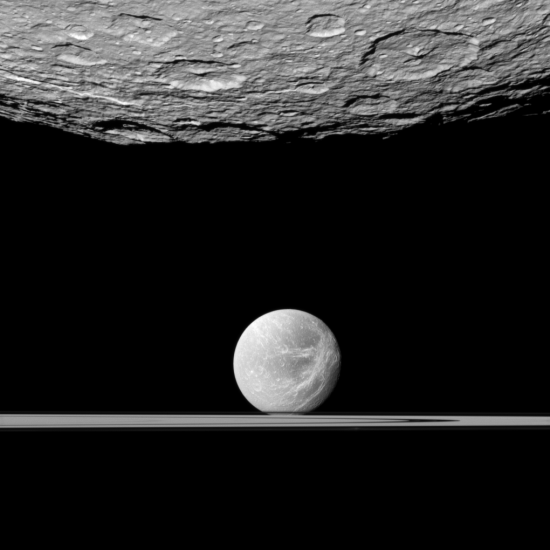
The image below was taken on January 11, 2011 by the space probe Cassini, in orbit around Saturn. First we see the southern polar regions of the moon Rhea, 949 miles in diameter. Beyond is the moon Dione, 698 miles across, appearing to sit on the rings of Saturn.

As far as I am concerned, this image, as well as almost every other image from Cassini, proves that any hotel built in orbit around Saturn is unquestionably going to be one of the hottest tourist spots in the solar system.

Looking past Rhea to Dione and Saturn's rings

2 comments

Sunspots and the danger of crying wolf

It’s that time of year again, buckos. Every June, like clockwork, stories and op-eds like these start to flood the media:

Not surprisingly, these stories always happen about the same time our federal bureaucracy puts together a one day June propaganda event called the Space Weather Enterprise Forum, designed to sell to journalists the idea that we are all gonna die if we don’t spend gazillions of dollars building satellites for tracking the sun’s behavior. Along with this conference come numerous press releases, written by the conference’s backers. Here for example is a quote from a press release emailed to me and many journalists:

Recent activity on the Sun, captured in stunning imagery from the Solar Dynamics Observatory, and the resulting threat of significant radiation storms and radio blackouts here on Earth are vivid reminders of our need to better understand the science, improve our forecasts and warnings, and better prepare ourselves for severe space weather storms as the next solar maximum approaches.

The problem for these fear-mongers, however, is that shortly before their forum the scientists who actually study the sun held another press conference, where they laid out in exquisite detail the sun’s astonishing recent decline in activity, and how the next solar maximum will likely be the weakest in centuries and might very well be the last maximum we will see for decades to come.

In other words, the annual effort by government bureaucrats to drum up funding for more space weather facilities has collided head on with the facts.

That there are science journalists from so many major news organization so easily conned into buying this fear-mongering is pitiful enough. More significant, however, is the fact that this annual effort at crying wolf has not been very successful. For years Congress has not funded any new space weather satellites, and doesn’t appear ready to do so in the future, especially with the present budget crisis.
» Read more

1 comment

Mann and company write more science fiction

Junk science: Michael Mann and associates have just released a paper claiming “The rate of sea level rise along the U.S. Atlantic coast is greater now than at any time in the past 2,000 years–and has shown a consistent link between changes in global mean surface temperature and sea level.” You can read the paper itself here.

For many, many, many reasons, I agree here with scientist Richard Mueller, who believes in global warming but also believes in good science, “I now have a list of people whose papers I won’t read anymore.”

Nonetheless, I have looked at this new paper by Mann and crew, and find its evidence so weak it ain’t worth the paper it’s written on. To look at the record of a single fossil and claim it is a sufficient proxy for sea level rise is downright laughable.

1 comment

The battle between global warming and the sun

The revelation last week that the sun is very likely about to go into a period of little or no sunspot activity has made a lot of global warming advocates, both scientists and journalists, very nervous. For years these climate activists have declared that the Earth’s climate is getting warmer, and that this warming trend was going to do us great harm. Putting aside whether these claims are based on fact (they are not), the possibility that the Earth might instead become cooler because of a dimming of the sun puts this political agenda under threat, and requires some form of immediate action to defuse that threat. See for example this short podcast (with full transcript) from Scientific American. The key quote:

A cooler sun might mean a drop in global average temperatures of at most 0.3 degree Celsius. But the carbon dioxide already in the atmosphere today will add 0.6 degree Celsius to global average temperatures by the end of the century. And more, since greenhouse gas emissions show no signs of diminishing. So the slightly cooler sun won’t counteract a much hotter Earth.

In order to discredit the threat that solar variation poses to global warming, the journalist here acts to minimize any danger from a dimming sun. Unfortunately, he does so by extrapolating a result (warmer climates) based on a very weak foundation: an unproven theory and our very limited knowledge of the climate.
» Read more

10 comments

Cool images from Mars and Mercury

Here are two image releases of interest, one from Mars and one from Mercury.

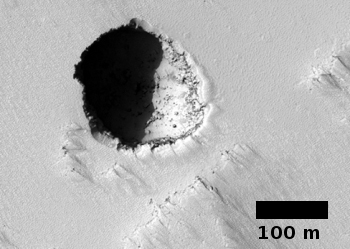
Pavonis Mons pit

First the Mars image. This close-up image of a pit, requested by a seventh grade Mars student team at Evergreen Middle School in Cottonwood, California, shows more evidence of underground voids on Mars. The pit is located on the flank of one of Mars’ larger volcanoes, and suggests that there is a lava tube below it. At some point the roof over the tube at this point became unstable and collapsed, producing the surface pit.

A close-up image of the shadowed part of the pit with the exposure turned way up unfortunately shows that there is no skylight in the pit into the lava tube.

Next, the Mercury image, from Messenger.
» Read more

0 comments

The progenitor of the May supernova in M51 identified

supernova 2011dh before it exploded

The progenitor star that produced the May supernovae in the Whirlpool Galaxy (also known as M51) has been identified, and it isn’t what scientists predicted.

In a preprint paper published today on the Los Alamos astro-ph website, astronomers describe the star that exploded as a yellow supergiant, not a red supergiant or Wolf-Rayet star, as predicted by the theory explaining this particular type of supernova. Moreover, though theory also favors the star being a member of a binary system, the progenitor of 2011dh appears to be a lone star, not even a member of a cluster.
» Read more

1 comment

Solar scientists predict a major decline in sunspot activity

At a press conference today at the 2011 meeting of the Solar Physics Division (SPD) of the American Astronomical Society (AAS) in Las Cruces, New Mexico, solar scientists predicted that not only will the next solar maximum in 2013 be the weakest in centuries, it is very likely that it will be followed by another long Maunder Minimum, a period of decades without sunspots. “The sun may be going into hiatus,” says Dr. Frank Hill, associate director of the NSOโ€™s Solar Synoptic Network. You can read the press releases for this announcement here and here.

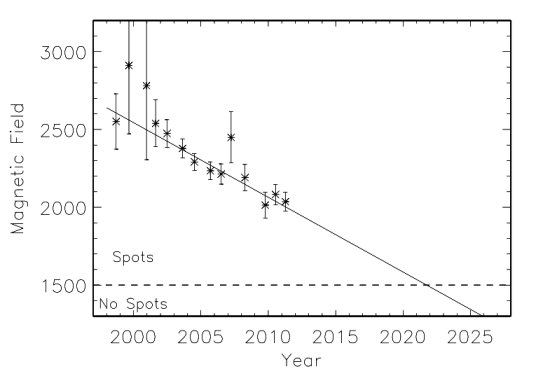
decline in magnetic field over the last few cycles

These conclusions are based on three lines of evidence:

  • There has been a long term weakening in the magnetic strength that produces sunspots themselves. The declining trend suggests that by 2022 it will no longer be strong enough to produce sunspots. The graph above shows this decline.
    » Read more
3 comments
1 117 118 119 120 121 139