Why I went to Belize

There are many reasons cavers decide to go to faraway places across the globe during their vacations. Some do it because they want to get out of the office. Some go because they like to see exotic sights and strange places well off the beaten path. Some go, like me, because they want the chance to see something new and unexplored. And we all do it because it is fun!

One doesn’t have to go to Belize to get these benefits. I could have traveled to England, Mexico, Hawaii, or any one of several dozen other countries to see the exotic, the new, and the unexplored. In fact, I have already done so in Russia, Ukraine, Germany, and Czechia (the new official name of the Czech Republic). Belize however was relatively close, the local population spoke English, I had never been there before, and most important, someone else was organizing things! When David and Eleanor Larson invited me to join their Belize project I decided this was a great opportunity to visit a strange and new place with a minimum of aggravation or planning. They had already done it, and I merely had to sign up and agree to do whatever their project needed doing. So, off I went.

Upon arrival, I soon discovered several very important additional reasons why this cave project exists. First there are the caves. They are grand and beautiful things, with very vast chambers filled with delicate and rare formations. The picture below, taken by fellow caver Laura Sangiala, shows one wall of the gigantic entrance room of one cave.
» Read more

4 comments

A bibliography of my research into climate

The recent long and refreshing debate thread on the subject of climate change between myself and others on Behind the Black has prompted me to upload my bibliography of the research I did on climate change and the sun’s influence from 2002 to 2010.

This bibliography, which is quite long, can be found here. I have also added a link to it in the top menu just below the banner at the top of the page

Though I stopped adding new entries to this bibliography in 2010, my research has not ceased. I just don’t update the bibliography anymore.

I make it available partly as a reference to my readers, and partly as a document to show that I base my opinions on solid research. I might not be a climate scientist, but I have made sure that I have a solid understanding of the science before speaking publicly about it. I think it wise that more people do the same.

0 comments

Why Russian aerospace will not compete

The fallout from the scrub and one day delay of the first launch at Vostochny, while Vladimir Putin was there and watching, has generated an investigation and the suspension of one designer.

The official goal of the commission was to find causes of the failed launch attempt and to check the completeness of tests leading to the incident.

However given a minor technical impact of the delay, the investigation likely had the primarily political nature, namely it was aimed to demonstrate to the Kremlin that the industry problems were being dealt with. Moreover, Rogozin also made a decision during the work of the commission to suspend the responsibilities of Leonid Shalimov, the designer general at NPO Avtomatika, which supplied the hardware allegedly responsible for the incident. Rogozin summoned Shalimov to Moscow on May 6, apparently to present the results of the investigation. [emphasis mine]

When you develop any new system or cutting edge technology, things are certain to go wrong. This is the one certainty that I will admit to and gladly embrace, and to which good designers, scientists, and engineers all agree. Vostochny is brand new. It stands barely finished. No launch had ever been attempted there before. For there to be a one day delay because of a minor engineering issue is hardly a sign of poor workmanship. Instead, it suggests the people who built it did a reasonably good job, even as many of their managers ripped them and the project off.

What we see here is an industry that is being run not by people who understand the business, but by distant politicians whose only interest is power and control. Can you imagine any manager in Roscosmos anywhere being willing to approve the start of a radical new engineering project, faced with pressure from Putin and these power-hungry politicians in Moscow? It won’t happen. Until there is a change and the politicians let go of their control of this industry, Roscosmos is going to take the safe route every single time.

Nothing new is going to come from Russia’s aerospace industry for a very long time.

0 comments

The stupid party, part 2

Update: Thomas Sowell chimes in, expressing some of the same thoughts I do below.

As we approach the Indiana primary next Tuesday, it appears that we are also approaching the moment of truth for Donald Trump, Ted Cruz, and the Republican Party. And not surprisingly, that party appears ready to once again shoot itself in the foot, as it did in 1996, 2000, 2008, and 2012.

Polls show that the race is very tight, though the momentum seems to be favoring Donald Trump.

Meanwhile, national polls as well as the analysis of most political insiders say that Trump will lose to Hillary Clinton in November, while those same polls and insiders say that Ted Cruz has a far better shot at winning the national election.

In other words, it looks like Republican voters are going to pick the weaker of the two candidates for their nominee.

Pretty dumb, eh? What makes it even dumber is that even the slightest honest appraisal of the political beliefs of Donald Trump quickly reveals himself to be a RINO, a liberal Democrat with many ties to the corrupt political establishments of both parties. In addition, his political positions both before and during the campaign have revealed himself repeatedly to be a liberal Democratic in all things except illegal immigration, and even here he has shown indications that he will go soft once in office.

Trump is not a corrupt lying politician like Hillary Clinton. He would definitely be a better choice than her. Moreover, the insiders and the polls might be wrong about his chances against her, but I do not think so. Trump’s primary election results suggested to me that he has the support, like Mitt Romney, of a large minority of moderate Republicans and moderate former Democrats (concentrated in the northeast) that will not translate into a majority in the general election. If anything, he has set himself up to be a nice target for the press to destroy, once he is the Republican candidate.

For the Republican Party to favor him over Ted Cruz, a committed conservative who has repeatedly proven his willingness to stand up for these ideals, even under terrible fire from the press, the left, and the Republican leadership that really doesn’t want the right to win, is either madness, or it shows that the country in general no long believes in the ideals that founded it.

I’m not sure which it is, but either way, the future does not look good.

43 comments

Money for space

The competition heats up: Three stories today about investors putting money into different space related business ventures are worth consolidating into one post, as they all indicate the same thing.

The first story involves a takeover by SES of the O3b satellite constellation that provides internet service globally. They already have 12 satellites in orbit, and have plans to launch 8 more by 2019. A partial list of their customers (Digicel Pacific, Royal Caribbean Cruise Lines, American Samoa Telecom, Speedcast, Rignet, Bharti International (Airtel), Timor Telecom, CNT Ecuador, Entel Chile and NOAA) illustrates the solidity of the company’s success, which is also why SES is spending $20 million to own it.

In the second two stories we find investment capital being committed for two different and unusual space-tourism-related companies. World View plans to launch high altitude balloons with passengers, taking them up 20 to 30 miles for a several hour journey on the edge of space. That they have secured an additional $15 million in investment even as their deal with the city of Tucson is being challenged in court indicates the confidence the investors have in their business.

SpaceVR is even more interesting. They plan to launch smallsats with cameras providing a 360 degree view, and link them to virtual reality headsets here on Earth. Consumers will then be able to experience being in space, without actually going. Though the press release does not specific how the product will be sold, it suggests that they are aiming for the education and museum market.

All three stories prove that the modern investment community, normally very adverse to high risk endeavors, is increasingly finding that the financial benefits of space travel and anything related to it are worth the financial risks. This fact can only lead to good things for the eventual development and exploration of space.

Moreover, the third story once again demonstrates the value of reducing the cost to get into orbit. SpaceVR’s idea is a very good one, but it couldn’t have happened before SpaceX forced a reduction in launch prices. Beforehand, no one could have afforded to buy the product because of the high cost to launch the satellites. Now, because the launch price is affordable, it can be marketed at a realistic price.

In other words, lower the price, and you increase the number of customers able to buy your product. I expect the rocket business to boom in the coming years.

2 comments

The Orion fantasy

There is a commercial space conference going on in Colorado this week, which explains the plethora of breaking stories from the new commercial space companies both yesterday and today.

Two stories today from Aviation Week, however, are more about the old big space industry and the old way of doing things, and both reveal the hollow nature of that entire effort.

Both stories are about work Lockheed Martin is doing in connection with its Orion capsule, and both try to convince us that this capsule is going to be the central vehicle for the first missions to Mars.

Function starts in the bones of the spacecraft,” [Mike Hawes, Lockheed Martin vice president and Orion program manager,] said in an April 12 interview at the 32nd annual Space Symposium here. “To be a deep space spacecraft, you have to build differently than you would if your requirements were to stay in low Earth orbit and be quiescent at the International Space Station for a few months. That’s driven Orion from the beginning. Any architecture you look at needs a crew capability, a long-term design requirement. So, you can debate a lot of different missions, but you need that fundamental capacity we have invested in Orion.”

I say balderdash. Orion is an over-priced and over-engineered ascent/descent capsule for getting humans in and out of Earth orbit. Spending billions so it can also go to Mars makes no sense, because its heat shield and other capsule technologies for getting through the Earth’s atmosphere are completely useless in interplanetary travel. Moreover, such a small capsule is completely insufficient for a long Mars mission, even if you test it for a “1,000 day” missions, as Hawes also says in the first article. To send a crew to Mars, you need a big vessel, similar to Skylab, Mir, ISS, or Bigelow’s B330 modules. A mere capsule like Orion just can’t do it.

Eventually, it is my hope that Congress will recognize this reality, and stop funding big space projects like SLS and Orion, and instead put its money behind the competitive private efforts to make money in space. Rather than trying to build its own capsules, space stations, rockets, and interplanetary vessels (something that NASA has repeatedly tried to do without any success), NASA should merely be a customer, buying the capsules, space stations, and interplanetary vessels that private companies have built, on their own, to make money, on their own.

Consider for example Bigelow’s B330. Each module is about as big as Skylab or Mir, and costs mere pennies to build and launch, compared to those government-designed stations. Moreover, Bigelow can build it fast, and repeatedly. Similarly, Orion has cost billions (about $16 billion when it makes its first manned mission in 2021 at the earliest) and will have taken 15 years to build. SpaceX built Dragon in seven years, Orbital ATK built Cygnus in five years, and Boeing is going to build Starliner in about four years, all for about $10 billion, total.

The contrast is striking, and though ordinary people with the ability to add 2 plus 2 can see it, it takes Congressman a little longer (as they need to use their fingers to count). Sooner or later they will get it, and Orion and SLS will disappear. Bet on it.

17 comments

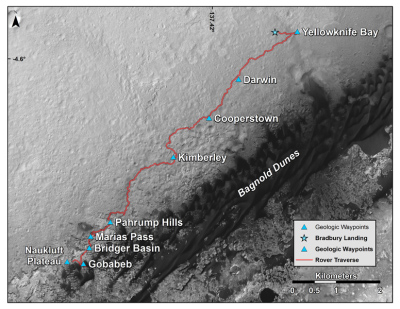
Pinpointing Curiosity’s location in Gale Crater

Curiosity's traverse

The Curiosity science team recently released a new Mars Reconnaissance Orbiter image, showing Curiosity’s overall route since its landing on Mars in August 2012. I have posted a reduced version on the right.

Similarly, on the Curiosity website you can view this more detailed map of its traverse route. This map is updated regularly as Curiosity continues its climb up Mount Sharp.

Neither of these maps is to me very satisfying or useful, however. Neither shows the overall location of Curiosity within Gale Crater. Nor do they give one a sense of how far it is has come on its climb up the mountain. In fact, it is very unclear how close the rover actually is to the peak from either image.

Thus, I decided to do a little research to get some better context of Curiosity’s position and its overall journey.
» Read more

13 comments

Monthly Solar Cycle update

NOAA released on Monday its monthly update of the solar cycle, showing the Sun’s sunspot activity in February. I am once again posting it here on Behind the Black, as I have done monthly since 2010.

February 2016 Solar Cycle graph

The graph above has been modified to show the predictions of the solar science community. The green curves show the community’s two original predictions from April 2007, with half the scientists predicting a very strong maximum and half predicting a weak one. The red curve is their revised May 2009 prediction.

The change in this month’s graph is so small that you will have to look real close to see it. Essentially, the February sunspot activity dropped only a tiny amount from January’s numbers, though it did drop. As such the decline from solar maximum continues to track perfectly the decline predicted by the low prediction of the 2007 predictions. This prediction success should not be taken very seriously, however, since that same prediction expected the solar maximum to begin two years earlier than it actually did.

0 comments

The Obama-like promises of Trump

During an interview on CNN yesterday, Donald Trump was asked about Obamacare and the insurance mandate. The first words out of his mouth were “I like the mandate,” which is what most conservative websites are focusing on.

I think it is more important to focus on Trump’s entire answer, which goes on for about two and half minutes. (I have posted the video below the fold, so you can listen for yourself.) As noted at the first link above,

Trump doesn’t have a freakin clue as to what he’s talking about. What he’s obviously done is extract a few focus group tested themes, like “dying on the street,” and “get rid of the lines,” and he simply says these over and over with connecting verbiage. The plan Trump refers to, the one that apparently suspends the idea of supply and demand and guarantees everyone a free lunch, simply does not exist. In the tech field it is a concept known as vaporware.

During Trump’s answer, he notes the dishonesty of Obama for making wild promises about Obamacare that were outright lies (‘If you like your plan, you can keep your plan. Period.” and “Obamacare will cut costs by $2500 per family.”). Trump then proceeds to spout his own wild and unrealistic promises about what he will do about healthcare when he is President. And they sound to me as dishonest and incoherent as the promises Obama made. Both set of promises remind me of school elections when I was in junior high school, where candidates would promise free ice cream at every break and soda machines in the halls. Such promises are silly, childish, and unrealistic, and the voters should try to be mature enough to see that.

Trump might be a better choice than Hillary Clinton or Bernie Sanders, but for Republicans to pick him as their nominee is insane. We can certainly do better.
» Read more

50 comments

The stupid party

The nickname for the Republican Party for the past few decades has been that of the “stupid” party. Why it has this reputation can be explained in numerous ways, from how its leadership in Congress routinely gets hosed in negotiations with Democrats, from how its Presidents since Reagan have routinely allowed liberals from the Democratic Party to dictate policy, from how the party since 2000 has routinely picked losers as its Presidential picks, and from how it has squandered every election victory it has earned since the day Ronald Reagan retired in 1988.

I think two stories today demonstrate that the stupidity is not limited just to the party’s leadership. In the first, we find that in every poll taken comparing a head-to-head election with Hillary Clinton, Ted Cruz does better than Donald Trump.

Polling has consistently shown Cruz to have an advantage over Trump in this regard: Fox News found that Cruz would fare 4 points better than Trump, beating Clinton by 7 points (50 to 43 percent) to Trump’s 3 (47 to 44 percent). NBC News and the Wall Street Journal found that Cruz would fare 6 points better than Trump, losing to Clinton by 4 points (49 to 45 percent) to Trump’s 10 (51 to 41 percent). And Quinnipiac found that Cruz would fare 5 points better than Trump, tying Clinton (at 45 percent apiece) while Trump would lose by 5 points (46 to 41 percent).

Nor should we be surprised by this. Trump might sound good now, but when he has to face Clinton (or anyone) in the election, his negatives, which are yuge (to coin a phrase) will sink him. Meanwhile, Cruz’s smart campaign strategy and his remarkable skill at debate make him a wonderful candidate. To paraphrase what he has said numerous times on the campaign trail, I can’t wait to get him in a head-to-head debate with Clinton or Sanders. He will make them look like fools.

In the second story, we find that Trump is crushing all opposition in South Carolina. Cruz comes closest, but even his best poll there so far has him losing by a good margin.

It appears no one is considering the eventual election. Instead, Republicans appear posed to pick a cool reality television star who happens to have a lot of money, merely because he is a cool television star that happens to have a lot of money.

There is madness here, and that madness can only lead to the kinds of villainy that eventually led to the deaths of millions, in places that also put their faith in strong personality cults.

36 comments

The long decline to solar minimum

On Monday NOAA released its monthly update of the solar cycle, showing the Sun’s sunspot activity in January. As I have done every month since 2010, I am posting it here with annotations to give it context.

What strikes me about this month’s continuing and steady decline in sunspots is how much it illustrates the long and steady nature of the ramp down to solar minimum, even for cycles that are very active. If you look at the ramp down during the previous solar cycle on the graph below the fold, it took four full years to reach solar minimum from a comparable sunspot level to what we have today.
» Read more

4 comments

Two thoughtful endorsements of Ted Cruz

While cable television and the general media goes nuts of the childish feud between Donald Trump and Fox News, Ted Cruz today got two different endorsements that not only supported his nomination for president, but also outlined in detail two completely different reasons for supporting him.

The first, at the website Legal Insurrection, outlined Ted Cruz’s consistent and long term history as a trustworthy constitutional conservative. Not only does the article review Cruz’s history in the Senate, where he did whatever he could to fulfill his campaign promises (often prevented from doing so by his own Republican caucus), the article also looks at his background before becoming a senator. Its conclusion?

In short, Cruz has a long (dating back to his early teens) record of being a conservative in both principle and action.  He didn’t bound out of bed one day, put his finger to the wind, and decide to become a conservative (as was charged against Mitt Romney, among others); he’s always been a conservative. [emphasis in original]

Conservatives have been complaining for decades that they can’t get a reliable conservative nominated to run for president. With Cruz, we actually have that chance, and he will be running against the weakest Democratic candidate since George McGovern.

The second article outlines Cruz’s particular advantages for cleaning out the bureaucratic corruption in the Justice Department and elsewhere in the federal government.
» Read more

10 comments
1 83 84 85 86 87 139