Blue Origin lands first stage rocket vertically

The competition heats up: Yesterday Jeff Bezos’s company Blue Origin did its second test flight of its New Shepard suborbital rocket and capsule, and successfully recovered the rocket’s first stage, landing the stage vertically using its rockets.

As Jeff Bezos wrote at the link:

Rockets have always been expendable. Not anymore. Now safely tucked away at our launch site in West Texas is the rarest of beasts, a used rocket.

This flight validates our vehicle architecture and design. Our unique ring fin shifted the center of pressure aft to help control reentry and descent; eight large drag brakes deployed and reduced the vehicleโ€™s terminal speed to 387 mph; hydraulically actuated fins steered the vehicle through 119-mph high-altitude crosswinds to a location precisely aligned with and 5,000 feet above the landing pad; then the highly-throttleable BE-3 engine re-ignited to slow the booster as the landing gear deployed and the vehicle descended the last 100 feet at 4.4 mph to touchdown on the pad.

When you watch the video youโ€™ll see that we took the liberty of engineering all the drama out of the landing.

I have posted video of the flight below the fold.

SpaceX has been attempting this with its orbital Falcon 9 rocket for the last two years. They have come very close, hitting their target and almost landing. They plan to try again in December. Blue Origin however has beaten them to it, even if they have done it with a suborbital rocket.This demonstrates unequivocally that the concept is sound and that a rocket’s first stage can be recovered. It also demonstrates that of all the rocket companies in the world, SpaceX and Blue Origin are in position to dominate for at least the next decade. I am very confident that SpaceX will succeed in its efforts to recover its first stage. I am also very confident that Blue Origin’s plans to upgrade New Shepard into an orbital rocket/capsule will proceed quickly.

In both cases, the companies will then move forward, capable of recovering and reusing significant parts of their rockets, thus making it possible to significantly lower the launch cost and thus charge their customers less. No one else is in this position, or even close to it. The launch market will belong to them.
» Read more
6 comments

Trump’s real weakness

While Donald Trump has remained the leader in every poll for president since he entered the campaign, it still remains to be seen whether Republican voters will give him the nod when actual voting begins in the primaries. I have tended to believe that they will not, and I base this on Trump’s essential lack of understanding of the small government principles of conservatism. Though it is very clear that Trump has rejected the left and the big government ideas of the Democratic Party, it is also clear that he really doesn’t really believe in small government either. This story quoting a Trump speech from yesterday illustrates this very well:

Speaking during a town hall meeting in Iowa Thursday, Republican front-runner Donald Trump told the crowd the way to make college affordable for students is โ€œto start some governmental program. … Well the only way you can do it is you have to start some governmental program and you have governmental programs right now,โ€ Trump told the crowd.

Click on the link to read the whole quote, which also illustrates the generally incoherent way in which Trump speaks. His incoherency however, is not what hurts him here, but his easy acceptance of the idea that government is the solution.

Don’t get me wrong. Trump is by far a better candidate than any of the Democratic Party options, and he would do a far better job then them as well. His business experience in the real world will make him a better president, and is also likely the reason he now generally favors conservative solutions. Nonetheless, when voting time comes I think the Republican voters are going to move away from him.

9 comments

The uncertainty of climate science

For the past five years, I have been noting on this webpage the large uncertainties that still exist in the field of climate science. Though we have solid evidence of an increase of carbon dioxide in the atmosphere, we also have no idea what the consequences of that increase are going to be. It might cause the atmosphere to warm, or it might not. It might harm the environment, or it might instead spur plant life growth that will invigorate it instead. The data remains inconclusive. We really don’t even know if the climate is truly warming, and even if it is, whether CO2 is causing that warming.

While government scientists at NASA and NOAA are firmly in the camp that claims increasing carbon dioxide will cause worldwide disastrous global warming, their own data, when looked at coldly, reveals that they themselves don’t have sufficient information to make that claim. In fact, they don’t even have sufficient information to claim they know whether the climate is warming or cooling! My proof? Look at the graph below, produced by NOAA’s own National Centers for Environmental Information.
» Read more

10 comments

Epic monuments and power

More Mexico City traffic

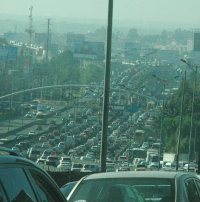
Being in Mexico on a sightseeing trip, it is of course necessary to visit some famous churches as well as some Aztec ruins. On Thursday we headed out to do both, though we first had to slowly work our way through Mexico City’s never-ending bumper-to-bumper traffic to get where we were going.

When we got there what struck me the most about the two different tourist sites we visited was how much they resembled each other, despite being separated by almost 1500 years and completely different cultures and religious beliefs.

The old Basilica

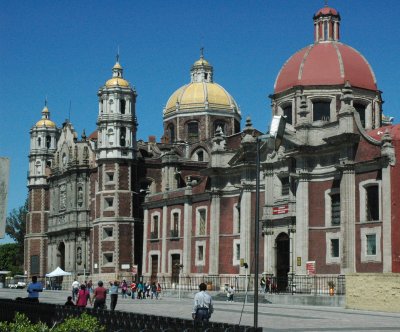
Our first stop was to see the Basilica of the Guadalupe, located in northern Mexico City. To understand the significance of this site it is important to know the background. According to the story, which is not documented in any writings by clergy at that time, in 1531 native Juan Diego Cuauhtlatoatzin had a series of visions of the Virgin Mary, speaking to him in his native Aztec tongue. In those visions she told him that a church should be built at a specific spot in her honor. Initially his vision was rejected by the clergy when he told them about it. When the Virgin Mary began to work miracles, however, including having her vision miraculously appear on the front of Diego’s cloak, they came to accept the visions and proceeded to build that church as requested. The result was the Basilica, where Diego’s cloak is still housed and is on display for all to see. Juan Diego himself was canonized as a saint in 2002, the Catholic Church’s first indigenous saint from the New World.

The significance of these events for the Catholic Church in Latin America is hard to measure.
» Read more

3 comments

Crowded Mexico City and colonization of space

This week Diane and I are in Mexico with friends doing some sightseeing. As is my habit, I can’t just enjoy the sights I have to ask a lot of questions while trying to get an impression of the place, its culture, its environment, its atmosphere, and its politics. Not surprisingly, the answers to some of those questions pointed me upward beyond the surface of the Earth. To understand why, read on.

Today we toured the inner parts of Mexico City, both on foot and by bus and subway (or the Metro as they call it here). I have spent considerable time in many of the world’s major cities, growing up in New York and visiting at length Moscow, Kiev, Prague, London, Chicago, Los Angeles and others. Mexico City has many of the same features you’d expect for this kind of big city, lots of people, lots of traffic, lots of buildings packed tight together, and lots of wealth and poverty sitting side-by-side.

Mexico City traffic

Mexico City however to me seemed to be most crowded and the most packed of any city I have ever visited or lived in. Its size and population probably rivals that of the entire New York metropolitan area, but somehow the traffic and crowds and architecture seemed more piled on top of each other with far less breathing room.

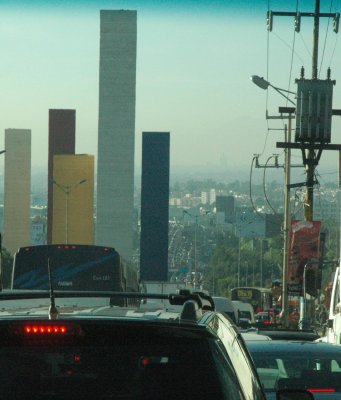
First was the traffic. Everywhere we went it was wall to wall vehicles. The major highways were never quiet, even at night. Nor could I see much difference between midday and rush hours. The picture on the right shows us heading from in from an outer neighborhood where we were staying to take the subway into the center of the city. Not only was it bumper-to-bumper, but if you look out in the distance the road is bumper-to-bumper as far as the eye can see. My host Alfonso added at one point that in order to avoid this traffic many people routinely leave for work before 5 am and come home after 8 pm. Schools have multiple shifts, including ones at night.

A side note: The tall rectangular structures in the foreground are not buildings. This is a work of art, five several hundred foot tall cinderblock structures supposedly forming a hand pointing up, with the thicker yellow tower in the front representing the thumb.
» Read more

3 comments

Pluto’s meandering canyons

canyons of Pluto

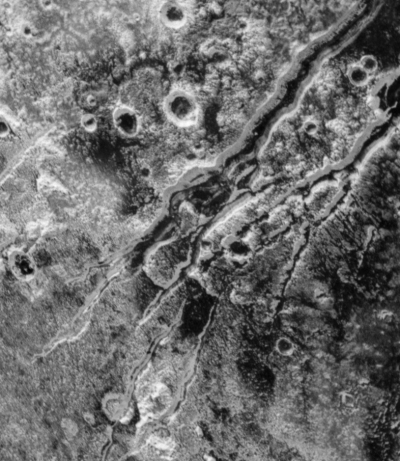
Cool image time! In scrolling through the new raw images downloaded from New Horizons today I came across an image, one of several, that showed what clearly appeared to be meandering canyons carved by flowing liquid.

To show it here, I have cropped it and reduced its size somewhat, highlighting the most interesting features. As you can see, the largest canyon not only appears to have a dark floor, it cuts right through an older crater. Smaller canyons do the same thing. In addition, many of the craters seem to be ponded with the same dark material that floors the canyons, while some of the smaller canyons show tributaries that come together, just like rivers. Are these flows of liquid nitrogen?

I eagerly await the conclusions of the scientists, who are probably only slightly less baffled by these features as I am.

Be sure and check out the full image, as well as the other raw images. The data continue to come in from New Horizons, but the science team is no longer under the same kind of public pressure to make announcements or hold press conferences. There are gems hidden there that are worth looking at, even if they are not as yet accompanied by any scientific analysis.

0 comments

The coming dark ages

I decided today, after one of my readers, John Harman, sent me a link to a very blunt but accurate piece describing the sad state of modern American culture, that it was necessary to explain why I had posted nothing here on Behind the Black on Thursday, even though I was home all day doing what I usually do, scanning the web for interesting stuff.

To begin, you might want to read the essay that John sent me, entitled Wimp Nation: Poised to Fall. It sums up the cultural situation quite nicely.

The United States has become a nation of weak, pampered, easily frightened, helpless milquetoasts who have never caught a fish, fired a gun, chopped a log, hitchhiked across the country, or been in a schoolyard fight. If their cat dies, they call a grief therapist. Everything frightens Americans.

Read it all.

You then might want to read this story about Hillary Clinton’s testimony and questioning on Thursday in front of the House Benghazi committee. Here too the author captures the sick intellectually dishonest nature of America’s political culture.

What we discovered is this: The White House and Clinton apparently knew that the Benghazi attack was the premeditated work of Islamic terrorists before the bodies were cold. She and the administration nevertheless proceeded to propagate a falsehood that advanced the presidentโ€™s preferred political narrative just six weeks before a tightly-contested national election.

As I noted to John, Hillary Clinton’s testimony wasn’t news, it was a joke. What did we learn? She is a liar? That’s news? What was worse, as the author of the article noted, were the reporters willing to make believe this wasn’t so.

Then there are these two stories:
» Read more

47 comments

Solar ramp down jumps slightly

My original post about NOAA’s October update to its monthly tracking of the Sun’s sunspot cycle contained an incorrect graph. For reasons I do not understand, the first graph they posted did not include the data for September, thus creating for me the illusion that little had changed in September. I am now posting the correct graph here, below the fold, with annotations to give it context.

In September numbers showed a slight jump in sunspot activity, though once again nothing so significant as to change the overall trends. Moreover, the correction doesn’t change what I wrote previously in any way: the rate of decline seems to have transitioned down from the 2009 prediction (red curve) to the 2007 weak prediction (lower green curve). This doesn’t real mean much, as the sunspot number can still vary up and down considerable before we reach solar minimum in two or three years.

» Read more

0 comments

Back from a weekend underground

Bob Zimmerman underground

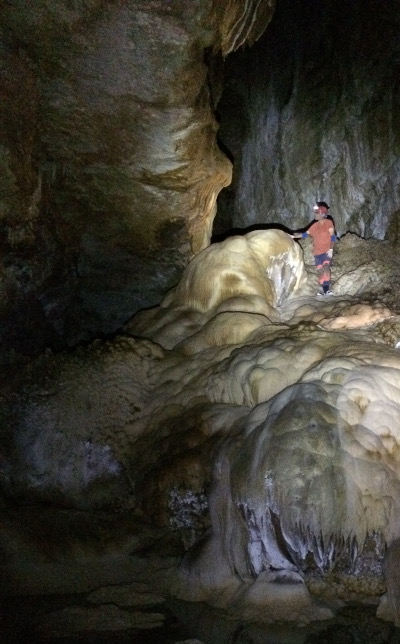
The picture on the right will explain why I have been silent posting since Friday. I have just returned with five friends from three days of caving in New Mexico, doing some wild caving plus my first visit to Carlsbad Caverns since 1992, guided by a local caver who has been helping me with my cave survey project in Arizona.

New Mexico probably has the largest concentration of truly large and spectacularly decorated caves in the entire world. I’ve caved there previously, but this was my first trip driving from Arizona. We went to two wild caves, one of which I had never visited before and a second that I had seen during my 1992 trip. The picture shows me in the latter, standing above a large clear pool near the back of the cave with some giant flowstone speleothems all around me.

The new cave contained a room dubbed Speleogasm, because every formation there, of which there are too many to count, is completely festooned with helectites and sodastraws in a mad protrusion that no geologist can as yet explain. Nor is there any way to describe it adequately or photograph it successfully. To witness it you need to go, requiring the specialized caving skills that include the techniques and equipment required to rappel and climb a 40 foot rope.

As always, the advantages of learning how to do this successfully is the reward of seeing things that few ever see. It is why engineers and scientists strive so hard to get planetary probes to distant planets. And why humans want to travel to the planets. For me, getting inside a remote and beautifully decorated cave will just have to do.

1 comment

How the Republican Party might break-up

Devin Nunes (R-California), a establishment Republican supporting Kevin McCarthy (R-California) for House Speaker, said today that any Republicans who don’t vote for McCarthy should be kicked out of the party.

Nunes is talking about the final House-wide vote for Speaker. First the Republicans vote in private among themselves, picking their nominee. McCarthy is expected to easily win that vote. Then the entire House votes. Some conservatives are threatening to not vote for McCarthy in that House-wide vote in order to extract greater influence over the entire party. Nunes wants them ejected from the party if they do that.

I have also read another story, the link to which I can’t find now, where establishment Republicans want to codify what Nunes is saying, so that any Republican who voted against McCarthy in the final vote would be kicked out of the party. If this happens, then we might very well see the Republican Party split, something that I increasingly see as a possibility. Right now the party is trying to be too big a tent, including conservatives and many moderate Democrats who find the modern Democratic Party unacceptable. (This is one reason why the Republican presidential field is so large.)

Should the party split, we might also eventually see the withering away of the Democratic Party, which today is very corrupt and far too leftwing for most Americans. If the Republicans split into conservative and moderate wings, many of those disenchanted Democrats would move to the moderate Republican faction. The result would be to cut off the corrupt modern Democratic Party from the reins of power.

I am of course being hopeful and naively optimistic. A more likely scenario would be for the Republican Party to split in such a way that the unified Democrats, still corrupt, would take over.

2 comments

Guess where?

Pluto lake

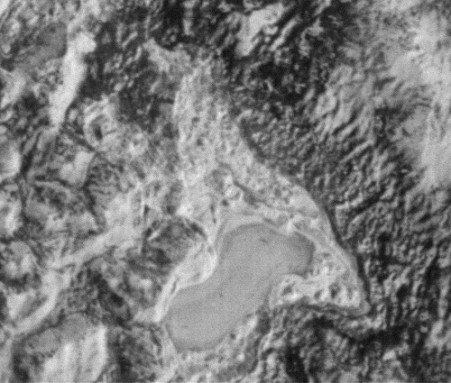
I found the image on the right while trolling about on the various raw image sites for NASA’s planetary missions. No press release yet, and maybe there never will be one. I do know the scientists involved in this particular mission are right now drooling over the details available in the full resolution image, which I have cropped and reduced to fit on the right. Take a look and you will drool as well.

Want to know where this is? I bet you have already guessed, but if you need help, click on the “read more” link below, where I have also added some comments.
» Read more

0 comments

Decline to solar minimum

Last week NOAA posted its monthly update of the solar cycle, showing the Sun’s sunspot activity in August. As I have done every month since 2010, I am posting it here, below the fold, with annotations to give it context.

The sunspot count continued its decline, though dropping only a small amount. Regardless, the decline continues at a rate far faster than predicted or is usual during the ramp down from solar maximum. If this rate of decline should continue, we will reach solar minimum sometime late in 2017, two years earlier than predicted (as indicated by the red curve).

» Read more

3 comments
1 85 86 87 88 89 139