Falcon 9 explodes two minutes into launch

Today’s Falcon 9 rocket launch of a Dragon freighter to ISS ended in failure slightly past 2 minutes after lift-off when the upper stage exploded.

My first thought about this failure is the supply problems it causes at ISS. The Progress failure in April strained the supply lines, making this Dragon flight somewhat critical.

In a presentation to a committee of the NASA Advisory Council here April 9, NASA officials said that food supplies on the ISS would reach a threshold called “reserve level” on July 24, and go to zero by Sept. 5. That assumed that the station received no more supplies beyond a SpaceX Dragon cargo mission launched to the station in April.

The other major limiting consumable is a solid waste container known by the Russian acronym KTO. Without additional cargo missions beyond the Dragon flight, KTO supplies would reach the reserve level July 20 and be exhausted on Sept. 2. Other consumables, including water, would not reach reserve levels until later in the year or early 2016.

In other words, some of the station’s toilets are going to begin to overflow without more supplies. It is possible however that this problem will be alleviated by the planned July 3 launch of the next Progress, especially since NASA officials claimed just prior to the launch failure today that ISS had enough supplies to last through October.

As for the launch failure, I expect that SpaceX will quickly pinpoint the problem and schedule another launch. I have embedded video of the launch below the fold. Prior to the explosion of the first stage all looks completely normal. In fact, immediately before the failure the announcer notes this fact, making what happens next especially shocking.

Update: I have corrected the first paragraph, correcting it from “first stage” to “upper stage.”
» Read more

14 comments

Some stories of hate

This morning civilized people the world over were greeted with several stories of hate and violence, where the perpetrators attempted to kill large numbers of people, merely because of their race or religion.

The first — and the one that our bankrupt mainstream media will spend all of its time reporting — occurred in Charleston, where a hate-filled racist killed nine black church-goers during a prayer session.

This was an evil act, committed by an evil and sick man. No sane or civilized person on the left or right condones it.

Two other stories, both reported in the Israeli news outlet The Jewish Press, described two attacks in the Middle East, one on a Jewish religious site and the other on a Christian religious site.

Both of these Middle Eastern attacks are as evil as the massacre in Charleston. Both expressed the same mass hatred of a group of people, this time based on religion rather than race. And as in Charleston, no sane or civilized person on the left or right should condone them.

Sadly, I expect America’s modern leftwing intellectual class, represented by our mainstream media, to focus entirely on the first, not only condemning the murderous attack in Charleston but to use that act as an excuse to attack all conservatives, essentially repeating the crime by expressing a mass hatred of an entire group of people, this time because of their political beliefs.

The Middle East violence will meanwhile be ignored. In fact, if you dig hard enough, you will likely be able to find examples in the left wing press where these acts are condoned.

In a sense, the reactions of people to these violent evil events provide us a litmus test for hate. They will reveal who is civilized and who is not. Those who are civilized will condemn them all, and will not spend any time trying to assign the act to their political opponents. Those who are not will try to make political points and will try to assign blame in all the wrong places.

Watch and listen. If you pay close attention over the next few days, and keep a clear mind, you will be able to learn a lot.

4 comments

Finding caves on Mars

A new study of pits on Mars has isolated one particular type of pit that has all the features of an Earth-like cave entrance, with a large number located in the regions around the giant volcanoes where evidence of past glacier activity has been found. From the abstract:

These Atypical Pit Craters (APCs) generally have sharp and distinct rims, vertical or overhanging walls that extend down to their floors, surface diameters of ~50–350 m, and high depth to diameter (d/D) ratios that are usually greater than 0.3 (which is an upper range value for impacts and bowl-shaped pit craters) and can exceed values of 1.8. Observations by the Mars Odyssey Thermal Emission Imaging System (THEMIS) show that APC floor temperatures are warmer at night and fluctuate with much lower diurnal amplitudes than nearby surfaces or adjacent bowl-shaped pit craters.

In other words, these pits are deeper with steeper and overhanging walls that suggest underlying passages. They also maintain warmer temperatures at night with their day/night temperatures changing far less than the surface, similar to caves on Earth where the cave temperature remains the same year-round.

The study’s most important finding, from my perspective, was the location of these pit craters.
» Read more

3 comments

Ramp down to solar minimum continues

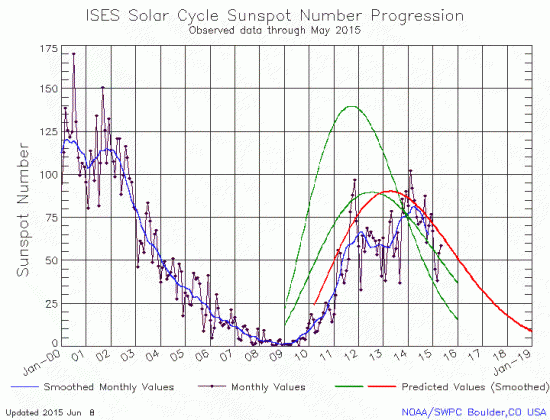
On Sunday NOAA posted its monthly update of the solar cycle, showing the Sun’s sunspot activity in May. As I have done since 2010, I am posting it here, with annotations to give it context.

May 2015 Solar Cycle graph

The graph above has been modified to show the predictions of the solar science community. The green curves show the community’s two original predictions from April 2007, with half the scientists predicting a very strong maximum and half predicting a weak one. The red curve is their revised May 2009 prediction.

Sunspot activity once again increased in May, though it continues to remain below the 2009 prediction of activity. Though it is still early in the ramp down, a look at the present pattern suggests that (as I also noted last month) sunspot activity is declining much faster than normal. In the past, the ramp down after solar maximum was long and drawn out, while ramp up was much faster. This ramp down seems much more precipitous than past solar cycles.

I should add that in early April Sunspot Index and Long-term Solar Observations (SILSO) had declared that the peak of the solar maximum had occurred in April 2014, and that they could now sum up the overall weakness of this maximum.

Cycle 24 proves to be 30% weaker than the previous solar cycle, which reached 119.7 in July 2000, and thus belongs to the category of moderate cycles, like cycles 12 to 15, which were the norm in the late 19th and early 20th century. Compared to strong cycles, such cycles typically feature a broader maximum, with a 3-year plateau on top of which two or more surges of activity can produce sharp peaks of similar height.

I had missed this announcement when it was first posted. It is worth noting however, especially since their discussion in April is interesting to read in the context of what has happened since.

1 comment

Same-sex science paper retracted

Politics corrupts science, again: The journal Science has retracted a paper that had claimed opinions on homosexual marriage could be changed quickly during a short conversation.

As noted in the journal’s retraction statement:

The reasons for retracting the paper are as follows: (i) Survey incentives were misrepresented. To encourage participation in the survey, respondents were claimed to have been given cash payments to enroll, to refer family and friends, and to complete multiple surveys. In correspondence received from Michael J. LaCour’s attorney, he confirmed that no such payments were made. (ii) The statement on sponsorship was false. In the Report, LaCour acknowledged funding from the Williams Institute, the Ford Foundation, and the Evelyn and Walter Haas Jr. Fund. Per correspondence from LaCour’s attorney, this statement was not true.

In addition to these known problems, independent researchers have noted certain statistical irregularities in the responses. LaCour has not produced the original survey data from which someone else could independently confirm the validity of the reported findings. [emphasis mine]

LaCour was the paper’s lead author. That he cannot provide the original data immediately discredits the work. It also discredits his only co-author, Donald Green of Columbia University, who apparently put his name on the paper without ever looking at the original data as well. When the above fraud was exposed, Green quickly called for the paper’s retraction, but I wonder how it was possible he allowed it to be published in the first place. Could it have been that he supports the idea of same-sex marriage, and wanted science to contribute its support as well, regardless of the facts?

Not being able to provide the original data is the same problem that Phil Jones of the Climate Research Unit had. Jones’ work documenting the global temperature for the past century has been the main source used by the entire climate field for decades, and when he couldn’t provide his original data, saying it was lost, his work should have received the same treatment as LaCour above — immediate retraction. Instead, Science protected him, as did the entire climate community.

Their willingness to cover-up Jones’ bad science is now coming back to bite them, with more examples of sloppy work getting into publication. Jones showed that it was all right to fake his results. LaCour decided to try it as well, and Green saw no reason to challenge the dishonesty. The result? Fake science done for the sake of homosexual politics.

The big difference now, however, is the willingness of Science to quickly retract the piece. It appears we are making some progress in re-establishing the rules of science to research and publication.

A minor side note: The author of the story above is John Bohannon, the same guy who just proved you can write a fake paper and get journalists to report it.

1 comment

Corruption in the Russian space industry

A slew of stories in the Russian press today illustrate again the deeply ingrained problems that country has, both in corruption and in its ability to produce a quality product.

The last story describes the overall scale of the corruption, which is not confined just to the space sector, but can be found in many industries. The aerospace industry just happens to be the most visible outside Russia, and thus the most embarrassing. Yet,
» Read more

1 comment

The liberal bias of pollsters

In a strained attempt to explain the failure of pollsters to predict the election results yesterday in Great Britain, pollsters and pundits seem unable to see the elephant in the room that explains their problems.

And what is that elephant? Take a look at this list of bad polling predictions provided by Nate Silver, the mainstream media’s big polling guru because he correctly predicted both Obama victories:

  • The final polls showed a close result in the Scottish independence referendum, with the “no” side projected to win by just 2 to 3 percentage points. In fact, “no” won by almost 11 percentage points.
  • Although polls correctly implied that Republicans were favored to win the Senate in the 2014 U.S. midterms, they nevertheless significantlyunderestimated the GOP’s performance. Republicans’ margins over Democrats were about 4 points better than the polls in the average Senate race.
  • Pre-election polls badly underestimated Likud’s performance in the Israeli legislative elections earlier this year, projecting the party to about 22 seats in the Knesset when it in fact won 30. (Exit polls on election night weren’t very good either.)

Does anyone notice a trend? I could also reference other elections that pollsters badly predicted, such as the Sandinista defeat in Nicaragua in 1994, the Republican victory in 1994, Bush’s victory over Kerry in 2004 and practically every vote for or against the European Union. And there are others. For a bunch of so-called intellectuals who claim to be experts in predicting human behavior, they seem very oblivious to the obvious.
» Read more

3 comments

Freedom speaks: An interview with Pamela Geller

Muhammad bomb cartoon

Link here. As she bluntly notes right at the start of the interview:

We incited no one. We didn’t call for violence, justify violence, or approve of violence. The people who were inciting were the ones saying that we should be killed for exhibiting Muhammad cartoons. There is no automatic or unavoidable response to being insulted. No one is forced to kill for being insulted. Those who choose to do so are responsible for their actions. No one else is.

When asked about the criticism that pundits and reporters on both the left and the right have been leveling at her for provoking the attacks, she was equally blunt, though she saved her harshest criticism for the quislings on the right.

This is the problem with the conservatives. This is why we can never nominate qualified, brave, true conservative candidates. The conservative movement has trimmed to accommodate the leftist media so much that they’ve trimmed themselves out of principle. They attack me because they’re desperately afraid that the leftist media will smear them by association with me. It is an act of sheer cowardice.

It has been disgusting these last few days watching the so-called intellectuals of our society, including many reporters who should know better, rush over themselves to blame Pamela Geller and the victims in this Islamic terrorist attack, merely because they exercised their first amendment rights.

The Islamic State has not only claimed credit for the attack, it says it plans to do more, targeting people in as many as 15 states, with Geller as one of those named to its kill list.

And we should blame Geller for the violence? How divorced from reality has our society’s intellectual class become?

14 comments

The Sun drifts downward

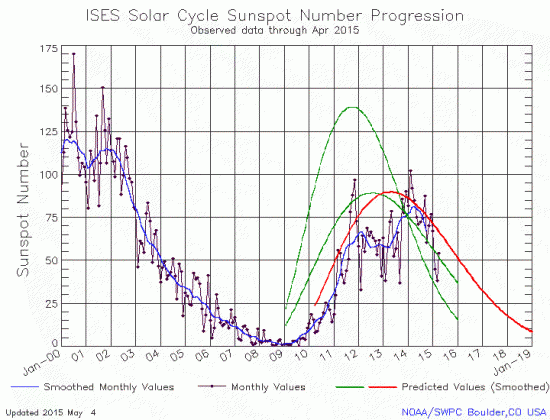
NOAA today posted its monthly update of the solar cycle, showing the Sun’s sunspot activity in April. As always, I am posting it here, with annotations to give it context, as I have done since 2010.

April 2015 Solar Cycle graph

The graph above has been modified to show the predictions of the solar science community. The green curves show the community’s two original predictions from April 2007, with half the scientists predicting a very strong maximum and half predicting a weak one. The red curve is their revised May 2009 prediction.

Though sunspot activity increased in April, it remained well below the predicted numbers from the 2009 prediction, as has sunspot activity generally done for this entire solar cycle.

Note that if you extrapolate the red curve of the 2009 prediction down to its end you find that the solar minimum was predicted to occur sometime after 2020. Based on the rate of activity we have seen for the past year, it is very possible that the minimum will occur sooner, and will likely last longer.

But then again, the sun does what the sun wants to do. We don’t exactly understand the root causes of the solar cycle, and can only watch it unfold time after time as we try to peel back its mysteries.

1 comment

New Shepard makes its first test flight

New Shepard launch

The competition heats up: Blue Origin completed on Wednesday its first test flight of its reusable suborbital spacecraft, New Shepard.

After reaching an altitude of 307,000 feet, or 58 miles, the capsule successfully separated from its first stage, what they call the propulsion module, and safely parachuted back to Earth. The first stage, designed to also be recoverable, was not recovered successfully. According to Jeff Bezos’s explanation, they “lost pressure in our hydraulic system” and that they were trying to land it vertically, like SpaceX’s Falcon 9 first stage.

The cropped image on the right of the full resolution image, gives us a close-up of the capsule and propulsion module. The small fins on the propulsion module suggest the capability for a vertical landing, but it is unclear from the image whether the module has legs, though other images and videos strongly suggest there are legs on this module.

The flight itself, getting above 50 miles, reached space according to most definitions. In fact, Blue Origin with this flight has accomplished what Virgin Galactic has been promising to do for more than a decade, a suborbital test flight of its spacecraft. Blue Origin’s flight was unmanned, but it demonstrated that their design works. They will of course have to re-fly the capsule as well as land that first stage successfully to prove the design’s re-usability, but this flight shows that they are off to a very good start. And their webpage clearly shows that they are almost ready to start selling tickets for suborbital flights.

The most significant success of this launch, however, is the performance of the BE-3 rocket engine. Blue Origin has convinced ULA to hire it to build the engines for its new Vulcan rocket. This success justifies that decision.

I have embedded their videos of the full flight below the fold.
» Read more

3 comments

The building rage is not just against Democrats

People who read my website only intermittently might get the impression that I am partisan and specifically hostile to the Democratic Party. This is false. I am an equal opportunity opponent to anyone that likes oppression and the use of government to impose it.

Some stories today, describing the actions or opinions of some of the so-called conservative or moderate leaders of both the Republican and Democratic parties, illustrate clearly that we still need a major house-cleaning in Congress if we are to get this out-of-control monster under control:
» Read more

2 comments

Why SpaceX’s first stage failure is really a magnificent success

Yesterday SpaceX attempted for the second time to land the first stage of its Falcon 9 rocket on an unmanned barge in the Atlantic. They failed, spectacularly.

I however consider this attempt to be a magnificent success. I also think they could fail at achieving this vertical landing for the next twenty launches and still those failures would each be a magnificent success.

Why? How can an engineering failure like this really be considered an achievement? It is very simple. Even if SpaceX continues to fail in its effort to recover its Falcon 9 first stage and reuse it, the possibility that they might succeed — demonstrated time after time by the company with each launch — has struck terror in the hearts of every other aerospace launch company. Each landing attempt shows SpaceX’s commitment to lowering launch costs while developing cutting edge engineering capabilities. Each attempt shows the world that they are the world’s leading launch company.

The result? Every other launch company in the world, both old and new, are scrambling desperately to lower their own costs as well as improve their own engineering.
» Read more

35 comments
1 87 88 89 90 91 139