
The Sun makes the scientists look good — for now!

NOAA today released its monthly update of the Sun’s sunspot cycle, covering the period of May 2013. As I have done every month for the past three years, I have posted this latest graph, with annotations to give it context, below the fold.

For the third month in a row, the Sun has shown increased sunspot activity. Though the total activity continues to remain well below all predictions, it appears that the Sun is going to produce a double-peaked maximum, as predicted by some solar scientists back in March. Be aware however that this prediction isn’t based on any real understanding of the physical processes that produce sunspots but is instead based on the fact that the Sun has sometimes done this in the past. If you asked these scientists why the Sun sometimes produces a double-peaked maximum they will wave their arms about but will really not be able to tell you.
» Read more

3 comments

The 2000th show

Tonight David Livingston will air the 2000th episode of The Space Show, what has become the world’s leading media outlet for the discussion of space exploration and the aerospace industry.

The Space Show began in June 2001, and in the ensuing dozen years David has interviewed almost every single big mover in the business of space exploration. I myself have been honored to appear on his show more than thirty times, a fact for which I am deeply grateful, since there are people far more important than I in this field.

It is difficult to measure the significance to space of David Livingston’s effort during these past twelve years. When the Space Show began, SpaceShipOne had not yet flow, the X-Price had not yet been won, and the idea of private space and space tourism were considered wild and absurd ideas. Twelve years later, these ideas are now common knowledge and are likely to be main path for the human race into space. By giving a forum to supporters of commercial space, the Space Show under David’s leadership made this paradigm shift possible.

Thank you David! When the solar system is finally settled, the colonists should remember that without his important contribution their journey to get there would have been far more difficult.

2 comments

The Sun shows a bit of life

It is that time again, buckos! Yesterday NOAA released its monthly update of the Sun’s sunspot cycle, covering the period of April 2013. As I have done every month for the past three years, I have posted this latest graph, with annotations to give it context, below the fold.

For the second month in a row the Sun’s sunspot output increased. The result is that April 2013 saw the most sunspot activity in more than a year, since December 2011.

» Read more

2 comments

Private space is winning

Today I attended an space industry conference here in Orange County, California, sponsored by the American Institute of Aeronautics and Astronautics. Unlike the Space Hackers conference which also occurred today and to which I was also invited, this was not a New Space get-together, but a standard aerospace event which included a lot of old time engineers from the big old-time companies like Boeing and Lockheed Martin.

Most of the talks today were engineering related. For example, one described in detail the engineering advantages of building ion engines and solar sails at the molecular level, nanotechnology to the max. Another talk, which I found astonishing and exciting, was an analysis of the orbital mechanics of getting to Mars. This analysis found that using constant acceleration as low as .01 G it would be possible to get to Mars in weeks, not years, and without the necessity of waiting for the perfect launch window. You could launch almost anytime. Though we don’t have engines that as yet can provide this much constant low acceleration, these numbers are not so high as to make it impossible. With some clever refinements, it might be possible to come up with propulsion systems capable of these constant Gs, and to do it in the near future. If so, it will open up the entire solar system to manned exploration very quickly. Not only will we be able to travel to the planets in a reasonable time, the constant Gs would overcome the medical problems caused by prolonged weightlessness.

It wasn’t these interesting engineering presentations that got my juices flowing however. Instead, it was presentation on public policy issues that completely surprised me and made me think the future of the American aerospace industry is really going in the right direction. This significant take-away was further reinforced by the audience’s reaction to my lecture in the evening.
» Read more

17 comments

A rocket reveals a fundamental truth about America

Yesterday, Orbital Sciences successfully completed the first test launch of its Antares rocket, developed, designed, and built in less than five years under a commercial contract with NASA to provide cargo to the International Space Station. The launch went like clockwork, perfectly, with no hitches at all, something that is quite remarkable for a new rocket on its first launch. Kudos to the engineers at Orbital Sciences for a job well done!

Besides demonstrating the skill of Orbital Science’s engineers, however, this successful launch illustrated in stark reality a fundamental fact about the culture of the United States that continues to allow it to stand out from the rest of the world, even as a large percentage of the present generation of Americans are doing their darndest to try to destroy that culture. Moreover, that fundamental cultural fact is basic to human nature, not just the United States, and if we recognize it, it will provide us all the right framework for what to do and not to do in trying to maintain human societies, both here on Earth as well as in the future in space.

In order to understand the true significance of Orbital Sciences’s success yesterday with Antares, however, we must first review the capabilities of the world’s launch industry. I am not going to list all the rockets capable of putting payloads into orbit, only those that are successfully competing for business in the open commercial market.
» Read more

14 comments

The Fantasy of Extreme Weather

This week there were three stories describing new research proving that global warming is going to cause an increase in the number and violence of extreme weather events. Each was published in one of the world’s three most important scientific journals.

Sounds gloomy, doesn’t it? Not only will extreme heatwaves, cold waves, and droughts tear apart the very fabric of society, you will not be able to drink your soda in peace on your next airplane ride!

However, one little detail, buried in one of these stories as a single sentence, literally makes hogwash out of everything else said in these three articles.
» Read more

34 comments

The weak solar maximum continues

Late last night NOAA released its monthly update of the Sun’s sunspot cycle, covering the period of March 2013. As I have done every month for the past three years, I am posting this latest graph, with annotations to give it context, below the fold.

While the Sun’s output of sunspots increased in March, it did not do so with much vigor, with the numbers still far below all predictions while also showing an overall decline since a single strong peak in October 2011.

» Read more

4 comments

Science and sequestration in context

On March 21, the House accepted the continuing resolution proposed by the Senate for the year 2013. This continuing resolution will fund everything in the federal government though September of this year, and includes the cuts imposed on March 1 by sequestration.

As it always does, the journal Science did a specific analysis of the science portion of this budget bill. As usual, they looked only at the trees, not the forest, comparing the budget changes up or down for the 2012 and 2013 years only, noting how those changes will impact each agency’s programs. As usual, Science also took the side for more federal spending, assuming that in each case any cut was sure to cause significant harm to the nation’s ability to do cutting edge science.

I like to take a wider and deeper view. Below is a chart showing how the budgets for these agencies have changed since 2008. They give a much clearer perspective of the consequences of sequestration and the cuts, if any, imposed by Congress on these science agencies.
» Read more

11 comments

We made it.

Getting to the Window in the Santa Catalinas is a challenge, mostly because of the 4000 foot elevation gain. In the past two years Diane and I have made three previous attempts, all of which were aborted because we simply either ran out of time or energy.

Today, we left very early in the morning, and because we are right now in very good shape, made it with little trouble, completing the entire hike in just under eleven hours. Some pictures below the fold.
» Read more

2 comments

More fraud in climate science

Fraudalent data

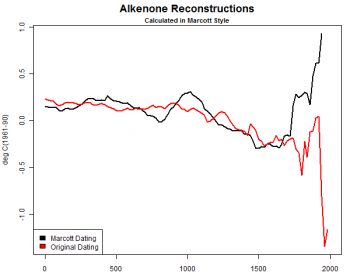
Steve McIntyre, the man who had demonstrated that Michael Mann’s hockey stick graph was a fraud, has now demonstrated that the work of a group of climate scientists attempting to resurrect it is even more fraudulent. It seems that in order to recreate the illusion of warming in the past four hundred years, the scientists, led by geologist Shaun Marcott, changed the dates on a series of ocean cores in order to get the results they wanted.

McIntyre found that Marcott and his colleagues used previously published ocean core data, but have altered the dates represented by the cores, in some cases by as much as 1,000 years.

Most significantly, the scientists made no explanation for changing these dates. It is as if they wanted to hide this decline, y’know?

The chart on the right, by McIntyre, illustrates the fraud. The black line shows the temperature numbers of the ocean cores used by Marcott. The red line shows the temperature numbers, as originally published in the scientific literature, for these ocean cores.

The discrepancy here is so egregious that it screams at you. More important, as John Hinderaker says,
» Read more

28 comments

Visiting a nuclear missile silo

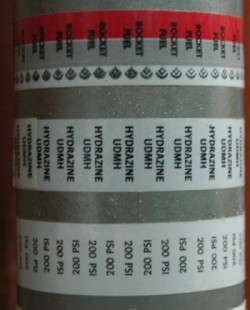
a fuel line for the Titan missile
A fuel line for the Titan missile.

Last week my oldest friend Lloyd and his wife Denise came to visit Diane and I here in Tucson. One of Lloyd’s requests was to visit the Tucson Missile Museum. This museum is built at the site of one of the now disabled missile silos built in the 1960s as a means for launching nuclear weapons against the Soviet Union. Fifty-four silos total had been built and operated, with eighteen of those silos scattered around the Tucson, Arizona area. When the U.S. signed a nuclear arms treaty with the Soviet Union in the 1980s these silos were then shut down and sold. Some became private residences. Others remain buried and abandoned.

One silo, however, was kept as intact as allowed by treaty and made into a museum in order to preserve this artifact of history. Because Diane and I happen to know Chuck Penson, the archivist at the museum, we were able to arrange an augmented tour of the facility. Below are some of my pictures as Chuck took us down into the deepest bowels of the silo.
» Read more

15 comments

The budget battle at NASA

Two stories today highlight not only the budget problems at NASA, but also illustrate the apparent unwillingness of both Congress and Americans to face the terrible budget difficulties of the federal government. In both cases, the focus is instead on trying to fund NASA at levels comparable to 2012, before the Obama administration or sequestration had imposed any budget cuts on the agency.

It is as if we live in a fantasy world, where a $16 trillion dollar debt does not exist, and where money grows on trees and we can spend as much as we want on anything we want.
» Read more

15 comments
1 97 98 99 100 101 139