How not to get to Mars

Yesterday the world’s first space tourist, Dennis Tito, testified before Congress about the plans his organization, Inspiration Mars, has put together to make possible a manned fly-by of Mars by 2018.

The flyby mission would require two launches in quick succession. In the first liftoff, an SLS would loft four payloads to Earth orbit: an SLS upper-stage rocket; a 600-cubic-foot habitat module derived from Orbital Sciences’ Cygnus cargo vessel; a service module that would support the habitat module with power, propulsion and communications systems; and an Earth re-entry pod, which would be based on NASA’s Orion capsule. The second launch โ€” this one likely using a commercial rocket โ€” would deliver the two astronauts to orbit aboard a yet-to-be-selected private spaceship. The crewmembers would then transfer to the habitat module, and the SLS upper stage would propel them on toward Mars.

In making this announcement Tito and his organization challenged Congress and NASA to make it happen. They also admitted that they had initially thought this manned fly-by could be done entirely with private resources, but have looking at it closely realized it needed NASA money and hardware.

What a pipe dream. As much as I support Tito’s effort to accelerate the United States’ space effort, neither Tito’s original ideas as well as this new proposal are realistic. At no time do these dreamers show the slightest understanding of the challenges involved in flying humans in weightlessness for more than a year and as far away as Mars.
» Read more

16 comments

The sun goes boom!

It is always best to admit when you are wrong as soon as you find out. Last month, in reporting NOAA’s monthly update of the solar cycle, I unequivocally stated that

My interpretation of this data tells me that almost certainly the solar maximum has ended. We might see some later fluctuations whereby the sunspot number jumps, but the Sun is clearly beginning its ramp down to solar minimum.

Well, I spoke too soon. Last night NOAA posted the newest update of the solar cycle, and it shows that in October the Sun was more active then it has been in two years. In fact, for only the second time this entire solar cycle the Sun’s sunspot activity actually came close to matching the predictions of scientists. This month’s graph is posted below the fold, with annotations.
» Read more

2 comments

Why governments can’t do it

A government official today unwittingly revealed a fundamental and unpleasant truth about how governments: operate. In an interview today, the head of India’s space agency denied that his country is in a space race with anyone.

Mr. Radhakrishnan, Secretary in the Department of Space and Chairman of Space Commission, said each country โ€” whether itโ€™s India, the US, Russia or China โ€” had their own priorities.

โ€œThere is no race with anybody. If you look at anybody, they have their own direction. So, I donโ€™t find a place for race with somebody. But I would say we are always on race with ourselves to excel in areas that we have chalked out for ourselves,โ€ he told PTI here in an interview.

How typical. By denying the reality of the competition that India is part of Mr. Radhakrishnan illustrates for me and everyone once again the basic reason all government efforts eventually fail.
» Read more

4 comments

Fresh impacts caused by Curiosity during landing

impacts from Curiosity debris

The image on the right is a cropped close-up of a Mars Reconnaissance Orbiter image taken in early September that shows a fresh cluster of impacts, all smaller than six feet across. Nearby but not visible in this image are four larger craters about 12 to 15 feet in diameter. The impact cluster is located just northwest of Gale Crater and was not present in images taken before Curiosity’s arrival on Mars. The cluster is also in line with other impact craters produced by other debris dropped by Curiosity as it descended onto the Martian surface.

Scientists are at the moment unsure what spacecraft debris caused these impacts.

Assigning each of the impacts to specific pieces of hardware is a challenging puzzle, but it is thought that the four large craters were produced by two large tungsten weights that broke in half to make these four craters, or by pieces of the cruise stage, which was designed to break up in the atmosphere for planetary protection purposes, to kill any Earthly microbes.

The cluster imaged here adds to the mystery, and may have been produced by a piece of the cruise stage that traveled farther through the Martian atmosphere and was therefore more thoroughly fragmented by the time it crashed onto the surface.

Identifying the source of the debris is a challenging engineering problem that also has scientific interest. Knowing what caused the impacts and then studying how the surface was changed by them will tell geologists a great deal about the make up of that surface.

3 comments

Ramping down from solar maximum

Yesterday, despite the government shutdown, NOAA posted its monthly update of the solar cycle, and as I do every month, I am posting it here, below the fold, with annotations.

My interpretation of this data tells me that almost certainly the solar maximum has ended. We might see some later fluctuations whereby the sunspot number jumps, but the Sun is clearly beginning its ramp down to solar minimum.
» Read more

4 comments

Freeing the Smoky Mountains

Maddron Bald trailhead during the federal shutdown
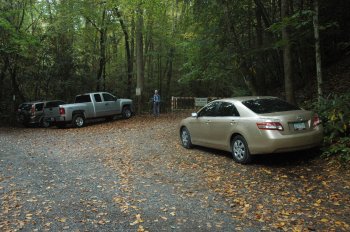
The Maddron Bald trailhead on October 3, 2013, during
the government shutdown.

Today we did our last hike in Great Smoky Mountains National Park. As I described yesterday, we decided to go to a place where we could park on private land and easily hike to a trail in the park. That way, we would reduce the level of power any fascist-minded ranger from the National Park Service might have over us should they confront us for being in our park.

As it turns out, there was no evidence at all of a shutdown at the trailhead we choose. We went to the Maddron Bald trailhead, just off state route 321. The parking area here is small, capable of holding no more than 5 or 6 cars. When we arrived there were three cars there, so we had no problem finding room, as you can see from the image to the left.

There were also no signs indicating the park was closed. Nor were there any barricades or cones. As far as we could tell, it was a normal day in the national park, which to me proved that the restrictions the park service is imposing on New Found Gap Road (as well as elsewhere across the nation) has absolutely nothing to do with their lack of funds. This particular trailhead is not as well known or visited, and is off the beaten track. Moreover, it would be hard to monitor. Thus, the park service chose to make believe it wasn’t there. Smart tourists could come here and enjoy the park, as intended, despite the shutdown.

If the shutdown really required the closure of the park, the park service would have sent a ranger here as well. They did not, proving that their obnoxious efforts are really aimed at causing problems for as many Americans as possible, not securing the park as they dishonestly might tell us.
» Read more

24 comments

Shut down fascism wins in the Smoky Mountains

See my October 3, 2013 update here.

The veterans in DC might be keeping the World War II memorial open by defying the Obama administration, but here in the Smoky Mountains the National Park Service has apparently succeeded in shutting down most access to Great Smoky National Park.

In my post yesterday I described how the park service appeared to be setting up barricades at the various lookouts, parking pull-outs, and trailheads along New Found Gap Road — a public highway through the park which they cannot close — in order to prevent access to the park. Such barricades are inappropriate, unnecessary, and are certainly being done for political reasons. The Obama administration is trying to pressure the Republicans to fold in the budget battle by hurting the American public. By blocking access to these pull-outs the administration is increasing the risks to hikers still in the park and to drivers on the road while damaging the local economy.

Today we drove back up to New Found Gap to see how things were developing and found that my suspicions were correct. While yesterday many of the major trailhead pull-outs were not yet blocked, this evening they all were. As we drove past the New Found Gap parking lot the barricades had been moved into place, preventing our entrance. I also noticed some cars trapped in the lot, as well as some people by the barricades. When I had turned around and returned, I found that a wide enough section of the barricade had been shifted, allowing me to pull into the lot. I immediately drove up to two guys standing by their car to ask them what had happened.
» Read more

29 comments

Shut down fascism in the Smoky Mountains

See my October 2, 2013 update here.

Today, October 1, 2013, my wife Diane and I went hiking in Great Smoky Mountains National Park. We did this despite the news from Washington that the federal government had shut down due to the lack of a funding from Congress and that all the national parks were closed.

The news reports had said that the National Park Service would close all roads into the park except for New Found Gap Road, the one road that crossed over the mountains from Tennessee to North Carolina. They couldn’t close this road because it was a main thoroughfare used by the public for basic transportation. Moreover, my research into the hikes we wished to do told me that several of those hikes originated on trailheads along this road. In traveling the road the day before, we had seen that these trailheads would not only be difficult to close, it would be dangerous and stupid to close them. For one, the road was windy and narrow. If there was a car accident or someone had car problems, any one of these parking areas might be essential for the use of the driver as well as local police and ambulances. For another, there are people still backpacking in the mountains who will at some point need to either exit with their cars or be picked up at these trailheads. Closing the trailheads will strand these hikers in the park, with dangerous consequences.

So, despite the shutdown, off we went to hike the Appalachian Trail, going to a well known lookout called the Jump Off, an easy 6.5 mile hike that leaves from the parking area at New Found Gap, the highest point on New Found Gap Road that is also on the border between Tennessee and North Carolina. It is also probably one of the most popular stopping points along the road, visited by practically every tourist as they drive across.
Smokies from the Appalachian trail

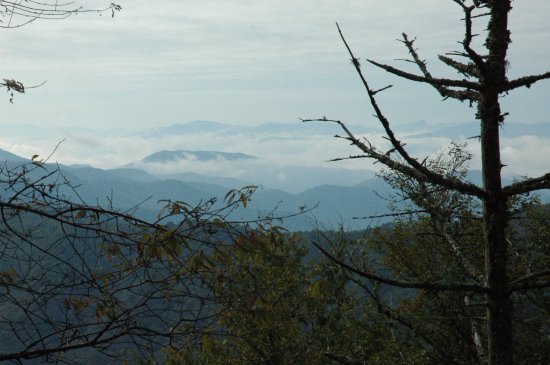
The hike itself was beautiful, if a bit foggy and damp. The picture above shows one of the clearest views we had all day. Nor were we alone on this hike. We probably saw one to two dozen other hikers, heading out to either the Jump Off or Charles Bunion (another well known day hike destination along this section of trail).
» Read more

36 comments

The Coney Island of the Smokies

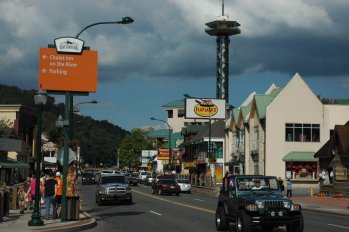
The main drag in Gatlinburg, Tennessee

I must admit I did not expect this. When we made our reservations to stay in a timeshare motel in Gatlinburg, Tennessee, I imagined the town would resemble the small West Virginia towns I am very familiar with from my many years of caving in that state. There would be a relatively quiet main street, with some restaurants, a supermarket, one or two gas stations, and some basic shopping.

What I found instead is a wonderfully energetic example of American capitalism, a carnival amusement area reminiscent of the amusement spots of the past and most epitomized by Brooklyn’s Coney Island.

When I was growing up in Brooklyn in the late 1950s and 1960s, Coney Island was a shadow of its grand past, but it still carried with it much of its old glory. You could stroll along the boardwalk or Surf Avenue and visit hundreds of shops, stores, and amusement rides, most of which were independently owned. In addition, the island also had several larger private amusement parks, such as Steeplechase Park, Astroland, and Luna Park (which unfortunately had closed before I ever saw it), each of which had a collection of their own rides and amusements. With some, like Steeplechase and Luna, you had to pay a separate admission price to get in.

This is exactly what I discovered here in Gatlinburg and the adjacent towns of Pigeon Forge and Sevierville.
» Read more

4 comments

Linking mass extinctions to the Sun’s journey in the Milky Way

The Sun's orbit in the Milky Way

In a paper published today on the Los Alamos astro-ph preprint service, astronomers propose that as many as eleven past extinction events can be linked to the Sun’s passage through the spiral arms of the Milky Way. (You can download the paper here [pdf].)

A correlation was found between the times at which the Sun crosses the spiral arms and six known mass extinction events. Furthermore, we identify five additional historical mass extinction events that might be explained by the motion of the Sun around our Galaxy. These five additional significant drops in marine genera that we find include significant reductions in diversity at 415, 322, 300, 145 and 33 Myr ago. Our simulations indicate that the Sun has spent ~60% of its time passing through our Galaxy’s various spiral arms.

The figure on the right, from their paper, shows the Sun’s orbit in red over the last half billion years. The Sun’s present position is indicated by the yellow spot, and the eleven extinctions are indicated by the circles.

There are obviously a great deal of uncertainties in this conclusion. Most significantly, the shape and history of the Milky Way remains very much in doubt, especially since we reside within it and cannot really get a good look at it. Though in recent years astronomers have assembled a reasonable image of the galaxy’s shape — a barred spiral with two major arms and several minor ones — this picture includes many assumptions that could very easily be wrong.

Nonetheless, the paper’s conclusions are interesting.
» Read more

7 comments

Why we must remember

I wrote these following words three years ago on the anniversary of the World Trade Center attack. I think they are worth repeating again, especially considering the confusing debacle of this administration’s Syria policy these past few weeks, and the continuing violent and oppressive behavior of the Islamic revolutionaries in that country.

My words on September 11, 2010:

The President has asked us to consider today “a national day of service and remembrance”. Though the sentiment seems reasonable, I must respectively disagree.

September 11 should not be turned into a day to celebrate volunteerism or service or American charity. Though these values are profound, important, and an expression of much of what makes our nation great, they are not why we remember September 11.

We remember the evil acts committed on September 11, 2001 in order to remind us that there is evil in the world.

We remember these evil acts so that we will have the strength to fight that evil, with every fiber of our being.

We remember those who died in order to prevent future attacks and further deaths.

We remember so that no one can ever try to make believe these events did not happen.

We remember so that no one can spread the lie that the perpetrators were something other than what they were: Men who had decided to kill in the name of Islam, based on what they believed their religion taught them.

And finally, and most important, we remember the horrible events of September 11, 2001 so that those innocent murdered souls — whose only crime that day was going to work — will not have died in vain.

6 comments
1 95 96 97 98 99 139