“The face of the sun is nearly blank.”

Today NOAA posted its monthly update of the solar cycle, and as I do every month, I am posting it here, with annotations.

Before we take a look at that, however, there is other climate news that is apropos. The Daily Mail in the UK put out an entertaining article on Saturday with the headline “And now it’s global COOLING! Record return of Arctic ice cap as it grows by 60% in a year.”

The article is entertaining because, after illustrating the ice-cap’s recovery this year, it then notes the 2007 prediction by global warming climate scientists that the Arctic Ocean would be “ice-free” by 2013. If this isn’t a good example of the dangers of crying wolf, I don’t know what is.

I should emphasize that the ice-cap recovery this year does not prove that global warming has ceased. A look at this graph from satellite data shows that even though the Arctic icecap has recovered, it is still remains small when compared to the past few decades. The increase this year might only be a blip, or it could be indicating a new trend. We won’t really know for another five years, if then.

The article is also entertaining because it outlines the confusion that is right now going on behind the scenes at the IPCC. The next IPCC report is scheduled to come out next month, but no one agrees with its conclusions because it apparently ignores or minimizes the approximately fifteen year pause in warming that has now been documented since the late-1990s.

In its draft report, the IPCC says it is ‘95 per cent confident’ that global warming has been caused by humans – up from 90 per cent in 2007. This claim is already hotly disputed. US climate expert Professor Judith Curry said last night: ‘In fact, the uncertainty is getting bigger. It’s now clear the models are way too sensitive to carbon dioxide. I cannot see any basis for the IPCC increasing its confidence level.’ [emphasis mine]

It appears that scientists and governments are demanding approximately 1500 changes to the IPCC draft, which suggests its release will be delayed significantly.

Meanwhile, the Sun continues its lackluster and weak solar maximum.
» Read more
2 comments

Space agencies of the world unite!

On Tuesday NASA released what it calls a new “space exploration roadmap,” outlining the agency’s goals for the human exploration of space over the next few decades.

Normally I’d say, who cares? The space agency puts these kinds of PR roadmaps together periodically. None of them really ever mean that much. And in truth, this particular report doesn’t mean that much either. However, what makes this “Global Plan” interesting and worth mentioning is the participants who wrote it. It seems that NASA and the Obama administration didn’t do it alone.
» Read more

6 comments

Pigs in space

Today I have an op-ed in the Wall Street Journal, entitled “No liftoff for these space flights of fancy.” It is essentially a more detailed reworking of my rant on the John Batchelor Show on July 30.

My point is that the federal space program mandated by Congress, the Space Launch System (SLS), is never going to go anywhere, and is nothing but pork that should be cut as fast as possible. (See my essay from November 2011 on how NASA and the federal government can better use this money to get more accomplished in space, for less.)

The comments to the article have generally been positive and in agreement. Those who disagree mostly question the $14 billion cost per launch that I claim SLS will cost. That number comes from John Strickland’s very detailed analysis of what it will cost to build, complete, and operate SLS. However, it doesn’t require much thoughtful analysis to realize that this number is not unreasonable.
» Read more

7 comments

Modern Journalism: Retyping press releases

This post is really about the monthly NOAA update of the solar cycle, but before I do that, I must note some really bad science journalism in connection with that solar minimum.

This week NASA released a poorly written press release describing how the Sun’s magnetic field flips whenever it goes through solar maximum, the period when sunspot activity reaches its maximum. The article gave the incorrect impression that this “flip” will be some grand singular and spectacular event and when it happens the consequences to Earth could be significant. Then it buried this most important little detail to the article’s final paragraphs:
» Read more

4 comments

My rant Thursday against politicians on the John Batchelor Show

On my Thursday appearance last week on the John Batchelor Show John and I devoted the entire segment to talking about the sad state of NASA and how the partisan bickering in Congress is not only failing to deal with those problems, that bickering is intentionally disinterested in actually fixing them. As I say,

What both those parties in Congress and in the administration are really doing is faking a goal for the purpose of justifying pork to their districts, because none of the proposals they’re making — both the asteroids or the moon — are going to happen.

I intend to elaborate in writing on this subject in the next day or so. In the meantime, here is the audio of that appearance [mp3] for you all to download and enjoy.

Note that I specifically talked about the following stories during this appearance:

4 comments

The Sun has a maximum and no one notices

On July 8 NOAA released its monthly update of the Sun’s sunspot cycle, covering the period of June 2013. As I do every month, this graph is posted below, with annotations to give it context.

After a brief period of renewed but weak activity during the last three months, the Sun’s sunspot production has once again plunged, dropping back to the levels generally seen for most of 2012.

As predicted by some solar scientists, the Sun seems to have produced a double-peaked maximum, though the second peak appears at this time to have been remarkably wimpy and brief. It is still possible, however, that this second peak is not over and that we might see another burst of renewed activity in the next month or so, based on the Sun’s past behavior during the ending stages of the previous solar maximum in 2001 and 2002. Nonetheless, from all appearances it looks like the Sun has shot its load and is in the process of winding down from a solar maximum peak that occurred back late 2011.

What is especially fascinating about this is that when that peak occurred in 2011, no one noticed!
» Read more

8 comments

Doing the Grand Canyon Right

The Tonto Plateau

The one thing about the Grand Canyon that attracts hikers is its intimidating nature. People feel challenged by its large size and depth, and want to prove to themselves that they can do it.

The irony of this to me is that it is that intimidating nature that generally causes most people the most problems. People worry about the climb out. They worry about the heat. They worry about the lack of water. And they worry about vastness around them.

All of these things — the climb, the heat, the lack of water, and the vastness — must be dealt with. Each has caused the death of many visitors. Each could kill you if you are not prepared. In fact, one or all of these factors are probably the primary causes behind all of the approximately 300 rescues that occur each year at the Grand Canyon.

Yet, none of these factors is actually the biggest obstacle for most people trying to climb in and out of the Canyon. Instead, it is the worry about these things that causes people the most difficulties.
» Read more

6 comments

At the rim 2

We have returned from inside the Grand Canyon. We hiked out on Tuesday, doing the climb up in what is for us record time, arriving at the rim at 12:30 pm after 7 hours of hiking. We were down at Phantom Ranch for two full days and three nights, doing some really spectacular day hikes each day. I will post some further details, with pictures, once I get home.

We are still touring about here in northern Arizona and will be until Sunday. Right now I am sitting in the patio of the motel at Grand Canyon Caverns, about two hours west of the national park. This morning we drove down to the Colorado on the Hualapai Reservation, using the only road on the south rim that reaches the river. This weekend I will be participating in a long term cave dig project here at this somewhat famous commercial cave. The dig has been going on for years in cooperation with the cave’s owners. This will be the first time that I will contribute to the project.

3 comments

At the rim

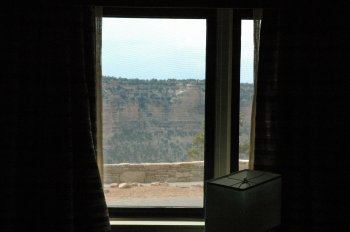
The Grand Canyon from our motel room

After a 5.5 hour drive we arrived at the south rim of the Grand Canyon and checked into our hotel. You can see the view from the window on the right. Not very spectacular, but then, you don’t spend much time in a hotel room on trips like this.

Tomorrow we take the shuttle bus to the North Rim, where will spend another night in the lodge there. On Saturday, we hike down on North Bright Angel trail, and will stay in a cabin at Phantom Ranch for the next three nights, doing day hikes from the bottom of the canyon on Sunday and Monday. We will hike then up on Tuesday, coming up Bright Angel trail to the south rim, completing our first rim to rim hike. Once we check out of our hotel tomorrow, we will be out of contact with the internet until we return to the south rim. I hope the world doesn’t fall apart in the interim.

This will be Diane’s third trip to the bottom, and my fifth. I can’t express how happy I am to be back. This is truly one of the grandest spots on Earth.

4 comments

Third Anniversary

This past weekend Behind the Black celebrated its third anniversary. I did it by posting very little, as the news in space, to my mind, has been very quiet, while the news in politics and culture has been very depressing, something I am growing tired of reading. It seems to me that freedom is dying, both in the United States and worldwide, being chipped away bit by bit until no one alive knows what the word means anymore.

Moreover, on July 4 Diane and I will head north to the Grand Canyon (our third trip together to the bottom) for ten days vacation, so expect posting for that time period to be very light or nonexistent.

I do intend to post until then and once I get back. If you have liked what I have written and posted these past three years, then please consider the idea of contributing to the website. The tip jar is in the right column, near the bottom.

And if you really want to find out the moment I believe American society began to die, you might want to consider reading the new ebook edition of my first book, Genesis: the Story of Apollo 8. The book tells the story of one of our country’s grandest achievements, and how that triumph ironically ended up teaching an entire generation all the wrong lessons.

5 comments

Close-minded politicians everywhere!

Despite the repeated news in recent weeks that the evidence for global warming is slim, or at least confused, today we have two elected officials and one appointed official screaming that the sky will fall if we don’t do something, including spending billions of dollars of other people’s money.

First we have our friend Al Gore, who was in Washington, DC to speak at an environmental event put on by Senator Sheldon Whitehouse (D-Rhode Island). Whitehouse you might remember was the senator who, even before the injured and dead had been counted from the terrible Moore, Oklahoma tornado, started blaming Republicans for the tornado because they weren’t doing more to stop global warming.
» Read more

9 comments

The red tape of the space bureaucracy

“An article in the Economist today has some chilling conclusions about the difficulties faced by the new commercial space companies.

Although the cost of developing new space vehicles, products and services is high, just as much of a burden can be imposed by such intangible expenses as regulatory compliance, legal fees and insurance premiums.

The article points out the heavy cost to these new space companies caused by insurance requirements and government regulation, including the ITAR regulations that restrict technology transfers to foreign countries. However, this paragraph stood out to me as most significant:

Then there is the question of vehicle certification. The first private astronauts and space tourists may soon take to the skies in new launch vehicles, and the FAA has initially agreed to license commercial spacecraft without certifying, as it does for aircraft, that the vehicles are safe to carry humans. The idea is that specific safety criteria will become apparent only once the rockets are flying and (though it is rarely admitted) an accident eventually happens. This learning period will keep costs down for makers of the new spacecraft, even if significant compliance expenses are likely when it is over. The exemption was meant to have expired last year and was extended to the end of 2015. Commercial space companies are understandably keen for it to be extended again. “In the dawn of aviation, planes had 20 to 30 years before significant legislation applied,” says George Whitesides, the boss of Virgin Galactic.

Back in 2004 I noted in a UPI column the problems caused by these regulations, even as they were being written. (I had also done something at the time that few reporters ever do: I actually read the law that Congress was passing.) Then I said,
» Read more

5 comments
1 96 97 98 99 100 139