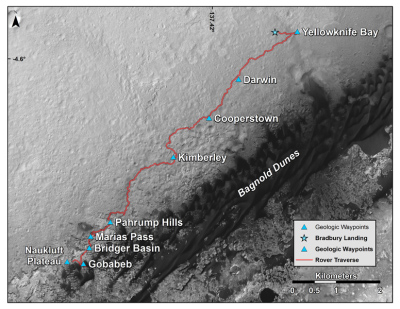
Rover update: Curiosity’s future journey

Mount Sharp, with Curiosity's future travels
Click for full image.

[For the overall context of Curiosity’s travels, see my March 2016 post, Pinpointing Curiosity’s location in Gale Crater. For the updates in 2018 go here. For a full list of updates before February 8, 2018, go here.]

Today the science team of Curiosity issued a press release outlining their travel plans for the rover over the next year. In conjunction, they also released a mosaic of 116 images taken by the rover showing that route, a reduced in resolution version shown above.

The rover’s next stop is a part of the mountain called the “sulfate-bearing unit.” Sulfates, like gypsum and Epsom salts, usually form around water as it evaporates, and they are yet another clue to how the climate and prospects for life changed nearly 3 billion years ago.

But between the rover and those sulfates lies a vast patch of sand that Curiosity must drive around to avoid getting stuck. Hence the mile-long road trip: Rover planners, who are commanding Curiosity from home rather than their offices at NASA’s Jet Propulsion Laboratory in Southern California, expect to reach the area in early fall, although the science team could decide to stop along the way to drill a sample or study any surprises they come across.

Overview map sol 2804 of Curiosity's route

This journey actually began in late May, at about the time of my last rover update. The overview map to the right shows in red their approximate planned route to avoid that large dune field to the south. The meandering yellow line indicates Curiosity’s actual route. The straight yellow lines indicates I think the area covered by the mosaic above. As you can see, since the end of May they have quickly returned to their planned route. Note also that the dune field extends about twice the distance beyond the eastern edge of this overview map.

The next big goal when they reach that sulfate-bearing unit will be to not only study it but to also study a recurring slope lineae on the slopes of that unit, a streak that darkens and lightens seasonally that might be caused by seeping brine from below. Because the sulfate unit and the linneae are both major geological goals, they are going to be moving fast to get there. I am sure they will periodically stop to do geology, but I think the travel will be, as it has been for the past month, quick-paced.

Once the rover gets to the sulfate unit, Curiosity will at last have actually reached the base of Mount Sharp. Up until now it has been traveling first in the surrounding plains, then in the mountain’s foothills. The terrain will get much rougher and be far more spectacular, as Curiosity will be entering canyons as it begins to climb the mountain itself.

1 comment

Air Force looking to buy flying cars

The Air Force is looking to buy commercially-made flying cars designed using drone technology.

The advantages of vertical landing and take-off are many. For example, they would not need runways that are targets and must be defended. They can take off and land practically anywhere. In the past however the cost and practicality of making an airplane do this has been a major obstacle.

Normally I would see an article like this in the military press as simply a lobbying effort by a government agency to garner a bigger budget for itself. That still might be the case, but this part of the Air Force’s proposal stood out:

Because a key aim of Agility Prime is to work with commercial industry, there are currently no plans to modify the design of the orbs for military use or arm them for strike missions. “We will not put any military unique requirements on them because the last thing you want to hear as a commercial backer of one of these companies is that the military is coming in and changing a vehicle away from a type that would have domestic use,” Roper said. “We want to create a supply chain in the U.S. that is dual commercial and military.”

In other words, the Air Force wants to buy these unmodified from commercial civilian companies, both to save money and speed utilization. They have issued the general specs for the two types of vehicles they want (one larger than the other) and are accepting bids from private companies for delivery.

If true and if the Air Force sticks to this policy (which is essentially the approach I advocated for NASA in my 2017 policy paper Capitalism in Space), they hope to have these vehicles flying operationally by 2023, and at a cost of only “a few hundred thousand dollars to a few million dollars per unit.”

10 comments

Midnight repost: NASA, the federal budget, and common sense

The tenth anniversary retrospective of Behind the Black continues: Tonight’s midnight repost is actually two. First we have what might have been my most telling report for John Batchelor, aired in late July 2013. In that appearance I was quite blunt about my contempt for the politicians in Washington and the fake space program they had been foisting on the American public for decades. As I said,

What both those parties in Congress and in the administration are really doing is faking a goal for the purpose of justifying pork to their districts, because none of the proposals they’re making — both the asteroids or the moon — are going to happen.

Here is the audio of that appearance [mp3] for you all to download and enjoy. For reference, these are specific stories from then that I am discussing:

That rant makes for a perfect lead in to an essay I wrote in late 2011, outlining what I would do if I was in a position to reframe NASA’s budget. Everything I said then still applies. And that it does is a great tragedy, in that it means that nothing has changed, and our federal government continues to gather power while bankrupting the country.

————————–
NASA, the federal budget, and common sense

Let’s be blunt: the federal government is broke. With deficits running in the billions per day, there simply is no spare cash for any program, no matter how important or necessary. Nothing is sacrosanct. Even a proposal to cure cancer should be carefully reviewed before it gets federal funding.

Everything has got to be on the table.
» Read more

1 comment

Have you fallen in love with your fear of COVID-19?

The Star Spangled Banner
Fort McHenry bombarded by the British in 1812

O say does that star-spangled banner yet wave
O’er the land of the free and the home of the brave?

These two lines are probably the most familiar words to most Americans of their national anthem, The Star-Spangled Banner by Francis Scott Key. When people sing the anthem before sports events, it is these lines alone which everyone clearly knows and sings out robustly. For the rest of the song everyone kind of goes along, mouthing the words based on what they think the entire crowd is singing.

We tend however not to think about what the words mean. That last line especially describes precisely the American nation as Key and his fellow Americans in 1812 saw it, as a land of free and brave people. They understood that they were free, but they also understood that it is impossible to be a free person if you are afraid. You must be brave to be free, because freedom carries risk and danger. The rewards are gigantic, but with those rewards comes the real risk of failure and even death. To be free you need accept that risk and face it boldly.

The results of that courage are evident by what the citizens of the United States of America achieved in the two hundred years since Key wrote these words. We fought a Civil War that killed more than 600,000 people to set everyone in our nation free. We fought two wars in Europe, with the second setting that entire continent free as well because we came not as conquerors but as liberators.

And we built a nation so prosperous, for all its people, that multitudes flock desperately to come here and be part of this great experiment in human freedom.

That noble experiment is now threatened. Within our nation are many people who hate it, and are striving hard to destroy it. Along the way they eagerly long for the day that freedom itself is squelched, a day when they by edict can decide what every citizen is permitted to do, and when they by edict will be able to arrest and destroy anyone who defies them.

It is very simple. They want power. Freedom for everyone denies them that.
» Read more

18 comments

Sunspot update: More evidence of an upcoming weak maximum

On July 4th NOAA updated its monthly graph tracking the monthly activity of sunspots on the Sun’s visible hemisphere. Below is that updated graph, annotated by me to show the past and new solar cycle predictions.

June 2020 sunspot activity

The graph above has been modified to show the predictions of the solar science community for both the previous and upcoming solar maximums. The green curves show the community’s two original predictions from April 2007 for the previous maximum, with half the scientists predicting a very strong maximum and half predicting a weak one. The blue curve is their revised May 2009 prediction. The red curve is the new prediction, first posted by NOAA in April 2020.

June saw an uptick of activity since my last update, though that activity remains quite low. We saw two sunspots during the month, both with polarities that link them to the next maximum and thus providing evidence that we will have a maximum in about five or six years. The first of those sunspots was also one of the strongest new cycle sunspots yet seen, and lasted for almost two weeks before it rotated off the visible face of the sun.

The ratio of next cycle sunspots vs sunspots from the past maximum has also been shifting. More and more, the new sunspots belong to the next cycle and less to the last. The ramp up to the next maximum is definitely beginning, though to call it a “ramp up” at this point is a big exaggeration. Sunspot activity remains low, though the last few months have seen some activity, unlike the seven months of nothing seen during the second half of last year.

The upcoming prediction for the next maximum calls for it to be very weak. Interestingly, the activity in June surpassed that prediction. This does not mean that the prediction will be wrong, only that June was more active when compared to the smooth prediction curve. As the cycle unfolds the monthly numbers will fluctuate up and down, as they did last cycle. The question will be whether their overall numbers will match closely with the prediction. In the past cycle actual sunspot activity was consistently below all predictions. It is too soon to say how well the new prediction is doing.

7 comments

Update on Starship test program: First tests for prototype #5

Link here. Lots of good information, including details about the growing assembly line of new Raptor engines.

Meanwhile, labeled “27”, the engine – logically assumed to be Raptor SN27 – SpaceX has just installed on Starship SN5 is also of interest. On top of Musk’s recent confirmation that SpaceX is already building Raptor SN30 (probably SN31 or SN32, now), SN27’s assignment to Starship SN5 confirms that the company has managed to complete (and test) at least one next-generation engines every other week since the first full-scale engine shipped to McGregor, Texas in February 2019.

For a brand new engine as complex as Raptor, that’s an impressive production milestone. Per Musk, the end-goal is to produce at least one Raptor per day in the near term – a necessity given that each Starship and Super Heavy booster pair will require at least 37 engines. To feasibly build a fleet of tens – let alone hundreds or thousands – of Starships and boosters, one engine per day is arguably the bare minimum required just for early orbital launch attempts and initial operations.

They hope to start static fire tests, with prototype #5 by July 8th. If these go well they will likely follow soon thereafter with the first short vertical hop.

1 comment

It appears we will have a comet show in July!

After two other comets this spring suggested they might become bright naked eye objects and then fizzled, it now appears that Comet NEOWISE will deliver, having survived its closest approach to the Sun to now brighten towards first magnitude.

For the northern hemisphere, this is what to expect if you wish to see it:

In the morning sky, the first views of NEOWISE could come as early as July 5 or 6 in the morning sky, very low above the northeast horizon. By around July 11, the comet will reach an altitude of nearly 10 degrees — for comparison, 10 degrees is roughly equal to the width of your fist held at arm’s length. Then over the next 10 days it will gradually slide back down toward the north-northeast horizon, eventually disappearing from dawn visibility.

A far-better viewing perspective will become available in the evening sky starting around July 12, when it will appear low in the northwest sky. In the evenings to follow, the comet will rapidly climb higher in the sky.

On July 22, NEOWISE will make its closest approach to the Earth, a distance of 64 million miles (103 million km). By July 25, the comet will appear 30 degrees (“three fists”) up from the west-northwest horizon as darkness falls. And on July 30-31st, the comet will be passing just to the north of the fine star cluster of Coma Berenices or Berenice’s Hair.

Will this comet brighten more to become comparable to glorious Comet Hale-Bopp in 1997? Keep your fingers crossed.

1 comment

Israel launches reconnaissance satellite

In its first launch since 2016, Israel yesterday successfully used its Shavit rocket to place a military reconnaissance satellite into orbit.

This was also Israel’s ninth successful launch since it completed its first in 1988. The country has averaged about one launch every four years since, almost of of which have been military reconnaissance satellites. Generally, the pattern has been for Israeli commercial satellites to get launched by other commercial rocket companies, leaving the military launches to Shavit.

The leaders in the 2020 launch race remain unchanged:

15 China
10 SpaceX
7 Russia
3 ULA

The U.S. leads China 16 to 15 in the national rankings.

7 comments

Midnight repost: Obama’s legacy of hate

The tenth anniversary retrospective of Behind the Black continues: This essay was posted originally on August 19, 2019. It quite correctly predicts the looting, rioting, and violence going on now against monuments honoring past American heroes and defenders of freedom. It also correctly predicts that this looting, rioting, and violence is as yet only beginning. Be prepared for far worse, especially if you wish to defend the honor of the American dream of individual freedom, personal responsibility, and rule by law.

——————
Obama’s legacy of hate

Of all of Obama’s achievements, probably the one that is going to ring down the decades the longest and maybe do the most to destroy the United States and western civilization was his willingness to either endorse or refuse to condemn the use of slanders and lies to advance the political power of his Democratic Party and the left.

The most obvious example of this were the false accusations by top Democrats that the Tea Party protesters against Obamacare were “racist”, despite zero evidence. (I speak from personal experience, as I was involved in Tea Party groups in both the DC and Tucson areas.) Obama was in a position to tamp down this hateful and dishonest rhetoric. Instead, he allowed members of his administration to encourage it.

This political tactic has now become pervasive and dominant throughout the Democratic Party and its minions in the mainstream press. This fact became especially evident to me this past weekend, during a demonstration in Portland by a group called the Proud Boys. This group was formed in 2016 in reaction to the modern political leftist pressure forcing Americans to adhere to leftist dogma. From their own webpage:
» Read more

9 comments
1 1,084 1,085 1,086 1,087 1,088 2,916