Click for original image.
While the images being sent to us from Mars Reconnaissance Orbiter (MRO) repeatedly show features that appear convincingly like glaciers, the data is also beginning to tantalize us with evidence of the endless glacial cycles that have occurred on Mars.
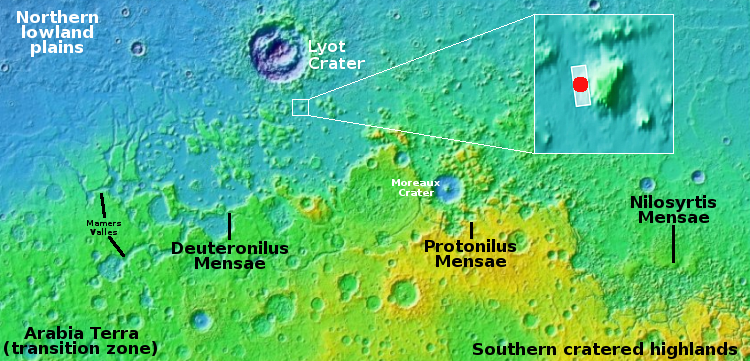
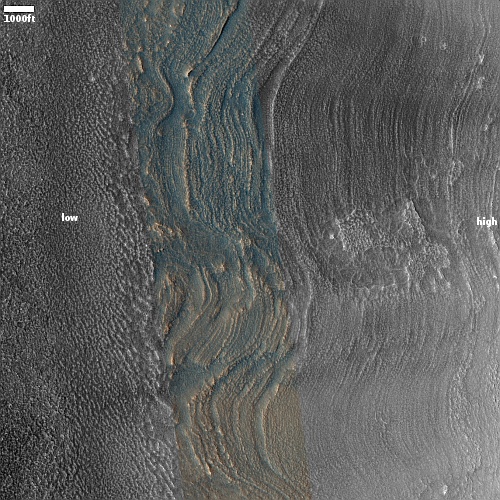
The picture to the right, cropped, reduced, and sharpened to post here, was taken on June 27, 2023 by MRO’s high resolution camera. The red dot in the inset of the overview map above shows the location, the western flanks of an apron that surrounds a 3,800-foot-high mesa in the chaos region Deuteronilus Mensae, the western end of the 2,000-mile-long mid-latitude strip of chaos regions I dub glacier country, because every image seems to show some form of glacial feature.
Today’s picture is no different. The apron shown here drops the last 1,000 feet of the mesa’s total 3,800-foot height, during which it shows dozens of what the scientists label “parallel lines.” These lines likely reveal the layers of glacial ice in this apron, with the older layers larger and more extensive. Apparently, with each growth cycle the glacier obtained less snow from the atmosphere, so the more recent layers grew less.
In other words, the amount of water on Mars has been declining with time.
Untangling these numerous layers will undoubtedly give us a remarkably detailed history of Mars entire geological history. Unfortunately, that untangling cannot happen until we have boots on the ground, on Mars, able to drill core samples from many different places.