Charles Dickens’ A Christmas Carol

A Christmas pause: As I have done now for several years on Christmas day, I bring you the classic 1951 version of Charles Dickens’ A Christmas Carol, starring Alastair Sim. Still by far the best adaption of the book and a truly wonderful movie.

And as I noted in a previous year:

Dickens did not demand the modern version of charity, where it is imposed by governmental force on everyone. Instead, he was advocating the older wiser concept of western civilization, that charity begins at home, that we as individuals are obliged as humans to exercise good will and generosity to others, by choice.

It is always a matter of choice. And when we take that choice away from people, we destroy the good will that makes true charity possible.

It is also most important that we all heed the words of Christmas Present: โ€˜This boy is ignorance, this girl is want. Beware them both, but most of all beware this boy.โ€™โ€

5 comments

China launches four weather satellites

China late today used its Kuaizhou-1A solid-fueled rocket to place four weather satellites into orbit, lifting off from its Jiuquan spaceport in the northwest of China.

No word on where the rocket’s lower stages crashed within China. This launch is the first of four Chinese launches known to be scheduled in the next few days, part of China’s typical rush of launches that seems to happen at the end of every year.

The leaders in the 2023 launch race:

94 SpaceX
62 China
18 Russia
8 Rocket Lab
7 India

American private enterprise still leads China in successful launches 108 to 62, and the entire world combined 108 to 98. SpaceX in turn trails the rest of the world (excluding other American companies) 94 to 98.

0 comments

Repost: The real meaning of the Apollo 8 Earthrise image

I wrote this essay in 2018, to celebrate the fiftieth anniversary of the Apollo 8 mission to the Moon. I think it worth reposting again, especially because stories about Apollo 8 still refuse to show the Earthrise image as Bill Anders took it.
———————————————

Earthrise, as seen by a space-farer

Today is the fiftieth anniversary of the moment when the three astronauts on Apollo 8 witnessed their first Earthrise while in orbit around the Moon, and Bill Anders snapped the picture of that Earthrise that has been been called “the most influential environmental picture ever taken.”

The last few days have seen numerous articles celebrating this iconic image. While all have captured in varying degrees the significance and influence of that picture on human society on Earth, all have failed to depict this image as Bill Anders, the photographer, took it. He did not frame the shot, in his mind, with the horizon on the bottom of the frame, as it has been depicted repeatedly in practically every article about this image, since the day it was published back in 1968.

Instead, Anders saw himself as an spaceman in a capsule orbiting the waist of the Moon. He also saw the Earth as merely another space object, now appearing from behind the waist of that Moon. As a result, he framed the shot with the horizon to the right, with the Earth moving from right to left as it moved out from behind the Moon, as shown on the right.

His perspective was that of a spacefarer, an explorer of the universe that sees the planets around him as objects within that universe in which he floats.

When we here are on Earth frame the image with the horizon on the bottom, we immediately reveal our limited planet-bound perspective. We automatically see ourselves on a planet’s surface, watching another planet rise above the distant horizon line.

This difference in perspective is to me the real meaning of this picture. On one hand we see the perspective of the past. On the other we see the perspective the future, for as long humanity can remain alive.

I prefer the future perspective, which is why I framed this image on the cover of Genesis: the Story of Apollo 8 the way Bill Anders took it. I prefer to align myself with that space-faring future.

And it was that space-faring future that spoke when they read from Genesis that evening. They had made the first human leap to another world, and they wished to describe and capture the majesty of that leap to the world. They succeeded beyond their wildest dreams.

Yet, they were also still mostly Earth-bound in mind, which is why Frank Borman’s concluding words during that Christmas eve telecast were so heartfelt. He was a spaceman in a delicate vehicle talking to his home of Earth, 240,000 miles away. “And from the crew of Apollo 8, we close with good night, good luck, a Merry Christmas, and God bless all of you — all of you on the good Earth.” They longed deeply to return, a wish that at that moment, in that vehicle, was quite reasonable.

Someday that desire to return to Earth will be gone. People will live and work and grow up in space, and see the Earth as Bill Anders saw it in his photograph fifty years ago.

And it is for that time that I long. It will be a future of majesty we can only imagine.

Merry Christmas to all, all of us still pinned down here on “the good Earth.”

12 comments

SpaceX launches two German military radar satellites

SpaceX today successfully launched two German military radar surveillance satellites, completing a planned three-satellite constellation, with its Falcon 9 rocket lifting off from Vandenberg Space Force Base in California.

The first stage completed its eighth flight, landing back at Vandenberg.

This launch almost certainly in the past would have launched on a Arianespace rocket, but Arianespace presently has no operational rocket, its Ariane-5 rocket retired and its Ariane-6 rocket not yet operational. Furthermore, its Vega and Vega-C rockets are grounded due to launch failures, and its partnership with Russia ended with Russia’s invasion of the Ukraine. Thus, SpaceX gets the business, being less expensive than ULA (which also has no rockets available right now to handle this launch) and there being no other company capable of launching such a payload.

The leaders in the 2023 launch race:

94 SpaceX
61 China
18 Russia
8 Rocket Lab
7 India

American private enterprise now leads China in successful launches 108 to 61, and the entire world combined 108 to 97. SpaceX now trails the rest of the world (excluding other American companies) 94 to 97.

1 comment

SpaceX launches 23 Starlink satellites

Early on December 23, 2023 SpaceX successfully launched another 23 Starlink satellites, its Falcon 9 rocket lifting off from Cape Canaveral.

The first stage successfully completed its 19th flight, landing on a drone ship in the Atlantic. This reuse was new record. In fact, the reuse numbers of SpaceX’s fleet Falcon 9 first stages are beginning to resemble the reuse numbers of NASA’s shuttle fleet, and are doing so in a significantly shorter period of time and for a lot less money.

The leaders in the 2023 launch race remain the same:

93 SpaceX
61 China
18 Russia
8 Rocket Lab
7 India

American private enterprise now leads China in successful launches 107 to 61, and the entire world combined 107 to 97. SpaceX now trails the rest of the world (excluding other American companies) 93 to 97.

4 comments

Trans-Siberian Orchestra – Christmas Eve/Sarajevo

An evening pause: Makes me think of Disney’s Peter Pan (1953) and Miyazaki’s My Neighbor Totoro (1988), about how some things only children can see.

Hat tip Judd Clark.

2 comments

December 22, 2023 Quick space links

Courtesy of BtB’s stringer Jay. Early today because Diane and I have a social event this afternoon and I want this posted before we leave. It is the holiday season, which has made it hard for me to write any political essays yesterday or today.


4 comments

Curiosity takes a close-up of distant cliffs

Panorama on December 20, 2023
Panorama on December 20, 2023. Click for full image.

Close-up of a distant cliff
Click for original image.

Cool image time! The picture to the right, reduced and sharpened to post here, was taken on December 21, 2023 by the chemistry camera (ChemCam) on the rover Curiosity. Originally designed to take close-ups of rocks very nearby the rover, the science team over time discovered that they could also use this camera to get close-ups of very distant objects, providing them another way to study the geology in Gale Crater and on Mount Sharp.

The picture to the right I think shows the horizon area indicated by the arrow on the panorama above, taken the day before. Note the many many layers, a geological feature that Curiosity has discovered is ubiquitous on Mars. Over eons the entire surface of the red planet has been layered repeatedly by cyclical geological events, producing layers within layers within layers. I guarantee that when Curiosity gets closer to this cliff it will see layers inside the smallest layers ChemCam can see now.

The red dotted line on the panorama above indicates the approximate planned route that Curiosity will eventually take, cutting across in front of that mountain and turning south somewhere near but to the west of where the cliff in this picture is located.
» Read more

8 comments

Firefly successfully launches for the second time in 2023

Alpha seven seconds after liftoff

UPDATE #2: According to a Firefly tweet on X, the second stage failed to fire its second burn. The satellite however was deployed, communications established, and mission operations started. Though its orbit will decay prematurely, it appears the customer, the Space Force, will achieve most of its mission objectives. This should be considered a successful launch, albeit not one that Firefly will want to repeat in this manner.

UPDATE: It appears the upper stage might have had a problem in its final engine burn intended to circularize the orbit for deployment. Either the burn failed to occur, or did not fire correctly. See this tweet. (Hat tip Jay.) I have found other reports that indicate the same question.

The question now is whether this is considered a successful launch. One of its main tasks was to demonstrate fast assembly and prelaunch procedures, for the Space Force. This was accomplished. If the satellite cannot function however is isn’t a full success. I will wait for more information before deciding whether to remove it from the launch stats.

Original post:
——————
Firefly today successfully completed its second launch in 2023, its third launch overall, its Alpha rocket lifting off from its launchpad at Vandenberg in California.

With this launch Firefly also met its launch prediction for 2023, two launches. The mission was its second for the Space Force this year, both designed to test quick launch procedures. As of posting the payload has not been deployed.

The leaders in the 2023 launch race remain the same:

92 SpaceX
61 China
18 Russia
8 Rocket Lab
7 India

American private enterprise now leads China in successful launches 106 to 61, and the entire world combined 106 to 97. SpaceX still trails the rest of the world (excluding other American companies) 92 to 97.

2 comments

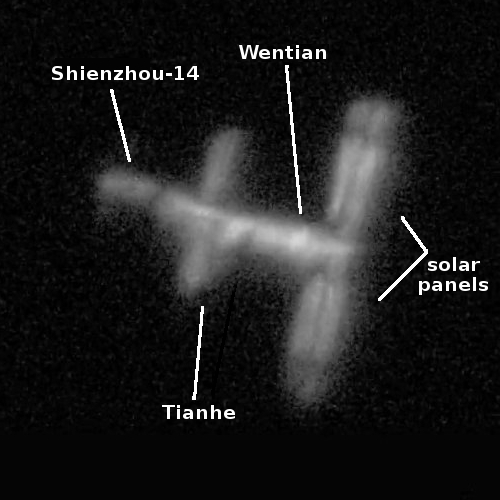
Chinese astronauts do spacewalk to repair Tiangong-3 solar panel

Two Chinese astronauts yesterday completed a 7.5 hour spacewalk on that country’s Tiangong-3 space station to test a repair technique to what the state-run press said was minor damage on a solar panel from micrometeorites.

The EVA posed new challenges for the astronauts, according to Dong Nengli, deputy chief designer of Chinaโ€™s human spaceflight program. โ€œFor the previous extravehicular activities, the major tasks for astronauts were to install and check. This round of extravehicular activities on Thursday we call experimental servicing,โ€ Dong told CCTV. โ€œThis time the astronauts operated on one of the solar wings. It is flexible, to a certain extent, and also very thin, which limits the space of operation to a certain degree,โ€ Dong said.

Dong added that the successful EVA meant the teams had mastered the ability for some extravehicular repairs. Success was thus, โ€œlaying a solid foundation for us to guarantee the space stationโ€™s safety and reliability in the future.โ€

It must be noted that no specific details about what was done were provided, nor did the short video released by China showing highlights of the spacewalk show the specific repair work.

Nonetheless, there is an aspect of China’s space station that makes it a far more powerful national symbol than ISS: It is China’s alone, built, launched, occupied, and maintained by China alone. It fuels national pride in a way that ISS never has, because President Bill Clinton decided to use it in the 1990s for foreign policy concerns by giving the Russians an equal partnership. Neither the U.S. nor Russia have obtained the same kind of prestige at home and abroad because neither really built ISS on their own. It was a shared effort, which meant neither could claim it.

3 comments

Spectacular 2,300-year-old wall mosaic found in archaeological dig in Rome

Archaeologists have uncovered a 2,300-year-old wall mosaic in almost perfect condition in Rome that had been part of a banquet room overlooking a garden.

Estimated to be around 2,300 years old, the work is part of a larger aristocratic mansion, located near the Roman Forum, that has been under excavation since 2018. Almost five meters long (16.4 ft) and featuring depictions of vines, lotus leaves, tridents, trumpets, helmets and mythological marine creatures, the mosaic scene was painstakingly created using mother of pearl, shells, corals, shards of precious glass and flecks of marble. The piece is framed by polychrome crystals, spongy travertine, and exotic, ancient Egyptian blue tiles.

What makes this discovery โ€œunmatched,โ€ said archaeologist Alfonsina Russo, head of the Colosseum Archaeological Park in charge of the site, is not only the incredible conservation of the mosaic, but its decoration which also features celebratory scenes of naval and land battles likely funded โ€” and won โ€” by an extremely wealthy aristocratic patron who commemorated the victories on their walls.

Though it is believed such tiled mosaics were common in the homes of wealthy Roman aristocrats, most have not survived in good condition, making this discovery significant as well as beautiful. In addition, the location of the house and the details within the mosaic could make it possible to actually identify the Roman who lived here, which in itself would be a major historical find.

0 comments
1 449 450 451 452 453 2,915