Andrea Bocelli – Panis Angelicus
An evening pause: Hat tip Dan Morris.
An evening pause: Hat tip Dan Morris.

Among the students, freedom of thought might
still exist at St. Joseph’s University.
A victory for free thought: When students at St. Joseph’s University in Pennsylvania were no longer required to take a class promoting race and the anti-white agenda of critical race theory, enrollment dropped so much that most of the offered classes will likely be canceled.
The university’s campus paper noted:
Multiple sections of the university’s new one-credit diversity course, Inequality in American Society (INT 151), are at risk of getting canceled for the spring 2022 semester due to under enrollment.
As of Dec. 4, only four of the 26 sections offered for the spring 2022 semester are full, according to numbers on the Course Registration website. Twelve of the 26 sections have 50% or more seats still available.
Of course, the teachers who are promoting this racist class want this problem solved by making the class a requirement. More important, these teachers are not really interested in diversity of thought, as illustrated by this comment by professor Brian Yates, the course’s leading advocate:
» Read more
New measurements of the orbits of several stars circling the Milky Way’s central supermassive black hole, Sagittarius A* (pronounced A-star), have confirmed that 99.9% of all mass at the galaxy’s center is concentrated in that black hole.
Astronomers have measured more precisely than ever before the position and velocity of four stars in the immediate vicinity of the supermassive black hole that lurks at the center of the Milky Way, known as Sagittarius A* (Sgr A*) [1]. These stars — called S2, S29, S38, and S55 — were found to be moving in a way that shows that the mass in the center of the Milky Way is almost entirely due to the Sgr A* black hole, leaving very little room for anything else.
The measurements, which further refine the mass of Sagittarius A* as 4.3 million times the mass of the Sun, show that very little of this mass is found in the surrounding space as gas or dark matter. It is all in the black hole, which might also help explain why the Milky Way’s central black hole is so quiescent. It has very little gas or other stars to feed it and thus produce emissions.
The uncertainty of science: In reviewing their measurements of the Hubble constant using a variety of proxy distance tools, such as distant supernovae, astronomers recently announced that their numbers must be right, even though those numbers do not match the Hubble constant measured using completely different tools.
Most measurements of the current acceleration of the universe (called the Hubble constant, or H0) based on stars and other objects relatively close to Earth give a rate of 73 km/s/Mpc. These are referred to as “late-time” measurements [the same as confirmed by the astronomers in the above report]. On the other hand, early-time measurements, which are based on the cosmic microwave background emitted just 380,000 years after the Big Bang, give a smaller rate of 68 km/s/Mpc.
They can’t both be right. Either something is wrong with the standard cosmological model for our universe’s evolution, upon which the early-time measurements rest, or something is wrong with the way scientists are working with late-time observations.
The astronomers are now claiming that their late-time observations must be right, which really means there is either something about the present theories about the Big Bang that are fundamentally wrong and that our understanding of early cosmology is very incomplete, or the measurements by everyone are faulty.
Based on the number of assumptions used with both measurements, it is not surprising the results don’t match. Some of those assumptions are certainly wrong, but to correct the error will require a lot more data that will only become available when astronomers have much bigger telescopes of all kinds, in space and above the atmosphere. Their present tools on Earth are insufficient for untangling this mystery.
Capitalism in space: According to a report yesterday at Ars Technica, more delays are expected in the delivery of Blue Origin’s BE-4 rocket engine to ULA, possibly preventing the first launch of Vulcan from occurring in ’22.
Testing suggests the engine itself is functioning well. However:
Blue Origin is unlikely to deliver two flight-ready versions of the BE-4 rocket engine to United Launch Alliance (ULA) before at least the second quarter of 2022, two sources say. This increases the possibility that the debut flight of ULA’s much-anticipated new rocket, Vulcan, could slip into 2023.
Vulcan’s first stage is powered by two BE-4 engines, which burn methane and are more powerful than the space shuttle’s main engines. The sources said there recently was a “relatively small” production issue with fabrication of the flight engines at Blue Origin’s factory in Kent, Washington. [emphasis mine]
Translation of the highlighted words: We have built the engine, it is working great, but we have suddenly discovered we haven’t figured out the mass production process for building it quickly and in large numbers so as to support numerous launches by both ULA’s Vulcan and Blue Origin’s New Glenn rockets.
ULA claims it can get Vulcan off the ground only a few months after getting those flightworthy BE-4 engines because it has done most of the design work using the dummy “pathfinder” BE-4 engines Blue Origin provided last year. Don’t believe it. The company is going to have to install working engines on Vulcan, and then do static fire tests to validate not only the rocket but its entire launch process. Such testing usually takes months, and is rarely completed in less than half a year, even by SpaceX.
These problems at Blue Origin means that both Vulcan and New Glenn will likely launch more three years behind schedule. Instead of 2020, both will fly no earlier than 2023, at best.
In a strangely worded NASA press release, the agency announced that it has “selected” Axiom for the second private commercial manned mission to ISS.
NASA has selected Axiom Space for the second private astronaut mission to the International Space Station. NASA will negotiate with Axiom on a mission order agreement for the Axiom Mission 2 (Ax-2) targeted to launch between fall 2022 and late spring 2023.
As at present there appears to be no other American company planning commercial manned flights to ISS, NASA wasn’t “selecting” Axiom at all. All NASA was doing was approving Axiom’s proposal to fly the mission to NASA’s space station, while confirming that Axiom will pay NASA’s greatly increased charges, raised about 700% more than the older price list.
The language of this announcement, combined with the exorbitant NASA charges, is only going to accelerate the effort of private companies, including Axiom, to build their own independent space stations. It isn’t NASA’s place to “select” any privately funded commercial flight into space, ever. That this government agency is making believe it has that right is only going to alienate the new private space industry, giving them reason to get away from NASA as fast as possible.
Meanwhile, Axiom is already scheduled to fly its first tourist flight to ISS in February 2022. The second flight that NASA “selected” today is to be followed by two more, for a total of four tourist flights. At that point, around 2024, Axiom will then launch its first module to ISS, beginning the process of relying less on NASA and leading to the undocking of Axiom’s station from ISS.
Capitalism in space: SpaceX has now installed its fourth Superheavy prototype on the orbital launchpad at Boca Chica, with the possibility of the first static fire test of Superheavy possibly occurring in the next week or so.
Around 10am CST (UTC-6), SpaceX began retracting more than a dozen clamps that hold the 69m (~225 ft) tall Super Heavy – the largest booster ever built – to its transport and work stand. By 11:30am, Booster 4 was safely extracted from the stand and hovering above it as the lift team crossed their Ts and dotted their Is before proceeding. SpaceX’s newest Starbase crane then spun around and crawled a short distance to the orbital launch mount, where it lifted Booster 4 above the mount.
In a process that this particular Super Heavy prototype is thoroughly familiar with, SpaceX then very carefully lowered B4 down into the center of the donut-shaped orbital launch mount, where 20 separate clamps – each capable of deploying and retracting – form a support ring and giant hold-down clamp.
The booster has 29 Raptor engines total, with 20 in the outer ring, 8 in the inner ring, and 1 in the center. It will be quite amazing to watch all these engines finally fire and lift the entire rocket, with Starshp, off the launchpad.
As for the upcoming static fire tests, road closures have been announced starting today through the end of this week.
According to a NASA press release today, Boeing has decided to swap Starliner service modules for the capsule’s first two missions, using the service module intended for the first manned flight on the unmanned demo flight, and assigning the service module for the unmanned demo flight — which had the valve issue — to the first manned flight.
The launch schedule for these two flights is now targeting May for the unmanned demo flight and August for the first manned Starliner demo mission.
Ongoing investigation efforts continue to validate the most probable cause to be related to oxidizer and moisture interactions. NASA and Boeing will continue the analysis and testing of the initial service module on which the issue was identified leading up to launch of the uncrewed OFT-2 mission in August 2021.
In other words, though they are claiming that they have figured out the sticky valve problem in that service module, it is also quite likely that it will not be used in August 2021. I suspect they will eventually put it aside and use another service module for the manned mission, and have only said now that they will use it on the manned mission for PR reasons. It appears they are confident the valve issue is solved for other service modules, but are not yet satisfied this troublesome service module is trustworthy.
The May-August schedule is tight, but doable, assuming the May unmanned flight goes well. If the August manned demo mission also goes well, Boeing will finally be able to begin selling seats on its Starliner capsule, though I would not be surprised if it makes no sales to anyone but NASA for the next few years. Considering its problem-filled development, private users are going to be reluctant to use this capsule until it establishes a successful track record.
The new colonial movement: China today launched the second Tianlian communications satellite for its manned space station missions, using its Long March 3B rocket.
No word on whether the rocket’s first stage used parachutes or grid fins to control its crash landing in the interior of China.
The leaders in the 2021 launch race:
48 China
28 SpaceX
22 Russia
6 Europe (Arianespace)
5 ULA
5 Rocket Lab
China now leads the U.S. 48 to 45 in the national rankings. This launch was the 124th in 2021, making the sixth most active year in rocketry since Sputnik in 1957.
An evening pause: Another one of the myriad sports that humans have invented. Stay with it, it gets better and better.
Hat tip Phill Oltmann.
In a perfect demonstration that a broken clock gets to be right, by accident, ever so often, Time magazine yesterday named Elon Musk its 2021 “Person of the Year.”
Time’s choices for the past several decades have been consistently cringeworthy, most often because its choices have either repeatedly hawked politicians and activists who deserve no credit at all because they had not actually done anything, such as Greta Thunberg and just-elected George Bush Jr (2000), Barack Obama (2008), Joe Biden/Kamala Harris (2020), or because the picks have been meaningless, such as the choice of “You” in 2006 and “The Protester” in 2011.
Not surprisingly, Time picked Musk apparently for all the wrong reasons, focusing on the modern leftist and Marxist agenda that despises success and now dominates the culture of most mainstream media outlets :
“In 2021, Musk emerged not just as the world’s richest person but also as perhaps the richest example of a massive shift in our society,” [Time’s chief executive Edward] Felsenthal wrote in the announcement. “From Amazon’s Jeff Bezos to Facebook turned Meta’s Mark Zuckerberg, the year brought home the extent to which, at a time of rising protest over ever deepening inequality, our lives and many of the basic structures around them are now shaped by the pursuits, products and priorities of the world’s wealthiest people.” [emphasis mine]
Thus, Felsenthal reveals that Time picked Musk not because he has achieved magnificent things that are fundamentally changing the world, but because he represents “the world’s wealthiest people” who illustrate society’s “deepening inequality.” Nor am I exaggerating. Read Felsenthal’s entire statement, which reeks with leftist and Marxist envy of the wealthy.
Musk deserves this kind of recognition, but not because he is wealthy, but because of how he became so, by actually creating businesses that fulfill needs and thus have customers pounding at the door to buy the product (Paypal, SpaceX, Starlink, Tesla). And along the way his creations have brought jobs and wealth to tens of thousands of people, and acted to rejuvenate whole industries.
We need more people like Musk. The more the merrier. Only by eagerly embracing their original and creative ideas can we hope to recover the civilization we once had.
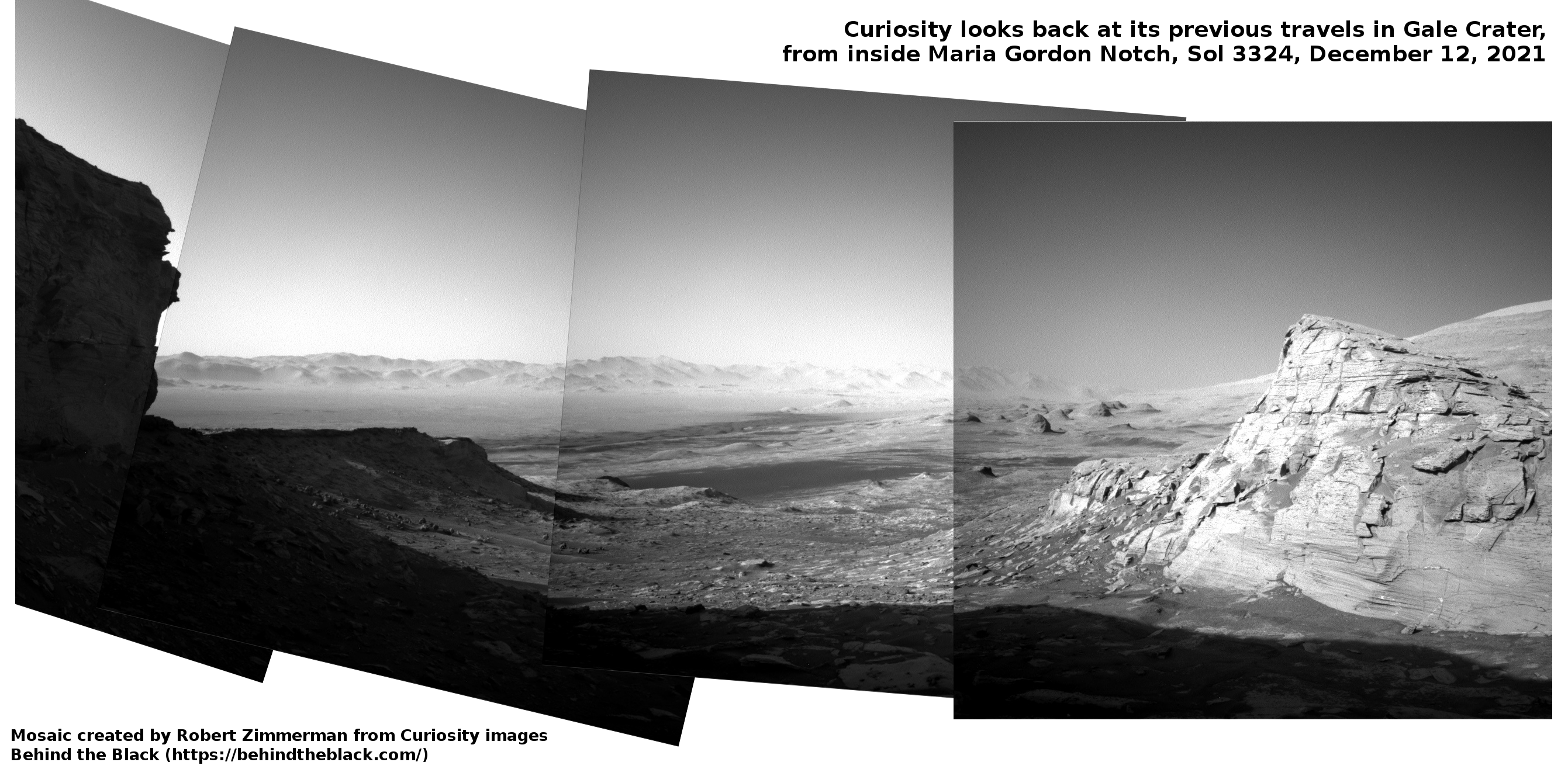
Click for high resolution mosaic. Original images here, here, here, and here.
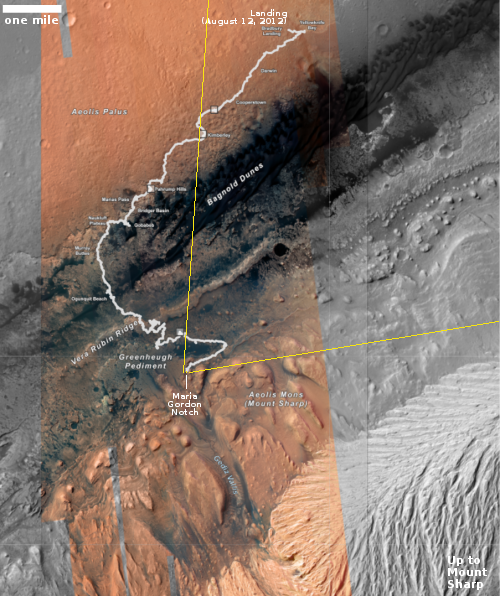
Click for interactive map.
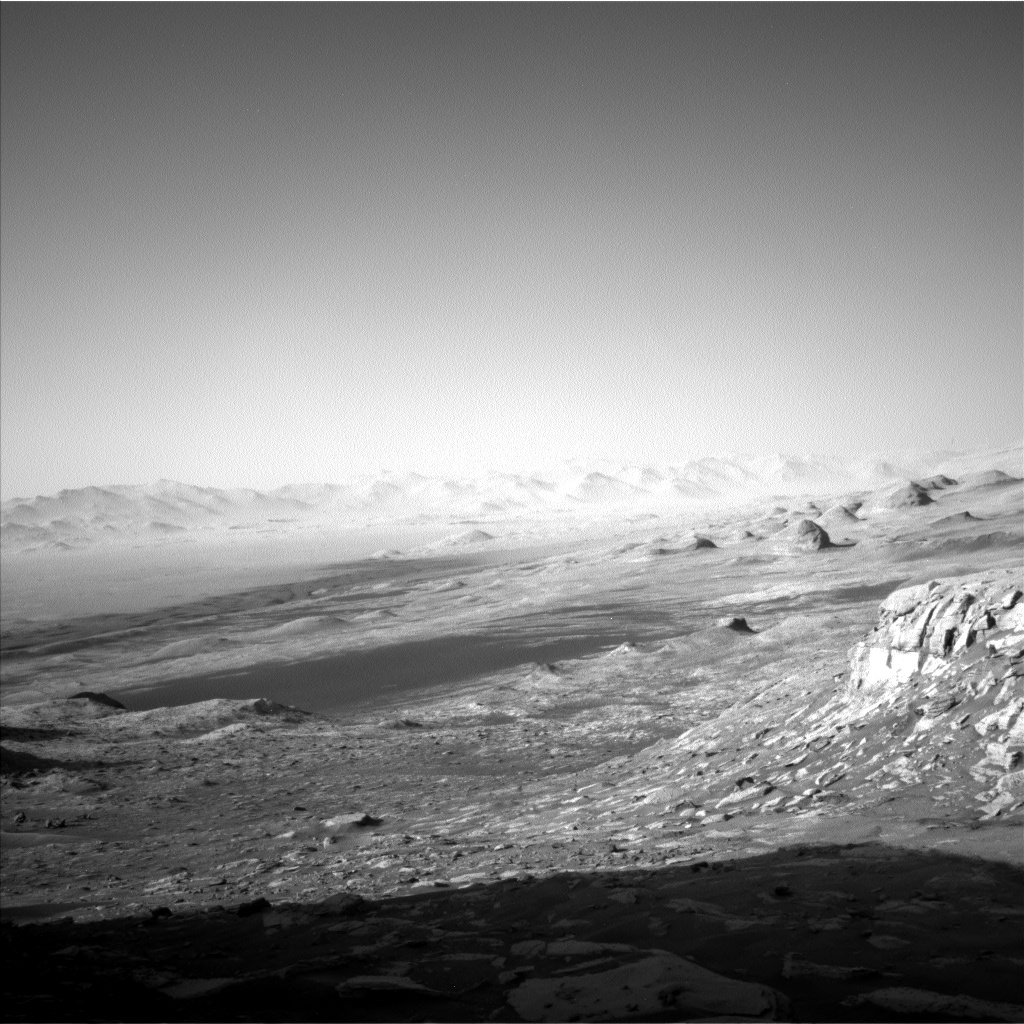
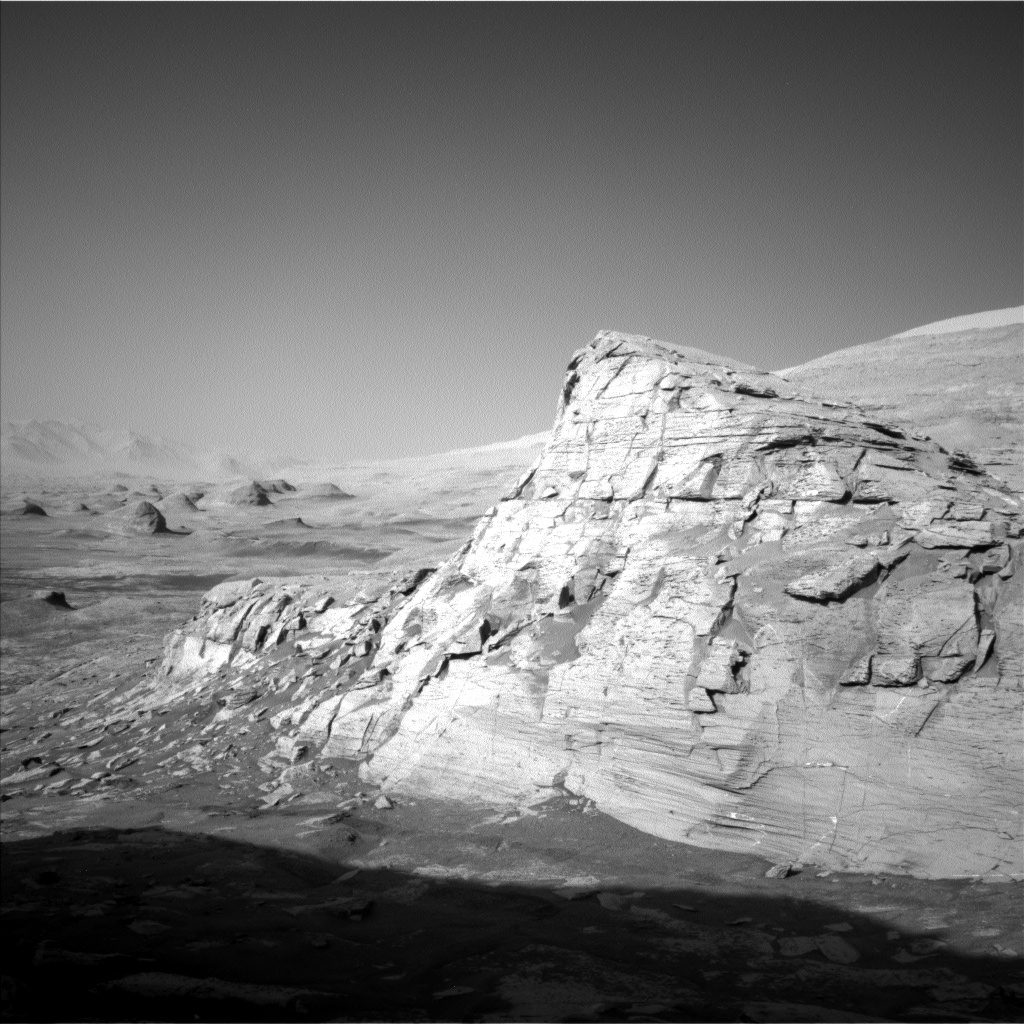
Cool image time! The mosaic above was created from four photos taken by Curiosity’s left navigation camera on December 12, 2021, just after the rover had moved into Maria Gordon Notch. The view is to the north, looking back at the rover’s journey climbing up the floor of Gale Crater into the foothills of Mount Sharp. The rim of Gale Crater can be seen about 25 to 30 miles away.
The cliff in shadow on the left is about 40 feet high. The cliff in sunlight on the right is between 30 to 60 feet high, depending on where you measure.
The overview map to the right shows Curiosity’s entire journey, with the yellow lines indicating the approximate area covered by the mosaic above. All told the rover has climbed about 1,700 feet since it landed. While much of the rover’s route is blocked from our view by the cliffs on left, the nearest sand dune sea in the center of the mosaic is the one that the rover circled around from January 2021 to June 2021.
» Read more
Russia early today successfully launched two Russian civilian communications satellites using its Proton rocket on its second launch in 2021.
This was Russia’s 22nd successful launch in 2021, matching its total from 2019 and the highest since 2015. In that year its launch totals dropped as its international commercial market share switched to SpaceX, partly because of the lower prices that American company offered and partly because of the many quality control problems in the Russian aerospace industry that were causing numerous launch failures.
With two more launches still on its manifest, ’21 looks like it will be a good year for Russia.
The leaders in the 2021 launch race:
47 China
28 SpaceX
22 Russia
6 Europe (Arianespace)
5 ULA
5 Rocket Lab
China still leads the U.S. 47 to 45 in the national rankings. With 123 launches this year, ’21 is now tied as the sixth most active year in the history of rocketry.
Mexico on December 9, 2021 became the fourteenth nation to sign the U.S.-led Artemis Accords, designed to bypass the Outer Space Treaty’s restrictions on private property in space.
[Marcelo Ebrard Casaubon, Mexico’s secretary of foreign relations,] announced Mexico’s accession to the accords at an event attended by several other Mexican government officials as well as U.S. Ambassador to Mexico Ken Salazar and José Hernández, a former NASA astronaut. Hernández said in the statement that Mexico’s decision to join the Artemis Accords was evidence that, for this return to the moon, “we are going to do it as a community.”
The full list of signatories at this moment: Australia, Brazil, Canada, Italy, Japan, Luxembourg, Mexico, New Zealand, Poland, South Korea, the United Kingdom, the United Arab Emirates, Ukraine, and the United States.
Russia and China have both said they oppose the accords. Both want control to be centralized to the government, and the accords act instead to strengthen the rights of the citizens and private companies in space.
France and Germany remain the two major Western space powers who have not signed the accords. Both undecided on what they will do. Both seem eager to partner with Russia and China, and to do so also seem willing to abandon in space concepts of private property and individual rights in order to make those partnerships happen. At the same time both — especially Germany — have been pushing private enterprise in space.
This policy conflict is making both countries appear very confused.
The FAA has decided to end an on-again-off-again program, only started in 2005, that issue wings to everyone who makes their first flight into space on a private commercial spacecraft.
he Federal Aviation Administration will stop awarding commercial astronaut wings at the end of this year, five months after it revised the criteria for receiving the wings.
The FAA announced Dec. 10 that it will award wings to all non-government individuals that flew on FAA-licensed commercial vehicles to date in 2021, as well as those who fly on any remaining launches through the end of the year. However, it will not award wings to anyone, either crew members or spaceflight participants, that flies on FAA-licensed vehicles after this year.
The program was merely a public relations effort designed to give an honor to tourists and others who flew on non-governmental space missions. The FAA is now getting out of that business, leaving it to the commercial space companies themselves.
That part of the reasons is that the FAA was finding it difficult to come up with a good criteria for awarding the wings based on the increasing numbers of people now flying on private missions is actually wonderful. It means going into space is becoming more routine.
Capitalism in space: Blue Origin’s New Shepard suborbital spacecraft today completed its third commercial suborbital passenger flight, this time carrying six people, including Laura Shepard Churchley, the daughter of Alan Shepard, the first American to fly in space.
Churchley, as well as former football player Michael Strahan, were not a paying passengers. What the other passengers paid for their flights has not been revealed. Nor has Blue Origin listed a ticket price anywhere.
It is good news that Blue Origin is now doing these suborbital commercial flights regularly. It would be much better news if the company started manufacturing its BE-4 engine as regularly so that its orbital New Glenn rocket could do the same.
Sorry for the lack of posting yesterday. I was starting the preparations for a caver’s party today at my home, and needed to do stuff related to that. While most of the organized caving community has blacklisted me and several others because we don’t cower in our basement doing zoom meetings but go caving instead, a good number agree with us and are coming today. Partying sometimes comes ahead of work!
Embedded below the fold in two parts.
To listen to all of John Batchelor’s podcasts, well worth your time, go here.
» Read more
An evening pause: Seems appropriate for the season.
Hat tip Dan Morris.
Russia, as part of the continuing barter deal with NASA for seats on the capsules of both countries, has selected rookie astronaut Anna Kikina to be the first Russian to fly on a Dragon capsule.
Kikina is the only woman currently active in the Russian cosmonaut corps. She was selected in 2012 but has yet to fly in space, although Rogozin and other Russian officials had previously said she would fly in the fall of 2022. She would likely be on the Crew-5 Crew Dragon mission, to which NASA astronauts Nicole Mann and Josh Cassada and JAXA astronaut Koichi Wakata are currently assigned.
While according to the Russians the barter deal is finalized, according to NASA negotiations are still ongoing. This announcement by the Russians might actually be a negotiating tactic, since the tensions between the U.S. and Russia over Russian threats to the Ukraine could threaten the partnership at ISS. By making this announcement the Russians might be trying to make the barter deal an accomplished fact.
China today launched two satellites thought to be for military reconnaissance, using its Long March 4B rocket.
The leaders in the 2021 launch race:
47 China
27 SpaceX
21 Russia
6 Europe (Arianespace)
5 ULA
5 Rocket Lab
China now leads the U.S. 47 to 45 in the national rankings. There have now been 122 successful launches in 2021, making it the seventh most active year in the history of space exploratoin.