Buried silo on Mars?

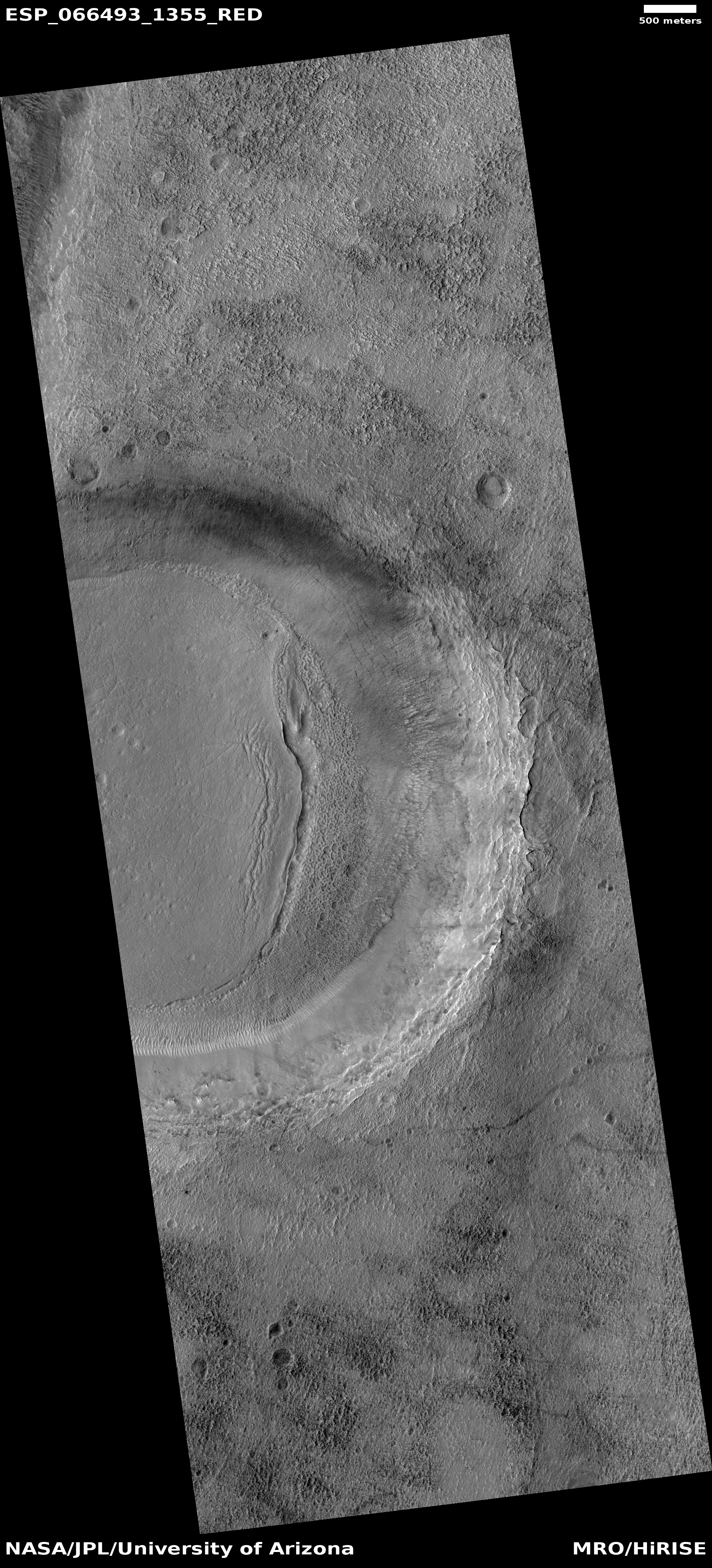
A buried silo on Mars?
Click for original image.

Cool image time! The picture to the right, rotated and cropped to post here, was taken on December 31, 2022 by the high resolution camera on Mars Reconnaissance Orbiter.

The headline is pure silliness, and should not be taken seriously. However, the geological feature is intriguing nonetheless. Its almost perfect circular shape suggests a partly buried or eroded crater, except that its consistent thickness, almost like a wall, does not match what the rims of any crater should look like. Crater rims are made up of ejected material pushed out during impact, and thus always include some chaotic features.

My guess is that this circular feature is volcanic in nature. Maybe this was once a caldera, and the circle indicates a final vent from which lava extruded and then solidified.

At least, that’s my story.

The feature is located in the southwest quadrant of Hellas Basin, the basement of Mars, at 49 degrees south latitude. While this also suggests that ice might help explain this, we must also remember that much of the geology in that basin remains unexplained. Thus, there is no reason not to add one more feature to the list.

2 comments

Is Amazon’s Kuiper Constellation project in trouble, or is it fleeing Seattle?

According to a on-going listing of open space-related jobs in Seattle, Amazon has almost completely ceased hiring in that city, even as it is about to launch the first prototype test satellites in its proposed internet Kuiper satellite constellation.

To see the decline, take a gander at the graph here.

The analyst at the first link also noted in a later tweet this fact about Amazon hiring in Seattle:

…Went from 189 at end of October to 14 yesterday (in WA state, not total). It’s unusual, at least in the nearly 3 years I’ve been monitoring. Could be due largely due to Amazon hiring freeze.

Amazon is required by its FCC license to get over 1,600 Kuiper satellites launched in the next 40 months. The first two are only scheduled for launch on the first Vulcan launch now targeting a late March liftoff. As test prototypes, they will have to be tested for a period of time in orbit, followed by an assessment that might require changes in the design and construction of later satellites. These satellites would then have to be launched at an unprecedented rate, almost faster than anything SpaceX has done with its Starlink constellation.

At the moment it thus seems impossible for Amazon to meet the FCC deadline.

That the company appears to have stopped hiring space-related positions in Seattle at this very moment makes that goal even more impossible. This hiring freeze thus suggests that management has decided that the Kuiper project is untenable and is quietly cutting it off at the knees.

Or it could be that the hiring freeze is instead an indication that Amazon is slowly shifting operations out of leftist and insane Washington state. If so, work on the Kuiper project, including hiring, might be going on elsewhere.

Regardless, the state of the Kuiper project continues to be tenuous and uncertain, at best.

Hat tip to Jay, BtB’s stringer.

4 comments

Two die at Northrop Grumman facility that makes solid rocket boosters

Two individuals died last night from an as-yet unknown cause at the Northrop Grumman Bacchus facility in Utah that makes solid rocket strap-on boosters for ULA’s rockets.

Further details about what exactly led to the deaths and who died were not made available.

The West Valley City Fire and Police Departments said they responded to the Bacchus facility after the two employees were found unconscious. Crews attempted life-saving measures and transported the two employees to the hospital, where they later died.

An investigation into the incident is ongoing by the Occupational Safety and Health Administration (OSHA).

Depending on circumstances, delivery of strap-on boosters for upcoming Atlas-5 and Vulcan launches could be impacted.

Hat tip to Jay, BtB’s stringer.

2 comments

Pushback: Student appeals conviction for distributing Constitution on public campus

Tizon's evil table at ASU
Tim Tizon (r) discussing free speech with another student on
March 3, 2022 at that banned YAL table on the ASU campus.

They’re coming for you next: Tim Tizon, a former Arizona State University (ASU) student, has now appealed his conviction for trespass, filed against him by the university because he had had the nerve to distribute copies of the Constitution to others, without obtaining the school’s permission.

He is being represented by the Liberty Justice Center (LJC). You can read his appeal here [pdf].

The facts of the case however are simple, and mirror numerous other similar incidents on many American campuses in the past decade, all designed to silence conservatives. On March 3, 2022, when he was still a student of ASU, he had set up a table on campus as a member of the ASU chapter of Young Americans for Liberty (YAL) to help educate others on the Constitution. As noted in his appeal:
» Read more

5 comments

A Martian hill of pillows

Curiosity's future path, taken January 31, 2023
Click for original image.

The cool image above was taken on January 31, 2023 by the left navigation camera on the Mars rover Curiosity. The red dotted line indicates roughly the planned route forward for the rover, though as Curiosity gets closer to that hill the terrain is looking increasingly difficult. The white box in the panorama below, taken two weeks earlier when the rover was about five hundred feet away, indicates the area covered by this picture. Since then Curiosity has traveled about 200 feet closer.

I post this picture specifically because of the small hill to the right of that path. Probably no more than fifty feet high, its entire surface appears cloaked by a pile of large, pillow-like pavement stones, almost as if the ground below had been washed away so that the massive top layer fell downward over time. Later, wind erosion over eons smoothed the rough edges of those massive blocks, giving them their cushion-like shapes.

This is strange geology. You might see such strange geology on Earth, but rarely. On Mars however strange geology appears increasingly common.

Moreover, to get a 3D sense of this terrain, load into your browser (on separate tabs) the full images of this hill, taken by Curiosity’s right and left navigation cameras (here and here). If you switch back and forth quickly between those tabs, you will see the slight shift in position between the two cameras, and be able to perceive this hill in three dimensions.

Panorama taken January 17, 2023 by Curiosity

2 comments

Galaxies without end

Webb infrared image of galaxies without end
Click for original image.

Cool image time! The mid-infrared picture to the right, cropped, reduced, and sharpened to post here, was taken by the Webb Space Telescope during its commissioning process last year shortly after launch, and was used to calibrate the Near-InfraRed Imager and Slitless Spectrograph (NIRISS) instrument, the very same instrument that for the past two weeks was not in operation because a cosmic ray had scrambled its software, requiring a reboot to fix it. From the caption:

The large spiral galaxy at the base of this image is accompanied by a profusion of smaller, more distant galaxies which range from fully-fledged spirals to mere bright smudges. Named LEDA 2046648, it is situated a little over a billion light-years from Earth, in the constellation Hercules.

While the large spiral is majestic, the tiny galaxy smudges are actually more important. Astronomers are right now scrambling to determine their distance and age in order to better understand what the universe was like, thirteen-plus billion years ago. So far the Webb data of these very early galaxies suggests that in this early universe there were many more fully formed galaxies, similar to ones we see in our time, than any theory of the Big Bang had predicted.

0 comments

Ingenuity successfully completes 41st flight

Overview map
Click for interactive map.

On January 27, 2023, the Mars helicopter Ingenuity successfully completed its 41st flight, flying about 600 feet total in an out-and-back flight that took 109 seconds, slightly longer in length and time than originally planned.

You can watch a very short animation from a handful of the pictures taken during the flight at the first link above. The green dot on the overview map to the right marks Ingenuity’s position before and after the flight, the blue dot Perseverance’s present location. The green line indicates the flight’s approximate path, designed to scout the route that Perseverance intends to follow, as indicated by the red dotted line. The actual flight path has not yet been published. I will add it to this map when the Ingenuity science team provides it.

Expect the next flight to duplicate this one, except it will likely not return but land somewhere out ahead.

0 comments

Astronomers discover twelve more Jupiter moons

In reviewing ground-based data from 2021 and 2022, astronomers have discovered another twelve Jupiter moons, bringing that planet’s total moon population to 92.

All of the newly discovered moons are small and far out, taking more than 340 days to orbit Jupiter. Nine of the 12 are among the 71 outermost Jovian moons, whose orbits are more than 550 days. Jupiter probably captured these moons, as evidenced by their retrograde orbits, opposite in direction to the inner moons. Only five of all the retrograde moons are larger than 8 kilometers (5 miles); Sheppard says the smaller moons probably formed when collisions fragmented larger objects.

One newly discovered moon, dubbed Valetudo, is about 3,000 feet across and orbits in a retrograde orbit that crosses the orbits of several other moons that orbit in the opposite direction. As the article notes, “This highly unstable situation is likely to lead to head-on collisions that would shatter one or both objects.”

6 comments

Webb instrument back in operation

Engineers have returned NIRISS, the near infrared spectrograph instrument on the Webb Space Telescope, to full operation after rebooting its software and determining the cause of the problem.

On Jan. 15, NASA’s James Webb Space Telescope’s Near Infrared Imager and Slitless Spectrograph (NIRISS) experienced a communications delay within the science instrument, causing its flight software to time out. Following a full investigation by NASA and Canadian Space Agency (CSA) teams, the cause was determined to likely be a galactic cosmic ray, a form of high-energy radiation from outside our solar system that can sometimes disrupt electrical systems. Encountering cosmic rays is a normal and expected part of operating any spacecraft. This cosmic ray event affected logic in the solid-state circuitry of NIRISS electronics known as the Field Programmable Gate Array. Webb engineers determined that rebooting the instrument would bring it back to full functionality.

After completing the reboot, NIRISS telemetry data demonstrated normal timing, and to fully confirm, the team scheduled a test observation. On Jan. 28, the Webb team sent commands to the instrument to perform the observation, and the results confirmed on Jan. 30 NIRISS is back to full scientific operations.

Engineers actually have a name for such cosmic ray incidents that effect software. They call it a bitflip.

2 comments

Developments at the Houston Spaceport industry park

Link here. The article gives a detailed review of the various space-related businesses (Axiom, Intuitive Machines, Collins Aerospace) that have set up operations at this industry park focused on attracting space companies to the Houston area.

The park in a sense in misnamed, as it isn’t a launch facility. However, it is now building a taxiway that will connect the park directly to Ellington Airport, which for these businesses will help facilitate the transport of large space station modules and lunar landers.

1 comment
1 624 625 626 627 628 2,914