
May 22, 2024 Zimmerman/Batchelor podcast
Embedded below the fold in two parts.
To listen to all of John Batchelor’s podcasts, go here.
» Read more
Very brief descriptions, with appropriate links, of current or recent news items.
Embedded below the fold in two parts.
To listen to all of John Batchelor’s podcasts, go here.
» Read more

Actually taking concrete stpes to end DEI
Under pressure by its state legislature, which last year banned all diversity statements from state agencies, the Board of Governors for the North Carolina University (UNC) system voted today to repeal its Diversity, Equity, and Inclusion (DEI) policies that have encouraged discrimination against non-minorities within the system.
The new policy now requires UNC schools to “ensure equality of all persons & viewpoints,” and promote “nondiscrimination in employment practices.” It also mandates that all UNC schools comply with a series of amendments passed by the North Carolina General Assembly in the past year that limit what can be discussed or taught about race, racism and sex in government institutions.
…Schools in the UNC System are required to comply with the new policy by September 1. The proposal does not indicate how many DEI jobs might be impacted.
Earlier this month, the Board of Trustees for the University of North Carolina Chapel Hill passed a separate proposal to divert $2.3 million from DEI programs to public safety.
The new policy, which you can read here [pdf], is very clear that DEI racial quotas and poltical favorism must end. » Read more
Using the TESS space telescope as well as a number of ground-based telescopes astronomers have discovered an Earth-sized exoplanet only 40 light years away that has a surface temperature estimated to be about 107 degrees Fahrenheit, assuming it has no atmosphere.
The host star, called Gliese 12, is a cool red dwarf located almost 40 light-years away in the constellation Pisces. The star is only about 27% of the Sun’s size, with about 60% of the Sun’s surface temperature. The newly discovered world, named Gliese 12 b, orbits every 12.8 days and is Earth’s size or slightly smaller — comparable to Venus. Assuming it has no atmosphere, the planet has a surface temperature estimated at around 107 degrees Fahrenheit (42 degrees Celsius).
At the moment however scientists do not yet know if the exoplanet has an atmosphere or not. Follow-up observations using the Webb Space Telescope are planned to find this out. Based on the data presently available, the exoplanet could either be like Venus, too hot to sustain life, or like Earth, cooler with water and an atmosphere and thus very habitable.
Gliese 12 b could therefore become one of the primary targets for the first interstellar missions once humanity begins such exploration.

Click for original image.
The Euclid science team today released five early science images in connection of the publication of ten papers.
The picture to the right is one of those images, cropped, reduced, and sharpened to post here. From the caption:
In this image Euclid showcases NGC 6744, an archetype of the kind of galaxy currently forming most of the stars in the local Universe. Euclid’s large field-of-view covers the entire galaxy, capturing not only spiral structure on larger scales but also exquisite detail on small spatial scales. This includes feather-like lanes of dust emerging as ‘spurs’ from the spiral arms, shown here with incredible clarity.
Scientists are using this dataset to understand how dust and gas are linked to star formation; map how different star populations are distributed throughout galaxies and where stars are currently forming; and unravel the physics behind the structure of spiral galaxies, something that is still not fully understood after decades of study.
Euclid is a wide-field space telescope that has instruments that observe in both visible and near-infrared wavelengths. Its primary mirror at 1.2 meters is half the width of Hubble’s. More details about these early images and links to the new science results can be found here.
Unlike Hubble, it appears Euclid will not be used as a general observatory, at least initially. Its primary goal is to do a survey of one third of the sky, focusing on extragalactic sources outside the Milky Way. Once this is complete however it is possible the space telescope will be made available for other observations.

Psyche’s flight path to the asteroid Psyche.
Click for original image.
The probe Psyche has successfully completed its six-month checkout since its launch in October 2023 and is now using its ion engines to steadily increase its speed as it heads to a 2029 rendezvous with the metal asteroid Psyche.
The orbiter is now more than 190 million miles (300 million kilometers) away and moving at a clip of 23 miles per second (37 kilometers per second), relative to Earth. That’s about 84,000 mph (135,000 kph). Over time, with no atmospheric drag to slow it down, Psyche will accelerate to speeds of up to 124,000 mph (200,000 kph).
The spacecraft will arrive at the metal-rich asteroid Psyche in 2029 and will make observations from orbit for about two years. The data it collects will help scientists better understand the formation of rocky planets with metallic cores, including Earth. Scientists have evidence that the asteroid, which is about 173 miles (280 kilometers) across at its widest point, may be the partial core of a planetesimal, the building block of an early planet.
The graphic to the right shows the path Psyche will take to get to the asteroid.
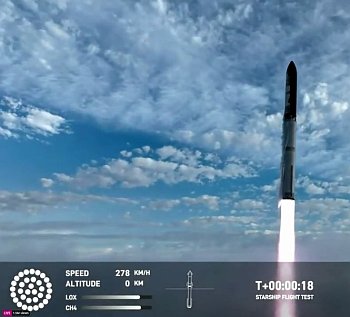
Superheavy/Starship lifting off on March 14, 2024
According to the FAA, SpaceX has officially asked the FAA to allow it to launch the next Starship/Superheavy test orbital launch before the agency officially completes its mishap investigation into the previous flight in March.
In a statement sent to ValleyCentral, the FAA stated that on April 5, SpaceX requested the FAA make a “public safety determination” as part of the Starship flight test mishap. “If the FAA agrees no public safety issues were involved in the mishap, the operator may return to flight while the mishap investigation remains open, provided all other license requirements are met.”
With this modification in place, SpaceX would be able to launch the fourth Starship test flight while the mishap investigation of the third flight is still open.
When these requests are received, the FAA evaluates safety-critical systems, the nature of the consequences of the mishap, adequacy of existing flight analysis, safety organization performance and environmental factors, the statement added. The FAA stated it is reviewing the request and will be “guided by data and safety at every step of the process.”
What does this request tell us? First, as expected SpaceX has completed its own investigation into the March launch and installed the upgrades it considers necessary. Second, the FAA however has not, even though the FAA has absolutely no competence in this matter. It is merely retyping the SpaceX report.
Third, SpaceX now realizes that the FAA will not have finished that retyping when SpaceX is ready to launch sometime in the next three weeks. Rather than sit and wait, as it did on the previous two test launches, it wants the FAA to recognize reality and let it proceed. Why wait when the FAA is literally contributing nothing to the process?
Will the FAA do so? I suspect there are people in the FAA who would very much like to. I also know that there are others both in the FAA and higher up the command chain (mostly in the White House) that like the idea of slowing SpaceX down, mostly for petty political reasons. We should not be surprised if those higher ups use their clout and insist the FAA reject this request.
If so, the fourth test launch of Starship/Superheavy will likely be further delayed, though by how much is unclear. Shortly after the March test launch I predicted that the next flight would occur in the June/July timeframe, not early May as SpaceX was then predicting, and the delay will be mostly because of FAA red tape. It now appears that prediction will be correct.
In a brief update posted today by NASA, the agency announced that Boeing, NASA, and ULA have a new 12:25 pm (Eastern) June 1, 2024 launch date for the first manned flight of Boeing’s Starliner capsule.
The announcement was incredibly obscure about what the issues are that have caused this additional week delay:
Work continues to assess Starliner performance and redundancy following the discovery of a small helium leak in the spacecraft’s service module. As part of this work, and unrelated to the current leak which remains stable, teams are in the process of completing a follow-on propulsion system assessment to understand potential helium system impacts on some Starliner return scenarios. NASA also will conduct a Delta-Agency Flight Test Readiness Review to discuss the work that was performed since the last CFT launch attempt on May 6, and to evaluate issue closure and flight rationale ahead of the next attempt, as part of NASA’s process for assessing readiness. The date of the upcoming Flight Test Readiness Review is under consideration and will be announced once selected.
It appears that engineers are worried the leak — which is linked to one of the attitude thrusters in the capsule’s service module — might impact the ability of Starliner to return to Earth safely. It also appears there is concern about the spacecraft sitting on the launchpad for more than a month, and an evaluation is on-going on whether this might be an issue as well.
I am guessing however. A more detailed explanation might be forth-coming after press update scheduled for 11 am (Eastern) tomorrow.
Engineers have resumed getting science data from two of Voyager-1’s four instruments for the first time since in November 2023, when corrupted computer memory caused the spacecraft to send only incoherent data.
The plasma wave subsystem and magnetometer instrument are now returning usable science data. As part of the effort to restore Voyager 1 to normal operations, the mission is continuing work on the cosmic ray subsystem and low energy charged particle instrument. (Six additional instruments aboard Voyager 1 are either no longer working or were turned off after the probe’s flyby of Saturn.)
Engineers hope to begin getting good data the other two instruments in the next few weeks.
March on bunny! SpaceX last night successfully launched another 23 Starlink satellites, its Falcon 9 rocket lifting off from Cape Canaveral in Florida.
The first stage completed its eighth flight, landing on a drone ship in the Atlantic.
The leaders in the 2024 launch race:
54 SpaceX
23 China
7 Russia
5 Rocket Lab
American private enterprise now leads the world combined in successful launches, 61 to 36, while SpaceX by itself leads the entire world, including other American companies, 54 to 43.
Courtesy of BtB’s stringer Jay. This post is also an open thread. I welcome my readers to post any comments or additional links relating to any space issues, even if unrelated to the links below.
Note that RFA did NOT win a contract for developing this capsule from ESA, as announced today, suggesting ESA rejected it.
Only one appears to have any engines. All are in various states of assembly.
Article at the link includes a nice map of the world’s existing and planned spaceports.
Only covers the first 12 seconds. Jay asks, “Anyone else notice the weird gassing at nose cone?”

Anthony Fauci: Washington’s liar-in-chief
More than 30,000 pages of emails provided to a House subcommittee from the man who worked under Anthony Fauci have revealed a deliberate effort by Fauci and many others at NIH to delete and hide evidence that showed Fauci’s connections with the creation and leak of the COVID virus from the lab in Wuhan.
A top adviser at the National Institutes of Health (NIH) deleted records critical to uncovering the origins of COVID-19 — and used a “secret back channel” to help Dr. Anthony Fauci and a federal grantee that funded gain-of-function research in Wuhan, China, evade transparency.
NIH senior adviser Dr. David Morens improperly conducted official government business from his private email account and solicited help from the NIH’s Freedom of Information Act (FOIA) office to dodge records requests, according to emails revealed in a memo by the House Select Subcommittee on the Coronavirus Pandemic, which The Post obtained Wednesday.
“[I] learned from our foia [sic] lady here how to make emails disappear after I am foia’d [sic] but before the search starts,” Morens wrote in a Feb. 24, 2021, email. “Plus I deleted most of those earlier emails after sending them to gmail [sic].”
As early as June 2020, only weeks after the full Wuhan panic had begun, Morens wrote the following to Peter Daszek, the man who used grant money awarded by Fauci to fund the dangerous infectious research at Wuhan and whose company Ecohealth Alliance has been suspended from all funding due to violations of NIH policy while doing this work.
“We are all smart enough to know to never have smoking guns, and if we did we wouldn’t put them in emails and if we found them we’d delete them.”
Morens worked under Fauci from 1998 to 2022. » Read more
The European Space Agency (ESA) today awarded contracts worth 25 million euros each to two European companies — the French startup The Exploration Company and the established Italian contractor Thales-Alenia — to begin development of their own unmanned freighters capable of bringing cargo to and from orbit.
During phase 1 development, the selected companies will mature the design of their respective vehicles, focusing on mission requirements, architectures, technology maturation, and de-risking activities. This phase of development is expected to run from June 2024 to June 2026.
Phase 2 of the initiative will see the companies develop and execute a demonstration mission that must be launched by the end of 2028. However, the commencement of Phase 2 will be subject to decisions and appropriations made at ESA’s next ministerial-level council meeting, which will take place in late 2025.
These contracts only cover phase 1. If successful, these capsules will compete with the cargo capsules that SpaceX, Northrop Grumman, and Sierra Space fly in providing supplies to the four commercial space stations presently being built.
SpaceX last night successfully placed a National Reconnaissance Office (NRO) reconnaissance payload into orbit, its Falcon 9 rocket lifting off from Vandenberg in California. Because of the classified nature of the flight, it is unclear whether the payload is one or several satellites.
The first stage completed its 16th flight, landing on a drone ship in the Pacific. The fairings completed their 12th and 3rd flights respectively.
The leaders in the 2024 launch race:
53 SpaceX
23 China
7 Russia
5 Rocket Lab
American private enterprise still leads the world combined in successful launches, 60 to 36, while SpaceX by itself still leads the entire world, including other American companies, 53 to 43.
In a very terse statement that apparently was only sent out by email to some sources, NASA and Boeing announced last night that the May 25, 2024 launch of the first manned Starliner mission on ULA’s Atlas-5 rocket had been postponed, with no new launch date set.
NASA, Boeing, and ULA are foregoing the Saturday, May 25 launch attempt for NASA’s Boeing Crew Flight Test. The team has been in meetings for two consecutive days, assessing flight rationale, system performance, and redundancy. There is still forward work in these areas, and the next possible launch opportunity is still being discussed.
NASA will share more details once we have a clearer path forward,
The first launch scrub prior to the first launch date of May 6th was due to a valve issue on the Atlas-5 rocket. ULA quickly replaced that valve and the launch was rescheduled for May 17th. Then Boeing engineers detected a helium leak related to one of the attitude thrusters in the capsule’s service module. The launch was first delayed until May 21st, then delayed again until May 25th. Now it is delayed indefinitely.
Whether that helium leak remains the cause of this new delay remains unknown. That no new launch date has been proposed suggests the need to bring the rocket and capsule back to the assembly building to destack it in order to fix the problem. That NASA, Boeing, and ULA are being so coy about revealing any details suggests however that some additional issue might have been uncovered.
Regardless, this new extended delay is very bad publicity for Boeing. While the comparison is somewhat unfair, it continues to make Starliner look like an American version of a Yugo, not the kind of vehicle one would nonchalantly climb into for a flight into space.
Courtesy of BtB’s stringer Jay. This post is also an open thread. I welcome my readers to post any comments or additional links relating to any space issues, even if unrelated to the links below.
It signed a deal with the airship company Aeros.
The test went off perfectly. However, one local news report stated that the company hopes to launch “by the end of the year”, which suggests a delay, caused either by development issues or red tape from the UK’s Civil Aviation Authority. Previously the word had been the launch would happen by June.
The expansion indicates the continuing growth in China’s pseudo-private launch industry. It also illustates another way the Chinese government maintains control over those pseudo-companies, which have to launch from government-run sites.
The rocket was the N1, which never launched successfully.

Click for original image.
Cool image time! The picture to the right, rotated, cropped, reduced, and sharpened to post here, was taken on March 27, 2024 by the high resolution camera on Mars Reconnaissance Orbiter (MRO). It shows what the scientists label as a “valley network”, what appears to be several tributaries flowing downhill from the northeast to come together into a larger single flow to the southwest. The elevation drop from the high to the low points in this picture is about 600 feet.
What formed the valleys? This location is at 35 degrees south latitude, so we are almost certainly looking at what appear to be shallow glaciers within those valleys, protected by a thin veneer of dust and debris. It also appears that the stippled surrounding plains might also contain a lot of near-surface ice, also protected by a thin layer of dust and debris. The stippling indicates some sublimation and erosion.
» Read more
Air Force is proposing the addition of seven more telescopes on the top of Haleakala on the Hawaiian island of Maui.
It appears it is also facing major opposition within Hawaii to this proposal.
Last week, the Air Force held scoping meetings in Kahului, Pukalani and Kihei that drew hundreds of people, many of them Native Hawaiians who consider Haleakala sacred and oppose any further installation of telescopes. They made their voices loud and clear in many hours of testimony.
“The American military is like a sick old man who won’t take no for an answer,” said Sesame Shim. Shim described the installation of telescopes on Haleakala as a violent desecration of a family member, an analogy several other women echoed in testimony, eliciting loud applause.
According to the Air Force, the telescope are needed to track the growing number of orbiting objects in space.
If the Air Force proceeds, I am sure this opposition will attempt to physically block construction, as it did with the now practically defunct Thirty Meter Telescope (TMT) on Mauna Kea on Hawaii’s big island. It appears that the political forces on Hawaii not only are opposed to all technology, they are hostile to all non-natives, and are working in the end to cleanse their islands of these white-skinned devils.
China yesterday successfully placed four satellites into orbit, its solid-fueled Kuaizhou-11 rocket lifting off from its Jiuquan spaceport in northwest China.
The only information about the satellites released by China’s state-run press was that one was “an ultra-low orbit technology test satellite,” likely similar to the reconnaissance satellites that Redwire is producing here in the U.S.
The state-run press also made no mention on where the rocket’s lower stages crashed inside China.
The leaders in the 2024 launch race:
52 SpaceX
23 China
7 Russia
5 Rocket Lab
American private enterprise still leads the world combined in successful launches, 59 to 36, while SpaceX by itself still leads the entire world, including other American companies, 52 to 43.
Capitalism in space: Sierra Space’s Tenacity Dream Chaser mini-shuttle has finally arrived at the Kennedy Space Center in Florida for its final testing and assembly onto ULA’s Vulcan rocket.
Upon arrival at Kennedy, teams moved Dream Chaser Tenacity to the high bay inside the Space Systems Processing Facility, where it will undergo final testing and prelaunch processing ahead of its launch scheduled for later this year.
…The remaining pre-flight activities at Kennedy include acoustic and electromagnetic interference and compatibility testing, completion of work on the spaceplane’s thermal protection system, and final payload integration.
If all goes right, Tenacity’s first mission will last 45 days, delivery about 7,800 pounds of cargo to ISS, and prove out the reusable mini-shuttle for up to seven more flights to ISS.
In an announcement today, the European Space Agency (ESA) narrowed the launch window for the first launch of its new Ariane-6 rocket to the first two weeks in July.
It also stated that the final launch date will be revealed in the first week of June, during presentations at an air show in Berlin, Germany.
In the next month the rocket will undergo a full dress rehearsal countdown on the launchpad. It will then be “drained of fuel in preparation” for the actual launch.
This rocket is built and mostly owned by the private consortium ArianeGroup, made up of a partnership of Airbus and Safran, and working in conjunction with ESA. Though Arianespace, ESA’s long time commercial arm, is mentioned as ESA’s “launch service provider” for this launch, it is very clear that it is being pushed aside and will soon become irrelevant. The rocket is four years behind schedule and being entirely expendable it is too expensive to compete in the modern launch market. The member nations of ESA have rejected it, and so they are shifting to a capitalism in space model, whereby they no longer have a government commercial “launch service provider” like Arianespace, but instead buy launch services from competing private European rocket companies.
Europe’s problem is that it will take time to develop these private companies. In the interim it will be forced to use Ariane-6, but likely only for a few years. There are at least five new rocket companies in Europe, with three (Rocket Factory Augsburg, PLD, and Hyimpulse) having already completed their first launch tests.