
May 20, 2022 Zimmerman/Batchelor podcast
Embedded below the fold in two parts.
To listen to all of John Batchelor’s podcasts, well worth your time, go here.
» Read more
Very brief descriptions, with appropriate links, of current or recent news items.
Embedded below the fold in two parts.
To listen to all of John Batchelor’s podcasts, well worth your time, go here.
» Read more
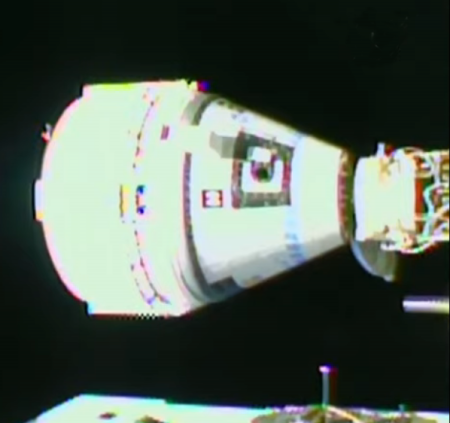
Screen capture just after soft docking.
Boeing and NASA today successfully docked an unmanned Starliner capsule to ISS for the first time, completing the up-from-Earth portion of this demo mission to prove out this Boeing spacecraft as a future ferry to bring astronauts to and from the station.
The screen capture to the right, taken from the live feed, shows Starliner just after a successful soft capture docking. This was shortly followed by a hard dock.
They will open the hatch tomorrow after checking out the capsule’s linkage with ISS.
The docking itself was delayed by about 78 minutes, partly to time the docking during a period of good orbital communications and partly because of an issue with NASA’s own docking ring on the station that required engineers to reset it.

Click for full image.
Another cool image to herald in the weekend! The photo to the right, cropped and reduced to post here, was taken by the Hubble Space Telescope and shows a pair of spiral galaxies about 800 million light years away.
The smaller galaxy is superimposed on the larger one, which is a type of active galaxy called a Seyfert galaxy.
Seyfert galaxies are named for astronomer Carl K. Seyfert who, in 1943, published a paper about spiral galaxies with very bright emission lines. Today we know that about 10% of all galaxies may be Seyfert galaxies. They belong to the class of “active galaxies” – galaxies that have supermassive black holes at their centers accreting material, which releases vast amounts of radiation. The active cores of Seyfert galaxies are at their brightest when observed in light outside the visible spectrum. The larger galaxy in this pair is a Type II Seyfert galaxy, which means it is a very bright source of infrared and visible light.
In other words, both of these galaxies emit a lot of radiation in the infrared, radio, and X-rays due to activity taking place at the supermassive black holes believed to be at their cores.

Click for original image.
Cool image time! The picture to the right, rotated, cropped, reduced, and annotated to post here, was taken on September 21, 2021 by the high resolution camera on Mars Reconnaissance Orbiter (MRO) and shows what appear to be a variety of flows, from alluvial fill to slope streaks to dust coming down the southeastern interior rim of 77-mile-wide Orson Welles Crater on Mars.
The location is almost right on the equator, so none of these flows are ice- or water-related. Nor are such flows unusual in the meandering 800-mile-long canyon that cuts through Orson Wells crater, dubbed Shalbatana Vallis. I featured similar flows at a spot to the north and downstream from this one in May 2021, also on the canyon’s eastern rim.
The overview map below provides some context.
» Read more

Michigan Governor Gretchen Whitmer, Democrat and would-be dictator
Bring a gun to a knife fight: A coalition of five Michigan bowling alleys has sued Democratic Party Governor Gretchen Whitmer as well as the state’s Department of Health and Human Services Director Robert Gordon for shutting down their businesses for more than a year during the Wuhan panic without providing them any just compensation.
You can read the complaint here [pdf].
Plaintiff’s chief counsel David Kallman told The Epoch Times after the appeals court hearing…
“Michigan is the only state in the nation where a governor’s public health emergency powers were overturned as unconstitutional. If we lose in the court of appeals, we will take this case to the U.S. Supreme Court.”Scott Bennett, executive director of the Independent Bowling and Entertainment Centers Association, told The Epoch Times: “The governor’s actions were devastating to our industry. Things went from ‘two weeks to slow the spread’ to indefinite shutdowns.”
» Read more

Click for interactive map.
Today’s update from the Perseverance’s science team provided a rough outline of their travel and drill-sampling plans for the Mars rover in Jezero Crater as it begins its climb up onto the delta that once poured into the crater. The route they plan to travel initially is dubbed Hawksbill Gap.
At Hawksbill Gap, however, we may instead carry out the first portion of the sampling sol path (which includes abrasion and collecting observations using our proximity science instruments) at up to 5 locations along our ascent. After that, we’ll turn around and begin a descent back down Hawksbill Gap and collect rock core samples at 3 of our abrasion locations.
This modified sampling strategy is intended to provide the team with valuable contextual information as we climb Hawksbill Gap and interpret the delta stratigraphy around us. With proximity science data in-hand, we can down-select our sampling sites to ensure we’ll be collecting the most scientifically valuable cores along our descent. Of course, we still maintain the option of collecting sample cores at any point during our ascent, if the team decides a particular abrasion site warrants immediate sampling.
The map above shows my guess (the red dotted lines) as to their potential routes uphill. As the science team has so far not published a map indicating exactly where Hawksbill Gap is, I can only guess at this point. The blue dot indicates Perseverance’s present position, the green dot Ingenuity.
As for the helicopter, there is no word yet whether the engineers have successfully gotten its batteries back to full charge. Until then, it cannot fly, and is also at risk of freezing up in the cold Martian winter.
The new colonial movement: India’s space agency ISRO has decided to delay the launch of its Gaganyaan manned orbital mission at least one more year (until ’24) in order to do two abort tests of the capsule.
“The first Test Vehicle for this purpose is ready and we will launch it in September this year. The human capsule will be sent up 15 kilometres, we will simulate an abort and then the capsule will be safely brought down by parachutes into the sea,’’ Somanath, who is also Secretary, Department of Space, said.
The second Test Vehicle will be launched in December this year, sent to a greater height and then brought back after a similar simulation is carried out.
The mission had originally been scheduled to launch in ’22, but was delayed significantly by India’s panic over Wuhan.

According to a report today in China’s state-run press, the team running its Zhurong Mars rover have placed it into a hibernation mode in order to sit out the Martian winter.
To tackle the dust storms and low-temperature challenges, the Chinese rover went into dormancy on Wednesday. It is expected to wake up and resume work in December when the dust clears and Mars enters its spring season, the administration said in a statement.
The rover sits somewhere in the blue circle in the map to the right, created using elevation data and images from Mars Reconnaissance Orbiter (MRO). This region is about 25 degrees north latitude, so though it is in the dry equatorial regions of Mars, it still gets very cold in winter, down to -180 degrees Fahrenheit at night. Furthermore, the increased winter dust storms block the light from the Sun, which reduces the available power the rover’s solar panels can produce.
Chinese engineers have apparently adapted the hibernation techniques they use on the Moon with their Yutu-2 rover to place Zhurong in hibernation.
Unbelievable: During the post-launch press conference last night Boeing officials revealed that, though the final burn to get Boeing’s Starliner capsule into orbit using its own thrusters succeeded, the thrusters did not function as planned.
Boeing Vice President Mark Nappi said a Starliner thruster failed after firing for one second as the spacecraft made a burn to enter orbit after separating from its Atlas V launch vehicle. The flight software switched to a second thruster, which fired for 25 seconds before shutting down prematurely. A third thruster took over and completed the firing, Nappi said.
The thrusters were made by Aerojet Rocketdyne, which also made the valves that did not work in the previous launch attempt in the summer of 2021. Whether the two problems are related is not known at this time.
A NASA official also noted that a cooling unit on the spacecraft operated “sluggishly during ascent,” but began working correctly once in orbit.
Right now NASA and Boeing are planning to proceed with the docking on ISS tonight at 7:10 pm (Eastern). It appears that though two thrusters have failed, they have ten more thrusters that can be used for further maneuvers throughout the mission. Furthermore, these thrusters are not used during the actual rendezvous and docking.
The live stream of the docking goes live at 3:30 pm (Eastern), and is embedded below. Until then enjoy NASA propaganda, some of it might be of interest.
Update: NASA has cut off coverage of the docking on the channel I had embedded previously. I have now embedded an active live feed.
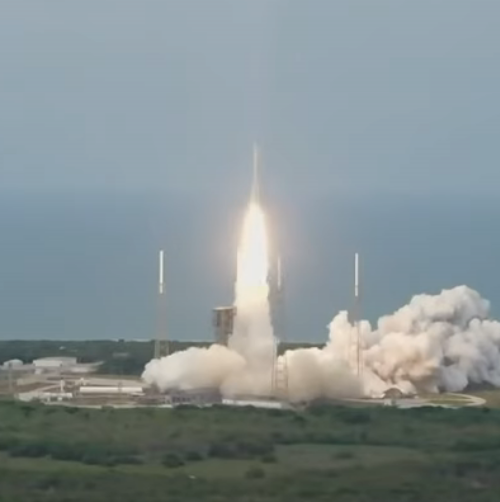
Screen capture just after lift-off
Capitalism in space: ULA’s Atlas-5 rocket today successfully launched Boeing’s manned Starliner capsule into orbit on its second attempt to complete an unmanned demo mission to ISS.
The capsule having been deployed by the rocket then followed with a final burn using the capsule’s own engines to get into its proper orbit for rendezvous with ISS tomorrow at 7:10 pm (Eastern). It was during this rendezvous period that Starliner had its problems in the first demo mission in December 2019 that caused the mission to be aborted prior to docking. Hopefully those software issues have been solved and all will go well through tomorrow.
It is interesting to compare the operation and equipment of Boeing/ULA vs SpaceX. While SpaceX has aimed for a sleek look, Boeing/ULA both retain the industrial feel of past rocketry. Neither is wrong, but the difference highlights the consequences of having competing operations. You get variety.
The leaders in the 2022 launch race:
21 SpaceX
15 China
7 Russia
3 Rocket Lab
3 ULA
American private enterprise now leads China 30 to 15 in the national rankings, and the entire world combined 30 to 25.

Alaska Airlines: Opposed to free speech and religious freedom
Picture credit: Quintin Soloviev
Bring a gun to a knife fight: Today’s blacklist story is a follow-up on a September 2021 story about two flight attendants — Marli Brown and Lacey Smith — who were fired by Alaska Airlines because they had the nerve to question the airline’s public support of a gay rights bill, and asked those questions on a forum the airline had itself arranged for employees to comment.
At the time the attendants, represented by the First Liberty Institute, had filed a complaint with the Equal Employment Opportunity Commission (EEOC), which recently issued “right-to-sue” letters to both attendants.
First Liberty has now filed its lawsuit, which you can read here [pdf]. The suit is against both Alaska Airlines and the Association of Flight Attendants Association of the AFL-CIO that failed to defend both Brown and Smith. From the complaint:
On February 25, 2021, Alaska Airlines posted an article about its support for the Equality Act to an internal employee message board and solicited employee comments. The Equality Act is proposed legislation that would add “sexual orientation and gender identity” as protected classes to a variety of federal statutes and would curtail the applicability of the Religious Freedom Restoration Act.
In response, Marli and Lacey felt compelled by their Christian faith to post one comment each, asking about the impact of the Equality Act on civil rights for religion and women in the workplace.
Alaska Airlines responded to Marli and Lacey’s posts by immediately removing Marli and Lacey from their flight schedules, terminating their employment, and disparaging their religious expression and beliefs as “discriminatory,” “hateful,” and “offensive.”
» Read more

The Sun’s south pole, as seen by Solar Orbiter at perihelion. Click for full movie.
The European Space Agency (ESA) yesterday released a few of the images taken by its Solar Orbiter spacecraft before and during its first perihelion (closest point in its orbit) on March 26, 2022.
The spacecraft was inside the orbit of Mercury, at about one-third the distance from the Sun to the Earth, and its heatshield was reaching around 500°C. But it dissipated that heat with its innovative technology to keep the spacecraft safe and functioning.
Solar Orbiter carries ten science instruments – nine are led by ESA Member States and one by NASA – all working together in close collaboration to provide unprecedented insight into how our local star ‘works’. Some are remote-sensing instruments that look at the Sun, while others are in-situ instruments that monitor the conditions around the spacecraft, enabling scientists to ‘join the dots’ from what they see happening at the Sun, to what Solar Orbiter ‘feels’ at its location in the solar wind millions of kilometres away.
The photo above, cropped, reduced, and revised slightly to post here, looks at the Sun’s south pole, from the side. The surface of the Sun (the top two thirds) almost looks like thunderheads on Earth, except the rain coming from them are high energy heat and radiation.
The data produced a lot of fascinating short movies, all available at the link, including a phenomenon the scientists have nicknamed a “space hedgehog” because of its look. About 15,000 miles across, “At present no one knows exactly what it is or how it formed in the Sun’s atmosphere.”
At 6:54 pm (Eastern) tonight a ULA Atlas-5 rocket will launch Boeing’s manned Starliner capsule on its second attempt to complete an unmanned demo mission to ISS.
NASA’s live coverage will begin at 6 pm on NASA-TV. I have embedded the youtube channel of this live stream below the fold. At the moment the station is broadcasting its regular NASA propaganda (some of which is actually informative). The launch’s actual coverage will begin at 6 pm (Eastern), and continue until the spacecraft is successfully inserted into orbit. Further coverage of the flight, including docking with ISS, will be as follows:
9 pm (Eastern) – Post launch press conference (time subject to change).
May 20
3:30 pm (Eastern) – Coverage begins of the rendezvous and docking to ISS, with the actual docking scheduled for 7:10 pm (Eastern).
May 21
11:30 am (Eastern) – Coverage of the opening of Starliner’s hatch, scheduled for 11:45 am (Eastern).
Boeing’s first attempt to complete this mission in December 2019 was forced to return to Earth before docking with ISS because of numerous software issues. Then, an attempt to launch again in August 2021 was scrubbed because numerous valves in the capsule’s service module failed to operate properly during the countdown. The company had to return the capsule to the factory to replace that service module as well as make some changes to the valves to make today’s launch possible.
For Boeing, these delays and fixes have cost the company a lot of money, since its contract with NASA is fixed price. This second demo mission will cost Boeing about $400 million, but even worse, the delays meant that SpaceX got some of the business with NASA and other private customers that it might have gotten had Starliner been operational.
Update: NASA has cut off coverage of the docking on the channel I had embedded previously. I have now embedded an active live feed.
Capitalism in space: Because of an as yet unexplained technical issue discovered on its New Shepard suborbital spacecraft, Blue Origin has scrubbed tomorrow’s planned fifth passenger flight.
The only information the company released was in a tweet yesterday:
During our final vehicle check-outs, we observed one of New Shepard’s back-up systems was not meeting our expectations for performance.
No other information has so far been released, nor has the company indicated when the flight might be rescheduled. It is intended to carry six passengers on a short suborbital flight, including one making his second flight on New Shepard.
Engineers are puzzling over strange operational data coming from Voyager-1, launched in 1977 and now in interstellar space more than 14 billion miles away, that suggests a technical problem but also makes no sense.
The engineering team with NASA’s Voyager 1 spacecraft is trying to solve a mystery: The interstellar explorer is operating normally, receiving and executing commands from Earth, along with gathering and returning science data. But readouts from the probe’s attitude articulation and control system (AACS) don’t reflect what’s actually happening onboard.
The AACS controls the 45-year-old spacecraft’s orientation. Among other tasks, it keeps Voyager 1’s high-gain antenna pointed precisely at Earth, enabling it to send data home. All signs suggest the AACS is still working, but the telemetry data it’s returning is invalid. For instance, the data may appear to be randomly generated, or does not reflect any possible state the AACS could be in.
The issue hasn’t triggered any onboard fault protection systems, which are designed to put the spacecraft into “safe mode” – a state where only essential operations are carried out, giving engineers time to diagnose an issue. Voyager 1’s signal hasn’t weakened, either, which suggests the high-gain antenna remains in its prescribed orientation with Earth.
Figuring out what has happened is made more difficult by distance. It takes about 20 hours for signals to get from Voyager-1 to Earth, even at the speed of light. Thus, any attempted fix will arrive almost two days after it first occurred, at the soonest.
Both Voyager-1 and Voyager-2 are still operating, though at significantly reduced power. It is expected that sometime in the next few years their nuclear power sources will finally be unable to produce enough power to keep them functioning. If so, both spacecraft will have survived the maximum time predicted when launched.
Russia’s military today successfully used a Soyuz-2 rocket to launch a satellite believed designed to map precisely the Earth’s topography.
The leaders in the 2022 launch race:
21 SpaceX
15 China
7 Russia
3 Rocket Lab
2 ULA
The U.S. still leads China 29 to 15 in the national rankings, and entire world combined 29 to 25.
Embedded below the fold in two parts.
To listen to all of John Batchelor’s podcasts, well worth your time, go here.
» Read more

Click for full image.
Cool image time! The image to the right, reduced to post here, was taken by the Hubble Space Telescope of the giant elliptical galaxy NGC 474.
Located some 100 million light-years from Earth, NGC 474 spans about 250,000 light-years across – that’s 2.5 times larger than our own Milky Way galaxy! Along with its enormous size, NGC 474 has a series of complex layered shells that surround its spherical-shaped core. The cause of these shells is unknown, but astronomers theorize that they may be the aftereffects of the giant galaxy absorbing one or more smaller galaxies. In the same way a pebble creates ripples on a pond when dropped into the water, the absorbed galaxy creates waves that form the shells.
About 10% of elliptical galaxies have shell structures, but unlike the majority of elliptical galaxies, which are associated with galaxy clusters, shelled ellipticals usually lie in relatively empty space. It may be that they’ve cannibalized their neighbors.
NGC 474 is no exception, also located in a relatively empty region of space.

Diamond “Ellie” Puentes, blacklisted because she believes
in “her body, her choice!”
They’re coming for you next: A student at Union College in New York, Diamond “Ellie” Puentes, was expelled from school because she refused to get a COVID booster because of the serious adverse effects she experienced after getting her second COVID shot.
More information here.
Worse, the school refused to accept her doctor’s note requesting she be exempt, or her hospital records describing the health issues she had experienced. From the first link above:
Union College’s Director of Health Services Angela Stefanatos asked her, “Are you here because you don’t want to get the booster or because you’re truly sick?”
Dr. Thomas Nelson, Puentes’ primary care physician, wrote a letter addressed to the college on April 11 regarding his patient’s concerns with the booster shot. He stated that Puentes was “in an unfavorable state of health, presumably caused by the vaccine itself.”
» Read more
Real insurrection: According to a Homeland Security memo, pro-abortion protesters have been organizing to storm the Supreme Court, burn it down, and murder justices in protest should the court decide to overturn Roe v. Wade.
The threats also included attacking places of worship as well as anti-abortion clinics.
As is typical nowadays, Homeland Security tried to de-emphasize the seriousness of these threats of violence from the left by first hinting it was really a response to white supremacy and thus possibly justified, and then claiming such violence is really nothing more than constitutional protected speech. These two quotes from the memo from this Axios story illustrate this:
“Some racially or ethnically motivated violent extremists’ embrace of pro-life narratives may be linked to the perception of wanting to ‘save white children’ and ‘fight white genocide,'” the memo … says.
But the memo warns that this time, extremist acts could come from abortion-rights proponents as well. [However] “The mere advocacy of political or social positions, political activism, use of strong rhetoric, or generalized philosophic embrace of violent tactics does not constitute domestic violent extremism or illegal activity and is constitutionally protected.”
As always, our leftist government uses the premises of the left to excuse leftist violence. To them, the violence of the left is merely speech, while the speech of the right is violence, and must be silenced.
Should the Supreme Court overturn Roe v. Wade, we should all be prepared for riots as bad or worse as those that occurred after George Floyd’s death. This memo is merely stating the obvious. Since the election of Donald Trump in 2016 the left has decided that the only democracy and law it accepts is one in which it gets its way, every single time.
We should also be prepared for our government to do nothing to stop it, and if any rioters are captured to arrange their release as quickly as possible. These protests are certainly intended as a weapon to warp the results of November’s election, in favor of Democrats. Remember, the violent leftist protesters are merely the storm-troopers of the Democratic Party, used to promote violence in order to make possible the reelection of its politicians, by hook or by crook.
.jpg)