Avio completes its first Vega-C launch for ESA

The Italian rocket company Avio today successfully completed its first Vega-C launch for the European Space Agency (ESA), placing into orbit ESA’s SMILE telescope, designed to study the Sun’s solar wind and its interaction with the Earth’s magnetic field.

The significance of this launch is that it is the first time the Vega-C was launched under the management of Avio, which manufactures it, rather than ESA’s commercial division Arianespace. Arianespace is being cut out of the picture. At the moment I think it only has one more Vega-C launch on its manifest. All other future Vega-C launches will be sold and managed by Avio directly.

As this was Avio’s first official launch in 2026 (or ever), the leader board for the 2026 launch race remains unchanged.

57 SpaceX
28 China
8 Russia
6 Rocket Lab

For the third straight year SpaceX leads the entire world combined in total launches, 57 to 50.

0 comments

May 18, 2026 Quick space links

Courtesy of BtB’s stringer Jay. This post is also an open thread. I welcome my readers to post any comments or additional links relating to any space issues, even if unrelated to the links below.

3 comments

The weird tilted layers on the floor of Danielson Crater on Mars

Tilted layers inside Danielson Crater
Click for original image.

Today’s cool image to the right returns us to a previous cool image from 2022. Then I called this strange terrain visible on the floor of the 41-mile-wide Danielson Crater “freaky badlands,” because of the innumerable layers that are all tilted and appear eroded in the same way by prevailing winds coming from the northeast.

Today’s image shows more of the same. The picture to the right, cropped to post here, was taken on March 26, 2026 by the high resolution camera on Mars Reconnaissance Orbiter (MRO). It not only shows these layers, in the full image (which I strongly suggest you look at), it also shows several terraced mesas with the same tilt, each looking almost like wedding cakes that have slumped sideways. The aquamarine colors in the hollows suggest finer-grained dust, while the orange colors on higher terrain suggest coarser materials and bedrock.

As I noted in 2022:
» Read more

0 comments

Cargo Dragon docks with ISS

Spacecraft presently docked to ISS
The spacecraft presently docked to ISS.

The unmanned Dragon capsule that SpaceX launched on May 15, 2026 successfully docked with ISS early this morning, bringing with it almost 6,500 pounds of cargo to the station.

In addition to cargo for the crew aboard the space station, Dragon will deliver several new experiments, including a project to determine how well Earth-based simulators mimic microgravity conditions, a bone scaffold made from wood that could produce new treatments for fragile bone conditions like osteoporosis, and equipment to help researchers evaluate how red blood cells and the spleen change in space. The Dragon spacecraft also will carry a new instrument to study charged particles around the Earth that can impact power grids and satellites, an investigation that could provide a fundamental understanding of how planets form, and a instrument designed to take highly accurate measurements of sunlight reflected by Earth and the Moon.

It also delivered a French-made spacesuit prototype to be tested by French astronaut Sophie Adenot to see if its design will allow her to get in and out of the suit in under two minutes. Based on what Adenot reports, engineers will use this prototype to develop “a new prototype” for further ground testing. (I wonder if this project is like most European space projects: After this second prototype is tested, they will build a third prototype, followed by a fourth and fifth, with the real article not actually going into operation for decades hence.)

2 comments

SpaceX prepares for the biggest IPO in history

SpaceX logo

As SpaceX and numerous banks get ready for the company’s initial public offering of stock (IPO), several tidbits about the structure of the stock and the company post-IPO have been dribbling out.

First, prior to the sale the company split its stock, converting each existing private share from one to five. It appears this action served to protect the value of that previously issued stock, much of which had either been issued to employees or purchased by major investors, including Musk. This split maintains their control over the company.

It also lowered the expected price of the stock in the IPO, ranging from present estimates of $100 to $160.

The absolute level of a stock doesn’t typically matter all that much, but a lower price might help smaller retail investors build positions. Retail shareholders are expected to be important for SpaceX. They hold a lot of Tesla shares.

Second, these preliminary stock arrangements appear designed to guarantee Elon Musk will remain in control of the company, even after it goes public. His shares, numbering 260 million (which could be more than a billion if prior to the stock split), will be given supervoting powers, ensuring his mastery of the company.

When the IPO happens remains uncertain. The Wall Street Journal says June 12, 2026, while Bloomberg says it could be as soon as May 20th.

Either way, it will be a major financial event, and should shake up the entire global launch industry in ways that cannot be predicted. It will certainly give SpaceX the funds it needs to develop Starship/Superheavy fully, making access to space cheap and affordable. It will also allow the company to pursue its goals in space, establishing data centers constellations in orbit and on the Moon (for profit) as well as colonies on Mars.

Whether the IPO will suck all the investment capital out of the rest of the industry remains uncertain, though some are claiming this. In reality, it could just as easily end up doing the opposite, as the market is never zero-sum game. Success in one place usually ends up fueling success all around.

Either way, this IPO is going to change things for sure. It will establish without question what I have been saying for more than a year, that the real American space program is being run by SpaceX, and that NASA’s Artemis program is merely a long term ineffective sideshow that is simply aiding the company achieve its goals.

7 comments

China launches another 18 Qianfan internet satellites

China today successfully launched 18 more Qianfan internet satellites (also called SpaceSail), its Long March 8 rocket lifting off from its coastal Wenchang spaceport.

Though China’s state run press did not reveal the number of satellites launched, other sources said the rocket placed 18 satellites into orbit. If so, there are now 173 Qianfan satellites in space, out of a planned constellation of as many as 12,000. The first phase of the constellation however only requires 648, which China hopes to reach before the end of the year.

The leaders in the 2026 launch race:

57 SpaceX
28 China
8 Russia
6 Rocket Lab

For the third straight year SpaceX leads the entire world combined in total launches, 57 to 49.

5 comments

SpaceX launches cargo Dragon to ISS

SpaceX today launched an unmanned Dragon freighter to ISS, its Falcon 9 rocket lifting off from Cape Canaveral Space Force Station in Florida.

The first stage completed its 6th flight, landing back at Cape Canaveral. The capsule is also making its sixth flight to ISS, and will dock with the station at 7 am (Eastern) on May 17, 2026.

57 SpaceX
27 China
8 Russia
6 Rocket Lab

For the third straight year SpaceX leads the entire world combined in total launches, 57 to 48.

0 comments

May 15, 2026 Quick space links

Courtesy of BtB’s stringer Jay. This post is also an open thread. I welcome my readers to post any comments or additional links relating to any space issues, even if unrelated to the links below.

9 comments

The barren hills west of Jezero Crater

The barren Martian hills west of Jezero Crater
Click for full panorama.

Overview map
Click for interactive map.

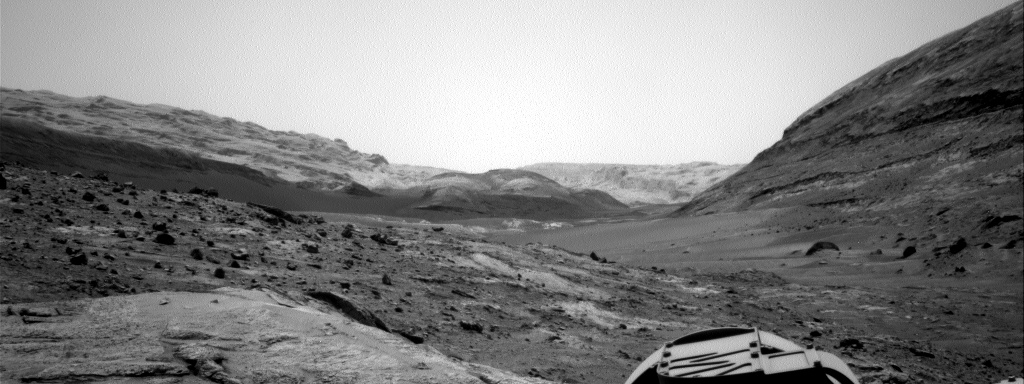
Cool image time! The panorama above, cropped and reduced to post here, was created on April 5, 2026 using 46 pictures taken by one of the high resolution camera’s on the Mars rover Perseverance. It also attempts to show this terrain in natural color.

The blue dot on the overview map to the right marks Perseverance’s present location. The green dot indicates where I think the rover was when the panorama was taken. (Note: I think the press release incorrectly lists the Sol number for these dates, but as I am not sure I can only guess.) The yellow lines indicate approximately the terrain seen in the full panorama.

As the press release notes, “the panorama offers one of the richest geological vistas of the rover’s mission, revealing a windswept landscape of diverse rock textures.” It also appears this is the direction the rover is presently headed.

I ask my readers to once again look at this panorama. It shows an utterly barren terrain. There is no life here, and if there ever was it was gone billions of years ago and never did much to shape the landscape. While some at NASA and in the planetary community like to tout the possibility of life on Mars in order to lobby for funding, the reality we see says there is none, and that life will only appear on Mars when humans finally arrive there to build new human societies.

5 comments

Intuitive Machines buys British ground station company

The lunar lander startup Intuitive Machines is now in the process of buying the British ground station company that operates antennas used for deep space communications in both Britain and the U.S.

Intuitive Machines announced May 14 that it entered into an agreement to acquire Goonhilly Earth Station Ltd. and its American subsidiary, Comsat. Intuitive Machines will pay 37 million pounds ($49.6 million) for Goonhilly, split equally between cash and stock, according to a Securities and Exchange Commission filing. The deal is expected to close in the third quarter pending regulatory approvals in the U.S. and U.K.

Goonhilly operates a ground station in Cornwall, England, that includes 30- and 32-meter antennas that have been used for lunar and deep-space communications. Through Comsat, it operates teleports in Southbury, Connecticut, and Santa Paula, California, that have dozens of antennas.

This antenna deal gives the company added flexibility in its future lunar missions. It also gives it a capability it can sell to both the European Space Agency as well as NASA. NASA for example is looking to accelerate in the next few years the number of unmanned lunar landers it will buy from the commercial sector. It also is looking for commercial options to improve its communications capabilities for those missions. Intuitive Machines is now better placed to compete for this work.

2 comments

Northrop Grumman completes successful test of new nozzle for its solid-fueled boosters

Unexpected debris falling from rocket at about T-1:00
Nozzle failure during February 12, 2026 Vulcan launch

Northrop Grumman on April 15, 2026 successfully completed a test of a new nozzle design of a GEM solid-fueled booster, the strap-on booster whose nozzle failed on two previous ULA Vulcan rocket launches.

On April 15, the company said Northrop Grumman performed a successful static fire test of a Graphite Epoxy Motor (GEM) 63XL Solid Rocket Booster (SRB). A spokesperson told Spaceflight Now on Thursday that the test served to “demonstrate nozzle design enhancements which were already in work and an advanced propellant technology for future solid rocket motors across their portfolio.”

“The information gathered from this test, along with findings from the investigations will provide critical data to validate analytical models and support Vulcan’s return to flight,” the spokesperson said.

At the moment the Pentagon has grounded all Vulcan launches because of this nozzle issue, and has given several planned Vulcan payloads to SpaceX instead. ULA hopes to resume normal Vulcan flights using GEM boosters before the end of the year, but it also hopes to launch Vulcan sooner without the boosters. It is right now preparing a boosterless Vulcan to do a launch for Amazon, placing an as yet undetermined number of Leo satellites into orbit. It is also possible it will do the same with AST SpaceMobile’s Bluebird satellites.

3 comments
1 2 3 4 5 6 2,413