August 2, 2023 Quick space links

Courtesy of BtB’s stringer Jay.


  • Luna-25’s mission profile
  • Based on this profile, the spacecraft will head to the Moon on its first orbit after launch, and get there only a few days later. This means it will be attempting its landing only days before India’s already launched Chandrayaan-3, which is targeting an August 23rd landing date.

0 comments

Voyager Space partners with Airbus to build its Starlab space station

Voyager Space, one of the three companies with a contract from NASA to develop a commercial private space station, has now signed a partnership agreement with the European aerospace company Airbus to work together to build its Starlab space station.

The companies announced Aug. 2 the creation of a joint venture, also called Starlab, that will be responsible for the development and operation of the station. The joint venture builds upon an agreement announced in January where Voyager selected Airbus to provide technical support for the proposed station.

“This transatlantic venture with footprints on both sides of the ocean aligns the interests of both ourselves and Voyager and our respective space agencies,” said Jean-Marc Nasr, head of space systems at Airbus, in a statement. “Together our teams are focused on creating an unmatched space destination both technologically and as a business operation.”

Though no specifics of the deal were released, Voyager will continue to retain 51% control. It appears that Voyager’s goal with this deal is to get its foot in the door of Europe. With ESA no longer considering doing any work on the space stations of either China or Russia, it needs a place to go after ISS is retired. By signing up Airbus as a partner Voyager makes Starlab the most likely go-to station for these European companies and governments.

Isn’t private enterprise and freedom wonderful? Without even trying Europe is going to get a space station of its own, and it will do it by hiring this private consortium of American and European companies.

Hat tip to Jay, BtB’s stringer.

0 comments

The first glacial evidence found on Mars back in 2007

Glaciers on Mars?
Click for original image.

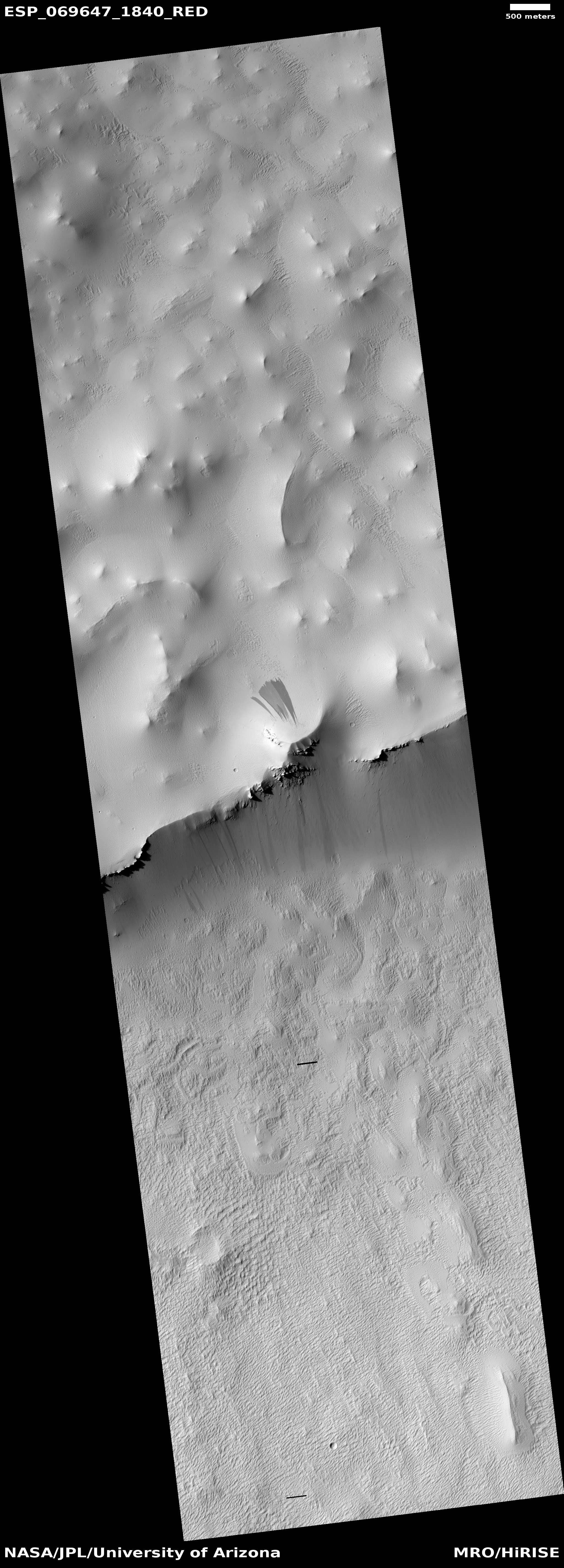
Cool image time! The picture to the right, cropped, reduced, sharpened, and annotated to post here, was taken on January 3, 2023 by the high resolution camera on Mars Reconnaissance Orbiter (MRO). It shows the eastern wall of what the scientists call a graben, a large depression caused when the ground inside the depression suddenly shifted downward.

The elevation difference between the high and low points is about 3,500 feet. The streaks on the lower half of the cliff wall are slope streaks, a phenomenon unique to Mars that remains at this moment unexplained. Though the streaks resemble avalanches, they do not change the topography in any way, have no debris pile at their base, and appear instead to be a stain that appears at random times of the year that fades with time.

What is intriguing about this picture however is the wavelike floor on its western half. At first glance these waves suggest some form of dust dunes or lava flows, but neither conclusion appears correct. Instead, we are looking at what was one of the first discoveries on Mars of what scientists have determined to be glacial features.
» Read more

0 comments

Senate committee gives NASA and Commerce responsibility for removing space junk

The Senate Commerce committee has now okayed a bill that would require NASA to develop several space junk removal projects while giving the Commerce department the responsibility of identifying what space junk needs to be removed.

The core of the bill would direct NASA to establish an active debris removal program. That would include funding research and development activities “with the intent to close commercial capability gaps and enable potential future remediation missions for such orbital debris,” the bill states. NASA would also fund a demonstration mission for debris removal and allow it and other agencies to procure debris removal services.

The version of the ORBITS Act approved by the committee is different from the version introduced earlier this year. Among the changes is in a section that originally called on NASA to develop a prioritized list of orbital debris to remove. In the new version, that responsibility is given instead to the Commerce Department. The Commerce Department, through its Office of Space Commerce, is developing a space traffic coordination system called the Traffic Coordination System for Space (TraCSS) that will take over civil space traffic management roles currently handled by the Defense Department. That involves taking in data from Defense Department and other sources and using it to provide warnings of potential close approaches to satellite operators.

Though unstated, this bill appears to be a direct slap at the FCC’s effort under the Biden administration to claim the power to regulate space junk, despite its lack of statutory authority to do so.

The bill is of course not yet law, as it still needs to be approved by both the House and Senate. However, some version that stops the FCC now seems very likely, as the House itself has already rejected a bill that would have approved the FCC power grab.

0 comments

Satellite startup Planet lays off 10% of its workforce, most located in San Francisco

According to a filing to the SEC yesterday, the smallsat startup Planet has laid off 10% of its workforce, 117 employees of which 85 are located in San Francisco, in order “to prioritize our attention on the highest ROI [return on investment] opportunities for our business and mission,” as expressed by the company’s CEO to his employees.

The company presently operates a constellation of more than 200 small satellites designed to provide high resolution imagery of the Earth. In late 2021 it went public through a merger with a SPAC (special purpose acquisition company), and has since seen its stock price drop from $11.35 to $3.75 yesterday.

The layoffs this week are likely simply the company recognizing that its main office in San Francisco had become bloated and it needed to economize. It is even possible the company is now considering a move from San Fran and California, though this is not mentioned in any of its announcements.

2 comments

Bones of the biggest ever whale species possibly found?

A big whale?

The uncertainty of science: Paleontologists have discovered a portion of the skeleton of what they claim might be the biggest and heaviest animal ever found, a whale that potentially grew to be as much as twice as big as a blue whale, the largest living species previously known.

A newly described fossilized whale named Perucetus colossus, dating to roughly 38 million years ago, might have been heavier than a blue whale, even if it was not as long. Blue whales, which are endangered, weigh about 100 to 150 tonnes, although some might be as heavy as 200 tonnes. Perucetus colossus was between 85 and 340 tonnes, according to the scientists who found and described the remains: 13 vertebrae, 4 ribs and a bit of pelvis. Their best-guess estimate is that the whale was around 180 tonnes. This mind-boggling mass is the result of its bones, which were big and dense — an evolutionary adaptation that helped it to dive.

The graphic to the right shows the discovered bones in red, with the rest of the theorized skeleton indicated in grey. Only in the article’s next-to-last paragraph does Nature recognize this very very very large uncertainty:

The team chose to create a visual reconstruction of what the whale might have looked like, basing the head on skulls of related basilosaurid species, but they caution that some of the details are speculative. It could have been skinnier. But it also could have been quite a bit longer or fatter, [co-author Eli] Amson says.

In other words, they presently have no idea what the species actually looked like, or how big it actually was. It very well could have been much shorter and thinner than proposed. It appears therefore they chose to highlight the largest possible size to garner the biggest press coverage — which of course they are getting.

0 comments

NASA detects weak signal from Voyager 2

Though communications with Voyager 2 have not been re-established, JPL engineers using NASA’s Deep Space Network of antennas have detected a weak signal from Voyager 2 that indicates the spacecraft is still functioning.

Using multiple antennas, NASA’s Deep Space Network (DSN) was able to detect a carrier signal from Voyager 2. A carrier signal is what the spacecraft uses to send data back to Earth. The signal is too faint for data to be extracted, but the detection confirms that the spacecraft is still operating. The spacecraft also continues on its expected trajectory. Although the mission expects the spacecraft to point its antenna at Earth in mid-October, the team will attempt to command Voyager sooner, while its antenna is still pointed away from Earth. To do this, a DSN antenna will be used to “shout” the command to Voyager to turn its antenna. This intermediary attempt may not work, in which case the team will wait for the spacecraft to automatically reset its orientation in October.

The hope is that new commands to re-orient, sent by the strongest signal possible, might be heard by the spacecraft, causing it to obey now. If not, this weak signal from Voyager 2 still suggests that the October reset will occur as normal and engineers will be able to recover communications then.

2 comments

Northrop Grumman’s Antares rocket successfully places Cygnus freighter into orbit

Northrop Grumman’s Antares rocket tonight successfully launched a Cygnus freighter into orbit to ISS, flying for the last time with a first stage built in the Ukraine with engines from Russia.

Until Firefly can provide Northrop Grumman with a new American-made first stage, for the next three Cygnus cargo missions to ISS the company has purchased SpaceX’s Falcon 9 rocket.

This was Northrop Grumman’s first launch in 2023, so there is no change to the leader board in the 2023 launch race:

51 SpaceX
30 China
9 Russia
6 Rocket Lab
6 India

American private enterprise now leads China in successful launches 59 to 30, and the entire world combined 59 to 50, with SpaceX by itself still leading the entire world (excluding American companies) 51 to 50.

2 comments

Sunspot update: In July the Sun continued its high sunspot activity

Today NOAA released its monthly update of its graph that tracks the number of sunspots on the Sun’s Earth-facing hemisphere. As I have done every month for the entire thirteen years I have been doing this website, I have posted that updated graph below, adding to it some extra details to provide some context.

Though the sunspot count in July was slightly less than the very high numbers in June (the highest seen in more than two decades), the decline was almost inconsequential. Except for June’s activity, the activity in July was still the highest sunspot count in a month since September 2002, when the Sun was just beginning its ramp down after its solar maximum that reached its peak in late 2001. From that time until the last two months, the Sun had been in a very prolonged quiet period, with two solar minimums that were overly long and a single solar maximum that was very weak with a extended double peak lasting almost four years.
» Read more

7 comments

August 1, 2023 Quick space links

Courtesy of BtB’s stinger Jay.


For the next three Cygnus cargo missions to ISS Northrop Grumman has hired SpaceX’s Falcon 9 rocket as its launch vehicle while it awaits a new first stage from Firefly.
 

0 comments

The wind-scoured dusty and cratered dry tropics of Mars

The wind-scoured dusty and cratered dry tropics of Mars
Click for original image.

Cool image time! The picture to the right, cropped, reduced, and sharpened to post here, was taken on June 2, 2023 by the high resolution camera on Mars Reconnaissance Orbiter (MRO), and shows one small area in Martian equatorial regions where the main features are a dusty plain interspersed with craters, not entirely dissimilar to the Moon .

In the picture the northwest-to-southeast orientation of ridge-lines, plus the position of divots with their steep and deep end all on the northwest side, all suggest the prevailing winds here blow in the same direction, from the northwest to the southeast.

We are looking at a very ancient terrain. Many of these craters likely date from the early bombardment period of the solar system, just after the planets had formed but there was still a lot of objects around crashing into them.
» Read more

1 comment

Teachers, parents, and even school districts sue PA Ed Dept over Marxist guidelines

Parents are rejecting this in droves
Now parents, teachers, and administrators are rejecting this mantra

In April a lawsuit against the Pennsylvania Department of Education was filed by the parents, teachers,and three different school districts in western Pennsylvania, challenging the guidelines issued by the state that would force leftist indoctrination down the throats of kids and teachers.

The Mars Area, Penn Crest, and Laurel school districts, as well as two teachers, several board members and parents, filed a lawsuit Monday trying to stop the Shapiro [Democrat] administration from implementing “culturally relevant and sustaining education,” also known as CRSE, in every school district in Pennsylvania.

Leonard Rich, the superintendent of the Laurel School District, explained to KDKA-TV why he and the district joined the lawsuit. “CSRE goes beyond and tells students what to think,” he said. “I’m more driven to tell students and encourage students on how to think.”

“The district’s objection that we are being mandated to not teach our kids how to think but what to think,” he added. “Freedom of expression is a First Amendment right.”

The Thomas More Society is representing the litigants. You can read the filed complaint here [pdf].

The new guidelines are right out of the critical race theory playbook, requiring schools and teachers to:
» Read more

3 comments
1 425 426 427 428 429 2,412