
Spaceports battle for space tourists
The competition heats up: Though it mentions the efforts of other spaceports, the story is mostly about Blue Origin’s spaceport in western Texas and how their rising activity is revitalizing the town of Van Horn.
Very brief descriptions, with appropriate links, of current or recent news items.
The competition heats up: Though it mentions the efforts of other spaceports, the story is mostly about Blue Origin’s spaceport in western Texas and how their rising activity is revitalizing the town of Van Horn.
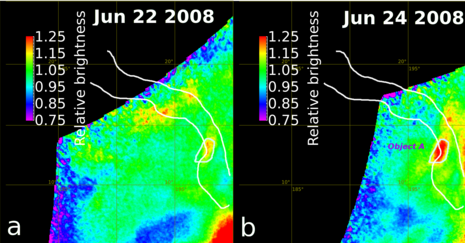
Cool image time! Using archival data from Venus Express, scientists have identified several spots on Venus where it appears there are active lava flows.
Using a near-infrared channel of the spacecraft’s Venus Monitoring Camera (VMC) to map thermal emission from the surface through a transparent spectral window in the planet’s atmosphere, an international team of planetary scientists has spotted localised changes in surface brightness between images taken only a few days apart. “We have now seen several events where a spot on the surface suddenly gets much hotter, and then cools down again,” says Eugene Shalygin from the Max Planck Institute for Solar System Research (MPS) in Germany, and lead author of the paper reporting the results in Geophysical Research Letters this month. “These four ‘hotspots’ are located in what are known from radar imagery to be tectonic rift zones, but this is the first time we have detected that they are hot and changing in temperature from day to day. It is the most tantalising evidence yet for active volcanism.”
The hotspots are found along the Ganiki Chasma rift zone close to the volcanoes Ozza Mons and Maat Mons. Rift zones are results of fracturing of the surface, which is often associated with upwelling of magma below the crust. This process can bring hot material to the surface, where it may be released through fractures as a lava flow.
There have been hints of volcanic activity on Venus since Pioneer Venus Orbiter first circled the planet from 1978 to 1992. This appears to be the first solid evidence of it.
Worlds without end: Scientists have measured the size and mass of the smallest exoplanet yet, a Mars-sized planet orbiting a star about 200 light years away.
The planet, named Kepler-138 b, is the first exoplanet smaller than the Earth to have both its mass and its size measured. It is one of three planets that orbit the star Kepler-138 and that pass in front of it on every orbit as viewed from Earth — a maneuver that astronomers call a transit. “Each time a planet transits the star, it blocks a small fraction of the star’s light, allowing us to measure the size of the planet,” said Dr. Daniel Jontof-Hutter, a research associate in astronomy at Penn State who led the study.
“We also measured the gravity of all three planets, using data from NASA’s Kepler mission, by precisely observing the times of each transit,” Jontof-Hutter said. The astronomers also were able to measure the masses of these planets. “Each planet periodically slows down and accelerates ever so slightly from the gravity of its neighboring planets. This slight change in time between transits allowed us to measure the masses of the planets,” Jontof-Hutter explained. After measuring both the mass and size of an exoplanet, astronomers then can calculate its density and its bulk composition.
Science discovers the obvious: Scientists have discovered that viewing cat videos on the internet provides people with pleasure and positive emotions.
Coming soon: Research finds that eating food prevents starvation!
An inspector general report last year had advised OPM to shut down many of its computer systems because they were running without sufficient security. The agency ignored that recommendation.
In the audit report published November 12, 2014, OIG found that 11 out of 47 computer systems operated by OPM did not have current security authorizations. Furthermore, the affected systems were “amongst the most critical and sensitive applications owned by the agency.” Two of the unauthorized systems are described in the report as “general support systems” which contained over 65 percent of all OPM computer applications. Two other unauthorized systems were owned by Federal Investigative Services, the organization which handles background investigations in connection with government security clearances. OIG warned bluntly, “any weaknesses in the information systems supporting this program office could potentially have national security implications.”
Because of the volume and sensitivity of the information involved, OIG recommended OPM “consider shutting down systems that do not have a current and valid Authorization.” But OPM declined, saying, “We agree that it is important to maintain up-to-date and valid ATOs for all systems but do not believe that this condition rises to the level of a Material Weakness.”
The head of OPM also claimed in House hearings yesterday that their failure to close these systems down was justified since the hackers were already in the system when the recommendation was made.
In other words, we didn’t do anything to make the system secure, and when hackers broke in it was further justification for not doing anything.
Yeah, let’s put our healthcare under their control also!
The competition heats up: UrtheCast has released high resolution videos of three Earth cities taken from its camera on ISS.
Take a look. The cameras are quite successful in capturing the motion of vehicles on highways and road, which is amazing considering the vibrations that ISS experiences merely from astronaut movements.
The company plans to offer the imagery in several tiers, from a free video feed on its website to an API that will allow customers, including corporations, governments and individuals, to purchase imagery data from its database or make real-time requests for a look at a given spot on the earth. The cameras scan the ground under the ISS, which tracks the earth between about 51 degrees north and south latitude.
The competition heats up: In negotiations resulting from increased competition in the launch industry, France and its space agency have agreed to sell their stock in Arianespace to Airbus Safran, builders of the new Ariane 6, giving that private company 74% ownership.
I have reported on this deal earlier. This report makes it clear, however, that Arianespace will essentially become irrelevant after the deal is completed. Airbus Safran will build and own the rocket, and will be in charge.
The competition heats up: Saudia Arabia has signed a deal with Russia to work together to explore space for peaceful purposes.
This deal has less importance to the exploration of space. Instead, it signifies clearly the worsening relations between the U.S. and Saudia Arabia. For decades the Saudis would always turn to the U.S. for such deals. They are now looking elsewhere, having found the U.S. to be an unreliable partner during the Obama administration.
Engineers have begun shifting Rosetta’s trajectory paralleling Comet 67P/C-G in order to maximize communications with the lander Philae.
Commands to adjust the trajectory were successfully uploaded Monday evening; further commands will be uplinked on Thursday evening. The spacecraft will perform two manoeuvres, one on Wednesday morning and the second on Saturday morning. The effect of the two ‘dog-leg’ burns will be to bring the orbiter to a distance of 180 km from the comet and to reproduce the orbiter-comet geometry of the first contact.
We should therefore not expect further news from Philae for the rest of this week.
New Horizons has successfully completed another course correction and is shipshape for its fly-by of Pluto on July 14.
A 45-second thruster burst on June 14 refined New Horizons’ trajectory toward Pluto, targeting the optimal aim point for the spacecraft’s flight through the Pluto system. This was only the second targeting maneuver of New Horizons’ approach to Pluto; Sunday’s burst adjusted the spacecraft’s velocity by just 52 centimeters per second, aiming it toward the desired close-approach target point approximately 7,750 miles above Pluto’s surface.
The maneuver was based on the latest radio tracking data on the spacecraft and range-to-Pluto measurements made by optical-navigation imaging of the Pluto system taken by New Horizons in recent weeks.
Right now all looks good for the fly-by.
Finding out what’s in it: An audit by the inspector general of Health and Human Services (HHS) has found that the agency has no internal system to verify that $2.8 billion in Obamacare subsidies were paid correctly, or even to the right people.
The [inspector general] said the agency did not have a system to “ensure that financial assistance payments were made on behalf of confirmed enrollees and in the correct amounts.” In addition, [HHS] relied too heavily on data from health insurance companies and had no system for state-based exchanges to “submit enrollee eligibility data for financial assistance payments.”
The government does “not plan to perform a timely reconciliation” of the $2.8 billion in subsidies. [emphasis mine]
Not only have they given out billions without proper record-keeping or proper verification, the agency has no intention of fixing the problem. “Ain’t my job, man!”
Environmental activists protesting the launch of a drilling rig in Seattle did serious damage to a nature reserve, costing $10K to clean it up.
I am not surprised. The left and environmental movement has this annoying habit of blaming everyone else for the world’s problems, insisting that only they have the solutions. When their solutions fail, or when they screw up, however, they are never willing to admit their error, take personal responsibility, and look for a more effective solution. To them, it is always someone else’s fault.
The uncertainty of science: Scientists have measured significant quantities of methane released from six meteorites believed to have originally come from Mars.
This result could provide a non-biological source for the methane detected by Curiosity in Gale Crater.
With a second short contact on Sunday engineers have confirmed that Philae is healthy and capable of doing science. Now they must re-arrange Rosetta’s orbit and re-establish regular communications to get that science started.
The competition heats up: OneWeb has chosen Airbus to build its initial order of 900 cubesats, designed to create a constellation of satellites providing global internet access.
Facists: Because a Maryland DJ refused to work a birthday party for a homosexual couple they have now registered a complaint to the Montgomery County Human Rights Commission.
In this case, Lampiris [the owner of the DJ company] said he had never heard of [Maryland’s anti-discrimination] law, “but it’s important for us to make a stand. We don’t want to go against the law, but we also sometimes are called to do that if it goes against your faith. To me it would be like a synagogue having to cater to a neo-Nazi party or black DJ having to do a KKK dance,” he said. Gay clients don’t pose a “physical threat – it’s a conscience thing, and conscience is very important for everybody. In fact, I think it’s the most important thing.
Once again, the homosexual has not been denied service. There are plenty of DJs in the DC area that would handle this party. By filing the complaint they have instead waved the flag that demands that everyone approve of their behavior, even though it is considered morally wrong by many. (I must note that no one in this case is trying to stop their homosexual lifestyle. The DJ company is merely refusing to endorse it or agree to it.)
Or to put it another way, you will be made to agree.
Link here. To sum up, the fast track trade authority for Obama actually passed, but the companion part of the law, dubbed TAA, failed badly. Since the Senate had passed both, the approved law needs to go back to conference so that both houses pass the same bill, or the House can vote again on the portion that was defeated.
That the House leadership is still fighting for this considering the strong opposition from the voters as well as from their own caucus tells us how little they understand the present political situation.
After more than six months of silence after its bouncing landing on Comet 67P/C-G, Rosetta’s Philae comet lander has awakened and resumed communications with the science team.
More details here. The data they have so far received, which is still being analyzed, suggests that the lander has awakened previously and gathered data at that time. More to come!
Take a look at this photo montage of the abandoned remains of the Soviet Union’s space shuttle program. They spent a lot of money just to keep up with the Joneses, for something they could not afford.
It isn’t just us dependent on them: One Russian aerospace industry expert noted today that three-quarters of all their satellite electronics comes from the United States.
According to [Nikolay Testoyedov], up to 75 percent of the electronic components for Russian satellites come from the US. Consequently, if it retaliates should Moscow refuse to sell RD-180 rocket motors to Washington – which Deputy Prime Minister Dmitry Rogozin has threatened – Russia’s satellite program would be frozen for at least two years. “The imported electronic components in our satellites represent 25 to 75 percent of the total in communications; in military ones, somewhat less; in commercial ones, more,” Testoyedov says. Of these imported components, approximately 83-87 percent come from the United States thus giving Washington the whip hand.
If we stop providing these electronics he estimates that after their present stock runs out in about a year it would take at least two years before Russia could replace these American-made parts.