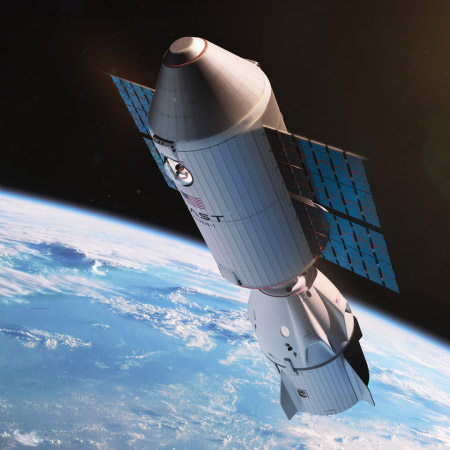
AST SpaceMobile reaffirms its goal to launch 45 Bluebird satellites by the end of ’26

Despite the launch failure last month by Blue Origin’s New Glenn rocket, causing the loss of its satellite, AST SpaceMobile in its most recent quarterly report this week reaffirmed its goal to get 45 Bluebird satellites into orbit by the end of 2026.

In AST SpaceMobile’s 10-Q filed with the SEC on Monday, the company said the loss is expected to be in line with the carrying value of the satellite, in the range of $155 million to $160 million. The company plans for an asset write-off in the second quarter of 2026. The company also said in the 10-Q it had launch insurance coverage that covered a portion of the satellite and launch costs and has filed claims.

“At the end of the day, remember, we have 33 satellites in advanced stages of production at the factory. So it was a loss, we’re on to the next,” Wisniewski told investors. He added that the company is working closely with Blue Origin and is “optimistic” about New Glenn returning to the launch pad soon.

The company’s next launch is with SpaceX on a Falcon 9 rocket that will launch three satellites — BlueBirds 8, 9 and 10. Wisniewski confirmed the company has contracted launch capacity to meet its target of deploying 45 satellites by the end of this year. He also mentioned that five BlueBirds would fit in a United Launch Alliance Vulcan configuration, mentioning the company has been developing other heavy launch providers outside of SpaceX and Blue Origin.[emphasis mine]

The highlighted sentence suggests the company is also negotiating new contracts with both Arianespace’s Ariane-6 rocket and India’s LVM3 rocket. It has already used the latter on one launch successfully.

Nonetheless, the only company with the capability of ramping up enough launches quickly this year to meet this goal will be SpaceX. Expect that company to get more Bluebird launches in 2026.

3 comments

The 12th Starship/Superheavy test orbital flight now scheduled for May 19, 2026

Starship/Superheavy (version 3) on launchpad

SpaceX yesterday announced that the 12th orbital test flight of its Starship/Superheavy rocket is now scheduled for May 19, 2026, with a launch window opening at 5:30 pm (Central).

The mission will be also be the first flight of what SpaceX calls Version 3 of both the booster and the spaceship, will include the first use of the Raptor-3 engine, and the first use of a completely redesigned launchpad.

The flight test’s primary goal will be to demonstrate each of these new pieces in the flight environment for the first time, with each element of the Starship architecture featuring significant redesigns to enable full and rapid reuse that incorporate learnings from years of development and test.

The booster’s primary test objective will be executing a successful launch, ascent, stage separation, boostback burn, and landing burn at an offshore landing point in the Gulf of America. As this is the first flight test of a significantly redesigned vehicle, the booster will not attempt a return to the launch site for catch.

The Starship upper stage will target multiple in-space and reentry objectives, including the deployment of 22 Starlink simulators, similar in size to next-generation Starlink satellites. The last two satellites deployed will scan Starship’s heat shield and transmit imagery down to operators to test methods of analyzing Starship’s heat shield readiness for return to launch site on future missions. Several tiles on Starship have been painted white to simulate missing tiles and serve as imaging targets in the test. The Starlink simulators will be on the same suborbital trajectory as Starship. A relight of a single Raptor engine while in space is also planned.

As an added potential test-to-failure, the company has also removed a single heat shield tile to test how Starship performs under this failure scenerio. The flight plan will be the same as the previous flights, designed to come down in the Indian Ocean.

A detailed description about the upgrades to Starship, Superheavy, and the ground systems can be found here.

The company will broadcast the launch live, which I will embed on Behind the Black once available.

16 comments

Genesis cover

On Christmas Eve 1968 three Americans became the first humans to visit another world. What they did to celebrate was unexpected and profound, and will be remembered throughout all human history. Genesis: the Story of Apollo 8, Robert Zimmerman's classic history of humanity's first journey to another world, tells that story, and it is now available as both an ebook and an audiobook, both with a foreword by Valerie Anders and a new introduction by Robert Zimmerman.

The print edition can be purchased at Amazon or any other book seller. If you want an autographed copy the price is $60 for the hardback and $45 for the paperback, plus $8 shipping for each. Go here for purchasing details. The ebook is available everywhere for $5.99 (before discount) at amazon, or direct from my ebook publisher, ebookit. If you buy it from ebookit you don't support the big tech companies and the author gets a bigger cut much sooner.


The audiobook is also available at all these vendors, and is also free with a 30-day trial membership to Audible.
 

"Not simply about one mission, [Genesis] is also the history of America's quest for the moon... Zimmerman has done a masterful job of tying disparate events together into a solid account of one of America's greatest human triumphs."--San Antonio Express-News

SpaceX kind of confirms rumor it is considering purchasing 136,000 acres in Louisiana

Pecan Island SpaceX facility?

In a tweet yesterday SpaceX sort of confirmed the rumor reported here last week that it is considering purchasing a giant 200-plus square mile plot (about 136,000 acres) on the south coast of Louisiana near the unincorporated town of Pecan Island.

It’s no secret that we intend to launch Starship a lot, targeting thousands of flights per year. That cadence will require the ability to launch from many different locations, so we are constantly exploring to find viable sites to expand Starship operations in the future, both domestically and internationally

This comment was in response to a tweet touting this rumor. Note that SpaceX’s comment is somewhat vague. It says the company is searching for additional launch locations for Starship, but does not say specifically if this Louisiana plot is one of them.

I suspect it is, based on all the known facts. The company is just being coy, likely because negotiations are still on-going. If so, the tweet tells us that if purchased SpaceX intends to use the site as a future spaceport. And because of its size, it will likely also install Raptor-3 engine test stands as well as its planned data-center satellite manufacturing, consolidating some operations in one location.

Hat tip BtB’s stringer Jay.

6 comments

Conscious Choice cover

Now available in hardback and paperback as well as ebook!

From the press release: In this ground-breaking new history of early America, historian Robert Zimmerman not only exposes the lie behind The New York Times 1619 Project that falsely claims slavery is central to the history of the United States, he also provides profound lessons about the nature of human societies, lessons important for Americans today as well as for all future settlers on Mars and elsewhere in space.

 
Conscious Choice: The origins of slavery in America and why it matters today and for our future in outer space, is a riveting page-turning story that documents how slavery slowly became pervasive in the southern British colonies of North America, colonies founded by a people and culture that not only did not allow slavery but in every way were hostile to the practice.  
Conscious Choice does more however. In telling the tragic history of the Virginia colony and the rise of slavery there, Zimmerman lays out the proper path for creating healthy societies in places like the Moon and Mars.


“Zimmerman’s ground-breaking history provides every future generation the basic framework for establishing new societies on other worlds. We would be wise to heed what he says.” —Robert Zubrin, founder of the Mars Society.


All editions are available at Amazon, Barnes & Noble, and all book vendors, with the ebook priced at $5.99 before discount. All editions can also be purchased direct from the ebook publisher, ebookit, in which case you don't support the big tech companies and the author gets a bigger cut much sooner.


Autographed printed copies are also available at discount directly from the author (hardback $29.95; paperback $14.95; Shipping cost for either: $6.00). Just send an email to zimmerman @ nasw dot org.

May 12, 2026 Quick space links

Courtesy of BtB’s stringer Jay. This post is also an open thread. I welcome my readers to post any comments or additional links relating to any space issues, even if unrelated to the links below.

3 comments

Leaving Earth cover

Leaving Earth: Space Stations, Rival Superpowers, and the Quest for Interplanetary Travel, can be purchased as an ebook everywhere for only $3.99 (before discount) at amazon, Barnes & Noble, all ebook vendors, or direct from my ebook publisher, ebookit.

If you buy it from ebookit you don't support the big oppressive tech companies and I get a bigger cut much sooner.


Winner of the 2003 Eugene M. Emme Award of the American Astronautical Society.

 
"Leaving Earth is one of the best and certainly the most comprehensive summary of our drive into space that I have ever read. It will be invaluable to future scholars because it will tell them how the next chapter of human history opened." -- Arthur C. Clarke

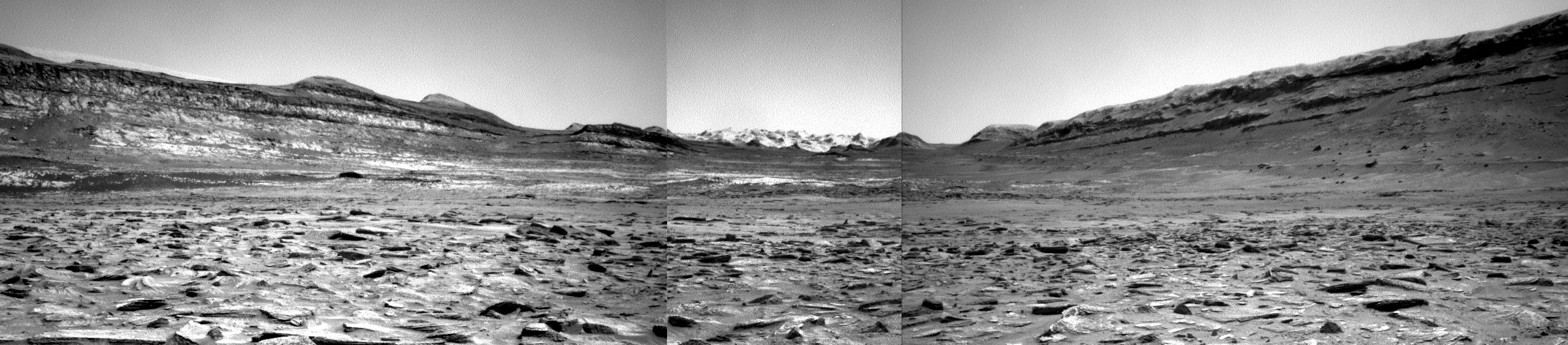
Curiosity looks closely at the broken slab that had been stuck on its drill bit

The rock Atacama
Click for original image.

As expected, the science team for the Mars rover hasdecided before moving on it would take a close look at the 28 pound slab of rock that had been stuck on its drill bit and when finally dropped free broken into several pieces when it hit the ground.

The top picture to the right, cropped and reduced to post here, shows that entire rock, labeled Atacama by the science team. The two insets below are close-ups of the delicate layering at the rock’s left edge as well as the drill hole itself. From team’s update today:

The highest-priority activities after liberating the drill included imaging the drill with Mastcam and ChemCam RMI, and imaging into the now-empty drill hole with MAHLI (the image above). The science team made the most of the freshly-broken surfaces created when Atacama fell back to Mars, and the freshly-exposed sand once hidden underneath Atacama.

The exposed sand is off camera, to the right. Expect a paper published about that sand, buried likely for millions of years, sometime in the next year or so.

The delicate flutes at the rock’s left edge are somewhat common rock features seen by Curiosity, made possible by Mars’ thin atmosphere and its one-third Earth gravity. On Earth the gravity and weather generally destroys such things. On Mars the lack of violent weather and light gravity allows them to form, and the thin wind even helps in their formation.

1 comment

SpaceX and Google negotiating deal to launch data centers into space

Though few details have been confirmed, according to the Wall Street Journal SpaceX and Google are in advanced negotiations to launch data centers into space.

We don’t know if these data centers will be part of a SpaceX/Google partnership, or whether Google is merely negotiating a SpaceX launch deal to place its own data centers in orbit. Nor do we know if this deal will use SpaceX’s Falcon rockets, or is aimed at using Starship when operational. Neither would surprise me. Nor would it be surprising if both occur.

The story is in linked to SpaceX’s impending initial public stock offering (IPO), expected to the biggest in history.

10 comments

OHB joins Dassault’s project to build a reusable mini-shuttle

Vortex
Vortex-S with service module attached. Click for original image.

The German aerospace company OHB has now joined with France’s Dassault Aviation in its project to build Vortex, a reusable mini-shuttle that could be used to supply cargo to the future commercial space stations presently under development.

An initial subscale demonstrator of the spaceplane, called the VORTEX-D, is being developed by the company with support from the French Ministry of the Armed Forces. During a 25 June 2025 hearing of the French National Assembly’s Committee on National Defence and the Armed Forces, it was revealed that the demonstrator is expected to be launched in 2028 and has a total project cost of €70 million, with Dassault providing more than half of the funding and the remainder coming from the French government.

The VORTEX-S is expected to follow the VORTEX-D demonstrator. This larger, more complex variant will be developed in partnership with OHB following the finalisation of the 11 May agreement, as the companies seek to secure ESA backing for the project. According to the release announcing the partnership, discussions are also underway with other major European space companies to “expand the team.”

Dassault will remain the lead contractor, building the mini-shuttle. OHB will build the service module. The hope is that later versions of Vortex could also ferry crews to and from space.

This project started in 2023, and initially hoped to do the first test mission to ISS in 2026. That test flight is now targeting 2029, with later missions slipping beyond 2031 and now targeting missions to one of the new stations replacing ISS.

4 comments

Two overnight launches from SpaceX and China

Both SpaceX and China successfully completed launches since yesterday. First, SpaceX launched a new group of satellites for the National Reconnaissance Office, its Falcon 9 lifting off from Vandenberg Space Force Base in California. For security reasons, the number of satellites launched was not revealed.

The first stage completed its 9th flight, landing on a drone ship in the Pacific.

Next China launched another set of Qianfan (SpaceSail) internet satellites into orbit, its Long March 6A rocket lifting off from its Taiyuan spaceport in northeast China. Though China’s state run press did not reveal the number of satellites launched, past Long March 6A launches of this constellation have placed 18 satellites into orbit. If so, there are now 155 Quinfan satellites in space, out of a planned constellation of as many as 10,000. The first phase of the constellation however only requires 648, which China hopes to reach before the end of the year.

The state-run press also did not reveal where the rocket’s lower stages (using very toxic hypergolic fuels) crashed inside China.

The leaders in the 2026 launch race:

56 SpaceX
25 China
8 Russia
6 Rocket Lab

For the third straight year SpaceX leads the entire world combined in total launches, 56 to 46.

SpaceX hopes to complete another launch later today, carrying a Dragon cargo capsule to ISS (on its sixth flight), but weather might force a scrub. UPDATE: Scrubbed due to weather, rescheduled for May 13, 2026.

0 comments

May 11, 2026 Quick space links

Courtesy of BtB’s stringer Jay. Reader Nate P also sent me the second link. This post is also an open thread. I welcome my readers to post any comments or additional links relating to any space issues, even if unrelated to the links below.

7 comments
1 10 11 12 13 14 2,929