
Buddy Greene – Classical Harmonica Medley
An evening pause: Hat tip Frank Kelly.
An evening pause: Hat tip Frank Kelly.
I’ve read a lot of analysis offering many ideas on what the Republican Congress should do to combat Obama in the next two years, but the best proposal I’ve read yet was posted as a comment to this website earlier today by mpthompson:
The best thing the Republicans can do would be to craft small, simple pieces of legislation that have the broad support of the American people (hmmmm,hmmmm border enforcement) and dare the Obama to veto. Do this week after week until it’s drilled into the electorates heads as to who is really the obstructionist.
Regarding Obamacare. Craft a one page amendment to the law that removes the mandate so that people can choose for themselves whether they want to participate (a pro-choice amendment so to speak). Then another amendment that removes the restrictions on they type of coverage a company can offer (another pro-choice amendment). Then let the public see the Dems for the big-government fascist they are.
There are a host of proposals that could fit this strategy. In addition to the ones suggested above, what about the approving the Keystone pipeline, cancelling the Obamacare medical tax, limiting the abuses of the IRS, limiting Obama’s travel expenses, and punishing the National Park Service for its partisan administration of the law during the Occupy movement and the government shutdown.
I am sure that my readers could think of many many more.
Update: It appears that the new Senate majority leader, Mitch McConnell (R-Kentucky), might be planning to follow this strategy, at least when it comes to Obamacare.

On Christmas Eve 1968 three Americans became the first humans to visit another world. What they did to celebrate was unexpected and profound, and will be remembered throughout all human history. Genesis: the Story of Apollo 8, Robert Zimmerman's classic history of humanity's first journey to another world, tells that story, and it is now available as both an ebook and an audiobook, both with a foreword by Valerie Anders and a new introduction by Robert Zimmerman.
The print edition can be purchased at Amazon or any other book seller. If you want an autographed copy the price is $60 for the hardback and $45 for the paperback, plus $8 shipping for each. Go here for purchasing details. The ebook is available everywhere for $5.99 (before discount) at amazon, or direct from my ebook publisher, ebookit. If you buy it from ebookit you don't support the big tech companies and the author gets a bigger cut much sooner.
"Not simply about one mission, [Genesis] is also the history of America's quest for the moon... Zimmerman has done a masterful job of tying disparate events together into a solid account of one of America's greatest human triumphs."--San Antonio Express-News
A former SpaceX employee has been arrested for operating one of the largest drug marketplaces on the dark part of the web.
It appears he must have spent a lot of his time at SpaceX designing and operating a dark web website where people could go to buy illegal drugs. It also appears that this might have contributed to SpaceX’s decision to fire him during SpaceX’s most recent employee purges.
I must say that I find this story very sad. The guy gets a job at one of the premier cutting edge companies in the world where he can help that company build rockets that will take humans to the stars, and what does he do with his time? He creates a webpage to sell illegal drugs.

The new ground-based telescope ALMA has taken an amazing image of a baby star and the planet-forming accretion disk that surrounds it.
ALMA uncovered never-before-seen features in this system, including multiple concentric rings separated by clearly defined gaps. These structures suggest that planet formation is already well underway around this remarkably young star. “These features are almost certainly the result of young planet-like bodies that are being formed in the disk. This is surprising since HL Tau is no more than a million years old and such young stars are not expected to have large planetary bodies capable of producing the structures we see in this image,” said ALMA Deputy Director Stuartt Corder.
ALMA has just been completed and is only in its initial shake-out period. It is also not an optical telescope, but observes in longer wavelengths above infrared. Thus, it can peer through dust clouds to see details like this. And these details confirm that the most accepted theory of planetary formation appears to be right.

Now available in hardback and paperback as well as ebook!
From the press release: In this ground-breaking new history of early America, historian Robert Zimmerman not only exposes the lie behind The New York Times 1619 Project that falsely claims slavery is central to the history of the United States, he also provides profound lessons about the nature of human societies, lessons important for Americans today as well as for all future settlers on Mars and elsewhere in space.
“Zimmerman’s ground-breaking history provides every future generation the basic framework for establishing new societies on other worlds. We would be wise to heed what he says.” —Robert Zubrin, founder of the Mars Society.
All editions are available at Amazon, Barnes & Noble, and all book vendors, with the ebook priced at $5.99 before discount. All editions can also be purchased direct from the ebook publisher, ebookit, in which case you don't support the big tech companies and the author gets a bigger cut much sooner.
Autographed printed copies are also available at discount directly from the author (hardback $29.95; paperback $14.95; Shipping cost for either: $6.00). Just send an email to zimmerman @ nasw dot org.
The heat of competition: Virgin Galactic today released hanger photos of the almost finished second SpaceShipTwo.
Even as the investigation into the fatal breakup of Virgin Galactic’s SpaceShipTwo rocket plane continues in Mojave, California, the next SpaceShipTwo is more than halfway complete in a Mojave hangar — and is expected to start going through tests on the ground and in the air next year.
Virgin Galactic’s manufacturing subsidiary, The Spaceship Company, has been working on the plane for two and a half years. It’s variously known as SpaceShipTwo Tail No. 2 or N202VG, and it’s part of Virgin Galactic plan to have a fleet of five SpaceShipTwo rocket planes and two WhiteKnightTwo carrier planes.
This story is a great example of the public relations genius of Richard Branson. Even with the pieces of SpaceShipTwo still being picked up on the ground he finds a way to sell his company positively to the world. They not only intend to continue their effort, they have the ship to prove it!
Disconnected from reality: Twenty crazy beliefs repeatedly argued by liberals and Democrats that have no connection at all with reality.
I especially like the one on climate, with this line: “Politicians in this country can vote to change the world’s climate to be an ideal climate.”
Leaving Earth: Space Stations, Rival Superpowers, and the Quest for Interplanetary Travel, can be purchased as an ebook everywhere for only $3.99 (before discount) at amazon, Barnes & Noble, all ebook vendors, or direct from my ebook publisher, ebookit.
If you buy it from ebookit you don't support the big oppressive tech companies and I get a bigger cut much sooner.
"Leaving Earth is one of the best and certainly the most comprehensive summary of our drive into space that I have ever read. It will be invaluable to future scholars because it will tell them how the next chapter of human history opened." -- Arthur C. Clarke
I don’t have much to add to the numerous reports about yesterday’s election by political pundits far more qualified than I. The Republicans won a big landslide victory yesterday, not only gaining control of the Senate, but winning more seats than expected. They also won more seats in the House than expected, widening their majority there to numbers not seen since the 1920s. In addition, they made it a grand slam by winning a plethora of governorships — many in Democratic stronghold states such as Massachusetts, Illinois, and Maryland — as well as taking control of more state legislatures than ever before.
What matters to me, however, is not the election but what this new Republican majority does with its majority. In the past, 1994 and 2000, they more or less squandered the opportunity to rein in government. In 1994, they allowed the government to grow but at a rate below the rate of inflation so that in a few years this resulted in a balanced budget and surpluses. But the government still grew in power and size. In 2000 they did not even do this, allowing government spending and yearly deficits to balloon, even though they had a Republican president who would have supported them if they had wanted to cut the size of government.
Thus, while I am hopeful, I also remain very skeptical about what will happen in the next few years. In order to prove to me and the conservative base that elected them that these Republicans mean what they say when they say they want to shrink the size of government, they are going to have to prove it with real action. They are going to have show us that they really do want to repeal Obamacare. They are going to have to show us that they really do want to gain some control over the border. And they are going to have to show us that they really do want to cut the budget and get it balanced.
I understand that the Democrats in the Senate and Obama can still block many of these initiatives, but too often Republicans have used this fact as an excuse to not try at all. This must stop! They must apply strong pressure on these left wing ideologues, make them reveal their politics for all to see by forcing them to veto or block these initiatives. Only by demonstrating a resolve to rein in government will anyone believe the Republicans when they claim that’s what they want to do. And by doing so they will also simultaneously expose the Democrats as the left wing ideologues that they are.
Making these points can only be for the good, politically.
Two more points, often unstated but fundamental to what elections in the United States represent.
» Read more
An evening pause: Hat tip Edward Thelen.
The monthly update by NOAA of the solar cycle is out, showing the sunspot activity for the Sun in October, As I do every month, I am posting it here, with annotations to give it context.
Despite the appearance last month of the largest sunspot in almost a quarter century, the number of sunspots in October dropped significantly, bringing overall activity back to levels seen in 2012, prior to the second peak in the solar maximum. If things go as expected (not something I would bet much money on), the overall ramp down of sunspot activity should now continue over the next few years. There will obviously be jumps periodically, but the general output of sunspots should steadily decline.
I also want to reiterate what I noted last month, that the 2009 prediction of the solar scientist community is looking better and better with time. Other than over-estimating the total activity somewhat while missing the dip between the two peaks, their overall curve, indicated by the red line, is reasonably close to what has actually happened.
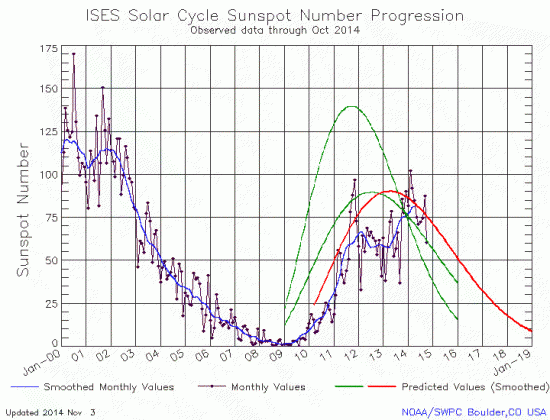
The graph above has been modified to show the predictions of the solar science community. The green curves show the community’s two original predictions from April 2007, with half the scientists predicting a very strong maximum and half predicting a weak one. The red curve is their revised May 2009 prediction.
The investigation into the launch failure of the Antares rocket one week ago is now focusing on the turbopump in one of the rocket’s first stage engines.
“The Investigation Board (AIB) is making good progress in determining the primary cause of last week’s failure. A preliminary review of telemetry and video data has been conducted and substantial debris from the Antares rocket and its Cygnus payload has been collected and examined,” noted Orbital on Wednesday. “While the work of the AIB continues, preliminary evidence and analysis conducted to date points to a probable turbopump-related failure in one of the two Aerojet Rocketdyne AJ26 stage one main engines. As a result, the use of these engines for the Antares vehicle likely will be discontinued.”
It was later noted that the AJ-26 could still be used if they were proven to be completely flight-worthy.
If Orbital Sciences decides to completely cease using the Russian engines, it could mean a very significant delay before they can launch again, maybe several years. If they do that, I expect them to face contract penalties from NASA for the failure to deliver cargo to ISS on a reasonable schedule. It will also mean that their chances of winning a second contract will go down significantly.
They need to replace the engine, but they also need to keep launching. The article as well as a company press release today describes how they are exploring other launch vehicles, including the Falcon 9, to launch Cygnus, but I see no reason for them to completely abandon the Russian engines immediately. What they need to do is find what failed, fix it in the remaining engines, and keep flying while they scramble hard to replace the engine entirely.
Spectroscopy from Curiosity’s most recent drilling has been found to match and thus confirm the spectroscopy of the same spot taken years ago from orbit.
In observations reported in 2010, before selection of Curiosity’s landing site, a mineral-mapping instrument on NASA’s Mars Reconnaissance Orbiter provided evidence of hematite in the geological unit that includes the Pahrump Hills outcrop. The landing site is inside Gale Crater, an impact basin about 96 miles (154 kilometers) in diameter with the layered Mount Sharp rising about three miles (five kilometers) high in the center.
“We’ve reached the part of the crater where we have the mineralogical information that was important in selection of Gale Crater as the landing site,” said Ralph Milliken of Brown University, Providence, Rhode Island. He is a member of Curiosity’s science team and was lead author of that 2010 report in Geophysical Research Letters identifying minerals based on observations of lower Mount Sharp by the orbiter’s Compact Reconnaissance Imaging Spectrometer for Mars (CRISM). “We’re now on a path where the orbital data can help us predict what minerals we’ll find and make good choices about where to drill. Analyses like these will help us place rover-scale observations into the broader geologic history of Gale that we see from orbital data.”
This is a significant finding. Not only does this data now prove that the orbital data is correct, it demonstrates that scientists can now use that orbital data to direct Curiosity to even more interesting geological surface features. In fact, this ground-based data will help them calibrate all their orbital data more precisely, thus making our geological knowledge of Mars more accurate and reliable.
An evening pause: Sometimes all one really wants is a silly pop song.
The uncertainty of science: New evidence suggests that the on-going ebola epidemic in Africa is beginning to ease, contrary to the predictions made by computer models.
The Ebola outbreak in West Africa has infected at least 13,567 people and killed 4,951, according to figures released on 31 October by the World Health Organization (WHO). Now, in a rare encouraging sign, the number of new cases in Liberia seems to be flattening after months of exponential growth. Scientists say it is too soon to declare that the disease is in retreat: case data are often unreliable, and Ebola can be quick to resurge. But it is clear that mathematical models have failed to accurately project the outbreak’s course. [emphasis mine]
The creators of these mathematical models should switch fields and go into climate change modeling. At least in that field the journal Nature would never trumpet the failure of their models to work. In climate science, the major journals do whatever they can, for political reasons, to hide these failures.
Additional details about the investigation into the crash of SpaceShipTwo have now been released.
The investigators are focusing on the telemetry that the pilots were receiving, as well as the system for activating the ship’s braking feathering system.
As I have noted in the comments, we must try not to speculate on this subject, especially because this issue could do harm to innocent people. For example, some reports have incorrectly attributed the crash to pilot error. To say this now is false. All the investigation has noted is that the co-pilot took the first step to activating the feathering system, as he was supposed to do, though slightly early. The feathering system then deployed on its own, without the second command being given.
We do not yet know the finer details that make his action significant, or not. This is why the investigation is checking into the telemetry the pilots were getting, which might have affected when they did what they did.
We need to wait for more data.
The competition heats up: Ground tests of Moon Express’s privately built lunar rover are about to begin at the Kennedy Space Center on a simulated lunar surface.
Moon Express has generally been favored to win the Google Lunar X-Prize.
An evening pause: Hat tip to Danae.
News reports suggest that — following last week’s SpaceShipTwo crash — more than thirty of the seven hundred people who placed deposits with Virgin Galactic to fly on SpaceshipTwo have pulled out, demanding their money back.
In response to the claim that more than 30 customers are considering their position in the aftermath of the crash, a spokesperson for Virgin Galactic admitted a number of people have asked for their money back. “We can confirm that less than three per cent of people have requested refunds,” the spokesman said.
This is not a surprise, nor should it be. A company can only survive a crisis like this by responding honestly, quickly, and directly. If Virgin Galactic does this, finding the cause of the crash and fixing it, they will likely hold onto most of their customers. If they don’t, those remaining customers will leave. This week’s cancellations are the first immediate response to the crash. The future of the company, however, will be determined by what happens in the next six months.
New data suggests that when a large impact hit Vesta’s Rheasilvia basin sometime in the past, the entire asteroid was shaken up, producing ripples that eventually surfaced as the giant grooves that circle the asteroid’s equator.
“Vesta got hammered,” said Peter Schultz, professor of earth, environmental, and planetary sciences at Brown and the paper’s senior author. “The whole interior was reverberating, and what we see on the surface is the manifestation of what happened in the interior.”
The research suggests that the Rheasilvia basin on Vesta’s south pole was created by an impactor that came in at an angle, rather than straight on. But that glancing blow still did an almost unimaginable amount of damage. The study shows that just seconds after the collision, rocks deep inside the asteroid began to crack and crumble under the stress. Within two minutes major faults reached near the surface, forming deep the canyons seen today near Vesta’s equator, far from the impact point.
Essentially, for a very very short period of time, immediately after the impact, the solid material of the asteroid acted more like a liquid, producing ripples that immediately settled down as the solid deep equatorial grooves we see today.
The uncertainty of science: The gas cloud, dubbed G2, that was going to be eaten by the supermassive black hole at the center of the Milky Way as it did a close fly-by this summer has instead turned out to be a massive star formed when the star’s of its binary system merged.
G2 survived the fly-by, produced no big fireworks which were what was predicted if it has been a gas cloud. The data now suggests that the object is instead a very big star formed when two stars merged.
Massive stars in our galaxy, [astronomer Andrea Ghez] noted, primarily come in pairs. When the two stars merge into one, the star expands for more than one million years “before it settles back down,” Ghez said. “This may be happening more than we thought; the stars at the center of the galaxy are massive and mostly binaries. It’s possible that many of the stars we’ve been watching and not understanding may be the end product of a merger that are calm now.”
Be warned that this new hypothesis about G2 has its own uncertainties. Better data might eventually find it to be something else again.
The investigation into the failure of SpaceShipTwo last week during a powered flight test has determined that the accident was not caused by the spaceship’s engine and that the spaceship’s feathering system for return to Earth began deploying early during powered flight.
The ship’s fuel tanks and its engine were recovered intact, indicating there was no explosion. “They showed no signs of burn-through, no signs of being breached,” Christopher Hart, acting chairman of the National Transportation and Safety Board, told reporters at the Mojave Air and Space Port in Mojave, Calif
Instead, data and video relayed from the ship show its hallmark safety feature — a foldable tail section designed for easy re-entry into the atmosphere from space — was deployed early.
More here. Deployment required two commands, activation and then deployment. Data shows that the co-pilot Michael Alsbury activated the system slightly early. The second command, however, was not given, but the feathering system began to deploy nonetheless, during powered flight when the ship was accelerating upward. That is when the ship broke up.