Scientists use Hubble and Webb to confirm there are as yet no planets forming in Vega’s accretion disk

Hubble and Webb images of Vega's accretion disk
Click for original image.

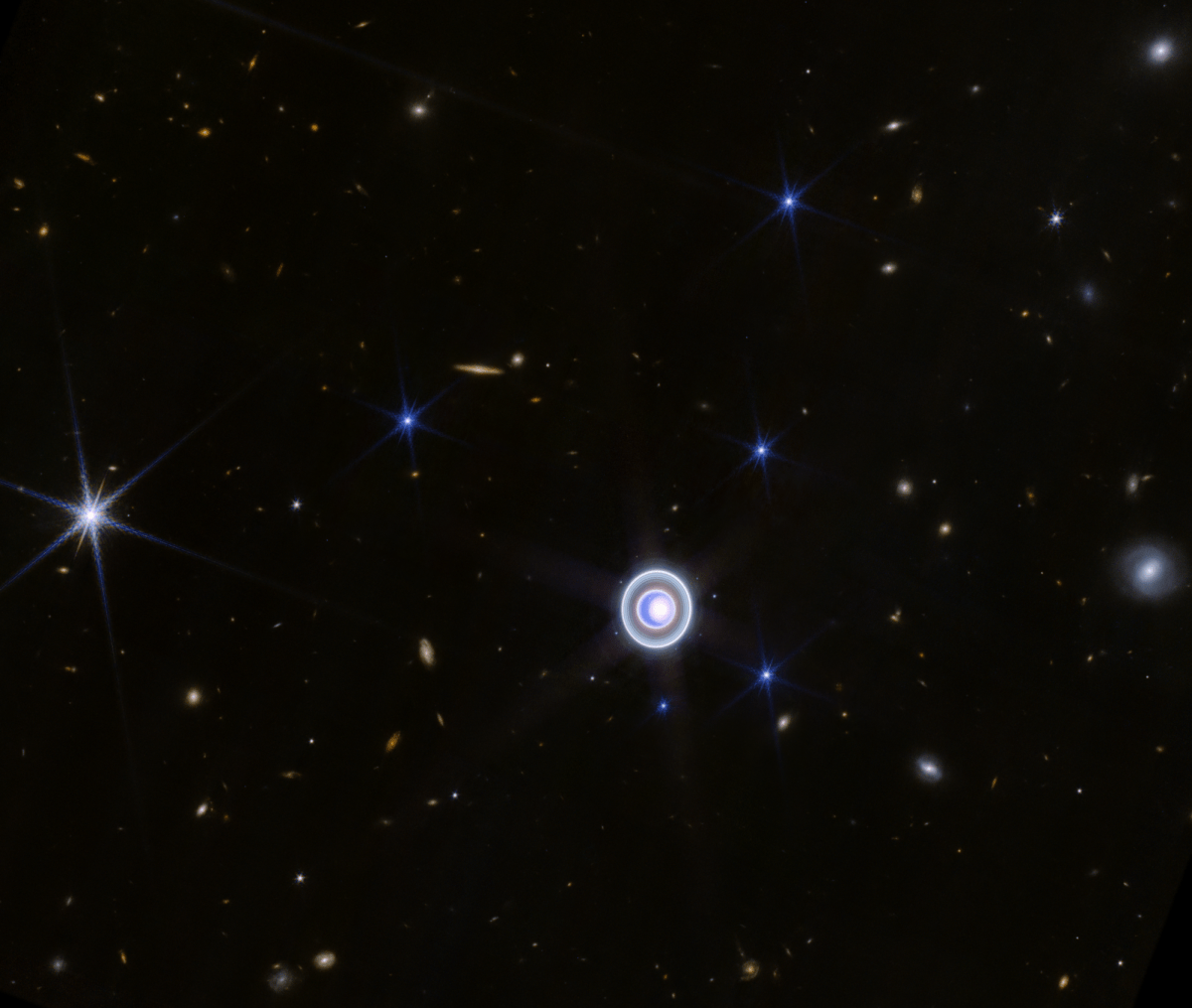
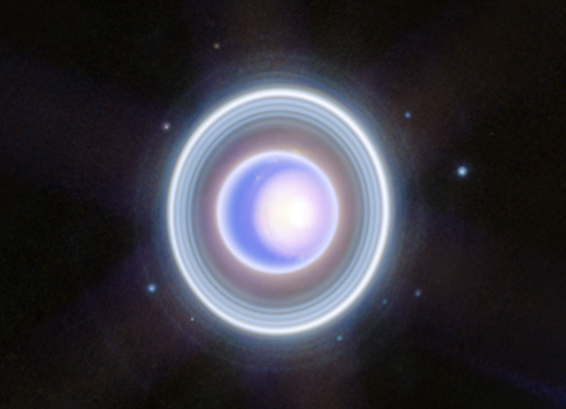
Using both the Hubble and Webb space telescopes, scientists have now confirmed, to their surprise, that the accretioni disk that surrounds the nearby star Vega is very smooth with almost no gaps, and thus apparently has not new exoplanets forming within it.

The two pictures to the right, cropped and reduced to post here, come from two different papers. The Hubble paper is here [pdf] while the Webb paper is here [pdf]. From the press release:

Webb sees the infrared glow from a disk of particles the size of sand swirling around the sizzling blue-white star that is 40 times brighter than our Sun. Hubble captures an outer halo of this disk, with particles no bigger than the consistency of smoke that are reflecting starlight.

The distribution of dust in the Vega debris disk is layered because the pressure of starlight pushes out the smaller grains faster than larger grains. “Different types of physics will locate different-sized particles at different locations,” said Schuyler Wolff of the University of Arizona team, lead author of the paper presenting the Hubble findings. “The fact that we’re seeing dust particle sizes sorted out can help us understand the underlying dynamics in circumstellar disks.”

The Vega disk does have a subtle gap, around 60 AU (astronomical units) from the star (twice the distance of Neptune from the Sun), but otherwise is very smooth all the way in until it is lost in the glare of the star. This shows that there are no planets down at least to Neptune-mass circulating in large orbits, as in our solar system, say the researchers.

At the moment astronomers consider the very smooth accretion disk surrounding Vega to be rare and exception to the rule, with most debris disks having gaps that suggest the presence of newly formed exoplanets within them. That Vega breaks the rule however suggests the rule might not be right in the first place.

1 comment

North Korea launches test ballistic missile for the 1st time in almost a year

North Korea not only successfully launched on October 30, 2024 a test ballistic missile for the 1st time in almost a year, the missile set a new altitude record, reaching an altitude of 4,350 miles, more than a thousand miles higher than the country’s previous missile record.

Japanese Defense Minister Gen Nakatani told reporters the missile’s flight duration of 86 minutes and its maximum altitude of more than 7,000 kilometers (4,350 miles) exceeded corresponding data from previous North Korean missile tests.

Having a missile fly higher and for a longer duration than before means its engine thrust has improved. Given that previous ICBM tests by North Korea have already proved they can theoretically reach the U.S. mainland, the latest launch was likely related to an effort to examine whether a missile can carry a bigger warhead, experts say.

In other words, North Korea is getting very close to having an operational ICBM that can deliver a nuclear warhead anywhere on the globe. Worse, it appears this solid-fueled rocket launches from a large mobile vehicle, making it impossible to locate and destroy beforehand.

4 comments

Genesis cover

On Christmas Eve 1968 three Americans became the first humans to visit another world. What they did to celebrate was unexpected and profound, and will be remembered throughout all human history. Genesis: the Story of Apollo 8, Robert Zimmerman's classic history of humanity's first journey to another world, tells that story, and it is now available as both an ebook and an audiobook, both with a foreword by Valerie Anders and a new introduction by Robert Zimmerman.

The print edition can be purchased at Amazon or any other book seller. If you want an autographed copy the price is $60 for the hardback and $45 for the paperback, plus $8 shipping for each. Go here for purchasing details. The ebook is available everywhere for $5.99 (before discount) at amazon, or direct from my ebook publisher, ebookit. If you buy it from ebookit you don't support the big tech companies and the author gets a bigger cut much sooner.


The audiobook is also available at all these vendors, and is also free with a 30-day trial membership to Audible.
 

"Not simply about one mission, [Genesis] is also the history of America's quest for the moon... Zimmerman has done a masterful job of tying disparate events together into a solid account of one of America's greatest human triumphs."--San Antonio Express-News

Hypersonic engine manufacturer Reaction Engines goes bankrupt

Reaction Engines, the British hypersonic engine company that since 2011 has been touting its Skylon spaceplane and winning a variety of development contracts to build it. has now gone bankrupt, shutting down all operations.

However, this year, the company found itself in major financial difficulties due to unexpectedly slow growth and the inability to secure an additional £150 million (US$193 million) in funding, followed by BAE Systems and Rolls-Royce being unwilling to put up bail-out capital.

As a result, as of October 31, Reaction Engines is in the hands of administrators PricewaterhouseCoopers (PwC). The company’s website forwards to PwC where there is a notice saying that further information will be released to creditors as the available assets are assessed. According to Sky News, 173 of the company’s 208 staff were made redundant.

After more than a decade of work and no apparent progress, it appears no one was willing to front the company any additional cash.

10 comments

European Commission finally awards contract to build its government Starlink-type constellation

The European Commission yesterday finally awarded a gigantic contract to a consortium of European satellite companises to build its government-conceived and government-designed communications constellation designed to duplicate constellations already in orbit and built by Starlink and OneWeb.

The full constellation, dubbed IRIS2 and first proposed in 2022, is expected to have 290 satellites. The consortium, dubbed SpaceRISE, is led by satellite companies SES, Eutelsat, and Hispasat, and also includes Thales Alenia Space, OHB, Airbus Defence and Space, Telespazio, Deutsche Telekom, Orange, Hisdesat, and Thales SIX.

In other words, practically every major European aerospace company gets a piece of the pie.

According to a 31 October press release, the European Commission aims to have the IRIS2 service up and running by 2030. The project was initially expected to cost approximately €6 billion, of which the European Commission would provide 60%, with the rest being covered by private industry. However, recent reports have indicated that the project’s budget will likely reach as much as €10 billion.

Based on these numbers, it is going to take more than six years to launch, with each satellite costing about 3.5 million euros.

This is a very typical European government project, conceived not to fill a real need but to make sure there is a European version of something for Europe to use. It is also conceived as a way to transfer cash to as many European aerospace contractors as possible. Considering the number of companies involved and the fact that the whole constellation is government designed, expect the budget to well exceed ten billion euros before completion, and take far longer to become operational than presently planned. For example, the project was first proposed more than two years ago and only now has the contract been issued. In that time SpaceX conceived and has practically launched its entire direct-to-cell Starlink constellation of about the same number of satellites.

4 comments

Conscious Choice cover

Now available in hardback and paperback as well as ebook!

From the press release: In this ground-breaking new history of early America, historian Robert Zimmerman not only exposes the lie behind The New York Times 1619 Project that falsely claims slavery is central to the history of the United States, he also provides profound lessons about the nature of human societies, lessons important for Americans today as well as for all future settlers on Mars and elsewhere in space.

 
Conscious Choice: The origins of slavery in America and why it matters today and for our future in outer space, is a riveting page-turning story that documents how slavery slowly became pervasive in the southern British colonies of North America, colonies founded by a people and culture that not only did not allow slavery but in every way were hostile to the practice.  
Conscious Choice does more however. In telling the tragic history of the Virginia colony and the rise of slavery there, Zimmerman lays out the proper path for creating healthy societies in places like the Moon and Mars.


“Zimmerman’s ground-breaking history provides every future generation the basic framework for establishing new societies on other worlds. We would be wise to heed what he says.” —Robert Zubrin, founder of the Mars Society.


All editions are available at Amazon, Barnes & Noble, and all book vendors, with the ebook priced at $5.99 before discount. All editions can also be purchased direct from the ebook publisher, ebookit, in which case you don't support the big tech companies and the author gets a bigger cut much sooner.


Autographed printed copies are also available at discount directly from the author (hardback $29.95; paperback $14.95; Shipping cost for either: $6.00). Just send an email to zimmerman @ nasw dot org.

October 31, 2024 Quick space links

Courtesy of BtB’s stringer Jay. This post is also an open thread. I welcome my readers to post any comments or additional links relating to any space issues, even if unrelated to the links below.

1 comment

Leaving Earth cover

Leaving Earth: Space Stations, Rival Superpowers, and the Quest for Interplanetary Travel, can be purchased as an ebook everywhere for only $3.99 (before discount) at amazon, Barnes & Noble, all ebook vendors, or direct from my ebook publisher, ebookit.

If you buy it from ebookit you don't support the big oppressive tech companies and I get a bigger cut much sooner.


Winner of the 2003 Eugene M. Emme Award of the American Astronautical Society.

 
"Leaving Earth is one of the best and certainly the most comprehensive summary of our drive into space that I have ever read. It will be invaluable to future scholars because it will tell them how the next chapter of human history opened." -- Arthur C. Clarke

Weird ring-mounds in one of Mars’ largest craters

Weird ring mounds on Mars
Click for original image.

Cool image time! The picture to the right, cropped, reduced, and sharpened to post here, was taken on August 16, 2024 by the high resolution camera on Mars Reconnaissance Orbiter (MRO). The science team labels these strange features “ring-mound landforms,” a term that has been used to describe [pdf] only vaguely similar features previously found in the Athabasca flood lava plain almost on the other side of Mars. That paper suggested that those ring mounds formed on the “thin, brittle crust of an active fluid flow” created by an explosive event. Since Athabasca is considered Mars’s most recent major flood lava event, the fluid was likely lava, which on Mars flows more quickly and thinly in the lower gravity.

Thus, in Athabasca the ring-mounds formed when a pimple of molten lava from below popped the surface.

But what about the ring mounds in the picture to the right?
» Read more

1 comment

Has there been a wave of fraudulent election ballots swamping PA? Let’s find out!

What does the newly discovered election fraud in PA tell us?
What does the newly discovered election
fraud in PA tell us?

In the past week there have been a bunch of stories in the conservative press from three different counties in Pennsylvania, suggesting that each county has been swamped with thousands of fraudulent ballots, produced in bulk and then delivered in large numbers so as to make it difficult to trace or investigate them.

I decided to take a closer look, because this story could either be telling us how corrupt the upcoming election will be, or it might actually be telling us that it is going to be much more reliable than we have anticipated.

The three counties involved are Lancaster, York, and Monroe. All told, less than six thousand voter registration applications, all submitted apparently in bulk by a Arizona-based company called Field+Media Corps, were under review, the number from each county being 2,500, 3,087, and 30 respectively. Note that these do not appear to be actual ballots, but registration forms that would once approved would allow the individual to vote, either by mail or in person.

Of these applications, the reviews have already produced results. For example, York County has found that of the 3,087 submitted, 47% were verified and approved, 29% needed more information, and 24% were declined and are under further review. In Monroe County the investigation has apparently only flagged these 30 forms, with one coming from a deceased person and others flagged for different reasons that in the end might be legitimate.

In Lancaster County officials have not yet issued a report. Initially it announced:
» Read more

14 comments

Post-collision images of two galaxies

Post-collision imagery by Hubble and Webb
Click for original image.

Using both the Hubble and Webb space telescopes, astronomers have now produced multi-wavelength images of the galaxies NGC 2207and IC 2163, as shown to the right.

Millions of years ago the smaller galaxy, IC 2163, grazed against the larger, NGC 2207, resulting today in increased star formation in both galaxies, indicated by blue in the Hubble photo. From the caption of the combined images:

Combined, they are estimated to form the equivalent of two dozen new stars that are the size of the Sun annually. Our Milky Way galaxy forms the equivalent of two or three new Sun-like stars per year. Both galaxies have hosted seven known supernovae, each of which may have cleared space in their arms, rearranging gas and dust that later cooled, and allowed many new stars to form.

The two images to the left leaves the Hubble and Webb separate, making it easier to see the different features the different wavelengths reveal. From this caption:

In Hubble’s image, the star-filled spiral arms glow brightly in blue, and the galaxies’ cores in orange. Both galaxies are covered in dark brown dust lanes, which obscure the view of IC 2163’s core at left. In Webb’s image, cold dust takes centre stage, casting the galaxies’ arms in white. Areas where stars are still deeply embedded in the dust appear pink. Other pink dots may be objects that lie well behind these galaxies, including active supermassive black holes known as quasars.

The largest and brightest pink area in the Webb image, on the bottom right and a blue patch in the Hubble image, is where a strong cluster of star formation is presently occurring.

6 comments

Russia launches military satellite

Russia today (October 31st in Russia) successfully launched a classified military satellite, its Soyuz-2 rocket lifting off from its Plesetsk spaceport in northern Russia.

The flight path took the satellite over the Arctic, where the rocket’s lower stages crashed harmlessly.

The leaders in the 2024 launch race:

107 SpaceX
49 China
12 Russia
11 Rocket Lab

American private enterprise still leads the rest of the world combined in successful launches 124 to 73, while SpaceX by itself still leads the entire world, including American companies, 107 to 90.

0 comments

Nearly four dozen anti-SpaceX activists organize to flood public meeting

At a public meeting of the Texas Commission on Environmental Quality (TCEQ) on October 17, 2024 nearly four dozen anti-SpaceX activists apparently arrived en masse in order to overwhelm the public comment period with negative opinions about the company and its operation at Boca Chica.

The report at the link, from the San Antonio Express-News, is (as usual for a propaganda press outlet) decidedly in favor of these activists, and makes it sound as if these forty-plus individuals, apparently led by the activist group SaveRGV that has mounted most of the legal challenges to SpaceX, represent the opinions of the public at large.

What really happened here is that the Brownsville public has better things to do, like building businesses and making money, much of which now only exists because of SpaceX and that operation at Boca Chica. Thus, the only ones with time or desire to organize to show up at these kinds of meetings are these kinds of activists.

It might pay however for some of the more business-oriented organizations in Brownsville to make sure they are in the game at the next public meeting, scheduled for November 14, 2024 [pdf]. This would not be hard to do, and it would certainly help balance the scales, which at present are decidedly been warped by this small minority of protesters.

3 comments

SpaceX: Only five more launches needed to complete Starlink direct-to-cell constellation

According to a tweet posted by SpaceX shortly after yesterday’s first launch from Vandenberg, the company needs only five more launches to complete its first constellation of Starlink direct-to-cell satellites.

More information here. At the moment the company has launched 260 of this version of its Starlink satellites. Since each launch places 13 more satellites in orbit, that means the first full iteration of the constellation will contain 325 satellites.

The satellites will allow cell phone users on the ground to use the constellations like a cell tower, thus providing service in areas where ground cell tower service does not exist. At the moment T-Mobile has a deal with SpaceX, so its subscribers will be able to use this service as soon as it is operational.

When when this be achieved? This story once again illustrates the speed in which SpaceX operates. The first launch of direct-to-cell Starlink satellites occurred on January 2, 2024, and in the last ten months the company has completed 23 launches to get the constellation where it is presently. At that pace the entire consellation might be complete before the end of this year.

The competition for this service is certainly fierce. The other satellite company offering this service, AST Mobile, has launched the first five satellites in its constellation, and has deals with AT&T and Verizon. Its design is different, and will only require 110 satellites to complete the constellation. At the moment five are about to become operational. It hopes to start regular launches next year to complete the constellation.

4 comments
1 285 286 287 288 289 2,929