A fluted mesa on Mars

A fluted mesa on Mars
Click for original image.

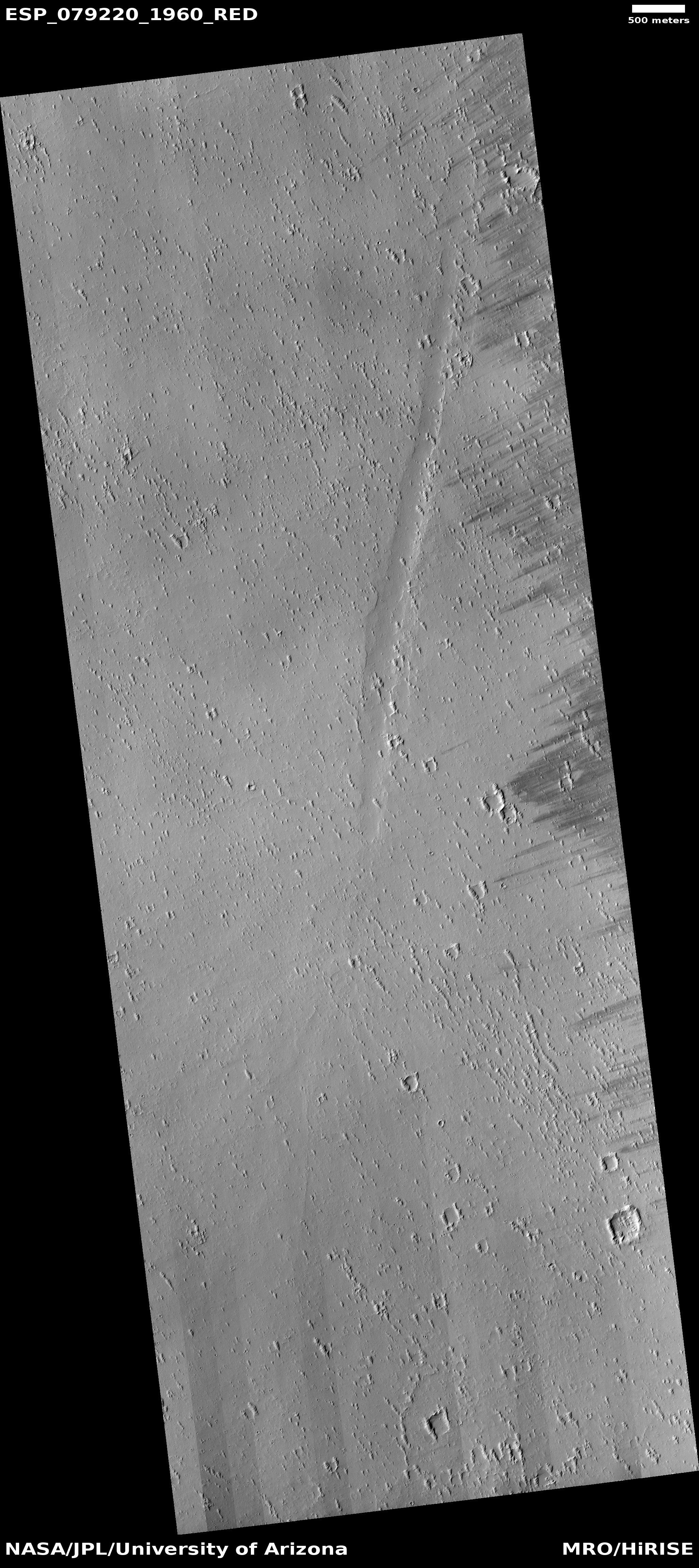
Cool image time! The picture to the right, cropped, reduced, and sharpened to post here, was taken on July 9, 2024 by the high resolution camera on Mars Reconnaissance Orbiter (MRO). It shows what the science team labels a “silica-rich mound”, as indicated by the bright streaks on all the high ridge points.

The flat-topped mesa on the right drops about 200 feet to the valley floor. The rims of that depression to the west rise about 50+ feet higher, while mesa nose in the upper left rising another 50+ feet more.

Was the depression caused by an impact? If so, the landscape has changed radically since that impact occurred, with most of the surrounding terrain eroded away. The two flat-topped mesas hint at the ancient surface when that impact occurred.

A wider view however raises questions about this impact theory.
» Read more

1 comment

Scientists re-create on Earth the sublimation of Mars’s winter mantle of dry ice

Spiders created on Earth
Click for original image.

Scientists have successfully re-created on Earth the process on Mars that creates the unique “spider” formations seen in the the Martian south pole region, produced when the winter mantle of dry ice begins to sublimate away into a gas.

The study confirms several formation processes described by what’s called the Kieffer model: Sunlight heats the soil when it shines through transparent slabs of carbon dioxide ice that built up on the Martian surface each winter. Being darker than the ice above it, the soil absorbs the heat and causes the ice closest to it to turn directly into carbon dioxide gas — without turning to liquid first — in a process called sublimation (the same process that sends clouds of “smoke” billowing up from dry ice). As the gas builds in pressure, the Martian ice cracks, allowing the gas to escape. As it seeps upward, the gas takes with it a stream of dark dust and sand from the soil that lands on the surface of the ice.

At the south pole, the ground below the mantle is stable enough that each winter the trapped CO2 gas follows the same path to the same points where the dry ice cracks, slowly creating “tributaries” that combine to form the spider formations.

The picture to the right, cropped, reduced, and sharpened to post here, comes from figure 9 of the paper [pdf]. It shows the lab-created spiders formed by this simulated process, thereby confirming this hypothesis about how the spiders form.

0 comments

Genesis cover

On Christmas Eve 1968 three Americans became the first humans to visit another world. What they did to celebrate was unexpected and profound, and will be remembered throughout all human history. Genesis: the Story of Apollo 8, Robert Zimmerman's classic history of humanity's first journey to another world, tells that story, and it is now available as both an ebook and an audiobook, both with a foreword by Valerie Anders and a new introduction by Robert Zimmerman.

The print edition can be purchased at Amazon or any other book seller. If you want an autographed copy the price is $60 for the hardback and $45 for the paperback, plus $8 shipping for each. Go here for purchasing details. The ebook is available everywhere for $5.99 (before discount) at amazon, or direct from my ebook publisher, ebookit. If you buy it from ebookit you don't support the big tech companies and the author gets a bigger cut much sooner.


The audiobook is also available at all these vendors, and is also free with a 30-day trial membership to Audible.
 

"Not simply about one mission, [Genesis] is also the history of America's quest for the moon... Zimmerman has done a masterful job of tying disparate events together into a solid account of one of America's greatest human triumphs."--San Antonio Express-News

Italian rocket company Avio outlines its future rocket plans

Link here. The plans include steady upgrades to its Vega-C rocket, including replacing the upper stage engine presently provided by a Ukrainian company with an engine built by Avio itself.

The bigger development will be a more powerful rocket, the Vega-E, to replace the Vega-C in 2027.

This version of the rocket will retain the first and second stages of the Vega C+ rocket and substitute the third and fourth stages for a single liquid fuel stage powered by the company’s new M10 methalox rocket engine.

The company is also hoping to begin test flights in 2026 of a Grasshopper-type small-scale demonstration rocket leading to the development of a reusable two-stage rocket that would eventually replace Vega-E.

3 comments

NASA receives 11 VIPER proposals from the private sector

NASA is now evaluating eleven different proposals from private companies to take over the agency’s canceled VIPER lunar rover.

Equipped with three scientific instruments and a drill, the rover was to be delivered to the Moon by a commercial lander, Griffin, built by Pittsburgh-based Astrobotic as part of NASA’s Commercial Lunar Payload Services (CLPS) initiative. Astrobotic and several other companies have CLPS contracts to deliver NASA science and technology experiments to the Moon. NASA pays for delivery services for its payloads. The companies are expected to find non-NASA customers to close the business case.

NASA is paying Astrobotic $323 million for landing services on top of the cost of VIPER itself. NASA’s commitment to Congress was that VIPER would cost $433.5 million with landing in 2023. By the beginning of this year, that had become $505.4 million with landing in 2024.

It appears NASA canceled the VIPER mission because the agency had doubts Astrobotic would launch Griffin on time. The rover cost overruns, plus additional costs from that launch delay, made NASA management back out.

Though NASA has not revealed any details about the new eleven proposals, we know that Astrobotic’s competitor, Intuitive Machines, is one of those proposals. How it can get it launched to the Moon for less than it would have cost to launch on Astrobotic’s Griffin however is a mystery to me.

Meanwhile, Griffin is still going to launch, with Astrobotic now able to sell that VIPER payload space to others and NASA paying for the flight.

0 comments

Conscious Choice cover

Now available in hardback and paperback as well as ebook!

From the press release: In this ground-breaking new history of early America, historian Robert Zimmerman not only exposes the lie behind The New York Times 1619 Project that falsely claims slavery is central to the history of the United States, he also provides profound lessons about the nature of human societies, lessons important for Americans today as well as for all future settlers on Mars and elsewhere in space.

 
Conscious Choice: The origins of slavery in America and why it matters today and for our future in outer space, is a riveting page-turning story that documents how slavery slowly became pervasive in the southern British colonies of North America, colonies founded by a people and culture that not only did not allow slavery but in every way were hostile to the practice.  
Conscious Choice does more however. In telling the tragic history of the Virginia colony and the rise of slavery there, Zimmerman lays out the proper path for creating healthy societies in places like the Moon and Mars.


“Zimmerman’s ground-breaking history provides every future generation the basic framework for establishing new societies on other worlds. We would be wise to heed what he says.” —Robert Zubrin, founder of the Mars Society.


All editions are available at Amazon, Barnes & Noble, and all book vendors, with the ebook priced at $5.99 before discount. All editions can also be purchased direct from the ebook publisher, ebookit, in which case you don't support the big tech companies and the author gets a bigger cut much sooner.


Autographed printed copies are also available at discount directly from the author (hardback $29.95; paperback $14.95; Shipping cost for either: $6.00). Just send an email to zimmerman @ nasw dot org.

The UK awards space removal contract to Astroscale/Clearspace partnership

The United Kingdom yesterday awarded a new $3 million contract to a partnership of the Japanese company Astroscale and the Swiss company Clearspace to further develop a mission to de-orbit two satellites in 2026.

The British subsidiaries of Japan-based Astroscale and Switzerland’s ClearSpace announced about 2.35 million British pounds ($3 million) each in funding before tax Sept. 11 to continue de-risking their robotic arm capture system and debris de-tumbling capabilities. The grants enable the ventures to continue working on their technologies until March, when the UK Space Agency is expected to decide which will conduct the demonstration mission.

Both consortiums passed preliminary design reviews for their mission earlier this year.

Both companies are positioning themselves as space junk removal operations, with Astroscale having already flown a partly successful mission to demonstrate rendezvous and capture technologies using its own proprietary magnetic capture system.

0 comments

Ispace targeting a December launch for its second attempt to softland on the Moon

Landing zone for Resilience lander

At a press conference yesterday officials of the Japanese company Ispace announced that they are now targeting a December 2024 launch of their second Hakuto-R lunar lander, dubbed “Resilience”, with the landing site located in the high mid-latitudes of the near-side of the Moon.

The map to the right indicates that location, inside Mare Frigoris. Atlas Crater is where Ispace attempted but failed to soft land its first lunar lander, Hakuto-R1, in April 2023.

This new lander will be launched on a Falcon 9 rocket. It carries six commercial payloads. It also appears the company decided to go for an easier landing site on this second mission. Rather than try to land inside a crater, it is targeting a very large and flat mare region, thus reducing the challenges presented to its autonomous software.

Ispace already has contracts both with NASA ($55 million) and Japan’s JAXA space agency ($80 million) for two more future landers, so a successful landing this time is critical to the company’s future.

0 comments

Leaving Earth cover

Leaving Earth: Space Stations, Rival Superpowers, and the Quest for Interplanetary Travel, can be purchased as an ebook everywhere for only $3.99 (before discount) at amazon, Barnes & Noble, all ebook vendors, or direct from my ebook publisher, ebookit.

If you buy it from ebookit you don't support the big oppressive tech companies and I get a bigger cut much sooner.


Winner of the 2003 Eugene M. Emme Award of the American Astronautical Society.

 
"Leaving Earth is one of the best and certainly the most comprehensive summary of our drive into space that I have ever read. It will be invaluable to future scholars because it will tell them how the next chapter of human history opened." -- Arthur C. Clarke

FAA attempts to justify its red tape

The FAA today responded to SpaceX’s harsh criticism of the licensing process that is delaying the next test orbital launch of Starship/Superheavy, claiming the delays were entirely SpaceX’s fault for changing the flight profile of the mission, likely involving the landing of Superheavy at the launch tower rather than in the Gulf of Mexico.

The agency also claimed that this change meant that the “environmental impact” would cover a wider area, requiring imput from “other agencies.”

An FAA official reiteriated these claims at a conference yesterday, stating that the delay was “largely set by the choices that the company makes.”

All crap and utter rationalizations. The FAA has decided that any change of any kind in the launch operations will now require major review, including bringing in Fish & Wildlife, the Coast Guard, and others to have their say. This policy however has nothing to do with reality, as there is absolutely no additional threat to the environment by these changes. Nor is there any significant increase in safety risks by having Superheavy land at Boca Chica. Even if there were, the only ones qualified to determine that risk are engineers at SpaceX. The FAA is merely rubberstamping SpaceX’s conclusions, and taking its time doing so.

This is America today. Unless something changes soon, freedom is dead. To do anything new and challenging Americans will have to beg permission from bureaucrats in Washington, who know nothing but love to exert their power over everyone else. Under these circumstances, we shall see the end of a great and free nation.

10 comments

SpaceX launches AST SpaceMobile’s first five operational cellphone satellites

SpaceX this morning successfully launched the first five operational satellites in the planned constellation by the company AST SpaceMobile’s for providing cellphone service from orbiting satellites, the Falcon 9 rocket lifting off from Cape Canaveral.

The first stage completed its thirteenth flight, landing back at Cape Canaveral.

AST’s orbital cellphone capability is in direct competition with SpaceX’s own Starlink orbital cellphone service. By launching this competitor SpaceX demonstrates that it is not using its dominance in the launch industry to squelch competition.

The leaders in the 2024 launch race:

90 SpaceX
38 China
10 Rocket Lab
10 Russia

American private enterprise now leads the rest of the world combined in successful launches 105 to 58, while SpaceX by itself leads the entire world, including American companies, 90 to 73.

1 comment

Two astronauts on commercial Polaris Dawn manned mission complete spacewalk

Jared Isaacman during his spacewalk

Jared Isaacman and Sarah Gillis this morning each successfully completed short spacewalks outside their Resilience capsule, exiting about halfway into space but floating free except for a umbilical tether.

It was very evident that the goal of both EVAs was to check out the engineering upgrades created by SpaceX to make this spacewalk possible. Both astronauts worked very carefully to vent the capsule’s atmosphere, open the hatch, exit, then close the hatch, though Isaacman (who exited first) opened the hatch and Gillis closed the hatch. All in all it took a little less then two hours to complete both spacewalks, with Isaacman outside for about ten minutes, and Gillis for a little less.

Though the actual EVAs were relatively unambitious, they were very comparable to the first government spacewalks by America’s Ed White and Russia’s Alexei Leonov in the 1960s. The engineering data that SpaceX obtained from this spacewalk will allow it to refine its spacesuits, its capsule, and make later commercial spacewalks more complex.

This new SpaceX capability is now something the company can market to other future customers. It not only gives this American private enterprise another skill, it makes SpaceX’s commercial capabilities more valuable.

25 comments

September 11, 2024 Quick space links

As BtB’s stringer Jay is on a work trip this week, reader Gary volunteered to send me some links. This post is also an open thread. I welcome my readers to post any comments or additional links relating to any space issues, even if unrelated to the links below.


6 comments

A new study, commissioned by NASA, endorses giving NASA more power and money, even as NASA becomes more irrelevant

NASA logo
It’s all about power and control.

Surprise, surprise! A just released report from the National Academies and paid for by NASA has concluded that the agency suffers from insufficient political and financial support, and that the agency’s recent shift to relying on private enterprise should be de-emphasized in order to grow NASA instead.

Two quotes from the report’s executive summary tells us everything we really need to know about its purpose and political goals:

NASA’s shift to milestone-based purchase-of-service contracts for first-of-a-kind, low-technology-readiness-level mission work can, if misused, erode the agency’s in-house capabilities, degrade the agency’s ability to provide creative and experienced insight and oversight of programs, and put the agency and the United States at increased risk of program failure.

In plain English, NASA’s transition to relying on the private sector for the development of rockets, spacecraft, and even planetary missions “erodes” the ability of the agency to grow. That those private companies are actually building and launching things and doing so for far less money, compared to NASA’s half century of relatively little achievement since the 1960s while spending billions, is something the report finds utterly irrelevant. If anything, that success by the private sector should recommend that NASA should shrink, not grow.

The second quote from this NASA-commissioned report underlines its effort to lobby for NASA:
» Read more

20 comments
1 312 313 314 315 316 2,929