November 2, 2022 Zimmerman/Batchelor podcast
Embedded below the fold in two parts.
To listen to all of John Batchelor’s podcasts, go here.
» Read more
Embedded below the fold in two parts.
To listen to all of John Batchelor’s podcasts, go here.
» Read more
An evening pause: A very different dance number from the 1969 film Sweet Charity, the first that Bob Fosse directed.
Hat tip Judd Clark.
On Christmas Eve 1968 three Americans became the first humans to visit another world. What they did to celebrate was unexpected and profound, and will be remembered throughout all human history. Genesis: the Story of Apollo 8, Robert Zimmerman's classic history of humanity's first journey to another world, tells that story, and it is now available as both an ebook and an audiobook, both with a foreword by Valerie Anders and a new introduction by Robert Zimmerman.
The print edition can be purchased at Amazon or any other book seller. If you want an autographed copy the price is $60 for the hardback and $45 for the paperback, plus $8 shipping for each. Go here for purchasing details. The ebook is available everywhere for $5.99 (before discount) at amazon, or direct from my ebook publisher, ebookit. If you buy it from ebookit you don't support the big tech companies and the author gets a bigger cut much sooner.
"Not simply about one mission, [Genesis] is also the history of America's quest for the moon... Zimmerman has done a masterful job of tying disparate events together into a solid account of one of America's greatest human triumphs."--San Antonio Express-News
Last week I had the opportunity to tour the offices space-based antenna startup Freefall, another one of Tucson’s many space-related companies.
Not surprisingly (and probably to the company’s credit), the offices and facility were themselves not that impressive. Essentially it was an open space with some areas reserved for desks and workers, and other areas where engineers could do some antenna construction and testing. In one corner was what the company’s CEO, Doug Stetson, labeled “their antenna graveyard,” past antenna experiments that were no longer needed or in use.
However, like all of these new independently-owned small aerospace companies popping up worldwide now that western governments have given up control of their space programs, what makes this company stand out is the creative innovations — both in design and manufacturing — that it brings to its products. In the case of Freefall, those products are all kinds of antennas, designed for all kinds of space-related uses.
First, there is design. The key to Freefall’s business model is its spherical dish antenna design.
» Read more
Courtesy of BtB’s stringer Jay.
This is one I’ll believe when I see something real, not an illustration.
“The delays are the result of Covid-caused business slowdowns and the lingering effects of an arsonist attack at prime contractor OHB SE in Bremen, Germany.”
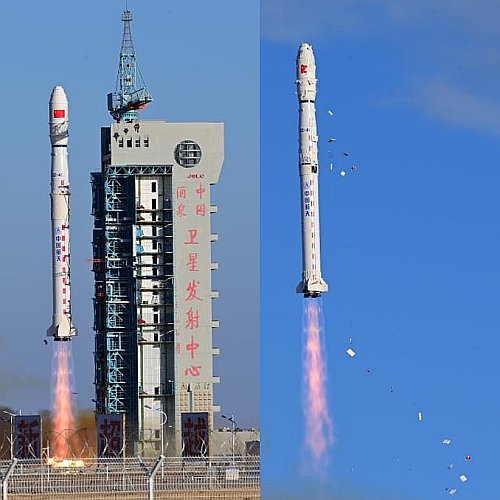
The payload is a Chinese communications satellite.
Now available in hardback and paperback as well as ebook!
From the press release: In this ground-breaking new history of early America, historian Robert Zimmerman not only exposes the lie behind The New York Times 1619 Project that falsely claims slavery is central to the history of the United States, he also provides profound lessons about the nature of human societies, lessons important for Americans today as well as for all future settlers on Mars and elsewhere in space.
“Zimmerman’s ground-breaking history provides every future generation the basic framework for establishing new societies on other worlds. We would be wise to heed what he says.” —Robert Zubrin, founder of the Mars Society.
All editions are available at Amazon, Barnes & Noble, and all book vendors, with the ebook priced at $5.99 before discount. All editions can also be purchased direct from the ebook publisher, ebookit, in which case you don't support the big tech companies and the author gets a bigger cut much sooner.
Autographed printed copies are also available at discount directly from the author (hardback $29.95; paperback $14.95; Shipping cost for either: $6.00). Just send an email to zimmerman @ nasw dot org.

WCAX: A modern news outlet, dedicated to censorship
Today’s blacklist story is a follow-up on an earlier blacklist story. In September officials running Randolph High School in Vermont banned all the girls from the school’s volley ball team from the girls locker room, so that a cross-dressing boy would have that girls dressing room all to himself.
At the time I noted how this action by the school was “so absurd that at first glance it is hard to believe.”
Well, the story has become even more absurd. The news outlet that first reported the story, WCAX-TV, decided in mid-October to blacklist its own story in order to protect and promote the queer agenda in the local schools.
But [on October 11th], links to the controversial story and a recording of the newscast from that night went instead to a page that read “404/Not Found.” When … asked about the missing content, WCAX news director Roger Garrity said the station took it down last week “to prevent others from using our reporting to attack people in the transgender community.
“We didn’t announce it then for fear it might further inflame the situation,” Garrity wrote in an email. “We are now working with LGBTQ advocates on a message to the community acknowledging the harm that was caused.” In response to follow-up questions, Garrity said the station was working with Outright Vermont and GLAAD to craft its message and would put it on the 6 p.m. newscast “as soon as we have it ready to go.”

Click for interactive map.
The science team running the Curiosity rover on Mount Sharp on Mars have decided to take the rover on a detour. As shown in the overview map to the right, rather than continue climbing directly up the mountain in the canyon dubbed Gediz Vallis, they have turned the rover to the west in order to put it back on its original planned route, though traveling in the opposite direction. The goal is to get to Gediz Vallis Ridge, which the rover attempted to reach by crossing the Greenheugh Pediment back in the spring, but was forced to retreat because the ground was simply too rough for the rover’s wheels.
From their October 31st update:
We are now officially on our detour, a short round trip to image and capture geochemistry of the “Gediz Vallis ridge” up on the pediment, before coming back down to the “Marker Band valley” and rejoining the MSAR (Mount Sharp Ascent Route). This detour will allow us to access some of the area we’d planned to visit before getting turned around by the ‘gator-back’ terrain on the Greenheugh pediment. For this part of the campaign, we are prioritizing driving, getting to our destination as fast as we can, but imaging as we go and marking areas of interest for contact science as we come back down.
The panorama above, cropped and reduced to post here, shows the rover’s view uphill to get to the ridge. The blue dot marks its present position. The yellow lines mark the approximate area viewed by the panorama above.
I think the rover’s path will take it up through the saddle between the two small peaks on the left. The science team is likely hoping that once they get up over that saddle, the terrain to get to the ridge will be smoother and less treacherous than the very broken and rocky surface of the Greenheugh Pediment.
This route also appears to also get them up on the marker band more safely. That band, marked by the white arrows, is a distinct smooth layer found in many places on the flanks of Mount Sharp.
Leaving Earth: Space Stations, Rival Superpowers, and the Quest for Interplanetary Travel, can be purchased as an ebook everywhere for only $3.99 (before discount) at amazon, Barnes & Noble, all ebook vendors, or direct from my ebook publisher, ebookit.
If you buy it from ebookit you don't support the big oppressive tech companies and I get a bigger cut much sooner.
"Leaving Earth is one of the best and certainly the most comprehensive summary of our drive into space that I have ever read. It will be invaluable to future scholars because it will tell them how the next chapter of human history opened." -- Arthur C. Clarke
The Aerospace Corporation has made its first rough estimate of the uncontrolled reentry of the core stage of China’s Long March 5B rocket that launched the Mengtian module to its Tiangong-3 space station on October 31st.
The prediction at present is very uncertain, covering about 20 orbits (about 30 hours) centered on November 5, 2021 over the Atlantic Ocean northeast of Brazil, as shown in the graphic to the right. Though this prediction will eventually narrow down to less than one full orbit, it will never be possible to predict in advance the core stage’s exact impact point. As the margin of error shrinks, the predictions will come more frequently.
At this moment, however, the core stage’s orbit crosses over most of the habitable areas of the Earth, and thus all those regions are under threat.
According to one NASA official, Axiom now plans on launching two as yet unnamed Saudi passengers on AX-2, its second commercial flight to ISS scheduled to launch in May 2023 on a Dragon capsule.
The names of the two Saudis on the flight have not been released, she said, but that “we are working very hard with them on training already.” A slide for her presentation noted the two would be named after formal approval by the ISS program’s Multilateral Crew Operations Panel. That slide also stated that crew training for the mission started Oct. 17.
The Saudi Space Commission and Axiom Space separately announced Sept. 22 plans to fly two Saudi citizens on a future Axiom Space mission. However, while it was widely rumored the two would fly on Ax-2, neither announcement stated a specific mission. The Saudi statement said that one of the two people would be a woman but did not disclose how the astronauts would be selected.
Neither Axiom nor the Saudis have revealed the ticket price, though it probably runs somewhere in the range of $20 to $50 million per ticket, based on past known purchase prices by NASA and others.
Rocket Lab announced yesterday that it will make its second attempt to catch the first stage of its Electron rocket using a helicopter during its next launch on November 4, 2022.
Using a modified Sikorsky S-92 helicopter to catch and secure the rocket by its parachute line, Rocket Lab will bring the captured stage back to its Auckland Production Complex to be processed and assessed by engineers and technicians for possible re-use.
This Electron recovery effort follows the catch of an Electron first stage during Rocket Lab’s first helicopter recovery attempt on the “There And Back Again” launch in May, and the recovery attempt for this mission will follow the same concept of operations as the previous launch.
In the May recovery attempt, the helicopter caught the stage, but then released it almost immediately because of unexpected stresses on the helicopter. If Rocket Lab is successful this time, it will be only the second private rocket company to recover a first stage capable of reuse, after SpaceX.
The launch itself will take place at 10:15 am (Pacific). When the live stream is available I will embed it on Behind the Black.
Russia today successfully used its Soyuz-2 rocket to launch a military early warning satellite, designed to detect the launch of any incoming missiles.
The leaders in the 2022 launch race:
50 SpaceX
47 China
19 Russia
8 Rocket Lab
7 ULA
American private enterprise still leads China 70 to 47, though it trails the rest of the world combined 75 to 70.
UPDATE: JPL has released a press release, outlining the steps the InSight team will take to shut the mission down. Key quote:
NASA will declare the mission over when InSight misses two consecutive communication sessions with the spacecraft orbiting Mars, part of the Mars Relay Network – but only if the cause of the missed communication is the lander itself, said network manager Roy Gladden of JPL. After that, NASA’s Deep Space Network will listen for a time, just in case.
There will be no heroic measures to re-establish contact with InSight. While a mission-saving event – a strong gust of wind, say, that cleans the panels off – isn’t out of the question, it is considered unlikely.
Original post:
—————–
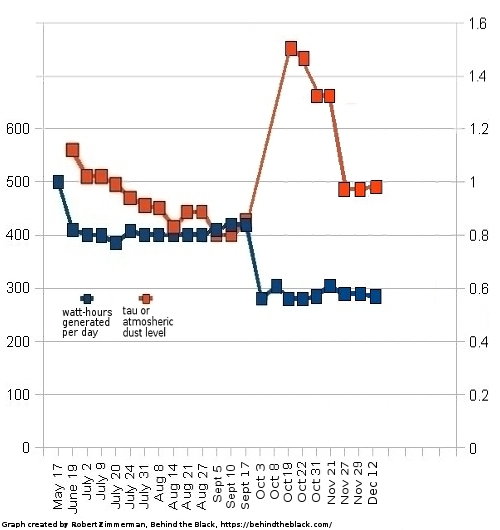
Another update on the power levels on the Mars lander InSight was released today, and is shown on the graph to the right.
As of October 31, 2022, InSight is generating an average between 280 and 290 watt-hours of energy per Martian day, or sol. The tau, or level of dust cover in the atmosphere, was estimated at 1.33 (typical tau levels outside of dust season range from 0.6-0.7).
Though the dust level in the atmosphere has dropped, it still is high. Moreover, there is no sign of any clearing of dust from InSight’s solar panels. During the press conference late last week announcing the discovery of impact craters using InSight’s seismometer, the science team gave the lander no more than six weeks of life. One of those weeks has now ticked off.
An evening pause: It is a commercial for KUKA robotics, and it is a bit staged, a competition between a KUKA robot and table tennis professional Timo Bollo playing music on glasses. Nonetheless, the punchline is good. Human creativity can always beat out robotic programming.
Hat tip Alton Blevins.
Courtesy of BtB’s stringer Jay, who reads Twitter so we don’t have to.
Maybe finally this spacecraft is getting close to launch, years late.
Jay says it succinctly: “This will be the second to the last flight of the Antares 220 rocket. After that, the next three flights of Cygnus be on Falcon 9 rockets, and then the new Antares 330 rocket powered by Firefly engines.” Antares 330 is targeting 2025 for first launch.
Better late than never I guess. And these engines were certainly late.
Apparently on its previous flight it released an object also just prior to its return to Earth. No guarantee the same thing will happen this time, but the event is noted.
Gee, ya think maybe screwing OneWeb might not have been wise, from a business standpoint?
Cool image time! The photo to the right, reduced and enhanced to post here, is an oblique view taken by Lunar Reconnaissance Orbiter (LRO) of the rays that were created when four million years ago an object smashed into the Moon’s far side and produced the 13.75 mile-wide Giordano Bruno crater.
Rays are formed as material ejected from an impact event slams into the surface and churns up local material. Rays are bright because they expose fresh material from depth (both the incoming material and locally churned soil). What is fresh material? Over time the lunar surface is impacted by micrometeoroids and bombarded by radiation; both processes work to darken the surface. The dark “mature” layer at the surface is often only about 50 cm (20 inches) thick, so energetic impacts can easily bring up fresh material from the subsurface. Eventually, the bright rays darken and fade into the background as the surface matures.
In this image, you can see where the ejecta blocks from Giordano Bruno hit the surface, creating a secondary crater, which dug up local material and spread that bright material downstream (so to speak).
The image itself is 4.78 miles wide, at its center, and was snapped from an altitude of 66 miles.

Banned by bookseller Amazon.
The modern dark age: Amazon has without explanation removed a book about Islam, The Islam in Islamic Terrorism: The Importance of Beliefs, Ideas, and Ideology and written by ex-Muslim Ibn Warraq, essentially blacklisting it from sale.
A search at Amazon confirms this fact. The book is no longer available there.
The publisher, New English Review, said this in its press release:
Amazon’s banning of the Warraq book follows on the heels of their earlier banning of another NER Press title, “Easy Meat: Inside Britain’s Grooming Gang Scandal” by Peter McLoughlin, which chronicles the actions, or rather the inaction, of the police, social services, justice system and government in the face of the widespread phenomenon of very young British girls being groomed and then pimped out and held in virtual sex slavery by gangs of grown men.
…As usual, no specific reason has been given for this latest book’s removal. NER Press appealed and that appeal was denied within two hours. “The Islam in Islamic Terrorism” had been on sale since May of 2017 and “Easy Meat” since March of 2016. Both had over 85% five-star ratings and both sold well. Mr. Warraq is the author of 17 books and “The Islam in Islamic Terrorism” was also translated into Korean.
Nor are these two books the only books Amazon has banned. » Read more
The private lunar lander HAKUTO-R, built by the Japanese company Ispace, has now been scheduled for a November 22, 2022 launch on a Falcon 9 rocket.
The launch of the first commercial lunar lander mission to attempt a landing on the Moon was originally scheduled between November 9 -15. However, ispace stated that after consulting with SpaceX, the new tentative launch date would be moved to November 22 because it “allows for best preparation for the mission when considering the fuel-loading schedule for the lander and launch date availability.” SpaceX has a busy schedule at the Cape and NASA still has the Artemis 1 launch scheduled for November 14.
HAKUTO-R’s primary mission is to test the lander. However, it also includes several customer payloads, the most significant of which is the Rashid rover from the United Arab Emirates. Rashid, which is about the size of a Radio Flyer red wagon, will operate for one lunar day, about two weeks. While its main mission is to test the engineering and to train the engineers who built it, it will have two cameras for taking pictures. In addition, on its wheels are test adhesive patches of different materials, designed to see how each material interacts with the Moon’s abrasive dust.
Using a variety of ground-based telescopes, astronomers have discovered three new near-Earth asteroids orbiting the Sun but inside Earth’s orbit, with one of these asteroids having the possibility of one day in the future impacting the Earth.
An international team using the Dark Energy Camera (DECam) mounted on the Víctor M. Blanco 4-meter Telescope at Cerro Tololo Inter-American Observatory in Chile, a Program of NSF’s NOIRLab, has discovered three new near-Earth asteroids (NEAs) hiding in the inner Solar System, the region interior to the orbits of Earth and Venus. This is a notoriously challenging region for observations because asteroid hunters have to contend with the glare of the Sun.
By taking advantage of the brief yet favorable observing conditions during twilight, however, the astronomers found an elusive trio of NEAs. One is a 1.5-kilometer-wide asteroid called 2022 AP7, which has an orbit that may someday place it in Earth’s path. The other asteroids, called 2021 LJ4 and 2021 PH27, have orbits that safely remain completely interior to Earth’s orbit. Also of special interest to astronomers and astrophysicists, 2021 PH27 is the closest known asteroid to the Sun. As such, it has the largest general-relativity effects of any object in our Solar System and during its orbit its surface gets hot enough to melt lead.
You can read their paper here [pdf].
2002 AP7 is the largest such potentially dangerous asteroid discovered in eight years. Its present orbit however never brings it closer to the Earth than 4.4 million miles, and it will be many thousands of years before that orbit might result in an impact. This of course doesn’t prevent foolish mainstream news outlets like the New York Times to label it a “planet-killer.”
The importance of this study however is that it underlines the possibility that there might be other such asteroids lurking close to the Sun that are difficult to spot. This is a blind spot in our asteroid surveys that needs to be eliminated.
Lockheed Martin has now invested $100 million in the startup smallsat-maker Terran Orbital, which has already been building satellites of a wide variety for customers.
Under the deal, which runs through 2035, the smaller Florida-based firm will build SAR and other advanced payloads, as well as satellite sub-assemblies, for the aerospace behemoth, Terran said in a press release today. These include electro-optical, hyperspectral, infrared and secure communication payloads, as well as things like star trackers and flight computers.
With this deal, Terran has also decided that it will no longer launch its own radar constellation, as that constellation would have competed directly with its radar satellite customers. Instead, it will make its radar satellite for others, including Lockheed Martin.
As an example of the variety of smallsats Terran Orbital has been building, it manufactured the smallsat lunar orbiter CAPSTONE for NASA, now on its way to the Moon but being operated for NASA by a different private company, Advanced Space.
The British startup rocket company Orbex has signed a 50-year lease to operate its own launchpad at the Space Hub Sutherland spaceport in Scotland.
The company will lease Space Hub Sutherland from a local development agency for an initial period of 50 years with an option to extend for a further 25 years. Orbex will soon commence construction at the 10-acre launch site on the A’Mhoine peninsula in Sutherland. The bulk of the construction work will be contracted out to technology solutions company Jacobs, which also does a lot of work for NASA.
The company hopes to launch its Prime rocket in ’23. At present it is testing launch operations of a prototype on its launchpad. All told, Orbex has raised a little over $100 million in private investment capital.
The new Mengtian module has docked with the main port of China’s Tiangong-3 space station.
The graphic to the right shows the planned design of the station. Mengtian however is not yet in its side port as shown, but in the main docking port in line with the core module where a Shenzhou crew capsule is shown docked. At some point soon the astronauts on board will use a small robot arm to move Mengtian from the main port to its side port. (This system is very similar to one the Russian’s used on Mir.)
Furthermore, the large vertically oriented solar panels have not yet been installed on the station. These will likely need to be delivered, and require spacewalks to deploy.