Ingenuity team confirms the helicopter is healthy

In a slightly more detailed status update today, the engineering team that operates the Mars helicopter Ingenuity has confirmed that the helicopter is healthy and apparently undamaged after its 72nd flight.

During that last flight, a vertical up-and-down hop to allow communications with the helicopter and thus obtain better information as to its status and location, contact was lost as Ingenuity descended to land.

On Saturday, Jan. 20, communications were reestablished between Ingenuity and NASA’s Perseverance rover. The Ingenuity team has determined the helicopter is power-positive and is sitting vertically on the surface. Next steps include running further diagnostic checks, commanding Ingenuity to take photos of its location on the surface, and performing a spin test.

It is still unclear if full communications have been restored. Ingenuity must be within line-of-sight of the rover Perseverance for this to happen, and it appears that still might not be so. During its 71st flight the helicopter landed prematurely in an unexpected spot, apparently limiting communications significantly. The 72nd flight was likely to locate it more precisely and gather data.

1 comment

Genesis cover

On Christmas Eve 1968 three Americans became the first humans to visit another world. What they did to celebrate was unexpected and profound, and will be remembered throughout all human history. Genesis: the Story of Apollo 8, Robert Zimmerman's classic history of humanity's first journey to another world, tells that story, and it is now available as both an ebook and an audiobook, both with a foreword by Valerie Anders and a new introduction by Robert Zimmerman.

The print edition can be purchased at Amazon or any other book seller. If you want an autographed copy the price is $60 for the hardback and $45 for the paperback, plus $8 shipping for each. Go here for purchasing details. The ebook is available everywhere for $5.99 (before discount) at amazon, or direct from my ebook publisher, ebookit. If you buy it from ebookit you don't support the big tech companies and the author gets a bigger cut much sooner.


The audiobook is also available at all these vendors, and is also free with a 30-day trial membership to Audible.
 

"Not simply about one mission, [Genesis] is also the history of America's quest for the moon... Zimmerman has done a masterful job of tying disparate events together into a solid account of one of America's greatest human triumphs."--San Antonio Express-News

Another apparent splat on Mars

Another apparent splat on Mars
Click for original image.

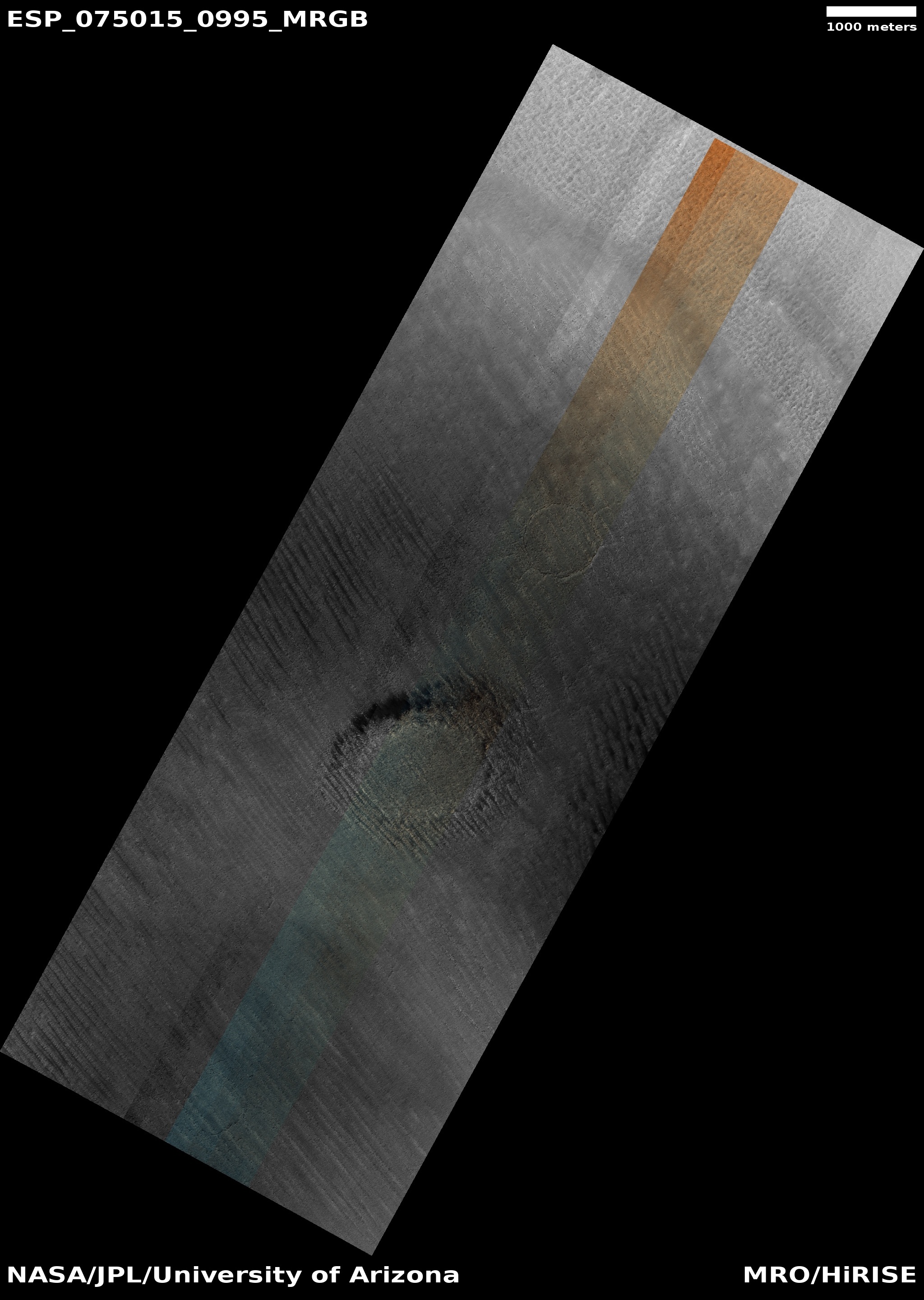
This cool image poses a mystery that might be important for future colonists. The picture to the right, cropped, reduced, and sharpened to post here, was taken on October 23, 2023 by the high resolution camera on Mars Reconnaissance Orbiter (MRO).

The science team merely labels this vaguely as simply “landforms.” What it appears to be is an ancient flow of mudlike material or a delta that moved from the west to the east. Its nature is even more evident in the full picture. The top of the delta however appears corroded and old, with a number of craters on top suggesting it has been here for a long time.

Its mudlike appearances suggests water was involved, possibly as ice impregnated within the soil. However, the location says no, unless this occurred so long ago that the entire climate of Mars and this region was vastly different. And in fact, it might have been.
» Read more

0 comments

Conscious Choice cover

Now available in hardback and paperback as well as ebook!

From the press release: In this ground-breaking new history of early America, historian Robert Zimmerman not only exposes the lie behind The New York Times 1619 Project that falsely claims slavery is central to the history of the United States, he also provides profound lessons about the nature of human societies, lessons important for Americans today as well as for all future settlers on Mars and elsewhere in space.

 
Conscious Choice: The origins of slavery in America and why it matters today and for our future in outer space, is a riveting page-turning story that documents how slavery slowly became pervasive in the southern British colonies of North America, colonies founded by a people and culture that not only did not allow slavery but in every way were hostile to the practice.  
Conscious Choice does more however. In telling the tragic history of the Virginia colony and the rise of slavery there, Zimmerman lays out the proper path for creating healthy societies in places like the Moon and Mars.


“Zimmerman’s ground-breaking history provides every future generation the basic framework for establishing new societies on other worlds. We would be wise to heed what he says.” —Robert Zubrin, founder of the Mars Society.


All editions are available at Amazon, Barnes & Noble, and all book vendors, with the ebook priced at $5.99 before discount. All editions can also be purchased direct from the ebook publisher, ebookit, in which case you don't support the big tech companies and the author gets a bigger cut much sooner.


Autographed printed copies are also available at discount directly from the author (hardback $29.95; paperback $14.95; Shipping cost for either: $6.00). Just send an email to zimmerman @ nasw dot org.

More evidence that smart phones are destroying minds

The smart phone: Bad for kids
The smart phone: Proven very bad for kids

Link here. The article is a detailed look at the growing body of evidence that now strongly suggests that the use of smart phones by young children is very bad for the development of their brains, and leads to numerous mental and physical issues later in life.

The article describes numerous studies that have tracked a sudden rise in childhood behavioral problems, beginning in the early 2010s, when smart phones started to be ubiquitous. For example,

In 2008, psychotherapist Tom Kersting, who worked as a school counselor for 25 years, saw a rise in attention-deficit/hyperactivity disorder (ADHD) diagnoses in children over age 8. ADHD tends to be detected in early childhood after a child starts school. However, he has witnessed increasing diagnoses in teenagers and adults. While it could be possible that some of these teens were missed by clinicians when they were young, Mr. Kersting suspects that some developed symptoms of ADHD due to screen use.

Around 2012, when 30 percent of teenagers had a smartphone, he started to see rebellious behavior and anxiety disorders becoming more common among children. Young adults and teenagers growing up now also tend to be more antisocial and have reduced emotional resilience, which may be related to insufficient in-person socializing due to spending most of their time behind screens. “It’s not just the amount of time spent in the cyber world,” Mr. Kersting told The Epoch Times, “but also what they missed out on: outside play and social learning.”

Other studies have found similar rises during this same time period in childhood depression, anxiety, autism, and an inability to control their emotions.
» Read more

15 comments

Merging galaxies

Merging galaxies
Click for original image.

Time for another cool image from the Hubble Space Telescope. The picture to the right, cropped, reduced, and sharpened to post here, was taken by Hubble to study “the overall physical characteristics of galaxies and their star formation.”

What the picture however reveals best is the ongoing merger of three galaxies.

Arp 300 consists of two interacting galaxies, UGC 05028 (the smaller face-on spiral galaxy) and UGC 05029 (the larger face-on spiral). Likely due to its gravitational dance with its larger partner, UGC 05028 has an asymmetric, irregular structure, which is not as visible from ground-based telescopes but is quite distinct in this new image from NASA’s Hubble Space Telescope. The bright knot visible to the southeast of the center of UGC 05028 may be the remnant of another small galaxy that is in the process of merging with that galaxy.

As always with Hubble galaxy images, there are a plethora of other background galaxies scattered about, including what appears to be another merger in the center right of two elliptical galaxies. In fact, except for one star in the lower right (with the four spikes), every other object in this photo is a galaxy of many shapes and distances.

0 comments

Leaving Earth cover

Leaving Earth: Space Stations, Rival Superpowers, and the Quest for Interplanetary Travel, can be purchased as an ebook everywhere for only $3.99 (before discount) at amazon, Barnes & Noble, all ebook vendors, or direct from my ebook publisher, ebookit.

If you buy it from ebookit you don't support the big oppressive tech companies and I get a bigger cut much sooner.


Winner of the 2003 Eugene M. Emme Award of the American Astronautical Society.

 
"Leaving Earth is one of the best and certainly the most comprehensive summary of our drive into space that I have ever read. It will be invaluable to future scholars because it will tell them how the next chapter of human history opened." -- Arthur C. Clarke

Perseverance looks back at the floor of Jezero Crater

Overview map
Click for interactive map.

Looking out across Jezero Crater
Click for original image.

Cool image time. The picture to the right, cropped, reduced, and enhanced to post here, was taken today by the left high resolution camera on the Mars rover Perseverance.

Though I am guessing somewhat, I think this image looks east and down into the floor of Jezero Crater, as indicated by the yellow lines in the overview map above. The mountains in the distance are not the easter rim of Jezero, which is generally indistinct, but some peaks inside the crater itself. They appear higher because Perseverance is looking down at them from the delta, near the western rim.

The white line on the map shows the rover’s entire journey so far since landing in February 2021, about 14.77 miles. Since Perseverance’s recent travels should be within this picture, and I can see no rover tracks, it suggests my guess as to what the picture looks at could be very wrong. No matter. Up until now the landscape inside Jezero Crater has in general been less spectacular than seen by Curiosity in Gale Crater many miles away. This picture however shows us that Perseverance can provide us some good views also. It is also a precursor to the views we shall get once the rover exits Jezero and begins to explore the rough regions to the west.

1 comment

Engineers shut lunar lander SLIM down in hope sunlight can recharge its batteries

SLIM's landing zone
Map showing SLIM landing zone on the Moon.
Click for interactive map.

Once they were able to download sufficient data, engineers have intentionally shut down Japan’s lunar lander SLIM in order to increase the chances it will recover should sunlight hit its solar panels and recharge its batteries.

The shutdown occurred three hours after landing on January 19, 2024, when the batteries still has a charge of about 12%.

Before turning the lander off remotely, mission control was able to receive technical and image data from its descent, and from the lunar surface. “We’re relieved and beginning to get excited after confirming a lot of data has been obtained,” JAXA said Monday in a statement, adding that “according to the telemetry data, SLIM’s solar cells are facing west”.

“If sunlight hits the Moon from the west in the future, we believe there’s a possibility of power generation, and we’re currently preparing for restoration,” it said.

The landing took place in the morning on the Moon, so there is a chance that in about a week, when the Sun shifts to the western sky, the panels will get sunlight and begin to recharge the battery.

Meanwhile, engineers confirmed that the two experimental mini-rovers were successfully deployed (see the media kit [pdf] for more details). At the moment we do not know if they have operated as planned, one rolling and the other hopping.

0 comments

Iran launches another satellite

Iran today claimed its second satellite launch in less than four months, placing a smallsat into an orbit its state-run press said was 466 miles high.

As yet this launch has not been confirmed by the U.S. military or any other sources. Like its previous launch in September, the information released is so slim it is unclear if the satellite is in orbit or not. This launch however used a new three-stage solid-fueled rocket dubbed Qaem-100, and from the image released, appears powerful enough to do the job.

Meanwhile, SpaceX once again scrubbed a Starlink launch, the third time in three days, due to weather, illustrating once again that despite the company’s almost clockwork ability to launch, its goal of reaching 150 launches in 2024 could be stymied simply by not having enough clear days where weather is not a problem.

The 2024 launch race:

6 SpaceX
5 China
1 India
1 ULA
1 Japan
1 Iran

6 comments

Scientists finally look at prime samples captured by OSIRIS-REx of the asteroid Bennu

The inside of OSIRIS-REx's sample return capsule
Click for original image.

Scientists have finally opened the sample capsule from OSIRIS-REx to see the prime asteroid material obtained from the asteroid Bennu during the spacecraft’s touch-and-go sample grab.

The captured material inside the capsule can be seen in the picture to the right. It is the debris inside the ring.

Erika Blumenfeld, creative lead for the Advanced Imaging and Visualization of Astromaterials (AIVA) and Joe Aebersold, AIVA project lead, captured this photograph of the open TAGSAM head including the asteroid material inside using manual high-resolution precision photography and a semi-automated focus stacking procedure. The result is an image that shows extreme detail of the sample.

Next, the curation team will remove the round metal collar and prepare the glovebox to transfer the remaining sample from the TAGSAM head into pie-wedge sample trays.

The final mass of material will be determined once it is removed and weighed, though the team has already recovered more than 70 grams that had clung to the outside the capsule, which in itself exceeded the mission’s targeted goal.

5 comments

Ingenuity’s status uncertain but likely healthy

Overview map
Click for interactive map.

Updates from the engineering team that operates the Mars helicopter Ingenuity in the past two days have suggested the helicopter might be in trouble. First the team issued a status update yesterday that indicated communications had been lost prematurely during the helicopter’s 72nd flight.

The flight was designed as a quick pop-up vertical flight to check out the helicopter’s systems, following an unplanned early landing during its previous flight. Data Ingenuity sent to the Perseverance rover (which acts as a relay between the helicopter and Earth) during the flight indicates it successfully climbed to its assigned maximum altitude of 40 feet (12 meters). During its planned descent, communications between the helicopter and rover terminated early, prior to touchdown.

A further update today said that communications had been regained, but also noted that the engineering team still did not have a full understanding of the helicopter’s status.

We’ve reestablished contact with the #MarsHelicopter after instructing @NASAPersevere
to perform long-duration listening sessions for Ingenuity’s signal.

Based on the information released (or lack thereof) from the previous flight, the 71st, it is my sense that the situation is not as dire as these reports suggest, and that the situation might simply be related to issues of communications. Let me explain why I have come to this conclusion.
» Read more

1 comment
1 436 437 438 439 440 2,930