Genesis cover

On Christmas Eve 1968 three Americans became the first humans to visit another world. What they did to celebrate was unexpected and profound, and will be remembered throughout all human history. Genesis: the Story of Apollo 8, Robert Zimmerman's classic history of humanity's first journey to another world, tells that story, and it is now available as both an ebook and an audiobook, both with a foreword by Valerie Anders and a new introduction by Robert Zimmerman.

The print edition can be purchased at Amazon or any other book seller. If you want an autographed copy the price is $60 for the hardback and $45 for the paperback, plus $8 shipping for each. Go here for purchasing details. The ebook is available everywhere for $5.99 (before discount) at amazon, or direct from my ebook publisher, ebookit. If you buy it from ebookit you don't support the big tech companies and the author gets a bigger cut much sooner.


The audiobook is also available at all these vendors, and is also free with a 30-day trial membership to Audible.
 

"Not simply about one mission, [Genesis] is also the history of America's quest for the moon... Zimmerman has done a masterful job of tying disparate events together into a solid account of one of America's greatest human triumphs."--San Antonio Express-News

December 9, 2022 Quick space links

Courtesy of BtB’s stringer Jay.


2 comments

Ancient lava flows down the flanks of the solar system’s largest volcano

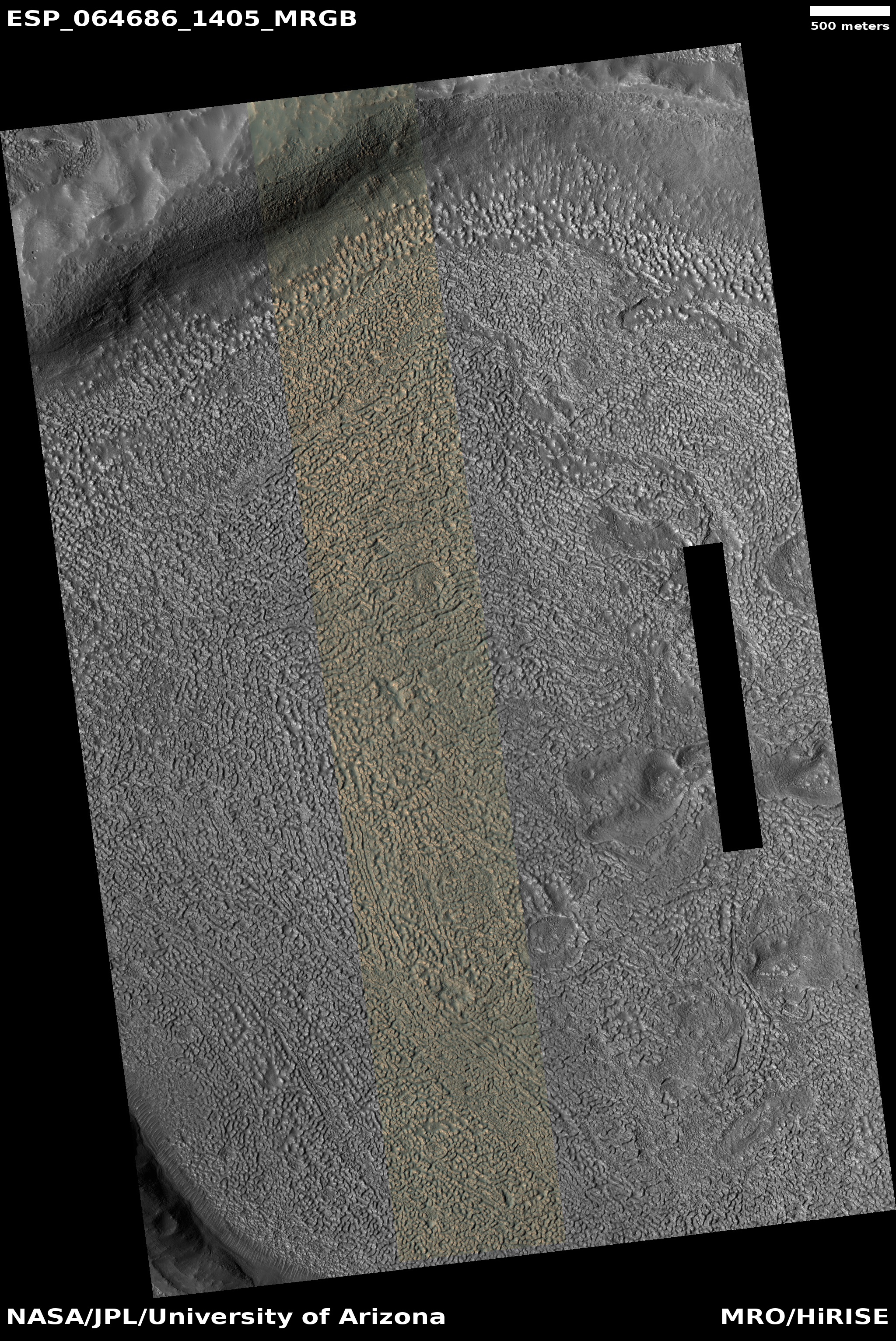
Lava flows on Olympus Mons
Click for full image.

Cool image time! The photo to the right, cropped, reduced, and sharpened to post here, was taken on October 2, 2022 by the high resolution camera on Mars Reconnaissance Orbiter (MRO). It shows what appears to be very old and eroded lava on the northeast flanks of Olympus Mons, the largest volcano on Mars as well as the entire solar system. About 600 miles across, from the edge to its peak, Olympus rises about 54,000 feet, with an actual height relative to Mars’ “sea level” of just under 70,000 feet, more than twice as high as Mount Everest on Earth.

The white arrow show the downward grade. Several different flows can be seen throughout the picture, some confined to a central channel with smooth aprons of overflows on either side. Others are more broken and less coherent, and suggest that either the flows were inherently different, or are much older and have deteriorated with time.
» Read more

0 comments

Conscious Choice cover

Now available in hardback and paperback as well as ebook!

From the press release: In this ground-breaking new history of early America, historian Robert Zimmerman not only exposes the lie behind The New York Times 1619 Project that falsely claims slavery is central to the history of the United States, he also provides profound lessons about the nature of human societies, lessons important for Americans today as well as for all future settlers on Mars and elsewhere in space.

 
Conscious Choice: The origins of slavery in America and why it matters today and for our future in outer space, is a riveting page-turning story that documents how slavery slowly became pervasive in the southern British colonies of North America, colonies founded by a people and culture that not only did not allow slavery but in every way were hostile to the practice.  
Conscious Choice does more however. In telling the tragic history of the Virginia colony and the rise of slavery there, Zimmerman lays out the proper path for creating healthy societies in places like the Moon and Mars.


“Zimmerman’s ground-breaking history provides every future generation the basic framework for establishing new societies on other worlds. We would be wise to heed what he says.” —Robert Zubrin, founder of the Mars Society.


All editions are available at Amazon, Barnes & Noble, and all book vendors, with the ebook priced at $5.99 before discount. All editions can also be purchased direct from the ebook publisher, ebookit, in which case you don't support the big tech companies and the author gets a bigger cut much sooner.


Autographed printed copies are also available at discount directly from the author (hardback $29.95; paperback $14.95; Shipping cost for either: $6.00). Just send an email to zimmerman @ nasw dot org.

Pushback: Students win $90K from University of Idaho for restricting their free speech

Idaho University bans religious speech
This college is still hostile to free speech.

Bring a gun to a knife fight: Three students who were punished last spring by the University of Idaho (UI) for daring to disagree publicly with an activist for the queer agenda have now won a $90K settlement as well as getting their records fully cleared.

As part of the settlement, university officials permanently rescinded the no-contact orders they had issued against Peter Perlot, Mark Miller, and Ryan Alexander, members of the Christian Legal Society chapter at the university, and Professor Richard Seamon, CLS’s faculty advisor, and paid $90,000.

I reported this case when it happened, noting that the university had essentially “decided that the only opinions that could be allowed were those that agreed with the queer political agenda, and acted unilaterally to punish these Christians for refusing to bow to that rule.” The university has now lost, and lost badly.
» Read more

5 comments

Astronomers confirm Webb galaxies from the early universe

Astronomers using Webb have now confirmed with spectroscopy the age of at least four galaxies from the very very early universe, existing only a short time after the theorized Big Bang.

Four of the galaxies studied are particularly special, as they were revealed to be at an unprecedentedly early epoch. The results provided spectroscopic confirmation that these four galaxies lie at redshifts above 10, including two at redshift 13. This corresponds to a time when the universe was approximately 330 million years old, setting a new frontier in the search for far-flung galaxies. These galaxies are extremely faint because of their great distance from us.

The scientists had aimed Webb at Hubble’s Ultra Deep Field, doing a long infrared exposure lasting 28 hours over three days in order to gather the faintest infrared radiation (that Hubble could not see) and thus the most distant galaxies. The spectrum of individuals stars was then measured, which indicating their redshift and their estimated age.

The astronomers will next aim Webb at the more famous Hubble Deep Field, the first such long exposure that optical telescope took back in the late 1990s.

1 comment

Leaving Earth cover

Leaving Earth: Space Stations, Rival Superpowers, and the Quest for Interplanetary Travel, can be purchased as an ebook everywhere for only $3.99 (before discount) at amazon, Barnes & Noble, all ebook vendors, or direct from my ebook publisher, ebookit.

If you buy it from ebookit you don't support the big oppressive tech companies and I get a bigger cut much sooner.


Winner of the 2003 Eugene M. Emme Award of the American Astronautical Society.

 
"Leaving Earth is one of the best and certainly the most comprehensive summary of our drive into space that I have ever read. It will be invaluable to future scholars because it will tell them how the next chapter of human history opened." -- Arthur C. Clarke

SOFIA to retire to Arizona museum

NASA yesterday announced that its airborne 747 SOFIA telescope will be retired to the Pima Air & Space Museum in Tucson, Arizona, making its final flight there December 13, 2022.

Pima, one of the world’s largest aerospace museums, is developing plans for when and how the SOFIA aircraft will eventually be on display to the public. Along with six hangars, 80 acres of outdoor display grounds, and more than 425 aircraft from around the world, Pima also has its own restoration facility where incoming aircraft like SOFIA are prepared for museum immortalization after their arrival.

While the idea of SOFIA, putting a astronomical telescope on an airplane to get it above most of the atmosphere, has some merit, this particular NASA project was always too costly and simply produced too little science to justify its expense.

In many ways, this museum display will provide one of the best ways to see a 747 itself, now also retired.

3 comments

NASA awards Collins contract to build spacesuits for space station spacewalks

Capitalism in space: NASA yesterday awarded Collins Aerospace a $97.2 million contract to build spacesuits for the agency’s future space station spacewalks.

In June NASA had picked Collins and Axiom as the vendors who would build spacesuits for the agency. In September it purchased its its first Artemis Moon spacesuits from Axiom. This new contract has NASA buying its first new space station suits from Collins.

In both cases, the companies own their designs, and can thus sell them to the other private space stations presently under construction.

This contract award follows NASA abandonment of its own failed spacesuit effort, which spent fourteen years and a billion dollars and produced nothing.

1 comment

Astrobotic’s Peregrine lunar lander passes launch tests

Astrobotic’s first demonstration lunar lander, dubbed Peregrine, has passed its vibration and acoustic tests, demonstrating it can survive launch on ULA’s Vulcan rocket, presently scheduled for the first quarter of ’23.

The lander is now undergoing electromagnetic interference testing, which will be followed by thermal vacuum tests. Once those tests are complete, the company said, it will ship the lander to Cape Canaveral, Florida, to be integrated with the Vulcan Centaur for a launch currently scheduled in the first quarter of 2023. That launch will be the inaugural flight of the Vulcan Centaur.

A great deal will be riding on that first Vulcan launch, both for Astrobotic and ULA.

1 comment

Billionaire Maezawa chooses his passengers for Starship lunar flight

Japanese billionaire Yusaku Maezawa yesterday announced the eight passengers he will take with him on his private Starship flight around the Moon, its launch date still not set.

The full list of ten (including the two back-up passengers) is a wide mixture of individuals with a wide range of disciplines coming from a wide range of countries. For those interested in space, the one name that stood out and was very familiar was Tim Dodd, created of Everyday Astronaut. He created a video describing his selection as well as Maezawa’s entire project, which I have embedded below:
» Read more

4 comments

Last 747 rolls off assembly line

Boeing earlier this week completed assembly of its very last 747 airplane, the 1,574th such plane built in the past half century.

Still in its iridescent green protective coating, the giant aircraft was towed out of the widebody aircraft factory in a low-key exercise without any fanfare. Once the 747 has been cleared, it will be flown to another Boeing facility where it will be painted in the Atlas Air livery in anticipation of final delivery to the customer next year.

The 747 was born out of a failed bid by Boeing to market a large jet transporter to the US military in the 1960s. That contract for what became the C-5A Galaxy eventually went to Lockheed, but Boeing was convinced that its basic design, with its high-bypass turbofan engine, could be reworked for the civilian market, which was booming at the time.

On January 9, 1969, the first 747 prototype took to the skies over Washington state. It was a staggering 225 feet (68.5 m) long, had a wing area larger than a basketball court, and the tail was as high as a six-story building.

Without question the 747 was one of the safest and well designed airplanes ever built. It was years after that first flight before one was involved in an accident, and that was not due to a failure of the plane itself. It also flew like a dream, its large size making it look like it was lumbering slowly in the air. Its retirement is almost entirely related to fuel cost-savings, since the 747 has four engines and thus more fuel than more modern planes.

5 comments

China completes two launches successfully

China today successfully completed two launches:

First, China’s government used its Long March 2D rocket to launch a classified Earth observation satellite into orbit. The rocket launched from an interior spaceport, dropping its expendable first stages within China.

Next, the China Academy of Launch Vehicle Technology (CALT) successfully completed the inaugural launch of its Smart Dragon-3 solid-fueled rocket, putting 14 smallsats into orbit. The rocket launched from a platform at sea, so its expendable stages fell in the ocean. Though the rocket is aimed at launching commercial payloads, it is still a Chinese government project using military missile technology.

The leaders in the 2022 launch race:

57 China
55 SpaceX
21 Russia
9 Rocket Lab
8 ULA

The U.S. still leads China 79 to 57 in the national rankings, but trails the entire world combined 87 to 79.

0 comments
1 653 654 655 656 657 2,929