Blondie – The Tide Is High
An evening pause: Performed live 1997.
Hat tip Diane Zimmerman.
An evening pause: Performed live 1997.
Hat tip Diane Zimmerman.
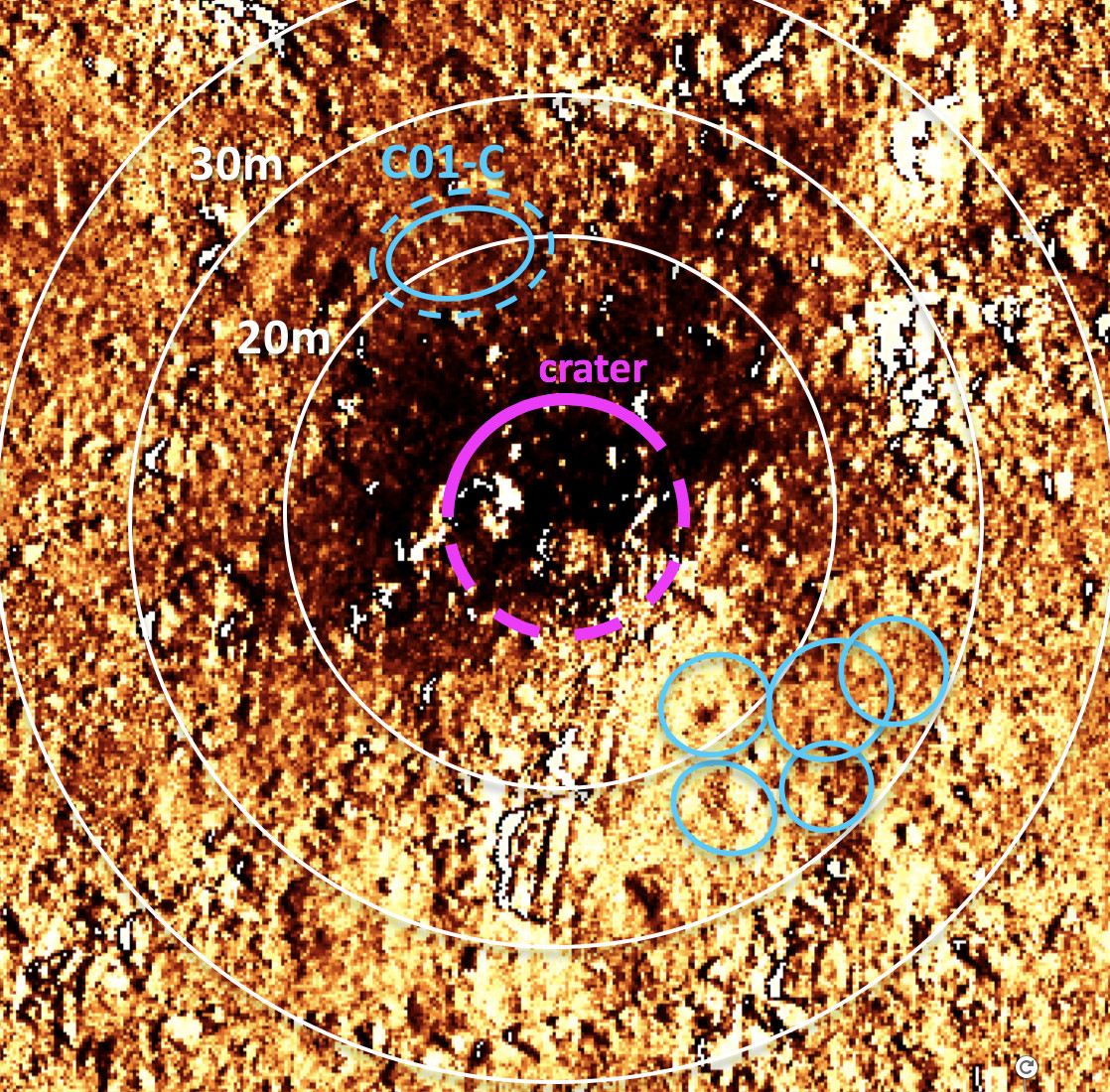
Cool image time and a mystery! The photo to the right, cropped to post here, was taken on March 29, 2022 by the high resolution camera on Mars Reconnaissance Orbiter (MRO) of an 18-mile-wide crater in the southern cratered highlands of Mars. The full picture, dubbed “Steep Cliff,” was taken apparently to get a good view of the crater’s northern rim. The rim’s steepness suggests that the floor of the crater is significantly filled.
More intriguing however are the scattering of strange depressions about six miles south of the rim. What caused them? The crater’s location is in a part of Mars where it is not unusual to find both glacial features as well as flood plain lava. In fact, the crater’s northeast and southwest rims appear to have been buried by what appears to be flood lava. The northern rim’s shallowness also suggests the crater is well filled with flood lava.
However, the crater is also at 38 degrees south latitude, a latitude where planetary scientists have found lots of glacial features. Much of this crater fill could be glacial.
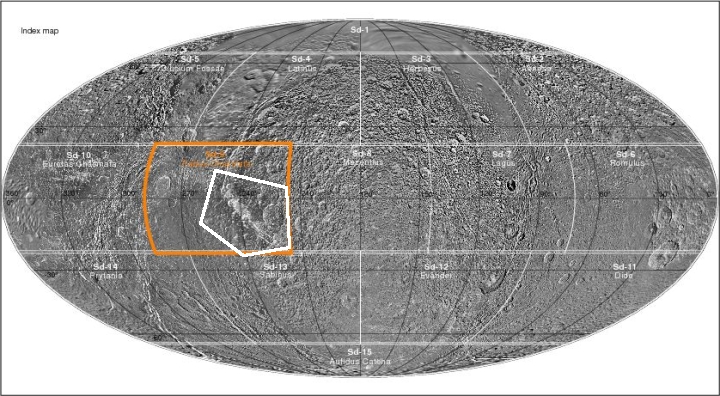
The overview map below illustrates this mystery.
» Read more
On Christmas Eve 1968 three Americans became the first humans to visit another world. What they did to celebrate was unexpected and profound, and will be remembered throughout all human history. Genesis: the Story of Apollo 8, Robert Zimmerman's classic history of humanity's first journey to another world, tells that story, and it is now available as both an ebook and an audiobook, both with a foreword by Valerie Anders and a new introduction by Robert Zimmerman.
The print edition can be purchased at Amazon or any other book seller. If you want an autographed copy the price is $60 for the hardback and $45 for the paperback, plus $8 shipping for each. Go here for purchasing details. The ebook is available everywhere for $5.99 (before discount) at amazon, or direct from my ebook publisher, ebookit. If you buy it from ebookit you don't support the big tech companies and the author gets a bigger cut much sooner.
"Not simply about one mission, [Genesis] is also the history of America's quest for the moon... Zimmerman has done a masterful job of tying disparate events together into a solid account of one of America's greatest human triumphs."--San Antonio Express-News

University of Central Florida: Hostile to free speech
Bring a gun to a knife fight: In January 2021 (in one of my first blacklist columns and just after Biden assumed power), I described how professor Charles Negy was fired from the teaching job he had had at the University of Central Florida for 22 years, merely because he had stated some obvious facts about BLM and affirmative action on his twitter feed.
The school claimed it did not fire him for these tweets (an obvious lie based on the events), but because of a supposed pattern of inappropriate classroom behavior obtained through anonymous tips, tips instigated by Negy’s tweets that by the way did not match any of the school’s previous assessments of his teaching.
Negy fought back, demanding his case be reviewed by an independent arbitrator, and has now won his case.
In the ruling on Monday, the arbitrator, Ben Falcigno, found that the university had failed to show “just cause” when it fired Dr. Negy because it had not given him a chance to change his conduct in the classroom or, alternatively, to show that he was incapable of changing his behavior.
» Read more
Capitalism in space: SpaceX has begun another private funding round, now asking for $1.725 billion in new investment capital.
The space venture is looking to bring in up to $1.725 billion in new capital, at a price of $70 per share, according to a company-wide email on Friday obtained by CNBC. Notably, SpaceX split its stock price 10-for-1 in February, which reduced the common stock to $56 a share – with the new valuation representing a 25% increase.
When added to past funding rounds — and including the $2.9 billion provided by NASA for turning Starship into a manned lunar lander — SpaceX will have raised approximately $12 billion total for building Starship.
Sounds like a lot, doesn’t it? Well, compared to what NASA has spent for its expendable SLS rocket (about $60 billion), $12 billion is chicken feed, especially because Starship will not be expendable, but entirely reusable.
If this contrast doesn’t illustrate the strength of freedom, competition, and private enterprise over government, I don’t know what does. Government, not caring about making a profit, produces a disposable rocket costing many billions, and takes two decades to do it. Private enterprise in comparison also wants a big rocket, but it also doesn’t look kindly on throwing away its investment with each launch. It instead insists the cost to build it be constrained, as well as the time to do it.
The result: Government accomplishes little and wastes a lot. Private enterprise makes it happen, and quickly for a reasonable cost.
Now available in hardback and paperback as well as ebook!
From the press release: In this ground-breaking new history of early America, historian Robert Zimmerman not only exposes the lie behind The New York Times 1619 Project that falsely claims slavery is central to the history of the United States, he also provides profound lessons about the nature of human societies, lessons important for Americans today as well as for all future settlers on Mars and elsewhere in space.
“Zimmerman’s ground-breaking history provides every future generation the basic framework for establishing new societies on other worlds. We would be wise to heed what he says.” —Robert Zubrin, founder of the Mars Society.
All editions are available at Amazon, Barnes & Noble, and all book vendors, with the ebook priced at $5.99 before discount. All editions can also be purchased direct from the ebook publisher, ebookit, in which case you don't support the big tech companies and the author gets a bigger cut much sooner.
Autographed printed copies are also available at discount directly from the author (hardback $29.95; paperback $14.95; Shipping cost for either: $6.00). Just send an email to zimmerman @ nasw dot org.
Capitalism in space: According to a story yesterday, Boeing, ULA, and NASA plan on launching Starliner through the end of the decade on the last few Atlas-5 rockets in existence, which in turn suggests that Boeing is either not looking for any Starliner customers outside of NASA or has none.
With NASA planning to alternate between Boeing’s Starliner and SpaceX’s Crew Dragon for International Space Station crew rotation missions once Starliner is certified, each flying once a year, it implies that Atlas 5 launches of Starliner could continue well into the latter half of the decade. ULA, which has stopped selling Atlas 5 launches, has previously discussed phasing out Atlas 5 in favor of Vulcan Centaur around the middle of the decade.
…Even at a pace of one mission a year, though, and with no other customers for Starliner, the supply of Atlas vehicles would be exhausted before the projected retirement of the ISS in 2030. “We would look, toward the end of the decade, to award other flights, or have other flights potentially for Boeing,” said Steve Stich, NASA commercial crew program manager. “We would look for a new system.” He added NASA would support human-rating a new system “when Boeing and ULA are ready.” [emphasis mine]
The implications of the story is that Boeing is simply not interested in finding other customers for Starliner, nor is it trying to find alternative launch vehicles to replace the Atlas-5. Instead, the company has simply calculated that there are enough Atlas-5s left to complete its obligations to NASA, and that is all it needs. Competing for additional commercial manned space flights does not interest it.
It also appears that only when NASA demands or needs another launch vehicle will Boeing and ULA make an effort to replace Atlas-5.
All in all, this does not speak well for the future of either Boeing or ULA. A lack of competitive spirit will quickly leave you in the dust, especially if a host of new startups exist to grab your market share. Either both companies change their attitudes, or both will die.
Capitalism in space: Mitsubishi this week announced a new technology it had developed that will allow small cubesats to 3D print antennas in space much larger than the satellite itself, using the sun’s ultraviolet radiation to harden the resin.
The full press release can be read here [pdf].
– On-orbit manufacturing eliminates the need for an antenna structure that can withstand vibrations and shocks during launch, which is required for conventional antenna reflectors, making it possible to reduce the weight and thickness of antenna reflectors, thereby contributing to the reduction of satellite weight and launch costs.
– Assuming the use of a 3U CubeSat (100 x 100 x 300 mm) specification, an antenna reflector with a diameter of 165 mm, which is larger than the size of the CubeSat bus, was fabricated in air, and a gain of 23.5 dB was confirmed in the Ku band (13.5 GHz).
Obviously this is still in development, but once viable commercially it will expand the capabilities of cubesats enormously, especially for interplanetary missions which need larger antennas for communications.
Leaving Earth: Space Stations, Rival Superpowers, and the Quest for Interplanetary Travel, can be purchased as an ebook everywhere for only $3.99 (before discount) at amazon, Barnes & Noble, all ebook vendors, or direct from my ebook publisher, ebookit.
If you buy it from ebookit you don't support the big oppressive tech companies and I get a bigger cut much sooner.
"Leaving Earth is one of the best and certainly the most comprehensive summary of our drive into space that I have ever read. It will be invaluable to future scholars because it will tell them how the next chapter of human history opened." -- Arthur C. Clarke
China today successfully launched three satellites of unexplained purpose using its Long March 2C rocket.
The leaders in the 2022 launch race:
21 SpaceX
16 China
7 Russia
3 Rocket Lab
3 ULA
The U.S. still leads China 30 to 16 in the national rankings, and the entire world combined 30 to 26.
Embedded below the fold in two parts.
To listen to all of John Batchelor’s podcasts, well worth your time, go here.
» Read more
An evening pause: For the weekend.
Hat tip Cotour, who adds, “Wait until this comes to Mars.”

Screen capture just after soft docking.
Boeing and NASA today successfully docked an unmanned Starliner capsule to ISS for the first time, completing the up-from-Earth portion of this demo mission to prove out this Boeing spacecraft as a future ferry to bring astronauts to and from the station.
The screen capture to the right, taken from the live feed, shows Starliner just after a successful soft capture docking. This was shortly followed by a hard dock.
They will open the hatch tomorrow after checking out the capsule’s linkage with ISS.
The docking itself was delayed by about 78 minutes, partly to time the docking during a period of good orbital communications and partly because of an issue with NASA’s own docking ring on the station that required engineers to reset it.
Another cool image to herald in the weekend! The photo to the right, cropped and reduced to post here, was taken by the Hubble Space Telescope and shows a pair of spiral galaxies about 800 million light years away.
The smaller galaxy is superimposed on the larger one, which is a type of active galaxy called a Seyfert galaxy.
Seyfert galaxies are named for astronomer Carl K. Seyfert who, in 1943, published a paper about spiral galaxies with very bright emission lines. Today we know that about 10% of all galaxies may be Seyfert galaxies. They belong to the class of “active galaxies” – galaxies that have supermassive black holes at their centers accreting material, which releases vast amounts of radiation. The active cores of Seyfert galaxies are at their brightest when observed in light outside the visible spectrum. The larger galaxy in this pair is a Type II Seyfert galaxy, which means it is a very bright source of infrared and visible light.
In other words, both of these galaxies emit a lot of radiation in the infrared, radio, and X-rays due to activity taking place at the supermassive black holes believed to be at their cores.
Cool image time! The picture to the right, rotated, cropped, reduced, and annotated to post here, was taken on September 21, 2021 by the high resolution camera on Mars Reconnaissance Orbiter (MRO) and shows what appear to be a variety of flows, from alluvial fill to slope streaks to dust coming down the southeastern interior rim of 77-mile-wide Orson Welles Crater on Mars.
The location is almost right on the equator, so none of these flows are ice- or water-related. Nor are such flows unusual in the meandering 800-mile-long canyon that cuts through Orson Wells crater, dubbed Shalbatana Vallis. I featured similar flows at a spot to the north and downstream from this one in May 2021, also on the canyon’s eastern rim.
The overview map below provides some context.
» Read more