
June 25, 2019 Zimmerman/Batchelor podcast
Embedded below the fold in two parts.
» Read more
Embedded below the fold in two parts.
» Read more

Click for full image.
Cool image time! The sequence of images above, reduced to post here, were taken in multiple wavelengths by the 2.1 meter Kitt Peak National Observatory in Arizona and the Spitzer Space Telescope in orbit.
The Whirlpool galaxy, also known as Messier 51 and NGC 5194/5195, is actually a pair of galaxies that are tugging and distorting each other through their mutual gravitational attraction. Located approximately 23 million light-years away, it resides in the constellation Canes Venatici.
The leftmost panel shows the Whirlpool in visible light, much as our eye might see it through a powerful telescope. In fact, this image comes from the Kitt Peak National Observatory 2.1-meter (6.8-foot) telescope. The spiraling arms are laced with dark threads of dust that radiate little visible light and obscure stars positioned within or behind them.
The second panel from the left includes two visible-light wavelengths (in blue and green) from Kitt Peak but adds Spitzer’s infrared data in red. This emphasizes how the dark dust veins that block our view in visible light begin to light up at these longer, infrared wavelengths.
Spitzer’s full infrared view can be seen in the right two panels, which cover slightly different ranges of infrared light.
The infrared views of the Whirlpool galaxy also show how dramatically different its two component parts are: The smaller companion galaxy at the top of the image has been stripped nearly clean of dust features that stand out so brilliantly in the lower spiral galaxy. The faint bluish haze seen around the upper galaxy is likely the blended light from stars thrown out of the galaxies as these two objects pull at each other during their close approach.
The Spitzer images above are likely among the last we shall see from that telescope, which has been in orbit since 2003 with a planned mission of only 2.5 years. As its cryogenic coolant became depleted in 2009, it has been functioning in a somewhat limited phase since. NASA will officially end the mission on January 30, 2020, more than thirteen years beyond that initial lifespan.

On Christmas Eve 1968 three Americans became the first humans to visit another world. What they did to celebrate was unexpected and profound, and will be remembered throughout all human history. Genesis: the Story of Apollo 8, Robert Zimmerman's classic history of humanity's first journey to another world, tells that story, and it is now available as both an ebook and an audiobook, both with a foreword by Valerie Anders and a new introduction by Robert Zimmerman.
The print edition can be purchased at Amazon or any other book seller. If you want an autographed copy the price is $60 for the hardback and $45 for the paperback, plus $8 shipping for each. Go here for purchasing details. The ebook is available everywhere for $5.99 (before discount) at amazon, or direct from my ebook publisher, ebookit. If you buy it from ebookit you don't support the big tech companies and the author gets a bigger cut much sooner.
"Not simply about one mission, [Genesis] is also the history of America's quest for the moon... Zimmerman has done a masterful job of tying disparate events together into a solid account of one of America's greatest human triumphs."--San Antonio Express-News
A evening pause: Hat tip Danae.

Click for full image.
Cool image time! In a sense, to announce that scientists have found an oddly shaped crater on Mars is to state the obvious. In the years since the first Martian fly-by by Mariner 4 in 1965, scientists have been discovering numerous odd-shaped craters on Mars, every single of which has challenged our assumptions about the planet’s geology. I myself have posted a half dozen such posts since January (January 7, January 10, January 14, March 26, March 27, June 12).
Yet, it is always worth looking when another one crops up, because of the fact that they challenge our assumptions about Martian geology. They are also always cool to look at! On the right, cropped and reduced to post here, is an image taken by the high resolution camera on Mars Reconnaissance Orbiter (MRO) on April 19, 2019 of what the scientists have dubbed an “Odd Shaped Crater in Arabia Terra.”
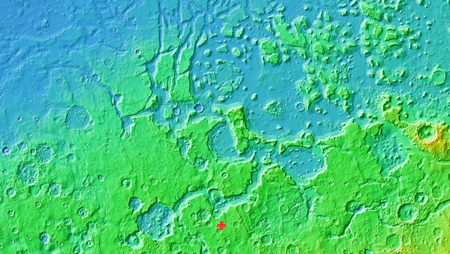
Arabia Terra is one of the largest regions of the transition zone between the northern lowlands and the southern highlands. This crater is located, as shown by the red cross in the overview map to the right, near its northern edge, in an area where the descent into the northern lowlands is somewhat abrupt and broken up by large craters and chaos terrain.
The crater itself holds numerous geological mysteries. Its shape suggests two impacts of different sizes overlapping each other, but without any remnant of the inner rim of the second impact. Where did that remnant go? Or maybe this wasn’t caused by two impacts, but by one impact that reshaped the surface in this odd and inexplicable way.
Then there is the three teardrop-shaped patterns in the crater’s floor. They look like the brushstrokes of a giant-sized painter. Were they caused by the wind? And if so, why in this pattern?
Planetary geologists could probably come up with a dozen more questions. The number tells us how little we know about Mars.

Now available in hardback and paperback as well as ebook!
From the press release: In this ground-breaking new history of early America, historian Robert Zimmerman not only exposes the lie behind The New York Times 1619 Project that falsely claims slavery is central to the history of the United States, he also provides profound lessons about the nature of human societies, lessons important for Americans today as well as for all future settlers on Mars and elsewhere in space.
“Zimmerman’s ground-breaking history provides every future generation the basic framework for establishing new societies on other worlds. We would be wise to heed what he says.” —Robert Zubrin, founder of the Mars Society.
All editions are available at Amazon, Barnes & Noble, and all book vendors, with the ebook priced at $5.99 before discount. All editions can also be purchased direct from the ebook publisher, ebookit, in which case you don't support the big tech companies and the author gets a bigger cut much sooner.
Autographed printed copies are also available at discount directly from the author (hardback $29.95; paperback $14.95; Shipping cost for either: $6.00). Just send an email to zimmerman @ nasw dot org.
They’re coming for you next: A leftist candidate, Tiffany Cabán, backed by socialists Alexandra Ocasio-Cortez (D-New York) and Senator Bernie Sanders (D-Vermont), has won an election for Queens District Attorney in New York.
Cabán, Alexandria Ocasio-Cortez’s preferred pick for the office, garnered 39.5% of the vote compared to Democratic rival Melinda Katz’s 38.3% with 98% of precincts reporting.
…Cabán is a 31-year-old public defender who wants to decriminalize sex work, close Rikers Island and end cash bail. The young lawyer was joined on stage with city Comptroller Scott Stringer and state Sen. Jessica Ramos.
The election was close enough that they will do a recount, but I don’t think that will change the result, which clearly shows that New Yorkers have not been put off in the slightest by Ocasio-Cortez’s extreme leftist positions, as many conservative pundits have assumed. If anything, her upfront willingness to push her beliefs, no matter our senseless or impractical or ignorant, have garnered her side more support.
I am reminded again of this quote from Walter Miller’s great end-of-the-world science fiction novel, A Canticle for Leibowitz:
Listen, are we helpless? Are we doomed to do it again and again and again? Have we no choice but to play the Phoenix in an unending sequence of rise and fall? Assyria, Babylon, Egypt, Greece, Carthage, Rome, the Empires of Charlemagne and the Turk. Ground to dust and plowed with salt. Spain, France, Britain, America–burned into the oblivion of the centuries. And again and again and again.
Are we doomed to it, Lord, chained to the pendulum of our own mad clockwork, helpless to halt its swing?
It doesn’t seem to matter that communism, socialism, fascism, Nazism, all top-down authoritarian systems no matter what their name or design, have consistently failed, and failed horribly, causing the deaths of millions and millions. Worse, these failures have not been in the distant past, but within the lifetimes of almost everyone living today. Several (Venezuela and North Korea) are occurring right this minute.
Yet, Americans want to try it for themselves. Sadly, they (and we) will reap the whirlwind, for it will fail again, as horribly as it has every other time.
The new colonial movement: The Israeli nonprofit company SpaceIL has decided that its second Beresheet spacecraft will not go to the Moon.
The association’s board of directors decided to involve the public in the process of choosing the challenge that Beresheet 2 will lead, as was done in the national mission to the moon. At the same time, the association will continue to focus on establishing the values of the “Beresheet effect” among the younger generation in Israel.
What I think is really going on is that they have realized that they cannot raise the necessary cash to fly another lunar lander, and are therefore setting their sights lower in order to find a mission they can fund.

Leaving Earth: Space Stations, Rival Superpowers, and the Quest for Interplanetary Travel, can be purchased as an ebook everywhere for only $3.99 (before discount) at amazon, Barnes & Noble, all ebook vendors, or direct from my ebook publisher, ebookit.
If you buy it from ebookit you don't support the big oppressive tech companies and I get a bigger cut much sooner.
"Leaving Earth is one of the best and certainly the most comprehensive summary of our drive into space that I have ever read. It will be invaluable to future scholars because it will tell them how the next chapter of human history opened." -- Arthur C. Clarke
An evening pause: Dalglish performed, wrote, and recorded some of the best hammered dulcimer music ever. I wish there had been some better camera angles on his fingerwork, but watch how he actually starts to play the dulcimer almost like a guitar.
Hat tip Diane Wilson.
NASA has initiated a project to have the nation’s K-12 elementary school children compete to name the 2020 Mars rover.
NASA has selected two partner organizations to run a nationwide contest giving K-12 students in U.S. schools a chance to make history by naming the Mars 2020 rover. An application to become contest judge also is now available online.
Battelle Education, of Columbus, Ohio, and Future Engineers, of Burbank, California, will collaborate with NASA on the Mars 2020 “Name the Rover” contest, which will be open to students in the fall of 2019. The student contest is part of NASA’s efforts to engage the public in its missions to the Moon and Mars.
They are also looking for people to judge the contest.
A hacker last year was successfully able to hack into the computer system at the Jet Propulsion Laboratory (JPL) in California and steal 500MB of data.
Who did the hacking is not revealed in the inspector general report [pdf], but the report lists six different hacks of JPL’s computers going back to 2009, two of which were linked to China. It is therefore reasonable to assume that China, which routinely steals new ground-breaking technology rather than develop it itself, was the likely culprit. In addition, the timing of these hacks, from 2009 to 2017, fits well with the steady growth of China’s lunar program. If you wanted to find out how to build an unmanned probe to go to the Moon, JPL would be the ideal facility to steal the technology from.
In returning three astronauts safely to Earth yesterday from ISS the Soyuz spacecraft experienced a technical problem immediately after its engines had fired, causing it to go to a backup system.
Moments after the completion of the braking maneuver, the emergency signal was heard inside the Descent Module and the communications between the crew and mission control discussed a failure of the first manifold in the integrated propulsion system of the Soyuz spacecraft and the switch to the second manifold. Kononenko first reported K1B (Manifold DPO-B) emergency at 05:02:54 Moscow Time and subsequently confirmed a switch to the second manifold. NASA later confirmed the problem, but did not provide any details.
There is no explanation what the “first manifold” is, though I suspect it is a direct translation from Russian for their term for a primary system. That the system automatically switched to its back-up is a good thing. That there was a failure of the primary system is not.
Once again, this raises more questions about the quality control throughout Russia’s aerospace industry. While so far none of the recent Soyuz problems, which have also included a launch abort and a still-unexplained drilled hole, have caused a loss of life. I fear that soon or later they will.
Using its Long March 3B rocket, China yesterday successfully placed into orbit another satellite for its GPS-type constellation.
The leaders in the 2019 launch race:
9 China
8 SpaceX
5 Russia
5 Europe (Arianespace)
3 India
China has now narrowed the U.S. lead in the national rankings, 13 to 9.
Capitalism in space: During last night’s Falcon Heavy launch SpaceX was for the first time able to catch one of the rocket’s fairings using its ship, GO Ms. Tree (formerly called Mr. Steven).
As noted at the link, SpaceX now has in its hands a fairing untouched by salt water that it can analyze for future reuse, something no other rocket company has been able to do. Moreover, that the ship was able to make the net catch at night bodes well for future fairing recoveries.
Hat tip commenter geoffc.
Capitalism in space: The Falcon Heavy successfully launched tonight, and is presently deploying the 24 satellites on board.
They successfully landed the two first stage side boosters, but the core stage apparently just missed hitting the drone ship in the Atlantic. You could see it come down, but not on the pad. While SpaceX has now successfully recovered all six side boosters on all three Falcon Heavy launches, they have not yet succeeded in recovering the core stage.
The mission’s full success will not be known for several hours, as the satellite deployments unfold. So far the first two satellites have been deployed successfully.
The leaders in the 2019 launch race:
8 China
8 SpaceX
5 Russia
5 Europe (Arianespace)
3 India
The U.S. has now widened its lead over China in the national rankings, 13 to 8.
Capitalism in space: SpaceX’s third Falcon Heavy launch is now a go for launch at 2:30 am (Eastern) tonight.
You can watch it live at SpaceX’s website here or at the embedded video below the fold.
This launch should be especially spectacular, as it will be at night, and the sky is clear. Moreover, they will once again be trying to land all three first stage boosters, with the side boosters flying for the second time only two months after their first flight on the last Falcon Heavy launch.
» Read more
Link here. From the lead paragraph:
Three decades after the Chernobyl disaster—the world’s worst nuclear accident—signs of life are returning to the exclusion zone. Wild animals in Chernobyl are flourishing within the contaminated region; puppies roaming the area are capturing the hearts of thousands. Tourists who have watched the critically acclaimed HBO series Chernobyl are taking selfies with the ruins. Once thought to be forever uninhabitable, the Chernobyl Exclusion Zone has become a haven for flora and fauna that prove that life, as they say in Jurassic Park, finds a way.
Read it all. What the story really reveals is that the fear-mongering of the anti-nuclear movement (second cousin to the global warming movement) was at a minimum over-wrought and over-stated, and at its worst mostly a lie. The worst nuclear accident ever, that made a 1000-square-mile area forbidden territory due to radiation, has produced no truly terrible long term damage. Things are different, the radiation release had consequences, but the overall situation today appears generally positive, only three decades later.
Leftist fascism: While I have noted this in my earlier post about Google’s effort to block both Trump’s election and many conservative sites, it is necessary to highlight: Google, the owner of youtube, has removed Project Veritas’s video expose from youtube.
The only reason they could have to do this is to block people from knowing about Google’s partisan and fascist behavior. You can still watch the video at the Project Veritas site.
As I said, people have to stop using Google. Both DuckDuckGo and StartPage are viable search engine alternatives, though the former is preferred because the latter depends on Google’s search engine.
If you have gmail, find an alternative. There are many.
And as I have said numerous times in the past, I would love it if those suggesting evening pauses for this website could find alternative sources other than youtube for those videos.
A evening pause: A nice cover of the song by the Alan Parsons Project.
Hat tip Danae.

Click for full image.
In my never-ending rummaging through the images released each month from the high resolution camera on Mars Reconnaissance Orbiter (MRO), I have sometimes been puzzled by the titles they choose for some photographs. For example, many pictures each month are simply titled “Terrain Sample.” The image to the right, cropped and reduced to post here, is one example, and its content adds to the mystery.
The photograph itself shows a generally featureless surface. Other than the scattering of small craters, there are only very slight topographical changes, the most obvious of which is the meandering ridge to the east of the largest crater.
I wondered why this picture was taken, and why it was given such a nondescript name. To find out, I emailed Veronica Bray at the University of Arizona. She had requested this image as part of her job as a targeting specialist for MRO. Her answer:
» Read more
Project Veritas strikes again! A whistle-blower at Google has revealed that the internet company that dominates all search engines has a conscious policy to oppose the re-election of Donald Trump while simultaneously suppressing conservative websites.
Jen Gennai is the head of “Responsible Innovation” for Google, a sector that monitors and evaluates the responsible implementation of Artificial Intelligence (AI) technologies. In the video, Gennai says Google has been working diligently to “prevent” the results of the 2016 election from repeating in 2020: “We all got screwed over in 2016, again it wasn’t just us, it was, the people got screwed over, the news media got screwed over, like, everybody got screwed over so we’re rapidly been like, what happened there and how do we prevent it from happening again.
“We’re also training our algorithms, like, if 2016 happened again, would we have, would the outcome be different?”
There’s more at the link. For example, Google is also working to adjust its search algorithms to automatically suppress conservative websites from those searches. The goal, to use Google’s own words, is to make the company “the single point of truth” for news, with a perspective that is decidedly leftist and partisan.
The public has got to stop using Google. There are plenty of viable search engine options, such as DuckDuckGo and Startpage. I’ve been using both for almost a decade.
Regardless, it appears that this information will likely fuel the political movement to have the government break this company, as well as Facebook, apart. Though I’d rather the market did the job, these companies are very clearly violating the law that treats them not as news sources but as objective utilities, and thus protects them in certain ways. They need to find out that breaking the law will have negative consequences.
I have embedded the Project Veritas video below the fold. Watch it. It will horrify you. Not surprisingly, the fascists at Google/Youtube have censored the video. If you wish to see it, you need to go the Project Veritas link above.
» Read more
In recreating their best guess as to the conditions and environment of Saturn’s moon Titan, scientists have produced a number of weird never-before-seen minerals.
To create Titan-like conditions in the laboratory, the researchers started with a custom-built cryostat, an apparatus to keep things cold. They filled the cryostat with liquid nitrogen to bring the temperature down. They then warmed the chamber slightly, so the nitrogen turned to gas, which is mostly what Titan’s atmosphere contains. Next, they threw in what abounds on Titan, methane and ethane, as well as other carbon-containing molecules, and looked for what formed.
The first things to drop out of their Titan hydrocarbon soup were benzene crystals. Benzene is perhaps best known as a component of gasoline and is a snowflake-shaped molecule made out of a hexagonal ring of carbon atoms. But Titan benzene held a surprise: The molecules rearranged themselves and allowed ethane molecules inside, creating a co-crystal.
The researchers then discovered the acetylene and butane co-crystal, which is probably a lot more common on Titan than benzene crystals, based on what’s known about the moon’s composition, Cable said.
The scientists think that these crystals might be found on the edge of Titan’s methane lakes, encrusted there like a bathtub ring.