SpaceX: Ready to launch Starship/Superheavy by end of January but it won’t

Surprise! During the NASA press update yesterday making official the new delays in its entire Artemis lunar program, a SpaceX official revealed that the company will be ready to launch the third orbital test flight of its Starship/Superheavy rocket by end of January, but it also does not expect to get a launch approval from the FAA for at least another month.

Speaking during the press conference, SpaceX Vice President of Customer Operations & Integration Jensen said Starship hopes to be ready to test Starship once more by the end of January and to receive the necessary license from federal authorities to do so by the end of February.

During the conference Jensen made it repeatedly clear that it will require numerous further launch tests to get ready ready for its lunar landing mission for NASA — about ten — and that the company hopes to have this task completed by 2025 so that the agency’s new delayed schedule can go forward as now planned.

Yet how will SpaceX do this if the FAA is going to delay each launch because of red-tape by at least one month? SpaceX might be confident the FAA will give the okay for a launch in late February, but no one should be sanguine about this belief. Bureaucrats when required to dot every “i” and cross every “t”, as it appears the Biden administration is demanding, can be infuriatingly slow in doing so, even if they wish to hurry.

This news confirms my prediction from November that the launch will happen in the February to April time frame. It also leaves me entirely confident that my refined December prediction of a launch no earlier than March will be right.

SpaceX wants to do about six test launches per year. I don’t know how it can do so with the FAA holding it back.

4 comments

NASA makes it official: The entire Artemis schedule is delayed

Surprise! NASA yesterday officially confirmed the rumors reported earlier about delays in its Artemis Moon program, outlining a new schedule that pushes all the launches back from months to more than a year.

NASA will now target September 2025 for Artemis II, the first crewed Artemis mission around the Moon, and September 2026 for Artemis III, which is planned to land the first astronauts near the lunar South Pole. Artemis IV, the first mission to the Gateway lunar space station, remains on track for 2028.

The agency cited issues with its Orion capsule that need fixing, including unexpected damage to its heat shield during the first test flight in 2022, battery problems found during ground testing, and new issues discovered with the as-yet unflown environmental systems designed to keep the astronauts alive.

One rumor that did not turn out to be true was the suggestion that first manned lunar landing would be shifted from Artemis 3 to Artemis 4, to give NASA more time to test things.

More details about the press briefing can be found here.

No one should take any of these dates seriously. NASA technique for announcing delays in this moon program have consistently been wrong. It announces small delays incrementally, to hide the fact that it knows the actual launch will be delayed far more that politics allows. The program was first proposed in 2004 with a planned landing in 2015. Since then NASA has announced numerous delays numerous times, always in small amounts. Yet by 2015 it was clear the first landing wouldn’t happen for at least a decade (after a decade of work), because of Obama’s unilateral cancellation of the initial program and Congress’s demand that it be re-established in a different form. By 2022 it was clear that the first manned landing mission was at least five years away.

Thus these new dates will certainly slip. You can bet on it. As I noted yesterday, NASA will be lucky to make that first manned lunar landing by 2030.

6 comments

GAO: First Artemis manned landing likely delayed to 2027

A new GAO report says that the first Artemis manned landing on the Moon is almost certainly not happen in 2025 as NASA presently wants, but will probably be delayed to 2027.

You can read the report here [pdf]. It clearly references the delays experienced by SpaceX due to regulatory roadblocks, but couches its language carefully so as to lay no blame on the government for those delays, placing the problem entirely on SpaceX instead.

In April 2023, after a 7-month delay, SpaceX achieved liftoff of the combined commercial Starship variant and Super Heavy booster during the Orbital Flight Test. But, according to SpaceX representatives, the flight test was not fully completed due to a fire inside the booster, which ultimately led to a loss of control of the vehicle. Following the launch, the Federal Aviation Administration—which issues commercial launch and reentry licenses—classified the commercial Starship launch as a mishap and required SpaceX to conduct a mishap investigation. The Federal Aviation Administration reviewed the August 2023 mishap report submitted by SpaceX and, as a result, cited 63 corrective actions for SpaceX to implement before a second test.

SpaceX had planned this demonstration as the first test flight of the booster stage, as well as the first test with the Starship riding on the booster and the whole system experiencing stage separation. However, SpaceX representatives said their Autonomous Flight Safety System initiated the vehicle self-destruct sequence and the vehicle began to break up about 4 minutes into the flight after the vehicle deviated from the expected trajectory, lost altitude, and began to tumble. HLS [Human Landing System] officials said that while the flight test was terminated early, it still provided data for several Starship technologies, including propellant loading, launch operations, avionics, and propulsion behavior.

GAO graphic

Note how this language makes it seem like the launch was a failure, when in fact SpaceX never expected it to reach orbit and instead intended to use the problems that occurred during this engineering test launch to find out what engineering designs needed to be reworked.

This language illustrates the fundamental dishonesties that routinely permeate government actions. The funniest and most absurd example of this intellectual dishonesty however has to be the graphic posted to the right, taken from the GAO report. The graphic gives the false impression that Orion and Lunar Gateway are far larger than Starship, when in fact, several of both could easily fit inside Starship’s planned cargo bay. In fact, when Starship finally docks with Lunar Gateway the size difference is going to make NASA’s effort here seem very picayune. Apparently, the GAO (or possibly NASA) decided it needed to hide this reality.

The real problem NASA’s Artemis program faces is red tape coming from the FAA and Fish & Wildlife. The GAO fails to note this fact, which makes its report far less helpful than it could have been.

4 comments

October 13, 2023 Quick space links

Courtesy of BtB’s stringer Jay.


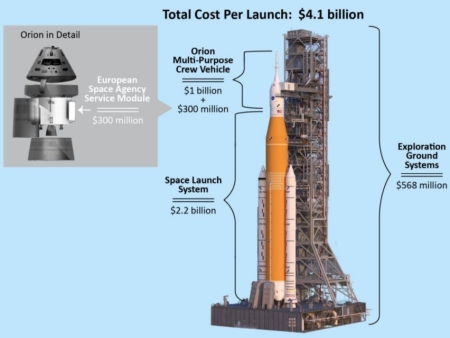
  • NASA’s inspector general agrees SLS is too costly and it will be impossible to reduce that cost
  • The report is available here [pdf]. Normally I’d highlight each new IG report that notes these plain facts, but I’ve grown bored with doing so. They (as well as I) have been saying the same thing time after time — going back to 2011 — but nothing ever changes. We keep pouring money into an SLS rocket that costs too much, can’t launch frequently, and in the end won’t accomplish much of anything, while other space projects of greater value (for much less) go by the wayside.

    And despite this report we shall continue to do so, because the federal government is broken utterly, from the White House down to the mail rooms in Congress and every agency in the executive branch. It has entirely abandoned its responsibilites to serve the American people. Instead its goal now is simply to funnel money to itself, even if that funnelling will bankrupt the country.

6 comments

Expect long delays after third Artemis mission

Link here. The article outlines from a different perspective the many problems faced by NASA’s Artemis program, specifically related to its SLS rocket.

First, that fourth Artemis mission will require a larger first stage, which is far behind schedule and should not be ready until late 2028 (though I predict at least one to two years beyond that date).

Second, that larger upper stage will require completion of a new mobile launcher platform, replacing the mobile launcher now in use that cost about a half billion and will only be used three times. The new launcher platform however is also behind schedule and overbudget. Its completion is not expected until 2027 (though I predict at least one year beyond that date).

Thus, even if the third Artemis mission flies in 2026, as presently scheduled, it will be at least two years before the fourth can fly, but more likely the gap will be three to four years.

Everything related to NASA’s SLS rocket is a mess. If the people running our government had brains, they would immediately dump it and do everything they can to speed development of Starship/Superheavy, which has a better design, is reusuable, is more powerful, has greater capabilities, and most important of all, will be able to fly frequently and quickly at a very low cost, something that SLS will never be able to do.

Unfortunately, the people running our government have no brains, or to be more precise, refuse to use them because of their own selfish petty interests. SLS will go on, wasting billions. And the effort to squelch Starship/Superheavy will also continue, because these petty federal officials can’t have a private company show them up. No way! It must be their way, or the highway!

18 comments

NASA engineers still struggling to understand why Orion’s heat shield ablated so much

NASA engineers still do not understand why the heat shield on its Orion capsule ablated as it did during its return to Earth on the first unmanned Artemis-1 mission.

The agency is still running tests. It also expressed confidence that the issue will not delay the Artemis-2 mission, the first intended to carry humans on SLS and in Orion and still scheduled for late 2024.

At the same time, agency officials hinted that the third Artemis mission, which has always been planned as putting humans on the Moon for the first time since Apollo, might not achieve that goal. It is still not clear whether the mission’s lunar spacesuits as well as SpaceX’s Starship lunar lander will be ready on time. The latter is facing serious regulatory problems imposed by the Biden administration that is generally preventing it from flight testing the spacecraft.

That second Artemis mission, the first planned to carry humans, is one that actually at present carries the most risk. It will not only use a heat shield that at present engineers do not entirely understand, it will be the first Orion capsule to have the environmental systems necessary for its human cargo. NASA is putting humans on the first test flight of those systems.

5 comments

NASA changes have cost Northrop Grumman $36 million on its Lunar Gateway module

Northrop Grumman yesterday revealed that unexpected requirement changes to the specifications of its HALO module for NASA’s Lunar Gateway space station has raised its cost for this fixed price contract by $36 million.

In the company’s fiscal second quarter financial results released July 27, the company announced an unfavorable estimate-at-completion adjustment of $36 million for its work on the Habitation and Logistics Outpost (HALO) module, one of the first elements of the Gateway. The company blamed the charge on “evolving Lunar Gateway architecture and mission requirements combined with macroeconomic challenges” that caused cost growth on the program.

…“We think that is best applied for commercial items or production programs with stable requirements and mature designs,” [the company’s CEO] said of fixed-price contracts. “As it’s turning out on the HALO program, the requirements are not as stable as we or the government anticipated, and we’re working with them to address that change management as we go forward.”

The HALO module was an upgrade of the company’s Cygnus cargo freighter, with its original fixed-price contract for $935 million.

On a fixed-price contract, NASA is not supposed to change its specifications. The company gets somewhat general requirements from NASA, and then builds the product to its own specifications. It appears that either NASA managers don’t seem to understand this and are causing the company problems, or the company itself had not anticipated some design and construction issues before bidding and are struggling to address them now. In the latter case Northrop Grumman managers might have themselves not understood the nature of fixed-price contracts, and had assumed NASA would simply pick up any increase in the project’s budget, as it does in cost-plus contracts. It apparently is not, and thus this old big space company is now suddenly forced to face reality.

1 comment

ESA transfers its Artemis-2 Orion service module to NASA

The European Space Agency (ESA) yesterday officially handed over to NASA its second completed Orion service module, to be used in 2024 on the first manned Artemis mission, dubbed Artemis-2, that will carry four astronauts on a mission around the Moon.

The European Service Module-2 will power the Orion spacecraft on the Artemis II mission that will see NASA astronauts commander Reid Wiseman, pilot Victor Glover, and mission specialists Christina Koch with Canadian Space Agency astronaut Jeremy Hansen complete flyby of the Moon and return to Earth.

The crew will fly Orion to 8889 km beyond the Moon before completing a lunar flyby and returning to Earth. The mission will take a minimum of eight days and will collect valuable flight test data, in the first time for over 50 years that humans have voyaged to our natural satellite.

The odds of this launching in 2024 are relatively slim. It will also be the first time NASA will be flying Orion’s environmental systems (the systems that keep the astronauts alive). We all hope those system work perfectly this first time, since people will be on board.

0 comments

NASA worried FAA launch permit delays to Starship/Superheavy will delay first lunar landing

During a public meeting on June 7, 2023, a NASA official expressed concerns that the FAA’s slow launch permit process for SpaceX’s test program for developing Starship/Superheavy will end up seriously delaying the first Artemis manned lunar landing, presently targeting a December 2025 launch date.

The official, Jim Free, was very careful how he worded his comments, but the FAA issue loomed large in his mind.

Free said NASA met with the Federal Aviation Administration recently to discuss the importance of the Starship rocket to the space agency’s moon exploration plans. The FAA is overseeing SpaceX’s investigation into the problems encountered on the April 20 test launch, when the flight termination system took longer to destroy the rocket than expected. The destruct system is designed to terminate the flight before an errant rocket threatens populated areas.

The FAA is not expected to grant SpaceX another Starship launch license until the investigation is complete, and federal regulators are satisfied with changes to the rocket to address any public safety concerns. “They just have to get flying,” Free said of SpaceX. “When you step back and you look at (it), that’s a lot of launches to get those missions done, so our FAA partners are critical to that.”

For the FAA to treat SpaceX’s test program like ordinary launches, requiring a detailed investigation by it after every test flight, will likely delay the development of Starship/Superheavy by years.

Following the early suborbital tests of Starship, the FAA did not “oversee” the investigations. The FAA merely observed closely SpaceX’s investigation, and let it move forward when SpaceX was satisfied. Now the FAA wants to determine for itself when each launch will occur, even though there is no one at the FAA truly qualified to do that. The result will be endless delays and paperwork, and many fewer flights spaced many more months apart, none of which will do anything to aid the development.

NASA is obviously trying to get the FAA to see this, but we must remember that the change in policy at the FAA almost certainly came from the Biden administration, which doesn’t care as much for getting to the Moon as it does wielding its power to hurt Elon Musk, whom it now sees as a political opponent. Expect NASA’s pleas to fall on deaf ears.

22 comments

NASA inspector general finds more cost overruns in the agency’s SLS rocket program

Surprise! Surprise! A new NASA inspector general report [pdf] has found that the agency’s SLS rocket program is continuing to experience cost overruns and mismanagement that are “obscene”, as noted in this news report.

An independent report published Thursday contained troubling findings about the money spent by the agency on propulsion for the Space Launch System rocket. Moreover, the report by NASA Inspector General Paul Martin warns that if these costs are not controlled, it could jeopardize plans to return to the Moon.

Bluntly, Martin wrote that if the agency does not rein in spending, “NASA and its contracts will continue to exceed planned cost and schedule, resulting in a reduced availability of funds, delayed launches, and the erosion of the public’s trust in the agency’s ability to responsibly spend taxpayer money and meet mission goals and objectives—including returning humans safely to the Moon.”

Things are really much worse than this, mostly because it appears the Marshall Space Flight Center that runs the SLS program for NASA uses cost-plus contracts, which are essentially a blank check for contractors to run up costs endlessly, all of which the government must cover, and allows the process to go over-schedule against its own regulations. Furthermore, the cost overruns are for rockets and engines that are not newly developed, but in use for decades by Northrop Grumman and Aerojet Rocketdyne.

Note that this really isn’t news. Anyone with any intellectual honesty at all will know that every aspect of SLS and Orion is mismanaged and will go over budget and behind schedule endlessly. These problems are not a bug, however, but a feature of the system. The goals of SLS and Orion are not really to build a rocket to explore the solar system but to create an endless jobs program in congressional districts here on Earth. This misguided approach meanwhile robs America of a viable space effort because the money wasted could have actually been used to jumpstart a viable and competitive space-faring economy that actually achieves something.

10 comments

NASA picks Blue Origin’s partnership for building second manned lunar lander

Artist's concept of Blue Moon
An artist’s concept of Blue Moon

NASA today announced that it has chosen the partnership led by Blue Origin to build a second manned lunar lander for its Artemis program.

Blue Origin will design, develop, test, and verify its Blue Moon lander to meet NASA’s human landing system requirements for recurring astronaut expeditions to the lunar surface, including docking with Gateway, a space station where crew transfer in lunar orbit. In addition to design and development work, the contract includes one uncrewed demonstration mission to the lunar surface before a crewed demo on the Artemis V mission in 2029. The total award value of the firm-fixed price contract is $3.4 billion.

The other partners in the contract are Draper, Astrobotic, and Honeybee Robotics.

This is NASA’s second contract for a lunar lander, with SpaceX’s Starship the first. The idea is to have two landers available from competing companies for both competition and redundancy, similar to the approach the agency has used for its manned ferry service to ISS, using SpaceX and Boeing. I wonder if NASA’s experience on the Moon will be similar to that ferry service, whereby only SpaceX so far has been able to deliver. The track record of Blue Origin suggests it will do about as poorly as Boeing has with Starliner.

28 comments

Aerojet Rocketdyne wins contract from Lockheed Martin to build more Orion engines

Aerojet Rocketdyne announced yesterday that it has been awarded a new $67 million contract from Lockheed Martin to build the Orion propulsion engines for Artemis missions six though eight.

This contract option includes delivery of three additional sets of Orion’s service module auxiliary engines and three additional jettison motors. The eight auxiliary engines each produce 105 pounds of thrust to help maintain Orion’s in-space trajectory and position, and supplement the Orion Main Engine. The jettison motor, located on Orion’s Launch Abort System (LAS), generates 40,000 pounds of thrust to separate the LAS from the crew module during both nominal operations and abort scenarios, allowing the spacecraft to continue on its journey. The jettison motor is the only motor on the LAS that fires during every mission.

These Artemis missions are not expected to occur until very late in this decade, by which time Starship will likely be making regular commercial trips to the Moon. At that time Orion will look increasingly ridiculous next to Starship, and will demonstrate starkly the difference in what government can do versus a free private sector.

6 comments
1 4 5 6 7 8 16