Scientists try to model what would happen if Ryugu hit Earth

Ryugu's northen hemisphere
Ryugu’s northen hemisphere. The arrow marks the spot Hayabusa-2
gathered samples

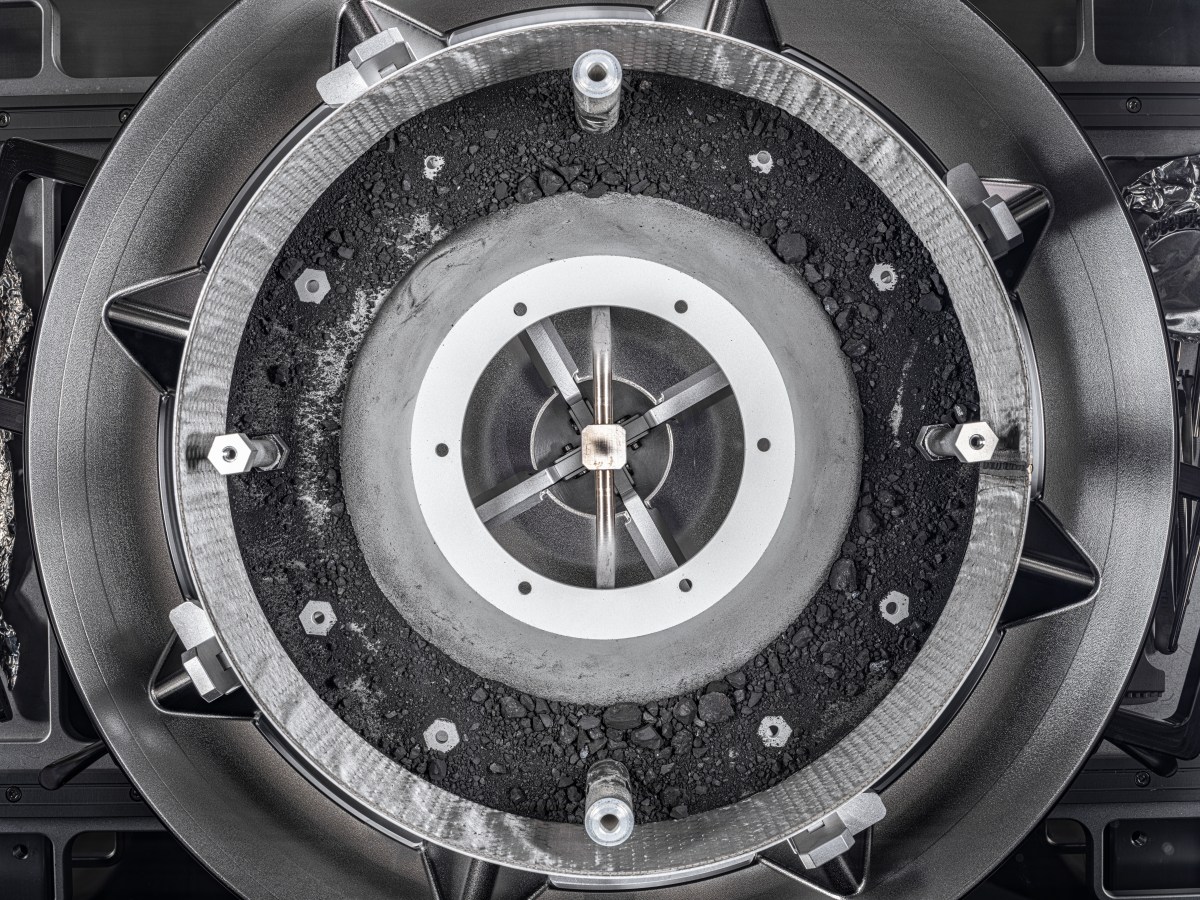
Scientists, using the data and rock samples gathered by the Japanese probe Hayabusa-2, have attempted to predict what what would happen if the rubble-pile asteroid Ryugu hit the Earth.

Without diversion intervention, Tanaka explained, if the Ryugu asteroid was heading to Earth and entered the planet’s atmosphere at an angle of 45 degrees and at a speed of around 38,000 miles per hour (17 kilometers per second), the rubble pile asteroid would break up at an altitude of around 25 to 21 miles (40 to 35 km) over the surface of the planet.

This would result in an “airburst” similar to that seen over Russia in February 2013 when the Chelyabinsk meteor erupted at an altitude of around 19 miles (30 kilometers) over Earth. The result of the Chelyabinsk blast was a bright flash of light and an atmospheric blast equivalent to the detonation of 400–500 kilotons of TNT. This is as much as 33 times the energy released by the atomic bomb that devastated Hiroshima at the end of the Second World War.

The Chelyabinsk meteor caused about 1,500 injuries, mostly from people injured by glass thrown out by breaking windows when it suddenly and unexpectedly exploded during re-entry. With Ryugu this would not be a surprise, so these injuries could be reduced, though not eliminated. The damage and injuries from pieces that survived the breakup and hit the ground remains unknown because scientists don’t know how much of the asteroid would survive the break up.

Ryugu of course poses no threat, because it is not on a collision course with Earth. Whether an asteroid like Ryugu could be diverted however remains unknown, since any such diversion must not cause the asteroid to break apart as well.

Psyche asteroid mission now scheduled for October 2023 launch

After a year delay because certain flight software was not ready on time for its first launch window in the fall of 2022, the science team for the Psyche asteroid mission are now aiming for an October 2023 launch.

The launch period will open Oct. 5 and close Oct. 25. The asteroid, which lies in the outer portion of the main asteroid belt between Mars and Jupiter, may be the remains of a core of a planetesimal, a building block of a rocky planet.

Due to the new launch date, Psyche has a new mission plan, which includes a flyby of Mars for a gravity assist and arrival at the asteroid in August 2029. The mission then will enter its 26-month science phase, collecting observations and data as the spacecraft orbits the asteroid at different altitudes.

Meanwhile, the two Janus probes that were to launch with Psyche last year remain in limbo, as this new Psyche launch date is useless to that mission’s plan to fly past a different asteroid.

Samples from Ryugu found to contain uracil, one of the four nucleobases in RNA

Japanese researchers analyzing the samples returned by Hayabusa-2 from the rubble-pile asteroid Ryugu have identified the molecule uracil, one of the four nucleobases that form the molecule RNA.

Hayabusa 2 collected 5.4 grams from two spots on Ryugu and delivered them to Earth on December 6, 2020. Early studies showed the samples contained many organic compounds. That led Oba’s group to analyze two 10-milligram samples using the same sensitive technique they had used earlier on meteorites. The technique can detect nucleic acid bases at levels down to parts per trillion in small samples.

Now, they report in Nature Communications that uracil is present at a level of parts per billion in both Ryugu samples. While this concentration is different than they’d previously found in meteorites, Oba says that might be because the parent bodies of the meteorites and of Ryugu underwent different levels of aqueous alteration and other processes. They also detected niacin (vitamin B3) as well as other organic molecules, but they didn’t find any other nucleobases.

RNA is formed from four nucleobases, uracil, adenine, cytosine, and guanine. To form DNA, the fundamental building block of life, uracil is replaced by thymine.

This data reinforces other data that suggests the formation of these essential molecules for life is relatively common and easy, at least in our solar system.

Dimorphus is dry, based on data obtained before and after DART hit it

Data collected by the ground-based Very Large Telescope (VLT) in Chile before and after the impact by the DART probe in September 2022 has revealed that the rubble-pile asteroid Dimorphos is very dry, with little or no water.

[The astronomers] observed the Didymos–Dimorphos system on 11 occasions, from just before the impact to about a month afterwards. MUSE [one of VLT’s instruments] is able to split the light from the double-asteroid into a spectrum, or rainbow, of colors, to look for emission at specific wavelengths that corresponds to specific molecules. In particular, Opitom’s team searched the ejecta for water molecules and for oxygen that could have come from the break-up of water molecules by the impact. However, no evidence of water was detected. Dimorphos, at least, seems to be a dry asteroid.

You can read the paper here.

Some theories prior to DART’s impact suggested that there could be ice within some inner solar system asteroids. Finding none instead suggests that inner solar system asteroids are very distinct and different from the icy comets and asteroids either coming from or orbiting in the outer solar system.

Scientists publish their results from the impact of Dimorphos by DART

Seconds after impact
Seconds after impact. Click for movie, taken by amateur
astronomer Bruno Payet from the Réunion Island.

Scientists today published five papers outlining their results from the impact of Dimorphos by DART, summed up as follows:

  • Dimorphos’s density is about half that of Earth’s, illustrating its rubble pile nature.
  • The orbital period around the larger asteroid Didymos was changed by 33 minutes.
  • The ejection of material from Dimorphos during the impact had a greater effect on the asteroid’s momentum than the impact itself
  • The mass ejected was only 0.3 to 0.5% of Dimorphos’s mass, showing that the asteroid was not destroyed by the impact.
  • The impact turned Dimorphos into an active asteroid, with a tail like a comet.

The data not only tells us a great deal about this asteroid binary itself, it suggests that this impact method might be of use in defending the Earth from an asteroid impact. There are caveats however. First, the orbital change was not to the system’s solar orbit, the path that would matter should an asteroid threaten the Earth, but to Dimorphos’s orbit around its companion asteroid. We don’t yet know the effect on the solar orbit. Second, the impact did not destroy this small rubble pile asteroid, which means such an asteroid might still be a threat to the Earth even after impact. Third, in order for an impact to be the right choice for planetary defense, detailed information about the target asteroid has to be obtained. Without it such an impact mission might be a complete waste of time.

The irony to all this is that we knew all this before the mission. DART in the context of planetary defense taught us nothing, so NASA’s claim that this mission was to learn more about planetary defense was always utter bunkum. The mission’s real purpose was the study of asteroids, but selling it that way was hard. The sizzle of planetary defense however was a better lobbying technique, and it worked, even if it was dishonest.

That the press was also fooled by it, and continues to be fooled by it, is a subject for a different essay.

For only 7th time, searchers find meteorite immediately after fall

For only 7th time, searchers on February 15th found a fragment of a meteorite that had only fallen to Earth three days before, and was furthermore only discovered mere hours before it entered the Earth’s atmosphere.

From the tweet of the discoverers:

FRIPON/Vigie-Ciel finds a fragment of asteroid 2023CX1 in Seine Maritime!!! The discovery was made by Loïs Leblanc, an 18-year-old student, part of the field research team.

Vigie-Ciel (“Sky Watchers”) and FRIPON are a volunteer project that searches for meteorites. The asteroid itself was discovered by Hungarian astronomer Krisztián Sárneczky while doing routine survey scan for near Earth asteroids.

The find was the second time Sárneczky has spotted an asteroid just hours before it broke apart in Earth’s atmosphere as a fireball, following an incredible find in March 2022.

By finding meteorites this quickly after arrival scientists get a more pristine sample, since the asteroid has not been exposed to the Earth’s environment for any extended length of time.

Astronomers find ring around distant dwarf planet Quaoar

The uncertainty of science: Astronomers have confirmed the existence of an uneven ring encircling the dwarf planet Quaoar, orbiting far enough from the planet that, according to present theories, the ring should have quickly coalesced into a small Moon.

At 1,110 km (690 miles) in diameter Quaoar is one of the largest objects known in the outer solar system. Its single moon, named Weywot, spans about 160 km and was discovered in Hubble images in 2007. But the first signs of material around Quaoar didn’t come until 2018; even then, evidence was insufficient to call it a ring, says Morgado. He began studying Quaoar in 2020 with the European Space Agency’s CHEOPS space telescope, originally designed to find and characterize exoplanets. Rather than looking for exoplanet transits, Morgado used CHEOPS to observe stellar occultations, when Quaoar passed in front of distant stars and momentarily blocked their light.

Now Morgado has extended his work, working with others to observe Quaoar’s stellar occultations using other telescopes. The team first predicted a few occultations and recorded them. Then, after those observations hinted at a ring, the researchers went back through previous occultation records. “We saw the ring in nine different regions, from observations taken between 2018 and 2021,” Morgado explains.

In Nature, the team reports the presence of a ring 4,100 kilometers from the center of Quaoar, far beyond its classical Roche limit of 1,780 km. Morgado says the ring is dense and irregular. “It has a very thin region about 5 km wide and also a large region about 300 km wide, depending on which part of the ring was probed,” he notes. If the material could all be collected into a single moon, it would be about 10 km in diameter, less than a tenth of Weywot’s size.

According to astronomers, they would expect such a ring at that distance to coalesce in just a matter of decades. Either their theories of the Roche limit are incorrect, or the creation of this ring is very very recent, caused by the collusion of two objects that were orbiting Quaoar.

Curiosity spots foot-wide meteorite on Mars

Meteorite on Mars?
Click for original image.

Curiosity appears to have identified a foot-wide rock on the surface of Mars that is likely a meteorite.

While the JPL press release at this link is certain this is a meteorite, the Curiosity science team is properly more circumspect:

The rock we are parked in front of is one of several very dark-colored blocks in this area which seem to have come from elsewhere, and we are calling “foreign stones.” Our investigations will help determine if this is a block from elsewhere on Mars that just has been weathered in an interesting way or if it is a meteorite.

The image to the right surely does look like a meteorite. If so, this would be one of the largest found so far on Mars by any rover.

Astronomers discover twelve more Jupiter moons

In reviewing ground-based data from 2021 and 2022, astronomers have discovered another twelve Jupiter moons, bringing that planet’s total moon population to 92.

All of the newly discovered moons are small and far out, taking more than 340 days to orbit Jupiter. Nine of the 12 are among the 71 outermost Jovian moons, whose orbits are more than 550 days. Jupiter probably captured these moons, as evidenced by their retrograde orbits, opposite in direction to the inner moons. Only five of all the retrograde moons are larger than 8 kilometers (5 miles); Sheppard says the smaller moons probably formed when collisions fragmented larger objects.

One newly discovered moon, dubbed Valetudo, is about 3,000 feet across and orbits in a retrograde orbit that crosses the orbits of several other moons that orbit in the opposite direction. As the article notes, “This highly unstable situation is likely to lead to head-on collisions that would shatter one or both objects.”

The twin asteroid Janus probes, stranded by Psyche delay, might go to Apophis

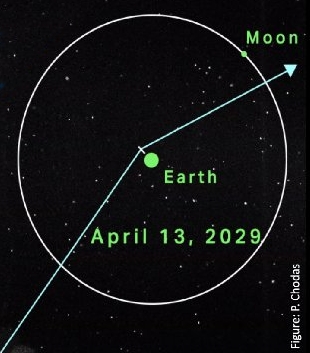
Apophis' path past the Earth in 2029
A cartoon showing Apophis’s path in 2029

The science team that built the twin Janus spacecraft, designed to fly past an asteroid but stranded when its launch got canceled, are now considering the potentially dangerous asteroid Apophis as a new target.

If the Janus spacecraft can find a ride by early 2028, scientists could use one or both of the spacecraft to scout out the large asteroid Apophis before its super-close approach to Earth in April 2029. (If only one spacecraft visits Apophis, scientists would see only about half of the asteroid but could send the second spacecraft elsewhere; if both spacecraft fly past the same object they can be arranged to reveal the whole surface.)

Initially the entire Janus mission had been designed on the assumption it would launch as a secondary payload when the Psyche mission to the asteroid Psyche launched last fall. When that launch had to be canceled because Psyche was not ready, Janus lost its mission. The science team has since been struggling to find a replacement, handicapped by the fact that it must go as a secondary payload.

There is a serious issue however with arriving ahead of Apophis’s close approach in 2029. The science community has discouraged such missions, because they fear a spacecraft arriving then could shift Apophis’s trajectory and actually increase the chance it will hit the Earth during a later close approach. Instead, all planetary probes presently going to Apophis in 2029 are planning to arrive after the flyby.

The risk is extremely small, but it must be considered before sending Janus to Apophis.

Lucy team adds 10th asteroid to the spacecraft’s tour

Lucy's route through the solar system
Lucy’s route through the solar system

The Lucy science team has now added a tenth asteroid to the spacecraft’s tour of the solar system, planning its route so that it will pass within 280 miles on November 1, 2023.

The Lucy mission is already breaking records by planning to visit nine asteroids during its 12-year tour of the Jupiter Trojan asteroids, which orbit the Sun at the same distance as Jupiter. Originally, Lucy was not scheduled to get a close-up view of any asteroids until 2025, when it will fly by the main belt asteroid (52246) Donaldjohanson. However, the Lucy team identified a small, as-yet unnamed asteroid in the inner main belt, designated (152830) 1999 VD57, as a potential new and useful target for the Lucy spacecraft.

The asteroid is about 2,300 feet wide. The primary goal of this visit however will be engineering, testing Lucy’s new method of tracking an object as the spacecraft flies past. On the map to the right the dots along Lucy’s path indicate the asteroids to be visited.

Lucy team suspends efforts to complete deployment of unlatched solar panel

Lucy's planned route
Lucy’s planned route to explore the Trojan asteroids

The Lucy science team has decided to suspend its efforts to complete the deployment of the unlatched solar panel that failed to fully open shortly after launch, having determined that little can be accomplished while the spacecraft is so far from the Sun.

A series of activities in 2022 succeeded in further deploying the array, placing it into a tensioned, but unlatched, state. Using engineering models calibrated by spacecraft data, the team estimates that the solar array is over 98% deployed, and it is strong enough to withstand the stresses of Lucy’s 12-year mission. The team’s confidence in the stability of the solar array was affirmed by its behavior during the close flyby of the Earth on Oct. 16, 2022, when the spacecraft flew within 243 miles (392 km) of the Earth, through the Earth’s upper atmosphere. The solar array is producing the expected level of power at the present solar range and is expected to have enough capability to perform the baseline mission with margin.

The team elected to suspend deployment attempts after the attempt on Dec. 13, 2022, produced only small movement in the solar array. Ground-based testing indicated that the deployment attempts were most productive while the spacecraft was warmer, closer to the Sun. As the spacecraft is currently 123 million miles (197 million km) from the Sun (1.3 times farther from the Sun than the Earth) and moving away at 20,000 mph (35,000 km/hr), the team does not expect further deployment attempts to be beneficial under present conditions.

The spacecraft will do another Earth fly-by on December 12, 2024, which will send it to the Trojans on the left side of the map above. Before that Lucy will do a mid-course correction in February 2024, at which time the engineers will reassess whether to try again to latch the panel, when Lucy is closer to Earth and thus also closer to the Sun.

NASA approves $1.2 billion asteroid-hunting space telescope

NASA has given the go-ahead to build NEO-Surveyor for $1.2 billion, more than twice the cost of its original proposal, to launch by 2028 and then look for potentially dangerous asteroids.

Notably, NEO Surveyor was earlier estimated to cost between $500 million and $600 million, or around half of the new commitment. The NASA statement said that the cost and schedule commitments outlined align the mission with “program management best practices that account for potential technical risks and budgetary uncertainty beyond the development project’s control.” Earlier this year, the project’s launch was delayed two years, from 2026, due to agency budget concerns.

The mission is designed to discover 90% of potentially Earth-threatening asteroids and comets 460 feet (140 meters) or larger that come within 30 million miles (48 million kilometers) of Earth’s orbit. The spacecraft will carry out the survey while from Earth-sun Lagrange Point 1, a gravitationally stable spot in space about 930,000 miles (1.5 million kilometers) inside the Earth’s orbit around the sun.

A prediction: It will cost more, and not launch on time. NASA’s decision to double the budget and delay the launch two years suggests it did not trust the JPL cost and time estimates. Based on most NASA-centered projects, however, it is likely the new numbers will still be insufficient.

Astronomers spot asteroid mere hours before it burned up in Earth’s atmosphere

For only the sixth time, astronomers this past weekend were able to image an asteroid just before it hit the Earth’s atmosphere and burned up over Canada.

The mini-asteroid, less than 3 feet (1 meter) wide, was spotted by astronomer David Rankin at Mount Lemmon Observatory in Arizona, according to SpaceWeather.com. Subsequent observations by other astronomers confirmed that the rock, coming from the direction of the main asteroid belt between the orbits of Mars and Jupiter, was on a collision course with Earth.

Only three hours after the first detection, the object, since dubbed C8FF042, sliced through the sky above Canada and landed in Lake Ontario, according to NASA.

While it is believed that most of the meteorite’s pieces that reached the ground fell into Lake Ontario, there is a chance some pieces might still be found along the south coast of the lake between Hamiliton and Niagara Falls.

Lucy engineers again attempt to complete deployment of solar array

Lucy solar panel graphic
Artist’s impression of solar panel

On November 7, 2022, the Lucy science team made another attempt to complete the deployment of one of the spacecraft’s two solar arrays, as shown in the graphic to the right. After launch that array failed to deploy properly, and though later attempts have gotten it mostly open, it has not latched tight.

On Monday, Nov. 7, the spacecraft was instructed to point toward the Sun and operate the array deployment motors for a short period of time. As expected, the latest attempt deployed the wing incrementally forward, but it did not latch. The operation did succeed in providing the team with data to evaluate the array’s status and ascertain any changes since the last deployment attempt on June 16.

During this analysis, the team identified that a small vibration occurred as the unlatched array interacted with the spacecraft’s attitude controller while the array was pointed toward Earth and at a cold temperature. The vibration did not occur as a result of the deployment activity itself. While this vibration is too small to pose a risk to the spacecraft in its current state, further array deployment attempts have been paused while the attitude controller is updated to resolve this issue. In the meantime, the spacecraft was reoriented so that the array is warmer, and the team found that the vibration is not present. The team will re-evaluate further redeployment activities once the updates to the controller are checked out on the spacecraft.

In other words, engineers have decided to halt further deployment attempts until they understand fully the cause of this vibration.

At present, the spacecraft is in good health, and the array, only a few degrees short of full deployment, is producing more than 90% of its expected power, more than enough to run the full mission.

NASA sets new launch date for Psyche asteroid mission

NASA yesterday announced that the delayed Psyche mission, to the asteroid Psyche, now has a new launch date of October 10, 2023, with a planned arrival in 2029.

The spacecraft missed its original launch date in 2022 because of the late delivery of its flight software combined with problems with the equipment needed to test that software.

The new launch date, though only one year later than planned, will cause the spacecraft to arrive two years late because of orbital mechanics.

InSight detects and dates large impact on Mars

InSight's Christmas Eve impact
Click for full image.

Using the data from InSight’s seismometer of a 4 magnitude earthquake on Mars on December 24, 2021, scientists were able to use the high resolution camera on Mars Reconnaissance Orbiter (MRO) to find the meteorite impact that produced that quake, the largest detected since spacecraft have been visiting Mars. The picture to the right, cropped and reduced to post here and unveiled at yesterday’s press conference, shows the new crater.

The meteoroid is estimated to have spanned 16 to 39 feet (5 to 12 meters) – small enough that it would have burned up in Earth’s atmosphere, but not in Mars’ thin atmosphere, which is just 1% as dense as our planet’s. The impact, in a region called Amazonis Planitia, blasted a crater roughly 492 feet (150 meters) across and 70 feet (21 meters) deep. Some of the ejecta thrown by the impact flew as far as 23 miles (37 kilometers) away.

With images and seismic data documenting the event, this is believed to be one of the largest craters ever witnessed forming any place in the solar system.

This is not the first such impact identified from InSight seismic data, but it is the largest. The white streaks surrounding the crater are thought to be near-surface ice ejected at impact.

The overview map below provides further context, as well as showing us the proximity of this impact to the proposed Starship landing sites on Mars.
» Read more

Lucy’s view of the Earth-Moon system during its October fly-by

The Earth and Moon system, as seen by Lucy
Click for original image.

Lucy's planned route
Lucy’s planned route to explore the Trojan asteroids

In the days prior to its October 16, 2022 fly-by of the Earth, the Lucy asteroid probe took several calibration images of the Earth and the Moon. The photo above, cropped, reduced, and enhanced to post here, shows both the Earth and the Moon together. From the caption:

On October 13, 2022, NASA’s Lucy spacecraft captured this image of the Earth and the Moon from a distance of 890,000 miles (1.4 million km). The image was taken as part of an instrument calibration sequence as the spacecraft approached Earth for its first of three Earth gravity assists. These Earth flybys provide Lucy with the speed required to reach the Trojan asteroids — small bodies that orbit the Sun at the same distance as Jupiter.

In the original, the Moon is so dim, compared to the Earth, that it was hard to find in the picture. I therefore brightened it considerably more than the Earth to make it easily seen above.

Hubble spots double tail of debris from DART impact of Dimorphus

Dimorphus double tail
Click for original image.

A series of images taken by the Hubble Space Telescope of the ejecta released when DART crashed into the small 525-foot-wide asteroid Dimorphus has found that debris forming a double tail trailing away from the Sun.

The picture to the right, cropped, reduced, and enhanced to post here, was taken on October 11, 2022 by Hubble, and shows those two tails as close parallel debris trails.

Repeated observations from Hubble over the last several weeks have allowed scientists to present a more complete picture of how the system’s debris cloud has evolved over time. The observations show that the ejected material, or “ejecta,” has expanded and faded in brightness as time went on after impact, largely as expected. The twin tail is an unexpected development, although similar behavior is commonly seen in comets and active asteroids. The Hubble observations provide the best-quality image of the double-tail to date.

Following impact, Hubble made 18 observations of the system. Imagery indicates the second tail formed between 2-8 October 2022.

Though observations by telescope will continue for the years to follow, the real punchline to this event will be when the European probe Hera rendezvouses with the Didymous-Dimorphus pair in 2026 to perform several years of very close observations.

Twelve years of data from WISE

The Wide Field Infrared Survey Explorer (WISE) was launched in 2009 with an intended mission of two years, during which it would map the sky looking for asteroids. In 2011 NASA extended the mission, renaming the telescope for inexplicable reasons to NEOWISE (adding “Near-Earth Object” to the beginning).

In the more than a decade since, the telescope has been able to get eighteen repeated scans of the entire sky, allowing scientists to track many changes in a variety of stellar objects over time.

Yesterday NASA issued a press release celebrating this long achievement.

Every six months, NASA’s Near-Earth Object Wide Field Infrared Survey Explorer, or NEOWISE, spacecraft completes one trip halfway around the Sun, taking images in all directions. Stitched together, those images form an “all-sky” map showing the location and brightness of hundreds of millions of objects. Using 18 all-sky maps produced by the spacecraft (with the 19th and 20th to be released in March 2023), scientists have created what is essentially a time-lapse movie of the sky, revealing changes that span a decade.

There is a bit of hype in this claim. The data isn’t really useful when looked at across the entire sky. One has to zoom into particular objects to see them evolve over time. Also, many of these changes, such as with variable stars, are well known and tracked by many other telescopes.

Nonetheless, this infrared database is very valuable. It can be used for example by astronomers to identify objects that should be viewed with high resolution in the infrared, by Webb.

OSIRIS-REx does mid-course correction

To better refine its path back to Earth in order to properly aim its sample return capsule, engineers had OSIRIS-REx do a short successful 30 second engine burn on September 21, 2022.

Nor will this be the only course correction prior to sample return on September 24, 2023 in Utah.

To ensure a safe delivery, “Over the next year, we will gradually adjust the OSIRIS-REx trajectory to target the spacecraft closer to Earth,” said Daniel Wibben, trajectory-and-maneuver design lead with KinetX Inc. “We have to cross Earth’s orbit at the time that Earth will be at that same location.” Wibben works closely with the Lockheed Martin team in Littleton, Colorado, that flies the spacecraft.

Last month’s maneuver was the first time the OSIRIS-REx team changed the spacecraft’s trajectory since it left Bennu on May 10, 2021. Following this course adjustment, OSIRIS-REx would pass about 1,367 miles (2,200 kilometers) from Earth. A series of maneuvers beginning in July 2023 will bring OSIRIS-REx even closer, to 155 miles (250 kilometers) off the surface, close enough to release its sample capsule for a precision landing – via parachute at the Air Force’s Utah Test and Training Range in the Great Salt Lake Desert.

Lucy to fly past Earth on October 16th

Lucy solar panel graphic
Artist’s impression of solar panel

As part of its planned route to get to the Trojan asteroids in Jupiter’s orbit, the planetary probe Lucy is scheduled to fly only 220 miles above the Earth’s surface on October 16th.

Lucy will be passing the Earth at such a low altitude that the team had to include the effect of atmospheric drag when designing this flyby. Lucy’s large solar arrays increase this effect.

“In the original plan, Lucy was actually going to pass about 30 miles closer to the Earth,” says Rich Burns, Lucy project manager at NASA’s Goddard Space Flight Center in Greenbelt, Maryland. “However, when it became clear that we might have to execute this flyby with one of the solar arrays unlatched, we chose to use a bit of our fuel reserves so that the spacecraft passes the Earth at a slightly higher altitude, reducing the disturbance from the atmospheric drag on the spacecraft’s solar arrays.”

That solar array remains unlatched (as shown in the graphic above), but because it is almost completely deployed and is producing about 90% of its intended electricity, engineers have ceased efforts to complete deployment and latching.

The known near Earth asteroid catalog now tops 30,000

Chart of NEA's discovered over time

The catalog of known near Earth asteroids that have been identified using a number of survey telescopes in space and on the Earth now totals 30,039. As defined at the link:

An asteroid is called a near-Earth asteroid (NEA) when its trajectory brings it within 1.3 Astronomical Units (au) of the Sun. 1 au is the distance between the Sun and Earth, and so NEAs can come within at least 0.3 au, 45 million km, of our planet’s orbit.

Currently, near-Earth asteroids make up about a third of the roughly one million asteroids discovered so far in the Solar System. Most of them reside in the asteroid belt between Jupiter and Mars.

NEAs are also called NEOs (Near Earth Objects). The chart above, produced by the Center for NEO Studies which tracks these objects, shows the number of NEAs discovered over time.

Of the 30,039 now known, about 1,400 have orbits with “a non-zero” chance of hitting the Earth. None however will do so in the next hundred years at least.

Though the pace of discovery is vastly improving — as indicated by the steep rise in the curve in the graph — only when that curve begins to flatten out will we know that we are getting close to having a more-or-less complete survey of these objects.

DART’s impact shortened Dimorphus’s orbit around Didymos by 32 minutes

LICIACube Explorer image of DART impact
LICIACube Explorer image just after the DART
impact. Dimorphus is the blob near the top.

After two weeks of analyzing the orbit of Dimorphus around its parent asteroid Didymos, astronomers have determined that the impact of DART on Dimorphus shortened its orbit by 32 minutes.

Prior to DART’s impact, it took Dimorphos 11 hours and 55 minutes to orbit its larger parent asteroid, Didymos. Since DART’s intentional collision with Dimorphos on Sept. 26, astronomers have been using telescopes on Earth to measure how much that time has changed. Now, the investigation team has confirmed the spacecraft’s impact altered Dimorphos’ orbit around Didymos by 32 minutes, shortening the 11 hour and 55-minute orbit to 11 hours and 23 minutes. This measurement has a margin of uncertainty of approximately plus or minus 2 minutes.

Before its encounter, NASA had defined a minimum successful orbit period change of Dimorphos as change of 73 seconds or more. This early data show DART surpassed this minimum benchmark by more than 25 times.

It also appears the ejecta from the impact — much greater than expected — helped propel Dimorphus, a result that I think was also not expected.

Researchers are now shifting to studying the debris and asteroid itself, to better understand what happened as well as the nature of Dimorphus itself. This will also include a European probe dubbed Hera that will launch in 2024 an dvisit both asteroids in 2026.

New computer simulation of theorized impact that created the Moon

The uncertainty of science: Before I even begin to describe this story, I must emphasize that it is pure science fiction. As much as it is founded on known data, that data is simply not sufficient to tell us exactly how the Moon was created. The data merely points to many hundreds of possibilities, of which the model below is simply one:

Computer programmers using a supercomputer at a United Kingdom university have created a new simulation of the theorized impact of a Mars-sized body to the Earth that some believe created the Moon, and determined it was possible for that impact to have created the Moon quickly, within hours.

You can read the research paper here.

The fun part of this story is to watch the video of this simulation, which I have embedded below. Whether it describes what actually happened is pure speculation, and in fact cannot be confirmed in any way at all.

It is intriguing, nonetheless.
» Read more

Chang’e-5 samples suggest lunar meteorite impacts took place the same time as big Chicxulub impact

In analyzing lunar samples brought back by China’s Chang’e-5 Moon lander, Australian scientists have found evidence of lunar meteorite impacts that apparently took place the same time as big Chicxulub impact in the Yucatan 66 million years ago, thought by many scientists to have caused the extinction of the dinosaurs.

Their findings suggest that the frequency of meteorite impacts on the Moon may have been mirrored on Earth, and that major impact events on Earth were not stand-alone events and instead were accompanies by a series of smaller impacts. The study has been published in Science Advances.

“We combined a wide range of microscopic analytical techniques, numerical modelling, and geological surveys to determine how these microscopic glass beads from the Moon were formed and when,” says lead author Professor Alexander Nemchin, from the Space Science and Technology Centre (SSTC) in the School of Earth and Planetary Sciences at Curtin University in Perth.

The data suggests two possibilities, neither of which is confirmed. First, the impacts could have occurred because a cluster of large objects hit both Earth and the Moon at the same time. Second, the impacts on the Moon could have been caused by objects thrown up from the Earth when the bigger impact occurred at Chicxulub.

Either way, the data suggests a greater and more complex interaction between events on the Earth and events on the Moon.

Hubble & Webb make first coordinated observations, tracking DART impact of Dimorphus

Webb and Hubble together look at DART impact of Dimorphus
Click for full image.

For the first time scientists have used both the Hubble Space Telescope and the James Webb Space Telescope to observe the same astronomical event, in this case the impact of the DART spacecraft on the asteroid Dimorphus on September 26, 2022.

The two images to the right show the asteroid several hours after impact. Both telescopes also captured images before the impact as well. From the press release:

Observations from Webb and Hubble together will allow scientists to gain knowledge about the nature of the surface of Dimorphos, how much material was ejected by the collision, and how fast it was ejected. Additionally, Webb and Hubble captured the impact in different wavelengths of light – Webb in infrared and Hubble in visible. Observing the impact across a wide array of wavelengths will reveal the distribution of particle sizes in the expanding dust cloud, helping to determine whether it threw off lots of big chunks or mostly fine dust. Combining this information, along with ground-based telescope observations, will help scientists to understand how effectively a kinetic impact can modify an asteroid’s orbit.

When Webb was first conceived in the late 1990s, it was exactly for this reason, to combine Hubble’s optical vision with Webb’s infrared view. Though more than a decade late, it has finally happened.

It will be months before scientists begin to decipher the data produced by all the telescopes and spacecraft used to observe the DART impact. What we are seeing now are merely hints at what has been learned.

Watch DART smash into asteroid today

At 7:14 pm (Eastern) the NASA’s Double Asteroid Redirection Test (DART) spacecraft will crash into the small and harmless asteroid Dimorphus to see if such an impact could be used in the future to change the path of another asteroid aimed at Earth.

Dimorphus is 525 feet in diameter, and is a small moon of the larger half-mile-wide asteroid Didymos. Both are presently about 7 million miles away from Earth.

I have embedded the live streams below, one from a DART camera, dubbed DRACO, that will view the asteroid as the spacecraft approaches, and the other from NASA’s official live stream. From the DRACO live stream webpage:
» Read more

Watching DART impact asteroid on September 26, 2022

A NASA planetary probe, dubbed DART, is on course for a planned impact of the asteroid Dimorphos this coming Monday, September 26, 2022, at 4:14 PM (Pacific).

DART was launched from Vandenberg Space Force Base, CA on November 23, 2021 PST (November 24 EST) headed to the asteroid Didymos and its tiny moon Dimorphos 7 million miles away. The plan is for DART to ram itself into Dimorphos while scientists on Earth measure whether its orbit around Didymos changes.

Dimorphos is about 525 feet in diameter, while Didymos is much larger, about a half mile in width. The goal is to see if this method can be used in the future to adjust an asteroid’s orbit enough to shift it away from hitting the Earth.

The impact will be observed by a camera on DART, as well as an Italian cubesat dubbed LICIACube.

NASA TV will be live streaming the event, and I will embed that live stream here when it goes live. Once DART gets close, its camera will record the asteroid’s approach through impact.

Samples from Ryugu prove the truly delicate and long-lived nature of the rubble-pile asteroid

Two new studies of samples brought back from the rubble-pile asteroid Ryugu by the Japanese probe Hayabusa-2 have found that the asteroid not only was never heated above 86 degrees Fahrenheit, it also contained dust grains older than the solar system itself.

The evidence from the first study, completed by Japanese scientists, suggested that:

  • 1.Asteroid Ryugu accreted some components that originated in the outer Solar System and contained abundant water and organics. The asteroid then traveled to the inner Solar System.
  • 2.Organics associated with coarse-grained phyllosilicates may serve as one of the potential sources of water and organics to the Earth.

The second study, using samples provided to American scientists, found two tiny dust grains that must have come from the material that existed before the formation of our solar system.

The team detected all the previously known types of presolar grains—including one surprise, a silicate that is easily destroyed by chemical processing that is expected to have occurred on the asteroid’s parent body. It was found in a less-chemically-altered fragment that likely shielded it from such activity.

This is not the first discovery of presolar grains, but their delicate existence in Ryugu confirms the conclusions of the first study, that Ryugu had to have formed in the outer solar system and then migrated inward over eons.

The second study also reviewed the make-up of the sample and concluded that Ryugu appears to most closely match the family of carbonaceous Ivuna-type (CI) chondrites, thought to be among the most primitive asteroids known, of which very few have been studied because of they rarely survive the journey through the Earth’s atmosphere.

1 3 4 5 6 7 31