
Primal Space – The Underground Clocks of Paris
An evening pause: Some fascinating technology history, worth fast forwarding through the annoying commercial in the middle.
Hat tip Willi Kusche.
An evening pause: Some fascinating technology history, worth fast forwarding through the annoying commercial in the middle.
Hat tip Willi Kusche.
SpaceX today received the okay from Cameron County to build a plant at Boca Chica to produce oxygen from the atmosphere for use in its Superheavy/Starship rocket.
The commissioners voted, 3-1, to give Elon Musk’s rocket company a beachfront construction certificate and dune protection permit, allowing the company to build a modern-day factory akin to an oil refinery to produce gases needed for space flight launches.
The plant will consist of 20 structures on 1.66 acres. The enclosed site will include a tower that will reach 159 feet, or about 15 stories high, much shorter than the nearby launch tower, which stretches 480 feet high. It is set to be built about 280 feet inland from the line of vegetation, which is where the dunes begin. The factory will separate air into nitrogen and oxygen. SpaceX utilizes liquid oxygen as a propellant and liquid nitrogen for testing and operations.
By having the facility on site, SpaceX hopes to make the delivery of those gases more efficient by eliminating the need to have dozens of trucks deliver them from Brownsville. The company says they need more than 200 trucks of liquid nitrogen and oxygen delivered for each launch, a SpaceX engineer told the county during a meeting last week.
As usual, the same cranks who always complain about this stuff are given space by this news outlet to whine, but the truth is that the commission’s vote well reflects the attitude of the local community. It supports what SpaceX is doing, because of the prosperity the company is bringing to this formerly depressed region.
Moreover, this facility will not only save SpaceX money and make it easier to launch more frequently, it is likely environmentally beneficial. I suspect the facility will be relatively clean compared to the truck convoys it will replace.
Hat tip Robert Pratt of Pratt on Texas.
The reason for Trump’s sudden decision yesterday to name Transportation Secretary Sean Duffy as interim NASA administrator, replacing long-time NASA manager Janet Piro — who had held the job since Trump took office — remains unclear.
This article suggests the president wanted someone with more political clout who was also part of his inner circle.
Two articles (here and here) imply the decision was related to the recent clashes politically between Trump and Musk, adding that Duffy and Musk have been reported to be in conflict over air traffic controller issues. Picking Duffy thus directly reduces Musk’s influence at NASA.
The truth is that we really don’t know exactly what motives brought Trump to make this appointment. It could be that Trump wants someone in charge who will have the political clout to push through his proposed NASA cuts. It also could be Trump wants someone with that clout to review those cuts and change them.
The bottom line is that NASA remains a political football, a situation that in the end had done decades of harm to the American space industry. The sooner it can be made irrelevant and replaced by a commercial, competitive, and (most important) profitable space industry, the better.
We really don’t need a “space agency.” We didn’t have such a thing when we settled the American west.
You might get deja-vu from this story, since I have reported repeatedly in the past that SpaceX has finally gotten regulatory approval to sell Starlink in India.
However, India’s complex regulatory framework — leftover from the days of British rule and strengthened for decades after independence when the strongly socialist Congress Party ruled — ended up requiring SpaceX to leap multiple regulatory hurdles to get the Starlink approved. According to news reports today, that last licensing hurdle has now finally been leaped.
The final approval marks a crucial milestone that will pave the way for the Musk-led company to launch its commercial satellite operations in the country. The Elon Musk-led company has been waiting for regulatory approvals since 2022 to operate legally in India. With this approval, Starlink has become the third company to enter the satellite space in India after Reliance Jio and Eutelsat’s OneWeb, in which Bharti Airtel, led by Sunil Mittal, is a shareholder.
Does this mean SpaceX can now sell Starlink in India? Of course not:
The next step for Starlink is to secure spectrum from the government, which will likely be assigned in the coming months. It also needs to set up infrastructure on the ground. One of the most critical aspects of Starlink’s India foray will be its compliance with the country’s security rules.
Since Starlink doesn’t need a complex ground infrastructure, selling terminals directly to customers, the infrastructure mentioned in the quote likely involves partnering Starlink operations with the Indian telecommunications companies Airtell and Jio, so that they get a piece of the action.
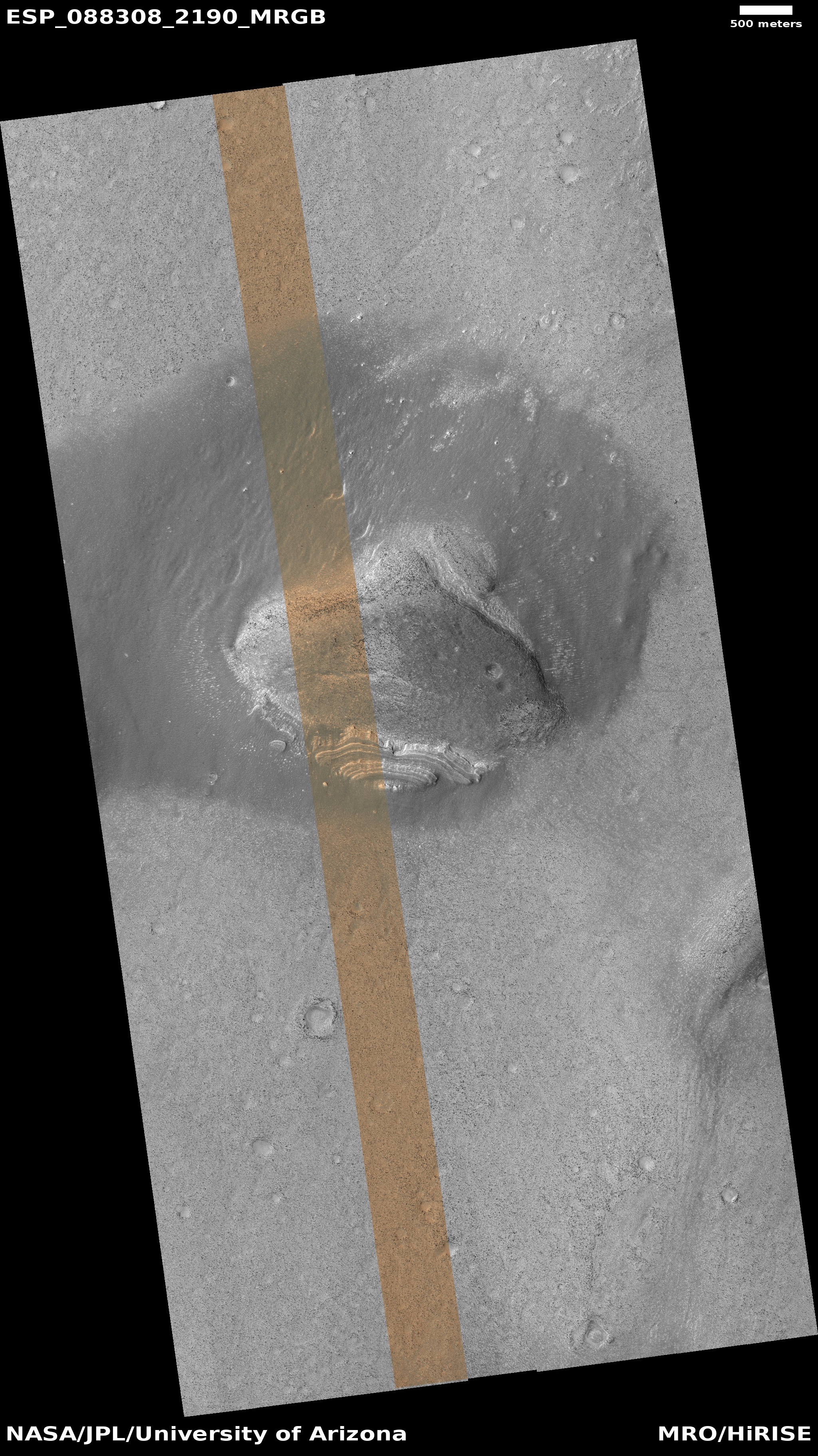
Click for original image.
Today’s cool image takes us sightseeing in the region on Mars that SpaceX has chosen for its prime landing zone for its Starship spaceship. The picture to the right, cropped, reduced, and sharpened to post here, was taken on May 29, 2025 by the high resolution camera on Mars Reconnaissance Orbiter (MRO), and shows a 465-foot-high unusually shaped mesa in this region.
The full resolution inset at the bottom of the picture focuses at the strange tilted layers on the southern slope of this mesa. Apparently the layers at this spot were pushed sideways so they lie significantly angled to the horizontal. Though it isn’t clear from this picture, it is possible that the mesa itself is made up of similar tilted layers, hidden below the surface. We can see the tilt only on the mesa’s southern flank because erosion has apparently exposed it.
Note also the black stain that surrounds the mesa. Though this might be caused by wind distributing dust, such stains have also been seen at a location where scientists suspect an inactive hot spring might exist, as well as another location where there may have been relatively recent volcanic activity.
Is this stain caused by any of these processes? In situ exploration would probably be necessary to find out. And we may soon actually have spaceships landing here in the relatively near future with the capability to do this.
» Read more

Click for original image.
The European Space Agency (ESA) revealed today that it has completed drop tests from a helicopter of an engineering vehicle of its proposed Space Rider reusable mini-shuttle — similar in concept to the U.S. military’s X-37B — testing the spacecraft’s parachutes and re-entry guidance system.
The drop-test campaign had two objectives: the qualification of the parachutes used to slow the spacecraft during descent, and to test the software that controls the parafoil, guiding the Space Rider’s reentry module to its precise landing site. Space Rider models were dropped from a CH-47 Chinook Italian Army helicopter from altitudes ranging from 1 to 2.5 km, at the Italian military’s training and experimentation area Salto di Quirra.
The press release provides no movie of any of the drop tests, and the images it provides are almost all taken from very far away, making it impossible to see in detail what the engineering vehicle looks like. Only one picture clearly shows it, and that is what I have posted to the right. This is not a model of a spacecraft, but a square box carrying the parachutes and sensors.
Note also that ESA was doing similar drop tests last summer of a similar model. Apparently they aren’t yet ready to test the real thing.
This X-37B copy was first tested by ESA in 2015 and by 2017 the agency was promising it would be flying commercially by 2025. A decade later and they have not yet begun testing a full scale spacecraft. In addition, ESA has established some very complex rules about who can use it commercially, rules so complex I predict few will be interested.
Europe might be trying to adopt capitalism and freedom as its model, but in many ways it behaves as if it hasn’t the foggiest idea what it is doing.

Nordspace’s proposed spaceport. Click for original.
Though details remain slim, the Canadian rocket startup Nordspace now says it is targeting an August launch of its hopes to fly first suborbital launch from its proposed spaceport in August.
NordSpace’s Taiga rocket isn’t going to reach orbit when it launches in August, but it’s a big step toward the company’s ultimate goal. Taiga is a small, liquid-fueled, hypersonic launch vehicle capable of carrying just over 110 pounds (50 kilograms) above the Karman Line. This summer’s shakedown cruise will be a low-altitude demonstration of Taiga’s capabilities.
The map to the right indicates the location of the spaceport, near the town of St. Lawrence on the southern coast of the island of Newfoundland.
Whether this launch occurs is very uncertain. For example, a previous report in January 2025 about this launch site suggested that government approvals were still required. It is not known if those approvals have been obtained.
Nordspace is the second company in Canada to propose offering a combined spaceport/rocket service. The other, Maritime Launch Services, first appeared almost a decade ago, but has never gotten off the ground. Nordspace first announced its plans in July 2024, so achieving a first test launch in 2025 will clearly place it ahead of Maritime.
As it appears right now to be the only American rocket company capable of taking on new launch contracts, SpaceX today was awarded a new launch contract from Globalstar to launch its third generation set of satellites.
The press release is not clear about the number of satellites or launches involved, but either way the deal signals SpaceX’s continuing dominance. For larger satellites it has no real competitors. Not only are its launch prices the cheapest, none of its competitors are capable of adding new customers to their launch manifests. In fact, those competitors, ULA, Arianespace, and Blue Origin, are having trouble simply getting their rockets off the ground on a regular basis.
This situation however is likely to change by two years, assuming the new rockets being developed by Rocket Lab, Stoke Space, and Relativity finally begin flying.
The Spanish high altitude balloon startup Zero-2-Infinity has now established an office in South Korea with the intention of flying tourist flights from there for a ticket price of about $60k per flight.
Zero 2 Infinity plans to begin its Korean operations with a project called “Byul” — the Korean word for star — which offers a symbolic farewell for pet lovers. The initiative will invite volunteers to send the ashes of their deceased furry companions into the stratosphere, carried in star-shaped, biodegradable capsules. The company aims to begin collecting participants this September, with the first near-space release scheduled for December in Korea.
Byul will apparently be a smaller balloon with no human passengers. The company claims it has already test flown a larger helium balloon with humans aboard to an altitude of 6 miles, and again unmanned to 20 miles. If so it has done so with no publicity at all. This announcement today appears more a push to raise the $70 million the company says it needs to develop this manned balloon capsule.
After an unusual pause of launches of several days (likely due to the July 4th weekend), SpaceX last night successfully launched by placing another 28 Starlink satellites into orbit, its Falcon 9 rocket lifting off from Cape Canaveral in Florida.
The first stage completed its 22nd flight, landing on a drone ship in the Atlantic.
The leaders in the 2025 launch race:
85 SpaceX
36 China
10 Rocket Lab
8 Russia
SpaceX now leads the rest of the world in successful launches, 85 to 63.

Capitalism in space: The European Space Agency (ESA) today announced that it has chosen five rocket startups — out of twelve that applied to its “European Launcher Challenge” — now approved to bid on future ESA launch contracts.
The startups are Isar Aerospace and Rocket Factory Augsburg from Germany, PLD Space from Spain, MaiaSpace from France, and Orbex from Great Britain. Though none have successfully completed a first launch. all five showed the most advancement. Isar has had one attempted launch failure, while Rocket Factory lost its rocket during a static fire test just before launch. PLD meanwhile has achieved a short suborbital test, while Orbex has said it was ready to launch three years ago but was blocked by red tape in the United Kingdom.
MaiaSpace is technically the least advanced, but it is also a subdivision wholly owned by ArianeGroup, a partnership of Europe’s largest aerospace companies, Airbus and Safran. It was also established in partnership with France’s space agency CNES. Thus, it has well-established connections within Europe’s aerospace industry that makes it favored.
The goal of this ESA program is to shift from the government model it has used for decades, where ESA builds and owns the rockets, to develop a competitive rocket industry of independent companies that market their rockets to ESA for contracts. ESA has seen the success in the U.S. when NASA shifted to this capitalism model in the past decade, and wishes to emulate this.
Whether it remains uncertain. ESA is still mired by bureaucratic government thinking, as illustrated by the next phrase in this challenge:
The next phase of the proposal will see ESA open dialogue between the preselected companies and their respective Member States. This process will help formalise the proposal ahead of the agency’s Ministerial-Level Council meeting (CM25), which will take place toward the end of the year. At CM25, Member States are expected to formally commit funding to the initiative. Following the meeting, ESA will issue a Phase 2 call for proposals, which will be restricted to the preselected candidate companies. European Launcher Challenge contracts will then be awarded after a final evaluation period.
The ESA’s very nature seems to impose odious bureaucratic rules on its member nations that could hinder these private companies. For example, these rules now block any other independent rocket startups from bidding on contracts. Like the bootleggers during Prohibitioin, the ESA has essentially divided competition up by territory and given it to these favored companies. No one else is allowed in.
A Martian rock that fell as a meteorite in Africa and was discovered by a professional meteorite hunter and is the largest such Mars rock found so far is about to go up for sale by auction.
NWA16788 is the largest known piece of Mars on Earth, and its internal composition suggests it was disgorged from the surface of the Red Planet by an asteroid impact so extreme that it turned some of the meteorite’s minerals into glass.
Looking certain to blow past its lower estimate of US$2.0 million, this monumental 54-lb (24.67-kg) lump of Mars has already been bid to $1,920,000 (inc Buyer’s Premium) 12 days before the on-line hammer falls, and even its $4-milllion upper estimate doesn’t look safe with this much interest so early in an online auction.
The expected high price is partly because of the meteorite’s size, and partly because almost such meteorites are found by scientists working for NASA, and are thus never made available for sale. To have one available for purchase is rare indeed.
After months of delay following the nozzle failure on the rocket’s second launch, ULA has now finally begun preparing a new Vulcan rocket for its third launch, carrying a number of a classified NSSL national security payloads.
Based on statements by ULA’s CEO, Tory Bruno, the company is finally about to begin the aggressive 2025 launch schedule he had promised last year.
During a media roundtable on the sidelines of the 40th Space Symposium in early April, Bruno said they planned to launch around 11 to 13 times by the end of the year. He said that would be a roughly 50-50 split between Atlas and Vulcan rockets.
The next two Vulcan launches are planned to be two NSSL Phase 2 missions: USSF-106 and USSF-87. The Vulcan rockets for both have been at the Cape since last year, but the status of the payloads hasn’t been publicly discussed given their ties to national security.
Bruno said following those two NSSL missions, ULA will launch the first Kuiper Vulcan mission and then bounce back and forth between Atlas and Vulcan flights through the end of the year.
If this schedule turns out to be true, it will be good news not only for ULA but for Amazon, as it indicates the possibility of ULA launching more than 500 Kuiper satellites before the end of the year. That will make a significant dent in its requirement to place 1,600 satellites in orbit by July 2026. At the moment only 54 are in space.
A Luxembourg-based startup aimed at building orbiting recoverable capsules for cargo as well as in-space manufacturing has won a $14.7 million grant from the European Innovation Council as part of its European Innovation Council Accelerator program to encourage development in Europe’s private commercial space sector.
The company, Space Cargo Unlimited, will use the money to develop what it calls its “BentoBox in-orbit testing and manufacturing platform.” It is also partnering with well-established European company Thales-Alenia, with the BentoBox development based on previous work done for the European Space Agency’s (ESA) Space Rider demonstrator project.
The overall nature of this grant and work illustrates Europe’s aggressive shift in the past two years from the government model, where ESA designed and owned everything, to the capitalism model, where the government is merely the customer, buying what it needs from the private sector. The government-built Space Rider, which was intended to be a re-usable space plane similar to the X-37B, has never flown. Now, its technology is being repurposed by private European companies for their own spacecraft with the intention of making profits. And this Bentobox project is a prime example.
The inaugural flight of the BentoBox platform as a standalone system using the ATMOS inflatable heatshield is expected in the fourth quarter of 2025. As of a late 2024 update, Space Cargo Unlimited had already secured bookings for 80% of the inaugural flight, and 50% and 40% of the second and third flights, respectively.
Note too that Space Cargo is a European competitor with Varda in the U.S. It appears Europe wants some of this business for itself.

SpaceX employees cheering the first chopstick capture of
Superheavy, October 13, 2025. Click for video.
Two new articles today outline two different new lawsuits against SpaceX by former employees, with both claiming harassment and discrimination as reasons for their firing.
In the first case, the former employee, L’Tavious Rice, claims that he “was fired for being late to work while caring for his young daughter as she recuperated from a heart transplant, while his white colleagues were given a pass for their own “consistent tardiness and absences.” The lawsuit also claims the SpaceX human resources department was retaliating against him because he testified about another employee’s misbehavior in another unrelated case.
In the second case, the former employee, Jenna Shumway, claims she was passed over for promotion, and the man who got the job “waged a campaign of harassment against her, which included stripping her of her responsibilities over a period of months and ultimately leading to her termination in October 2024.” She also claims this “harassment extended to other female employees, too.”
I have no idea whether these claims are true or not. I tend to be skeptical, because of the overall make-up of SpaceX’s entire work-force. The image to the right, a screen capture from the company’s broadcast during the fifth flight of Starship/Superheavy on October 13, 2024 and taken mere seconds after the first successful capture of Superheavy. illustrates this. The SpaceX work-force is young, and typical of engineering, more male than female. At the same time it has many long time female employees, including the company’s president and chief operating officer, Gwynne Shotwell.
We must not also dismiss the possibility of political motives in these lawsuits. In the past three years the left has made it clear it is out to get Elon Musk, and that campaign has included vandalism, regulatory sabotage, and numerous other environment lawsuits by leftist activist groups whose funding is political.
At the same time, it is very possible that these two former employees have legitimate beefs. We shall have to see how both cases play out in the courts.
Fifteen months into a five year mission it appears the methane climate satellite MethaneSat has apparently failed prematurely.
From the press release by the environmental activist organization Environmental Defense Fund that operated the satellite:
On Friday, June 20, the MethaneSAT mission operations lost contact with MethaneSAT. After pursuing all options to restore communications, we learned this morning that the satellite has lost power, and that it is likely not recoverable.
The satellite was unusual in that it was developed and built by this activist organization, not a government or academic institution. Its failure is especially unfortunate at this time, because this non-governmental approach to science research is exactly what the science community needs to pursue faced as it is with major cuts in federal funding.
SpaceX yesterday successfully completed two launches from Florida. First, it placed a European Union weather and climate research satellite, Sentinel-4, its Falcon 9 rocket lifting off from the Kennedy Space Center. The first stage completed its ninth flight, landing on a drone ship in the Atlantic.
Next, it continued its unrelenting pace of launching Starlink satellites, its Falcon 9 rocket lifting off with 27 from Cape Canaveral. The first stage completed its 29th flight, landing on a drone ship in the Atlantic.
That flight makes this particular first stage the third most traveled launch vehicle, with only the space shuttles Discover (39 flights) and Atlantis (33 flights) ahead of it.
The leaders in the 2025 launch race:
84 SpaceX
35 China
10 Rocket Lab
7 Russia
SpaceX now leads the rest of the world in successful launches, 84 to 61.
According to anonymous sources at Blue Origin, the company has now delayed the second launch of its New Glenn rocket to September, ten months after its first launch in January 2025, and hopes to quickly follow with three more launches by the middle of 2026.
The September launch will launch NASA’s two smallsat Escapade Mars orbiters.
After Escapade, Blue Origin has several missions tentatively plotted out. However, sources cautioned that the manifest could be moved around due to the readiness of subsequent New Glenn vehicles and their payloads. Based upon information received by Ars, the launch manifest could look something like this:
- New Glenn 2: ESCAPADE (fall 2025)
- New Glenn 3: Firefly’s Elytra orbital transfer vehicle (end of 2025, early 2026)
- New Glenn 4: Blue Moon MK1 lander (first half of 2026)
- New Glenn 5: First batch of 49 Amazon Project Kuiper satellites (mid-2026)
Whether this schedule will occur as speculated is unknown. Blue Origin’s long term track record — slow and timid — suggests it is very unlikely. And even if it does fly as planned, it suggests strongly that Amazon is not going to meet its FCC license requirement to have 1,600 Kuiper satellites in orbit by July 2026. So far Amazon has only placed 54 operational Kuiper satellites into orbit, on two Atlas-5 launches. It has contracts to launch these satellites 46 times on ULA rockets (8 on Atlas-5 and 36 on Vulcan), 27 times on Blue Origin’s New Glenn, 18 times on ArianeGroup’s Ariane-6, and 3 times on SpaceX’s Falcon-9.
Except for the Falcon 9, none of the other rockets have begun flying with any frequency. Vulcan has only launched twice, New Glenn once, and Ariane-6 twice. All three have been extremely slow to ramp up operations, with months passing between each launch. To meet Amazon’s FCC license requirements, they will have to achieve between 35 to 60 launches in the next twelve months, a pace of three to six launches per month. At this point none of these companies appear capable of even coming close to doing this.
Nor does Amazon have the option to switch these launches to the Falcon 9. SpaceX would certainly accept the business, but the manifest for the Falcon 9 is presently very full. It is doubtful it could do more than double or triple its commitment to Amazon.
Mitsubishi Heavy Industries, which developed the new H3 rocket for Japan’s space agency JAXA, wants to attract commercial launch business, and to do so hopes to cut the rocket’s launch price to about $35 million.
According to the article at the link, the price for the H2A rocket that the H3 has replaced was 10 billion Japanese yen, about $70 million.
The H2A launched more than 70 satellites and other objects into space, serving as the backbone of Japan’s space transportation. However, there was an average of only two launches a year, and most depended on “public demand” for government satellites. There were only orders for commercial launches for five satellites belonging to foreign countries, such as South Korea and the United Kingdom.
…For Mitsubishi Heavy Industries, Ltd., which took over the manufacture and operation of the H2A from JAXA in 2007, winning commercial orders has been a longstanding issue. The H3 was jointly developed by MHI and JAXA with the aim of halving the launch fee.
That price listed for the H2A rocket is likely wrong, much lower than the real price, as it matches what SpaceX has been offering publicly for the Falcon 9 for more than a decade. If the H2A had been that cheap, it would have garnered some business. It did not.
Lowering the cost for the H3 rocket to $35 million would definitely be competitive in the present launch market. Whether Mitsubishi can accomplish this however remains unclear. So far there is no indication that this new rocket has attracted any more business than the H2A, but as the rocket has only just started launching it is still too early to judge.
Link here. The article provides a detailed overview of the situation at Boca Chica following the static fire explosion of a Starship on June 18, 2025, which badly damaged the Masseys test stand used by Starship prior to launches.
The problem facing the company is that it wants to fly the last few version-two Starships (called Block 2) before it is ready to switch to the upgraded Block 3, and these two versions apparently require a different set up on the test stand. The article outlines three options, with the first two the simplest and most straightforward, but require the most delays.
Option three, which is the most SpaceX-like of them all, would involve the repair Masseys for Block 3 and, in parallel, attempt to come up with a plan to static fire Ships on Orbital Launch Pad 1 (A). This would allow SpaceX to continue testing and flying the remaining Block 2 Ships while preparing for Block 3 of Starship. This is what SpaceX is planning.
In other words, do Block 2 Starship prelaunch static fire tests on the launchpad itself while Masseys is being rebuilt for Block 3.
The article outlines in detail the technical difficulties this plan requires, because the launch mount is also used for prelaunch static fire tests of Superheavy. The two rockets require different mount clamping and fueling systems.
If this is the plan that SpaceX is following, it will likely mean that the next test flight, the tenth, will occur in about two months, maybe sooner. We will get a better idea of the company’s plans in the coming weeks.