A molecule found by Rosetta on Comet 67P/C-G proves discovering life on exoplanets will not be easy

The uncertainty of science: Scientists have long assumed that the molecule dimethyl sulfide (DMS) is an excellent biosignature of life, since it is only produced by life here on Earth. When they discovered it in the atmosphere of an exoplanet last year many thought, especially in the media, that it proved that life existed on that exoplanet.

A scientist who had worked on the Rosetta mission to the Comet 67P/C-G thought otherwise, that DMS was not a reliable biosignature and quickly proved it.

Just 1 day of data from Rosetta’s mass spectrometer, an instrument that can identify molecules by their specific weights, was enough for [Nora Hänni] and her colleagues to find DMS. She says lab experiments will now be needed to pin down exactly how DMS forms in space, where ultraviolet light and cosmic rays can power the synthesis of complex organic molecules. Another important question is whether comets could deliver significant amounts of DMS to a planet—and perhaps account for detections like the K2-18b claim. “If it impacted the atmosphere, it could contaminate the atmosphere of the planet,” Noack says, potentially complicating searches for alien life.

Like the fake news in 2020 that life was found in the atmosphere of Venus (it wasn’t), it is a big mistake to use the detection of one molecule to assume it is evidence of life on an alien world. The universe is far more complicated.
2 comments

Citizens enlisted to find changes to Comet 67P/C-G during Rosetta mission

The European Space Agency (ESA) and Zooniverse have partnered to create a new citizen science project, allowing anyone to more easily review the archive of high resolution photos taken by Rosetta of Comet 67P/C-G and look for changes that occurred during the probe’s mission to the comet.

“The Rosetta archive, which is openly accessible to scientists and the public, contains a vast amount of data collected by this extraordinary mission that have only been partially explored,” says Bruno Merín, head of ESA’s ESAC Science Data Centre near Madrid, Spain. “In the past few years, astrophotographers and space enthusiasts have spontaneously identified changes and signs of activity in Rosetta’s images. Except for a few cases, though, it has not been possible to link any of these events to surface changes, mostly due to the lack of human eyes sifting through the whole dataset. We definitely need more eyes!”

This is why ESA partnered with the Zooniverse, the world’s largest and most popular platform for people-powered research. The new Rosetta Zoo project presents a particular set of data: pairs of images collected by Rosetta’s OSIRIS camera showing Comet 67P’s surface before and after perihelion.

Volunteers are invited to view images of roughly the same region side by side and identify a variety of changes, from large-scale dust transport to comet chunks that moved or even vanished. Sometimes this may require zooming in or out a few times, or rotating the images to spot changes on different scales, getting up close and personal with the iconic comet.

Using Rosetta Zoo will require no software, nor will anyone need to register to use it. You simply go to the website and begin comparing pairs of images, for as long as you wish, marking differences you spot of the same locations.

0 comments

Amateur finds moon orbiting comet in Rosetta archive

In mining the Rosetta archive of images of Comet 67P/C-G, an amateur astronomer has discovered a twelve-foot-diameter chunk of material that had broken from the comet and was in orbit around it.

Modelling of the Rosetta images indicates that this object spent the first 12 hours after its ejection in an orbital path around 67P/C-G at a distance of between 2.4 and 3.9 km from the comet’s centre. Afterwards, the chunk crossed a portion of the coma, which appears very bright in the images, making it difficult to follow its path precisely; however, later observations on the opposite side of the coma confirm a detection consistent with the orbit of the chunk, providing an indication of its motion around the comet until 23 October 2015.

While it is not really unusual for their to be small objects in the coma of the the comet, orbiting it, this is apparently the largest so far found. That they missed it initially is also not surprising, considering the amount of data they were gathering in such a short time.

2 comments

The changing surface of Comet 67P/C-G

Changes on Comet 67P/C-G after outburst

More results from this week’s 50th Lunar and Planetary Science Conference in Texas! Two presentations today focused on showing the dramatic changes on the surface of Comet 67P/C-G that were documented by Rosetta. The first focused on the changes produced after massive outbursts during the comet’s closest approach to the Sun. The second documented several more evolutionary changes that changed more slowly.

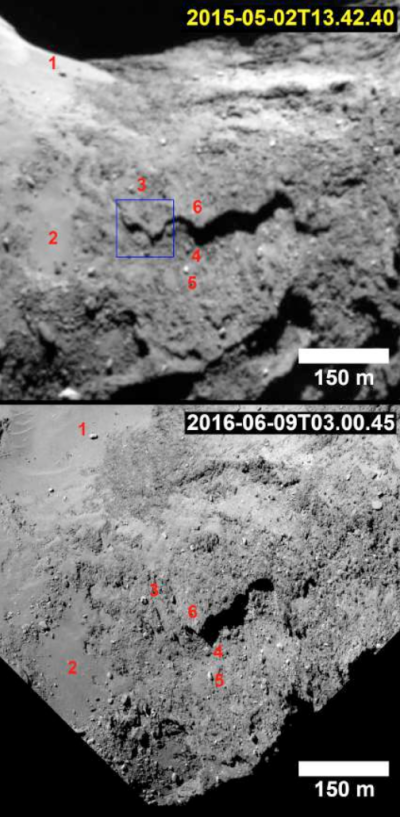
The image to the right comes from the first paper, and shows the changes that took place on the surface following one massive outburst, with the numbers in red indicating unchanged features between the two photographs.

It appears an entire cliff section has disappeared, replaced by a single large giant boulder. Interestingly there is no obvious vent opening for the outburst. Instead, it appears that the eruption occurred below ground, and merely blasted part of the surface into space. As noted in the paper:

We report here on a third cliff collapse that occurred in the southern hemisphere in the Sobek region [7], which corresponds to the neck region in the 67P’s southern hemisphere. Due to the close alignment of the 67P’s
southern summer solstice with perihelion passage, the southern hemisphere is subjected to higher solar input, resulting in higher levels of activity and more intensive erosion. The location of the collapsing cliff in Sobek is consistent with the inferred source region of one of the strong outbursts [previously reported].

The paper also showed evidence of a large boulder more than a 100 feet across moving several hundred feet over a period of seven months.

The second paper showed various changes in a number of depressions and scarps on the smooth flat surfaces near the narrow neck that connected the comet’s two lobes. Examples of this terrain can be seen in high resolution pictures here and here and here and here.

From this data scientist suggest that the neck region is slowly dissolving away, its material in these flat areas flying away because the neck happens to be a region of low gravity.

0 comments

Short movie from Rosetta of Comet 67P/C-G

A search by a Twitter user of the Rosetta archive from its visit to Comet 67P/C-G has produced a very short movie of the comet’s surface.

The bright dots travelling from the top of the frame to the bottom, which look something like snow, are in fact background stars. They have that apparent motion as the spacecraft moves and the comet rotates. The more rapidly moving streaks are thought to be dust particles illuminated by the Sun. There also appear to be a few streaking cosmic rays.

Take a look. The twelve second movie gives a flavor of what it would be like to walk that comet’s surface.

4 comments

Rosetta’s capture of a dust jet from Comet 67P/C-G

Dust jet on Comet 67P/C-G

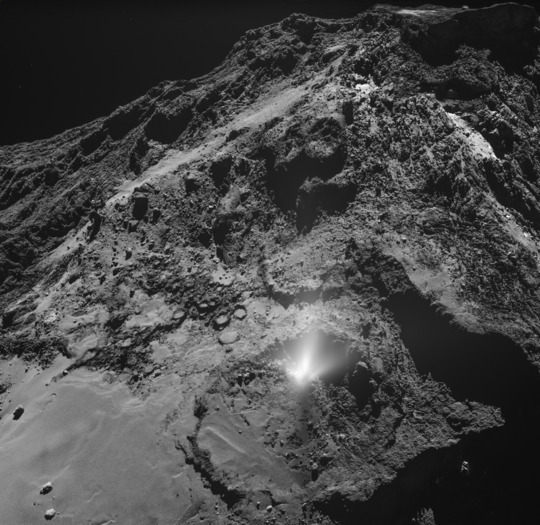
Cool image time! The Rosetta science team has released images and data gathered in July 2016 when the spacecraft successfully observed a dust outburst erupting from Comet 67P/C-G’s surface. The image on the right, slightly reduced in resolution, shows that outburst.

When the Sun rose over the Imhotep region of Rosetta’s comet on July 3, 2016, everything was just right: As the surface warmed and began to emit dust into space, Rosetta’s trajectory led the probe right through the cloud. At the same time, the view of the scientific camera system OSIRIS coincidentally focused precisely on the surface region of the comet from which the fountain originated. A total of five instruments on board the probe were able to document the outburst in the following hours.

As should be expected, the results did not match the models or predictions. The jet, instigated by water-ice just below the surface turning into gas when heated by the Sun, was much dustier than predicted. They have theories as to why, but it appears that no one likes these theories that much.

1 comment

One last image from Rosetta

Rosetta's last image

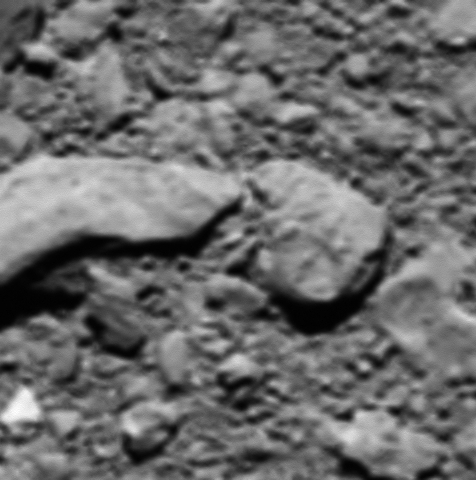
Engineers reviewing the last bits of telemetry that was transmitted back to Earth by Rosetta just before it crashed on Comet 67P/C-G have discovered one last image of the comet’s surface.

That image is on the right. It is slightly blurred because of the limitations of Rosetta’s camera at this short range, and the incompleteness of the data received.

The image covers an area about a meter across, with a resolution of about two millimeters per pixel.

I imagine this surface is relatively soft, since the gravity holding the comet together is so slight. If you wanted to dig down, you would find it easy digging.

2 comments

The changes seen by Rosetta on Comet 67P/C-G

A new study released today describes in detail the many changes seen by scientists in the data collected by Rosetta during its two years in close proximity to Comet 67P/C-G.

“We saw a massive cliff collapse and a large crack in the neck of the comet get bigger and bigger,” said El-Maarry. “And we discovered that boulders the size of a large truck could be moved across the comet’s surface a distance as long as one-and-a-half football fields.”

In the case of the boulder, Rosetta’s cameras observed a 282-million-pound (130-million-kilogram), 100-feet-wide (30-meter) space rock to have moved 150 yards (460 feet, or 140 meters) from its original position on the comet’s nucleus. The massive space rock probably moved as a result of several outburst events that were detected close to its original position.

The warming of 67P also caused the comet’s rotation rate to speed up. The comet’s increasing spin rate in the lead-up to perihelion is thought to be responsible for a 1,600-foot-long (500-meters) fracture spotted in August 2014 that runs through the comet’s neck. The fracture, which originally extended a bit longer than the Empire State Building is high, was found to have increased in width by about 100 feet (30 meters) by December 2014. Furthermore, in images taken in June 2016, a new 500- to 1,000-foot-long (150 to 300 meters) fracture was identified parallel to the original fracture.

“The large crack was in the ‘neck’ of the comet — a small central part that connects the two lobes,” said El-Maarry. “The crack was extending–indicating that the comet may split up one day.”

It is almost a shame that Rosetta did not see that break-up. The images would have been breath-taking, and the science learned priceless.

1 comment

Comet 67P/C-G slowly breaking apart

A comparison of Rosetta images before and after Comet 67P/C-G’s close approach to the sun last year found new fractures and an enlargement of older fractures.

The fractures appear to be developing as forces subtly bend the comet to and fro, Stubbe Hviid, a planetary scientist at the German Aerospace Center Institute of Planetary Research in Berlin, reported October 17 in a press conference at a meeting of the American Astronomical Society’s Division for Planetary Sciences. Hviid and colleagues combined maps from Rosetta with computer simulations of all the forces at work within the comet to determine how the cracks develop. They found that the two bulbous ends rock in opposite directions as the comet spins, flexing the neck and creating severe stress. Because the comet isn’t held together strongly — it’s a conglomeration of dust and ice not much stickier than snow, Hviid said — the neck is starting to break. After a few hundred more years, he said, the comet could fold itself in half as the two lobes snap apart and smoosh together.

0 comments

The interior of Comet 67P/C-G

The Rosetta science team has released a summary of what they have learned about the interior of Comet 67P/C-G.

Essentially, they have found that the comet’s interior has a rather uniform and soft and fluffy interior, with few voids or dense pockets. They also found that the comet’s two lobes almost certainly came from two different objects that somehow made contact and stuck to each other. And finally, it appears that the upper few feet of the surface of the smaller lobe where Philae landed is different than its interior, a difference likely caused by the surface’s exposure to the Sun.

0 comments

The outbursts on Comet 67P/C-G

The Rosetta science team has released a detailed analysis of the jets and outbursts that they observed coming from Comet 67P/C-G during the comet’s close approach to the Sun.

Brief but powerful outbursts seen from Comet 67P/Churyumov–Gerasimenko during its most active period last year have been traced back to their origins on the surface.

In the three months centred around the comet’s closest approach to the Sun, on 13 August 2015, Rosetta’s cameras captured 34 outbursts. These violent events were over and above regular jets and flows of material seen streaming from the comet’s nucleus. The latter switch on and off with clockwork repeatability from one comet rotation to the next, synchronised with the rise and fall of the Sun’s illumination.

By contrast, outbursts are much brighter than the usual jets – sudden, brief, high-speed releases of dust. They are typically seen only in a single image, indicating that they have a lifetime shorter than interval between images – typically 5–30 minutes. A typical outburst is thought to release 60–260 tonnes of material in those few minutes.

They have also released a new image taken by the navigation camera of Rosetta’s September 30th landing zone.

1 comment

Rosetta’s last days

The Rosetta team has released a detailed description of what will be happening in the last two weeks of the spacecraft’s mission, leading up to its landing on the comet’s surface on September 30.

Their description of the difficulty of planning maneuvers based on the complex asymmetrical gravitational field of the two-lobed comet nucleus is especially interesting.

1 comment

Rosetta’s final descent to Comet 67P/C-G

The Rosetta science team today posted two stories, describing details about the planned final descent of the spacecraft to the surface of Comet 67P/C-G on September 30, ending the mission.

The spacecraft will land in a region dubbed Ma’at that contains several active pits more than 300 feet across and 150 feet deep. This is also where several of the comets dust jets originate.

3 comments

Philae found!

Philae!

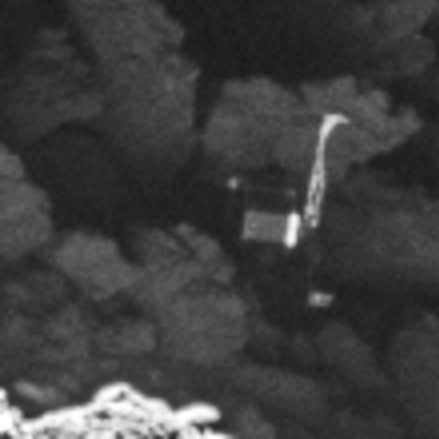
Less than a month before Rosetta’s mission ends the spacecraft’s high resolution camera has finally located Philae in its final resting spot on the surface of Comet 67P/C-G.

The images were taken on 2 September by the OSIRIS narrow-angle camera as the orbiter came within 2.7 km of the surface and clearly show the main body of the lander, along with two of its three legs. The images also provide proof of Philae’s orientation, making it clear why establishing communications was so difficult following its landing on 12 November 2014.

The image on the right clearly shows the lander on its side with one leg sticking up, as theorized by the Rosetta engineers based on the small amount of data they had received before Philae went dead. Furthermore, the wide image at the link above shows that the lander landed exactly as predicted by data, up against a wall — in this case a large boulder — which placed it in shadow most of the time.

8 comments

Changes on Comet 67P/C-G

Cool image time! Below the fold are two images taken by Rosetta of the smooth boulder-strewn area on Comet 67P/C-G called Imhotep, which has been featured many times by the Rosetta science team. The image on the left was taken October 26, 2014 soon after the spacecraft’s arrival at the comet. The image on the right was taken August 17, 2016, almost two years later after it had completed its close approach to the Sun. With both images I have cropped them and reduced their resolution to fit here. With the more recent image I have also stretched it horizontally to better match it to the older image.

The point? The giant boulders on this smooth region act as markers so that we can more easily compare the region and see how it has changed with time. The newer image clearly shows a loss of material from the surface, with the depressions in the smooth areas having grown much larger and in some areas much deeper. At the same time, there has been a softening in some of the edges between the lower and higher areas, especially in the middle of the smooth region.

What will happen here in the future? It appears that the smooth area is actually pond of dust that is slowly evaporating away with each close approach to the Sun, leaving behind the solid bedrock pinnacles within it that only appear as boulders because they are mostly buried. Eventually, when the dust is gone, some of those pinnacles will break away as well.
» Read more

2 comments

Rosetta photographs outburst on Comet 67P/C-G

The Rosetta science team today released data and images of a February 19, 2016 outburst on Comet 67P/C-G that the spacecraft was able to photograph, as it happened.

A strong brightening of the comet’s dusty coma was seen by the OSIRIS wide-angle camera at 09:40 GMT, developing in a region of the comet that was initially in shadow. Over the next two hours, Rosetta recorded outburst signatures that exceeded background levels in some instruments by factors of up to a hundred. For example, between about 10:00–11:00 GMT, ALICE saw the ultraviolet brightness of the sunlight reflected by the nucleus and the emitted dust increase by a factor of six, while ROSINA and RPC detected a significant increase in gas and plasma, respectively, around the spacecraft, by a factor of 1.5–2.5.

In addition, MIRO recorded a 30ºC rise in temperature of the surrounding gas. Shortly after, Rosetta was blasted by dust: GIADA recorded a maximum hit count at around 11:15 GMT. Almost 200 particles were detected in the following three hours, compared with a typical rate of 3–10 collected on other days in the same month.

Be sure an look at the animated gif at the link.

1 comment

A fine collection of Rosetta images

Comet 67P/C-G

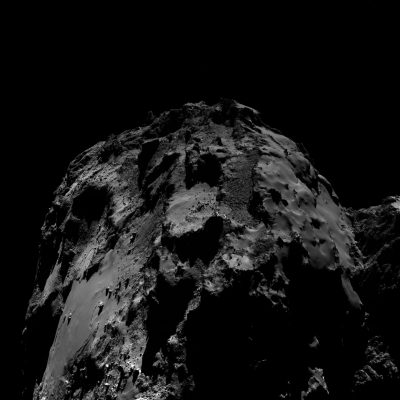
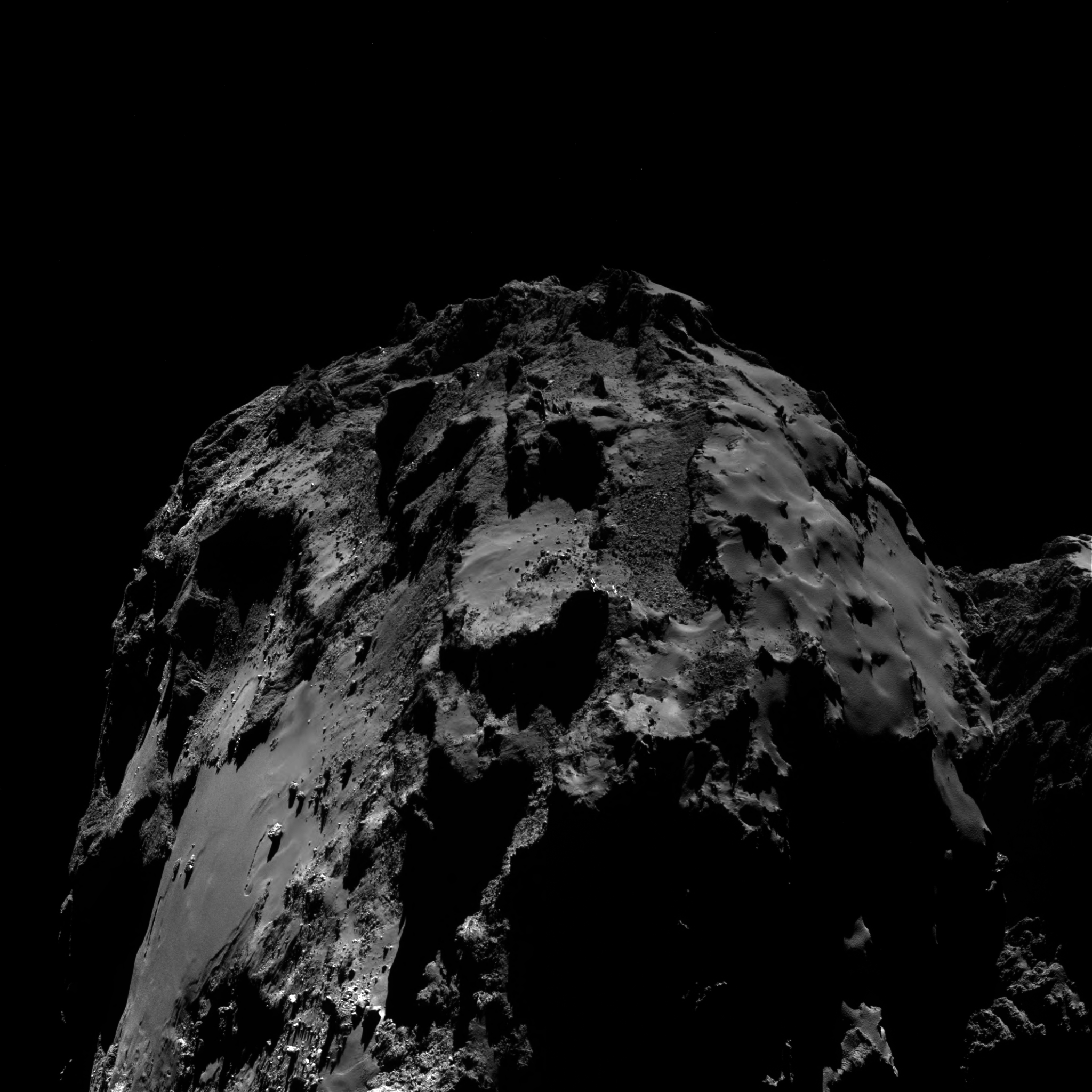
Many cool images! The Rosetta team has released a bunch of very nice images taken of Comet 67P/C-G during August when the spacecraft was flying in close. The image on the right, cropped and reduced in resolution to post here, shows the comet’s large lobe, with the narrow neck to the left. Make sure you check out the full resolution image. It was taken on August 10, 2016 from about 8 miles away, and has a resolution of less than four feet per pixel. If a person was standing there you could just see them!

What I find most fascinating is the incredible curvature of the comet’s surface. The smooth area on the left, dubbed Imhotep (images of which have been posted here previously), has several big boulders on its flat surface. If you stood there, the ground would be down and horizontal. Walk only a short distance and you quickly reach the curving horizon and that flat area would look like a steep slope dropping down behind you. Yet, the boulders do not roll down hill! Walk a short distance more and you begin to enter the neck region, with giant walls rising above you, until you start to walk up them and they become the floor!

5 comments
1 2 3 7