A 2nd Starlink satellite since December fails catastrophically

According to reports from two different companies (here and here) that monitor objects in orbit, a Starlink satellite broke apart for unknown reasons on March 29, 2026.

SpaceX yesterday confirmed the incident.

On Sunday, March 29, Starlink satellite 34343 experienced an anomaly on-orbit, resulting in loss of communications with the satellite at ~560 km above Earth. Latest analysis shows the event poses no new risk to the Space_Station, its crew, or to the upcoming launch of NASAโ€™s Artemis II mission. We will continue to monitor the satellite along with any trackable debris and coordinate with NASA and the USSpaceForce.

This is the second time in just over three months that a Starlink satellite has failed suddenly. In mid-December a Starlink satellite began to tumble when fuel began venting from a tank. It burned up in the atmosphere a month later.

Considering that SpaceX has approximately ten thousand Starlinks in orbit, any failures should not be a surprise. You launch that many, some are going to fail. That the company has only had two such failures indicates instead SpaceX’s incredible quality control in manufacturing, as almost every satellite works as expected with no such failure.

3 comments

SpaceX launches first stage for record 34th time, passing shuttle Atlantis

SpaceX today successfully launched another 29 Starlink satellites, its Falcon 9 rocket lifting off from Cape Canaveral Space Force Station in Florida.

The first stage (B1067) completed its 34th flight, landing on a drone ship in the Atlantic, only 32 days after its previous launch. With this flight, this stage passed the space shuttle Atlantis to hold second place in the rankings of the most reused launch vehicle.

39 Discovery space shuttle
34 Falcon 9 booster B1067
33 Atlantis space shuttle
32 Falcon 9 booster B1071
31 Falcon 9 booster B1063
30 Falcon 9 booster B1069
28 Columbia space shuttle
27 Falcon 9 booster B1077
27 Falcon 9 booster B1078

Sources here and here.

SpaceX continues to recycle its first stages in a month or less, so expect this booster to pass Discovery before the end of the year. We should also expect all the boosters in the list above to do the same by the end of next year, though it is possible some will be retired as SpaceX begins to transition from its Falcon 9 high launch rate to using Starship/Superheavy instead.

The leaders in the 2026 launch race:

40 SpaceX
16 China
5 Rocket Lab
4 Russia

SpaceX continues to lead the entire world combined in total launches, as it did in both โ€™24 and โ€™25.

10 comments

Brownsville’s mayor: SpaceX has brought billions of dollars to the region

According to Brownsville’s mayor, John Cowen, SpaceX has brought billions of dollars to the region as well as created tens of thousands of jobs, and should be unanimously hailed by everyone there.

โ€œThe aerospace giant has infused $13 billion into into the economy across Brownsville and South Texas. It has created 24,000 direct and indirect jobs across the region, with approximately 4,000 jobs on site today. It is projected that 4,000 more jobs are coming,โ€ Cowen said.

Cowen made his remarks about SpaceX at his 2026 State of the City Address, held March 25 at Texas Southmost Collegeโ€™s Performing Arts Center.

โ€œSpaceX has generated more than $305 million in tax revenue. It has managed business relationships with more than 350 suppliers, putting $147 million into the regional supply chain,โ€ Cowen said.

None of this is a surprise, except to some local and national news outlets that like to act as PR departments for the fringe activist groups — Save RGV, the South Texas Environmental Justice Network and the fake Indian tribe dubbed the Carrizo/Comecrudo Nation of Texas — that have opposed SpaceX’s Boca Chica operations from day one, and have repeatedly gone to court to try to shut it down. Those news outlets always give these activists a big bullhorn to tout their position, even though they represent practically no one in the region and likely get their funding from leftist sources outside of Texas.

Hat tip to Robert Pratt of Pratt on Texas.

6 comments

Two launches from China and SpaceX early today

Early this morning both SpaceX and China successfully launched rockets. First, SpaceX completed its sixteenth Transporter mission placing 119 payloads in orbit, its Falcon 9 rocket lifting off from Vandenberg Space Force Base in California.

The first stage completed its 12th flight, landing on a drone ship in the Pacific. A detailed description of the 119 payloads can be found here.

Next, China successfully completed the maiden launch of its Kinetica-2 rocket, lifting off from its Jiuquan spaceport in northwest China and placing three demonstration satellites into orbit. The rocket is built by the pseudo-company CAS Space, which is entirely owned by one of China’s government space agencies.

According to the developers, the rocket stands 53 meters tall, with a core stage diameter of 3.35 meters and a fairing 4.2 meters wide. At liftoff, it weighs 625 tons and produces 753 tons of thrust. It can deliver up to 12 tons to a 200 kilometers low Earth orbit or 8 tons to a 500 kilometers sun-synchronous orbit.

On this launch, the liquid-fueled core stage and two side boosters were expendable, and crashed somewhere in China. China will use this rocket to partly replace its older expendable Long March 2 and Long March 3 rockets that use very toxic hypergolic fuels, thus reducing the risk to its citizens somewhat from crashing lower stages. Eventually the plan is to make the core stage and boosters reusable, so that they no longer crash uncontrolled inside China.

The leaders in the 2026 launch race:

39 SpaceX
16 China
5 Rocket Lab
4 Russia

SpaceX continues to lead the entire world combined in total launches, as it did in both โ€™24 and โ€™25.

SpaceX has another Starlink launch scheduled for later today, using a first stage on a record 34th flight.

2 comments

Another rocket startup in India hopes to launch from its own spaceport

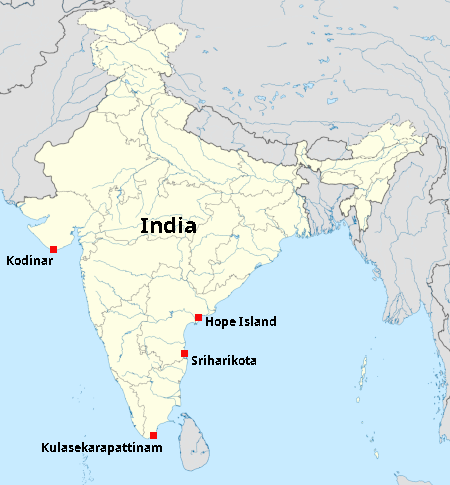
India's spaceports, active, under construction, or proposed
India’s spaceports, active, under construction, or proposed

A new rocket startup in India, dubbed Bharath Space Vehicle (BSV), is not only building a commercial rocket to launch smallsats, it hopes to establish its own private spaceport near the town of Kodinar in western India.

BSV has proposed a launch complex near Kodinar in Gujarat’s Gir Somnath district. Gujarat’s Science and Technology Minister Arjun Modhwadia told the state assembly that IN-SPACe has identified a suitable location between Diu and Kodinar for a satellite launch facility, comparable to Sriharikota.

The coastal location offers open sea access and favourable launch corridors for specialised satellite trajectories. Isro had earlier evaluated a Gujarat site for its SSLV launch complex before Kulasekarapattinam in Tamil Nadu was selected.

Sriharikota has been operated for decades by India’s space agency ISRO. Kulasekarapattinam is a new ISRO spaceport set to begin operations next year, focused on launching its Small Satellite Launch Vehicle (SSLV) for commercial missions. Hope Island is a proposed private and commercial spaceport, under study.

BSV’s rocket is called Agasthya-1 and will use liquid-fueled engines. It appears to be similar in design to SpaceX’s first rocket, the Falcon-1.

Though the company’s founders are all ISRO veterans who helped develop its rockets, its website makes no mention of a launch schedule. At present, India has two rocket startups, Skyroot and Agnikul, that appear close to their first orbital launch.

1 comment

Rocket Lab launches GPS-type demo satellite for Europe

Rocket Lab this morning successfully placed a European Space Agency (ESA) smallsat into orbit, its Electron rocket lifting off from one of its two launchpads in New Zealand.

The smallsat, dubbed Celeste, is the first of two such demo satellites that ESA has contracted Rocket Lab to launch. They are designed to test a low Earth orbit constellation for providing global navigation and location information to users on the ground, similar to the U.S.’s GPS constellation. Celeste will work from low orbit with Europe’s medium orbit Galileo constellation, but being smaller will be cheaper and faster to build and launch.

The leaders in the 2026 launch race:

38 SpaceX
15 China
5 Rocket Lab
4 Russia

SpaceX continues to lead the entire world combined in total launches, as it did in both โ€™24 and โ€™25.

4 comments

Ispace to replace engine on its lunar lander, delaying its NASA mission to 2030

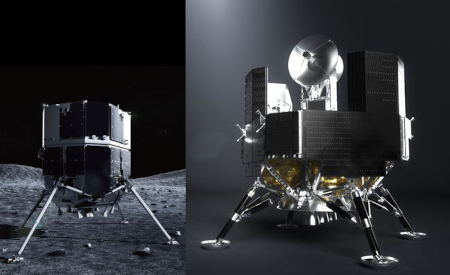
Ispace's old and new landers

The Japanese lunar lander startup Ispace has been forced to institute a major shake-up of its upgraded lunar lander design because a subcontractor’s engine did not meet the required specifications.

The engine, called Voidrunner and built by Agile Space Industries, was about to be installed in the lander for a 2027 launch of NASA lunar lander mission when a review found its performance to be unsatisfactory.

After closely monitoring the engineโ€™s status and conducting careful review, Ispace has determined that a change in the development plan to incorporate a new alternative engine is necessary to ensure the successful execution of the lunar landing mission. The new engine, which will replace VoidRunner, has already been developed by the alternative supplier and has a proven track record of operation in past lunar missions.

The company has also decided to standardize its two lunar lander designs, one developed in Japan and the second in parallel by its American division. The new lander, dubbed Ultra, will use this new engine and fly all of Ispace’s subsequent missions. The image above shows the company’s original lander Hakuto-R on the left, compared to its new Ultra lander on the right.

This change will delay its planned NASA mission by three years, to 2030, though the company hopes it will not impact the schedule of two other lunar lander missions for Japan. Its new updated schedule, all using Ultra:

  • 2028: a Japanese mission funded by Japanโ€™s Ministry of Economy, Trade and Industry
  • 2029: a Japanese mission funded by Japanโ€™s Space Strategy Fund (designed at encouraging the private space sector
  • 2030: NASA’s mission, being built in partnership with the American company Draper

Ispace has also created a new lunar satellite program, to provide communications, location data, and satellite tracking from lunar orbit, with a goal of launching its first lunar orbiter by next year, and five by 2030.

As a lunar lander company Ispace has had a very mixed record. It has successfully flown two landers to lunar orbit and then down to the surface. Each however crashed, failing just prior to landing due to software issues. This new delay of its NASA mission is not going to please NASA administrator Jared Isaacman, who instead wants to speed up the agency’s lunar lander program, flying almost monthly beginning in 2030. It likely means Ispace is going to have problems winning any new NASA lander contracts, until it proves its new Ultra lander design.

0 comments

SpaceX launches another 25 Starlink satellites

SpaceX this afternoon successfully placed another 25 Starlink satellites into orbit, its Falcon 9 rocket lifting off from Vandenberg Space Force Base in California.

The first stage completed its 23rd flight 39 days after its previous flight, landing on a drone ship in the Pacific.

The leaders in the 2026 launch race:

38 SpaceX
14 China
4 Rocket Lab
4 Russia

SpaceX continues to lead the entire world combined in total launches, as it did in both โ€™24 and โ€™25.

1 comment

Carl Perkins & Ringo Starr – Honey Don’t

An evening pause: Performed live 1985.

Hat tip Judd Clark.

Readers: I am in need of evening pause suggestions. If you’ve sent me suggestions in the past you know the drill. More suggestions are welcome! If you haven’t and want to suggest something, say so in the comments below, but DON’T provide the link to your suggestion or mention it. I will contact you to send you the guidelines so you can send it to me to schedule.

0 comments

The space station part of Isaacman’s new program is facing push back, from industry and Congress

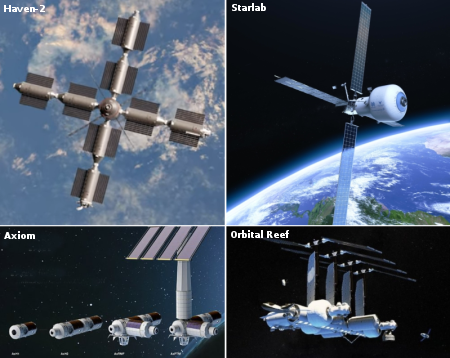
The American space stations under construction
Four of the American space stations under development.
The fifth, Max Space, is a late comer and not shown.

At a hearing yesterday before the space subcommittee of the House Science, Space, and Technology Committee, both the trade organization representing the five commercial space station projects as well as some members of Congress expressed strong reservations about NASA’s new plan to build a core module as a basis for helping these companies develop their space stations.

Dave Cavossa, President of the Commercial Space Federation (CSF) that represents these companies, outlined in his statement [pdf] to the committee the industry’s dissatisfaction, not so much because of the specifics of NASA’s plan but because it follows other sudden changes last year by the previous NASA administrator Sean Duffy, and is still uncertain in its outline.

Given the delays and possible shifts in strategy, industry has been left to continue spending resources to develop private space stations without a full understanding of what NASA will require from a private station, how the agency will structure the rest of the procurement and program, and when industry may see a return on investment. This uncertainty challenges the public-private partnership business model and puts the agency at risk of deorbiting ISS before private stations are operational.

The trade group proposed that NASA stick with its previous plan to fund two or more station projects, dropping Isaacman’s core module proposal. It also wanted Congress give the agency the funds to do so.

Cavossa also strongly disputed NASA’s claim that the market at present doesn’t support these commercial stations.
» Read more

18 comments
1 15 16 17 18 19 898