SpaceX successfully launches four astronauts to ISS

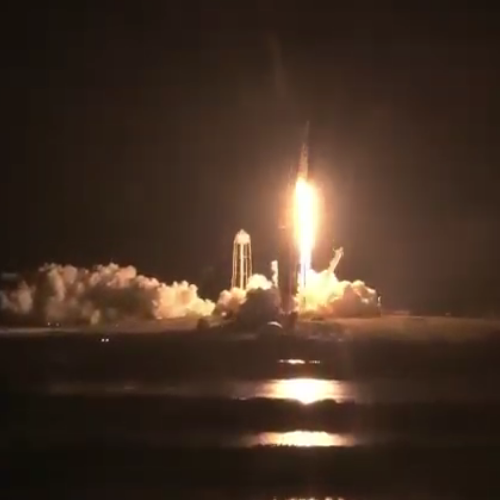
Falcon 9 launch on November 15, 2020 with four astronauts

Capitalism in space: SpaceX tonight successfully launched four astronauts to ISS on its Dragon capsule Resilience, using its Falcon 9 rocket.

They also recovered the first stage, landing it on its drone ship in the Atlantic. The routine manner in which SpaceX ran this launch is truly admirable. They make landing and reuse of the first stage so expected it is hard to believe that for fifty years rocket managers and engineers insisted it wasn’t doable.

They had one issue today, a failure of the capsule hatch to hold air pressure after closure. They calmly reopened the hatch, cleared the issue, added some lubricant, and closed the hatch, all in less than ten minutes.

Resilience will dock with ISS tomorrow evening.

The leaders in the 2020 launch race:

30 China
20 SpaceX
5 ULA
4 Europe (Arianespace)
4 Rocket Lab

The U.S. now leads China 32 to 30 in the national rankings.

6 comments

Watch today’s launch of SpaceX’s Resilience manned capsule

According to a NASA report yesterday, the weather then stood at 50% for allowing a launch of four astronauts to ISS on SpaceX’s Resilience capsule tonight at 7:27 pm (Eastern).

That percentage was still reported this morning. Part of the issue is that SpaceX wants to recover the first stage, and the weather therefore not only has to be good in Florida, it has to be good in the Atlantic where the stage will come down.

NASA’s live coverage begins at 3:15 pm (Eastern). The link to that live stream is below the fold. As I write this at around noon (Eastern) it is simply NASA TV’s normal feed, which is essentially full time propaganda for NASA. After 3:15 pm it will switch to live coverage, which unfortunately will still be packed with pro-NASA propaganda, even though this launch is entirely being run by the private company SpaceX. NASA’s only part is that of a customer, with the ability to say “no” at any point. The rocket, the capsule, the launchpad, and the countdown, is operated completely by SpaceX and its employees.

I have also added the clean feed from NASA, which appears to carry little commentary or narration.

» Read more

4 comments

Weather forces one day delay in launch of Resilience with four astronauts

Because of high winds and ocean weather interfering with the recovery of the first stage, NASA and SpaceX today decided to delay the launch of SpaceX’s second manned Dragon mission, the capsule Resilience carrying four astronauts, to Sunday, November 15.

NASA and SpaceX are now targeting 7:27 p.m. EST Sunday, Nov. 15, for liftoff of the agency’s SpaceX Crew-1 mission to fly astronauts from Launch Complex 39A at NASA’s Kennedy Space Center in Florida to the International Space Station.

Teams moved the launch by one day because of onshore winds and to enable recovery of the first stage booster, which is planned to be reused to launch the Crew-2 mission next year. The booster is expected to land on the recovery ship about nine minutes after launch.

They now plan to dock with ISS at 11 am (eastern) on November 16th.

1 comment

NASA officially approves operational Dragon manned missions

Capitalism in space: NASA yesterday officially certified SpaceX’s Dragon capsule for future operational manned missions to ISS.

NASA officials gave approval Tuesday for SpaceX to begin regular crew rotation flights to the International Space Station with the launch of four astronauts set for Saturday from the Kennedy Space Center in Florida, signaling a transition from development to operations for the human-rated Dragon spacecraft.

Mission managers completed a two-day Flight Readiness Review Tuesday and issued a preliminary go-ahead for the launch of SpaceX’s Crew Dragon “Resilience” spacecraft Saturday at 7:49 p.m. EST (0049 GMT Sunday) with NASA commander Mike Hopkins, pilot Victor Glover, and mission specialists Shannon Walker and Soichi Noguchi, a veteran Japanese space flier.

The decision means that SpaceX will now be rotating crews for NASA at ISS every six months. It will also be reusing both the first stages and the capsules. Endeavour, the capsule used on the demo flight earlier this year, will be reused in the spring. Resilience, the capsule scheduled for launch on November 14th, will be reused next fall.

Since SpaceX also has a commercial manned flight planned for next fall, that will probably require a third capsule. With those three capsules they will have at least for the next few years a fleet will cover all their initial needs. Don’t be surprised if however the introduce an upgraded capsule or two along the way, based on what they learn on these initial flights.

The article had one other piece of new news concerning Boeing’s Starliner capsule. The second unmanned demo flight has now officially been delayed into the first quarter of next year, rather than late this year.

0 comments

NASA offers public chance to experience next manned mission virtually

NASA is now offering the general public the opportunity to virtually experience the next manned Dragon flight to ISS, set to launch on November 14th.

“Members of the public can attend the launch virtually, receiving mission updates and opportunities normally reserved for on-site guests,” NASA officials wrote in a statement on Tuesday (Nov. 3). “NASA’s virtual launch experience for Crew-1 includes curated launch resources, a digital boarding pass, notifications about NASA social interactions and the opportunity for a virtual launch passport stamp following a successful launch,” the agency added.

While much of this will be fun to do, much of it is also pure hype, designed to sell NASA to the public, even though the mission is being launched and run almost entirely by the private commercial company SpaceX, not NASA.

5 comments

Next manned Dragon launch delayed

Because of an engine issue that caused Falcon 9 launch of a military GPS satellite to abort at T-2 seconds on October 2nd, SpaceX and NASA have decided to delay the next manned Dragon launch from October 31st “to early-to-mid November.”

The one to two week delay will give the company time to analyze the issue involving an “unexpected pressure rise in the turbomachinery gas generator” that are used to drive the rocket’s Merlin engine turbopumps.

It seems unlikely that this problem is systemic to all Merlin engines, considering the number of rocket launches SpaceX has successfully completed in the last four years. Each launch has used ten engines, with no evidence of this problem appearing previously.

At the same time, no one wants a problem on a manned flight. Better to completely understand why it happened on the GPS launch first before launching four astronauts on the rocket.

0 comments

Crew for next Dragon manned flight name capsule “Resilience”

Capitalism in space: The crew for next Dragon manned flight, scheduled now for October 31st, have given the capsule the name “Resilience.”

Before arriving at Resilience, Hopkins and his crewmates filled a whiteboard with a long list of “good ideas” for their spacecraft’s name and then narrowed down their choices, he said.

“We wanted to make sure that the name fit,” Hopkins said in an interview with collectSPACE, following Tuesday’s press conference. “We got it down to two or three names and they were all very close in terms of that we liked them and could have been really happy with them, [but] at the end of the day, it was the one that just felt right.”

The crew of the first Dragon manned capsule named it Endeavour, to honor the shuttle spacecraft they had both flown in. The names of these capsules is not merely symbolic. Both capsules will be reused, like the shuttles, and thus deserve names to mark them when they fly again.

What is not clear yet is exactly how many capsules SpaceX will build, nor exactly how many times each capsule will be reused. The latter will of course help determine the former. It will take a few years and multiple flights to find out. Eventually however SpaceX will have its own fleet of manned spaceships, available not only to NASA but to private customers.

1 comment

Changes in engineering and procedures for next manned Dragon flight

SpaceX is making several engineering and operational changes involving flights of its manned Dragon capsule, based on the company’s experience during the first manned flight several months ago.

First, they are reinforcing the heat shield in one area.

After a successful test flight that ended when NASA astronauts Bob Behnken and Doug Hurley splashed down in the Gulf of Mexico on Aug. 2, the company noticed “a little more erosion than we wanted to see” in a few areas of the capsule’s heat shield, Hans Koenigsmann, SpaceX’s vice president of build and flight reliability, said during a press call this week. He said there “was nothing to be concerned with at all times. The astronauts were safe, and the vehicle was working perfectly.”

Second, they are revising the software used to determine the altitude when the capsule’s drogue parachute is released.

Koenigsmann said the company is refining how it measures the capsule’s altitude as it returns to Earth. During the August test flight, the drogue parachutes deployed at a slightly lower altitude than the company expected, but still well within safety parameters, he said.

Finally, they are going to more strictly enforce a 10-mile “keep-out zone” in the ocean where the capsule splashes down. They do not want to see another crowd of recreational boats swarming the landing zone, as happened when the capsule returned to Earth in August.

0 comments

NASA & SpaceX set Oct 31st for next manned Dragon mission

Capitalism in space: NASA and SpaceX have now scheduled Oct 31st as the target launch date for the first operational manned Dragon mission to ISS, the second manned Dragon mission overall.

This new date delays the launch a week from the previous announced schedule, and was done to give some space between its launch and the launch of a manned Soyuz on October 14th and the return of a different Soyuz with the present ISS crew on October 21st.

0 comments

Axiom, SpaceX, and NASA finalizing first wholly private manned mission

Capitalism in space: Axiom, SpaceX, and NASA are close to finalizing the deal for the first wholly private manned mission to ISS, tentatively set for October 2021.

One of the topics Axiom is negotiating with NASA involves how much insight the space agency will have into the private astronaut mission. While the Axiom missions will be managed by commercial companies, the AX-1 flight will fly with a reusable Crew Dragon spacecraft that will carry NASA astronauts on other missions. “There’s a certain amount of insight (NASA) would like on our flight, on a commercial flight,” [Axiom official] Suffredini said Friday. “So that is one aspect of that process. We’re using a vehicle that is going to be re-flown, and NASA will certify the re-flights because they want to do re-flights.”

Axiom and SpaceX will also have to confirm a schedule with NASA for the AX-1 mission to dock with the space station. The orbiting research complex has a busy schedule of arriving and departing crew and cargo vehicles, and managers also have slot in spacecraft dockings amid spacewalks, experiments, and other critical operations.

NASA also oversees safety of the space station with the program’s international partners.

The private companies however will in the end be responsible for the flight.

There have been rumors that the passengers on this flight will be Tom Cruise and his film director, though this is not confirmed. Also, these same arrangements will be used for the tentative 2023 private flight of the winner of a proposed reality television show dubbed Space Hero.

2 comments

Reality show to fly contestant to ISS

Capitalism in space: A new reality show, dubbed Space Hero, will have audiences watch contestants compete to be a passenger on a private capsule, likely SpaceX’s Dragon, and fly to ISS for ten days.

The selected group of contestants will undergo extensive training and face challenges testing their physical, mental and emotional strength, qualities that are essential for an astronaut in space. I hear the idea is for the culmination of the competition to be in a an episode broadcast live around the world where viewers from different countries can vote for the contestant they want to see going to space. The show will then chronicle the winner’s takeoff; their stay at the ISS for 10 days alongside professional astronauts traveling at 17,000 mph, orbiting the Earth 16 times a day; and end with their return to Earth. The Space Hero company is currently in discussions with NASA for a potential partnership on STEM initiatives onboard the ISS.

The trip of the Space Hero winner is expected be on a SpaceX Dragon rocket though a launch provider is yet to be officially selected. Space Hero, billed as the first space media company, is working with Axiom Space, manufacturer of the world’s first privately funded commercial space station — a module for the ISS where the private astronauts can stay — and full-service human spaceflight mission provider.

The project seems more viable and realistic than previous such attempts, aided by the fact that tickets can now be purchased on a private and operational manned capsule.

1 comment

NASA targets October 23rd for next manned Dragon flight

Capitalism in space: NASA and SpaceX yesterday announced that they have now set October 23rd as the earliest launch date for next manned Dragon flight.

The mission will carry Crew Dragon commander Michael Hopkins, pilot Victor Glover, and mission specialist Shannon Walker, all of NASA, along with Japan Aerospace Exploration Agency (JAXA) mission specialist Soichi Noguchi for a six-month science mission aboard the orbiting laboratory following launch from Launch Complex 39A at NASA’s Kennedy Space Center in Florida.

They had previously said they were aiming for a late September launch, but this extra delay allows them to better coordinate with other traffic to and from ISS, while also giving them an extra month to review the data from the first manned flight, just completed.

0 comments

Endeavour at Cape, being prepped for next flight

Capitalism in space: Endeavour, SpaceX’s Dragon capsule that was the first to fly two astronauts to ISS, has now arrived at the company’s facility at Cape Canaveral, where it will be inspected, refurbished, and prepped for its next manned flight in the the spring of 2021.

SpaceX teams at Cape Canaveral will remove the exterior panels from the Crew Dragon spacecraft, and begin inspections to assess how the spacecraft weathered its 64-day space mission, according to Benji Reed, SpaceX’s director of crew mission management. “We want to make sure that we kind of dig deep and understand everything that’s gone on with this vehicle, make sure we’re really ready to go, and then do some of the aspects of the refurbishment,” Reed said. “There are some things that we will replace, some things that are standardly replaced, some things that we want to upgrade based on lessons learned, or that were already planned in work.”

SpaceX will still need to build a new trunk for each Crew Dragon mission. The trunk is an unpressurized module mounted to the rear of the Crew Dragon capsule, providing electrical power with solar arrays, and radiators to maintain steady temperatures inside the spaceship.

I guarantee the company will use what it learns in this inspection to improve later Dragon manned capsules. Right now they plan on from 5 to 10 flights per capsule. Since their contract right now only calls for six flights, that likely means the company only needs to build at most three to cover this NASA contract. However, NASA is certain to extend that contract, since six flights will only cover about two to three years, and ISS will be manned longer than that. Moreover, SpaceX has at least two tourist flights booked, so that calls for additional capsules as well.

Either way, we must shift our thinking. These might only be Dragon capsules, but they each get a name because each will fly more than once. It is thus appropriate to use that name instead of just calling them Dragon.

10 comments

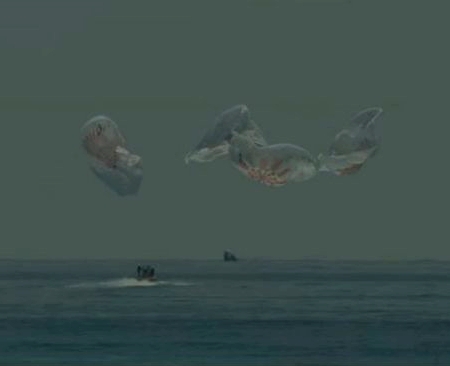
Endeavour safely splashes down

Splashdown of Endeavour

Capitalism in space: SpaceX’s Endeavour Dragon capsule has successfully splashed down in the Gulf of Mexico, returning two humans back to Earth safely after completing the first two month long manned commercial space mission.

If you go to the live stream to watch recovery operations, note that the boats and ships and persons involved are all property and employees of SpaceX. This is entirely an operation of the private company. The government is not involved, other than NASA’s justified monitoring as SpaceX’s customer.

One cool tidbit for the future. Endeavour is scheduled to fly again, in the spring of 2021. On that flight will be Megan McArthur, the wife of astronaut Bob Behnken, and she will likely sit in the same place he did on his flight.

31 comments

Manned Dragon return on August 2nd threatened by weather

Capitalism in space: The splashdown of SpaceX’s first manned Dragon capsule Endeavour on August 2nd is now threatened by weather.

Isaias officially became a named tropical storm on Wednesday night, when its wind speeds exceeded 39 mph. The storm could affect several landing areas just as Endeavour is supposed to reenter Earth’s atmosphere, deploy its parachutes, and splash into the Atlantic Ocean or Gulf of Mexico.

Three of the seven landing zones that SpaceX and NASA prescribed for the test mission, called Demo-2, lie within the “cone of probability” for the storm’s path. Those splashdown sites are located off the coasts of Cape Canaveral, Daytona, and Jacksonville, according to NASA. A July 30 map shows NASA and SpaceX’s landing zones for the Crew Dragon Demo-2 mission amid the estimated path and conditions of Tropical Storm Isaias. The outer-edge green shows a 5-10% chance of sustained tropical storm-force winds. Google Earth; NOAA; NASA; Business Insider

Depending on how large the storm grows and how nasty weather conditions become, mission managers may scrub the undocking and landing attempt. Steep waves, rain, lightning, low clouds, poor visibility (for helicopters to fly the astronauts from a SpaceX recovery boat back to land), or even winds stronger than about 10 mph can trigger a “no-go” decision.

At the moment they are go for undocking on August 1st and splashdown the next day, but that could change depending on how the weather changes.

1 comment

NASA announces third Dragon flight crew

NASA today announced four-person Dragon flight crew for that spacecraft’s third flight in the spring, the second official operational flight.

NASA astronauts Megan McArthur and Shane Kimbrough will join JAXA’s Akihiko Hoshide and ESA’s Thomas Pesquet on that flight, which will follow Crew-1 currently scheduled for sometime in late September after Demo-2 concludes. This is a regular mission, meaning the crew will be staffing the International Space Station for an extended period – six months for this stretch, sharing the orbital research platform with three astronauts who will be using a Russian Soyuz spacecraft to make the trip.

Pesquet will be the first European to fly on Dragon. McArthur however is more interesting, in that this will be her first spaceflight in more than a decade. She had previously flown only once before, in 2009 on the last Hubble repair mission. She is also the wife of Bob Behnken, who is on ISS right now having flown on the first Dragon manned mission now preparing for its return to Earth on August 2nd.

The long gap in flights was certainly due to the shuttle’s retirement. Why she didn’t fly on a Soyuz is a question some reporter should ask her at some point.

9 comments

Watching the splashdown of the first manned Dragon capsule

Capitalism in space: NASA yesterday released its broadcast schedule for watching the undocking from ISS and the splashdown of SpaceX’s first manned Dragon capsule, carrying two American astronauts.

The schedule includes preliminary press conferences, the undocking, the splashdown, and the post-recovery press conference, all centered around the planned August 2nd return.

5 comments

Dragon update for the ongoing and next mission

Two stories today provide an update of the overall schedule and status of SpaceX’s manned Dragon capsule, both now and into the future.

First, they are preparing for the return of Bob Behnken and Doug Hurley from ISS on August 2nd. Prior to return they will use the station’s robot arm to inspect the capsule’s heat shield to make sure it did not sustain any damage during its two months in space. Such inspections will be standard procedure on future flights, something NASA did not do on shuttle flights until after the Columbia failure.

It is unlikely there is any damage, but making this inspection is plain common sense. If the heat shield has been damaged, the astronauts can stay on board ISS until the next Dragon arrives, which can then bring them home.

Second, NASA and SpaceX have worked out a tentative schedule for that next Dragon manned launch, now set for sometime in late September. The agency wants a bit of time to review the full results of the first demo mission before flying a second.

Based on all that has happened so far, it now appears unlikely that the agency will find anything that prevents that late September flight.

1 comment

NASA: Dragon crew will return to Earth August 2nd

Capitalism in space: Assuming that the weather cooperates, NASA has now set August 2nd as the date the manned Dragon capsule will return to Earth with its two man crew.

Assuming good weather and a smooth final few weeks on the International Space Station, astronauts Doug Hurley and Bob Behnken are scheduled to undock from the orbiting research outpost Aug. 1 and return to Earth the next day to wrap up a 64-day test flight of SpaceX’s Crew Dragon spaceship.

NASA Administrator Jim Bridenstine confirmed the target dates for the Crew Dragon’s undocking and splashdown in a tweet Friday. A few hours after departing the space station, the Crew Dragon will fire its Draco thrusters for a braking burn and re-enter the atmosphere, targeting a parachute-assisted splashdown at sea. “Splashdown is targeted for Aug. 2,” he tweeted. “Weather will drive the actual date. Stay tuned.”

Note that the recovery operations, as has been the case with everything else on this flight, will be run entirely by SpaceX and its employees. NASA’s only real role is that of a customer and observer, though obviously agency officials are taking a hands-on part in determining the landing date.

2 comments
1 5 6 7 8 9 22