Israel’s former Google Lunar X-Prize contestant to launch in 2018

Capitalism in space: Despite a failure of all contestants to to win the Google Lunar X-Prize, Israel’s competitor announced today that they still plan to launch, and will do so in December of this year.

The SpaceIL spacecraft will be launched from the United States on a Falcon 9 orbital launch vehicle, built by Elon Musk’s Space Exploration Technologies Corporation, or SpaceX. At a press conference on Tuesday, SpaceIL representatives announced that the unmanned lunar landing craft will be transferred to the US in November, with a launch date in December.

According to SpaceIL, the unmanned space vessel will reach the moon and complete the lunar landing on February 13th next year.

They say the lander will plant an Israeli flag on the Moon, but the images at the link, as well as the announcement, suggests that the lander will no longer have the ability to rove, as required for the X-Prize. It appears to me that they have simplified the mission in order to fly it quickly and gain the public relations such a flight will give them.

4 comments

First manned Dragon capsule completes thermal vacuum tests

Capitalism in space: SpaceX’s first manned Dragon capsule has completed its thermal vacuum tests ahead of its test orbital flight, presently scheduled for September of this year.

There have been hints that this schedule could be further delayed. That neither SpaceX nor NASA were willing to comment about the results of the thermal tests could be a cause for concern, or it could simply be that they have not yet digested the material and wish to do so first before commenting.

I suspect a more firm schedule will be announced before the end of this month.

0 comments

China launches GPS satellite, matches record for annual launches

China today completed its 20th launch in 2018, putting a GPS satellite into orbit with its Long March 3C rocket.

Twenty launches matches China’s 2016 record for annual launches, but they have done so in just over half a year. They continue on track to meet their prediction of about 40 launches in2018.

The updated 2018 leader launch standings:

20 China
12 SpaceX
8 Russia
5 ULA
4 Japan

China now leads the U.S. 20 to 18 in the national rankings.

2 comments

Why Google blurs surface images of Israel, and why that blurring could end

Link here. A 1997 U.S. law requires that all satellite imagery of Israel, Gaza, and the West Bank be blurred. The law also sets the resolution standard based on the best images produced by other commercial companies outside the U.S.

NOAA is now reviewing the law, since high resolution European commercial images have been available since 2012. If it decides this is the new standard, high resolution views of this very politically hot region could become publicly available for free.

The article focuses on the wonderfully good things in science and research this change would bring. It completely ignores the use that terrorist organizations, set on killing as many Israelis as possible, could put to such images.

In general, I prefer freedom and the wide distribution of information. In this case I am torn.

3 comments

Interorbital successfully test flies its upper-stage engine

Capitalism in space: The smallsat rocket company Interorbital Systems successfully test flew the upper-stage engine for its rocket last week.

Video of the test below the fold. This company had appeared to be moving towards test flights in 2014, than nothing seemed to happen until earlier this year. The four year gap made me suspect they were in trouble. It now appears they are moving forward towards their first flight, though when that will happen remains unclear.
» Read more

7 comments

China launches two satellites on Long March 2C

China today launched two satellites for Pakistan using its Long March 2C rocket.

Both satellites are for observing the Earth. Both were built by China for Pakistan.

The leaders in the 2018 launch standings:

19 China
12 SpaceX
7 Russia
5 ULA
4 Japan

In the national standings, China now leads the U.S. 19 to 18. China is also one short of matching its highest ever total of launches for a single year, 20, and it is getting there in just over half a year.

0 comments

3D image of Ryugu

The lead guitarist of the rock band Queen, Brian May, is also an astronomer, and he has taken Hayabusa-2’s first full close-up image of Ryugu and produced a 3D image of the asteroid.

If you have red/blue 3D glasses you should definitely click on the link and view the image. The asteroid appears much more elongated back to front than it appears in the flat image.

3 comments

Close look at bright spots in Occator Crater on Ceres

Bright spot in Occator Crater on Ceres

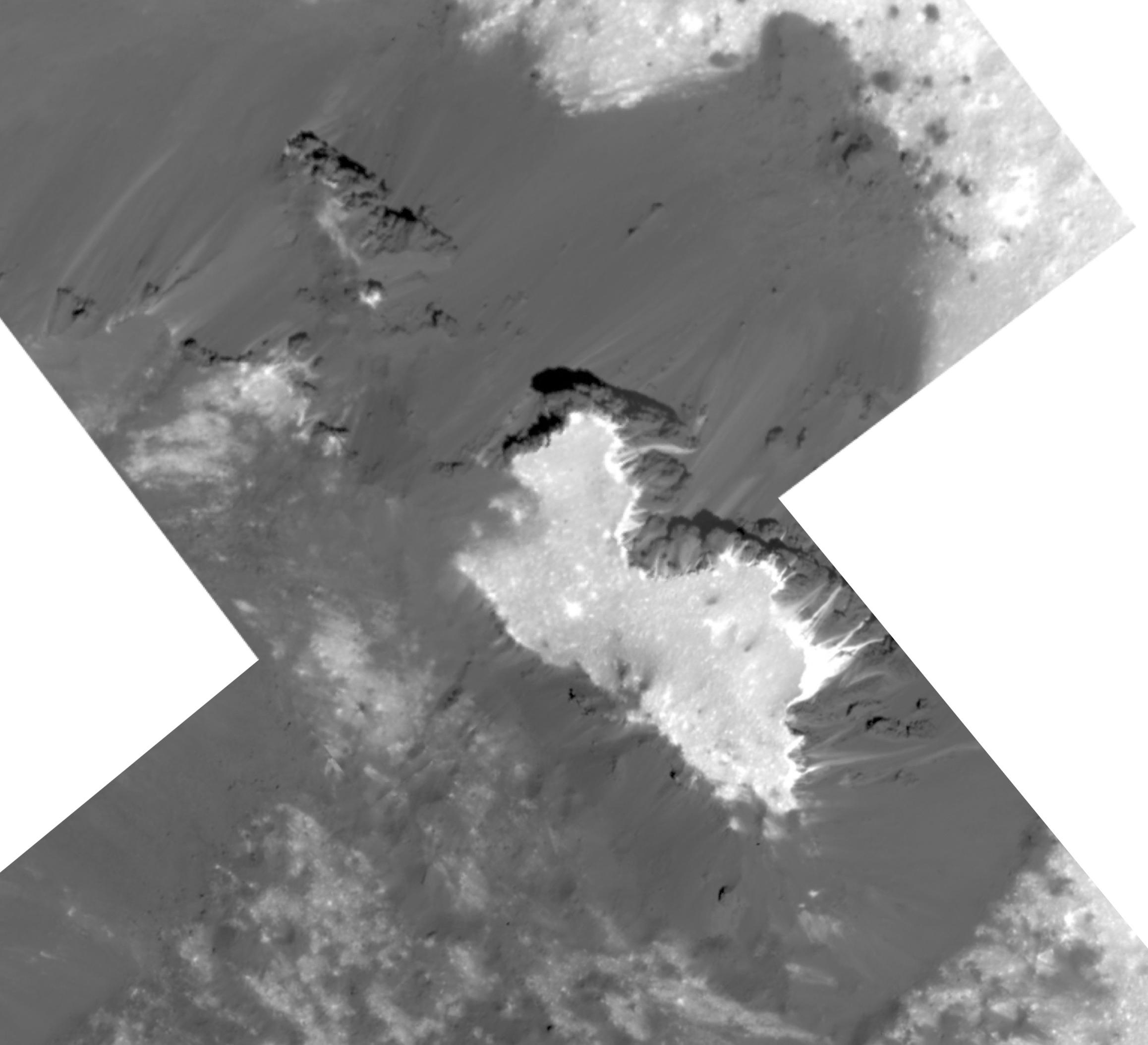
Cool image time! In this week’s release of new images from Dawn, the science released close-ups of one of the bright spots located on the floor of Occator Crater on Ceres. The image on the right, cropped and reduced in resolution to post here, shows one white-topped mesa in that crater.

The geometry of this feature is similar to a mesa or large butte with a flat top. It has been puzzling scientists since its discovery in the early images of the Dawn mission at Ceres. These new images reveal many details. In particular, the relationships between the bright material, mostly composed of sodium carbonate, and the dark background might hold clues about the origin of the facula.

If you click on the image you can see the full image at full resolution.

The sun appears to be coming from the southeast, with the mesa’s cliff’s at the top. Along with some scattered bright spots, the white material appears to have a bright area aligned along the cliff’s rim. The white material also appears to be flowing down one gully in that cliff face.

It is important to remember that these bright spots are generally found in a depression in the crater. scientists now think they are remnants of a volcano-like mound that after erupting slowly slumped back down. Note also that the soft puffiness of the cliff faces probably indicates the lower density of this material due to Ceres’s tiny gravity, about 3% that of Earth’s.

4 comments

Failed Soviet-era Venus probe to crash to Earth between 2023-2025

A failed Soviet-era probe to Venus that never left Earth orbit is now predicted to crash to Earth sometime between 2023-2025.

The Kosmos 482 interplanetary station, which was unsuccessfully sent towards Venus in 1972 by the USSR, may crash land on Earth between 2023 and 2025, astronomer and cosmonautics historian Pavel Shubin told Sputnik. He couldn’t pinpoint the exact location of the future crash site, but noted that it would be between 52 degrees north and 52 degree south latitude.

The astronomer has studied the data on Kosmos 482 orbit as well as its deterioration and detected that it started to degrade faster due to it getting closer to Earth and experiencing increased gravitational pull.

He also expressed confidence that the station would successfully reach the surface since it was adapted for entering the much harsher atmosphere of Venus so is able to endure stress of 300g and 100 atmospheres. The astronomer is anxious to study the station after it lands in order to analyze how prolonged exposure to open space affected its materials.

It is not likely that this probe will land anywhere where it can be recovered, as most of the Earth is ocean. However, the scientist’s hopes are not unreasonable, as it is always worthwhile for future engineering designs to study how the environment of space effects materials over long periods of time.

2 comments

China reveals details of its planned heavy-lift and reuseable rockets

The new colonial movement: At a conference in late May a senior designer for China’s space program revealed details of their planned heavy-lift rocket, called the Long March 9 and comparable to SLS, as well as their first reusable rocket, the Long March 8.

The Long March 9 will be a Saturn 5-class super-heavy-lift rocket comparable in capacity to the Space Launch System currently being developed under NASA.

According to Long, the Long March 9 will be capable of lifting 140 metric tons to low Earth orbit, 50 tons to Earth-Moon transfer orbit, and 44 tons to Earth-Mars transfer orbit. The 93-meter-high Long March 9 is expected to have a launch mass of over 4,000 metric tons, producing close to 6,000 tons of thrust.

…Long explained in the lecture that the Long March 8 would be CALT’s first rocket to attempt first stage reusability, which will launch for the first time in 2021.

As previously reported, the Long March 8 is based on the existing Long March rockets, using a core very similar to that of the 3.35-meter-diameter Long March 7, a new-generation medium-lift rocket that had its maiden flight in 2016, with the second stage to be based on the 3-meter-diameter liquid hydrogen-liquid oxygen second stage of the older Long March 3A. The rocket will also use two solid propellant boosters, likely based on the Long March 11.

Long stated that both the first stage and boosters will attempt vertical landing.

At this moment we must take China’s future space plans somewhat seriously. The upper management of their government is packed with former space program managers, all of whom are likely to view space development favorably. They have also done a good job either stealing our ideas and technology and adapting it, or building their own. And they have a somewhat robust economy, much of which has been privatized, that is generating a lot of cash for their government.

We must also remember that though the Chinese are signatories to the Outer Space Treaty, and will not publicly claim any territory they eventually possess on the Moon, Mars, or asteroids, they are likely to privately ignore that treaty and make it very clear to everyone that any territory they possess is theirs, and theirs alone. I also expect them to devise ways to expand that definition of possession to make it as extensive as possible.

The problem we have in competing with them is that our government seems more focused on creating pork instead of affordable and useful rockets. SLS’s design is cumbersome, expensive, and inefficient. It can’t fly often enough to accomplish much. And though private options that are more efficient and practical are now being built, the federal government seems very uninterested in buying them.

5 comments

Kepler on verge of death

The Kepler space telescope is now almost out of fuel, and scientists have ceased science observations to devote the telescope’s last days downloading its last 51 days of data.

The telescope lasted far longer than planned, and discovered thousands of exoplanets. Its archives will be producing new discoveries for decades. And a new exoplanet space telescope, TESS, is already in orbit to take over.

2 comments

India tests launch abort system for its own manned capsule

India on July 5 successfully tested its own launch abort system for use on its own manned capsule.

The test was over in 259 seconds, during which the crew escape system along with crew module soared skyward, reached an altitude of nearly 2.7 km, swerved over the Bay of Bengal and floated back to Earth under its parachutes about 2.9 km from Sriharikota.

A video showing excerpts of the test can be viewed here.

India has not yet fully committed to building a manned capsule, but they have been moving forward on testing for several years now, and I expect them to make a commitment within the next year. In fact, I think it likely that India will be the fourth nation, after Russia, the U.S., and China, to launch its own astronauts into space on its own spacecraft.

4 comments

AT&T: How to Use the Dial Phone

An evening pause: I would not be surprised if some of the younger readers of Behind the Black would need the instructions in this silent film in order to properly use a rotary phone.

Introducing any new technology requires instruction. This was strange stuff to homeowners in 1927, but a great improvement over party line phones that required an operator to do the dialing. And this was cutting edge then, and a symbol of the future.

Hat tip Jim Mallamace.

12 comments

2″ 2.5″ 3″ 4″ 5″ 6″ 7″ 8″ 10″ 12″ 16″ 24″ 36″ 48″

An evening pause: As John Adams predicted right after ratification of the Declaration of Independence, Independence Day “…ought to be solemnized with pomp and parade, with shows, games, sports, guns, bells, bonfires, and illuminations from one end of this continent to the other, from this time forward forever more.”

It was a declaration for freedom. And even if freedom dies here in this country, the idea will live on, as long as the individual soul of any human beats strong.

As an aside, check out this old post, before I moved to Arizona, when I used to participate on a fireworks team.

Hat tip Willi Kusche.

5 comments

More launch delays from Russia

Russia has decided to delay one of three commercial Soyuz rocket launches to 2019 due to unspecified “readiness” issues.

The launch of Soyuz-ST launch vehicle with a European satellite was initially scheduled for October 6, a source in the aerospace industry told Interfax. “However, evaluating relevant conditions and the launch vehicle’s readiness, the decision was made to move the launch to November 6,” the source said.

In all, three Russian launch vehicles were expected to take off from the Kourou Space Center by the yearend. Italy’s CSG-1 satellite was scheduled to be launched in November, which was to be followed by the launch of OneWeb’s pilot mini-satellites. Due to the delay of the European weather-forecasting satellite’s launch, the launch of two more rockets from Kourou was endangered. “One of the three launches has to be postponed until next year. This is most likely to be Italy’s CSG-1 satellite. However, a lift-off of satellites under the contract with OneWeb may be adjourned,” he said.

In addition, there was this story (behind a paywall) that noted that the only Proton-M launch in 2018 will also be delayed until 2019.

While such delays in rocket launches are not unusual and are an accepted part of the business, these delays for Russia do not help them. The technical problems in recent years that have caused many launch failures, combined with these delays, will further encourage their international customers to go elsewhere.

2 comments

Virgin Orbit gets first launch license

Capitalism in space: Virgin Orbit has obtained its first launch license from the FAA.

They hope to fly this first orbital flight before the end of the summer. Previously they have announced launch contracts calling for commercial launches in 2019, which requires these test flights in 2018.

Either way, it appears that, as I predicted in 2016, Virgin Orbit will achieve its first operational flight ahead of Virgin Galactic, even though the latter has been in development more than twice as long.

0 comments

More close-up images of Ceres

On Monday the Dawn science team released more close-up images of Ceres, taken from Dawn’s final close orbit of the dwarf planet, with the focus of this release Occator Crater and its bright spots.

The current images now show numerous sections of Occator Crater from an altitude of 35 kilometers and with a resolution less than 5 meters per pixel. “The data exceeds all our expectations,” Dr. Andreas Nathues from the MPS, Framing Camera Lead Investigator, says. In the new images, the surface is now ten times better resolved than in the best images from the previous three years.

Impressive avalanches reveal themselves in the new views of the eastern wall of Occator Crater: there are clear signs that material has been recently moving down the slopes; some of it remains stuck halfway. Other images allow a close look at the interplay of bright and dark material in the eastern part of the crater. “We now hope to understand how the bright deposits outside the crater center came about – and what they tell us about Ceres’ interior,” says Nathues. Various analyses of the past years suggest that Ceres has a water-rich crust. Small impacts and landslides regularly expose ice at the surface, which produces a thin exosphere of water vapor.

I have posted some of these images previously, but there are several new ones at the link.

0 comments

Private Japanese smallsat rocket fails at launch

Capitalism in space: The second test flight of a private Japanese smallsat rocket company, Interstellar Technologies, today failed immediately at launch.

A rocket developed by a Japanese startup company burst into flames seconds after a failed liftoff Saturday in northern Japan.

The MOMO-2 rocket, developed by Interstellar Technologies, was launched in Taiki town on Hokkaido, Japan’s northernmost main island. It was supposed to reach as high as 100 kilometers (62 miles) into space. Television footage showed that the 10-meter (33-foot) pencil rocket lifted only slightly from its launch pad before dropping to the ground, disappearing in a fireball. Footage on NHK public television showed a charred rocket lying on the ground.

The incident caused no injuries.

Rocket science is hard. Competition and freedom carries risks. This company might not be dead, but this failure is definitely a significant setback.

Posted from Belize.

3 comments
1 496 497 498 499 500 820