
Arianespace aims for 14 launches in 2018

The competition heats up: Arianespace officials told reporters today that it plans to complete 14 launches in 2018, which would be a record for the company.

For 2018, the company is targeting seven launches of the Ariane 5 model, four launches for the Soyuz model and three launches of the Vega satellite launcher.

Isn’t competition wonderful? SpaceX forces everyone to lower their launch prices, and instead of going out of business, which the old rocket companies were saying would happen for decades should they be forced to drop prices, everyone gets more customers, more business, and more profits. I am shocked, shocked!

Whether Arianespace can maintain this growth however is another story. As newer rocket companies, such as Blue Origin, come on line with even lower costs, I am not sure their more expensive rockets will survive.
1 comment

An update on Zuma status

Link here. The article provides a nice summary of all the reports on the SpaceX launch and its mysterious top secret payload Zuma, including outlining the various failure possibilities. The one scenario they do not mention, however, is that the failure story itself is entirely bogus, a misinformation campaign by the unknown government agency that launched it.

I have no idea what happened, though it still appears to me most likely that SpaceX’s rocket performed as contracted.

12 comments

A new prime number, 23 million digits long

An online pubic program designed to allow ordinary people to use their computers to identify previously unknown prime numbers has found the largest so far, 23 million digits long.

It was discovered on December 26, 2017 by electrical engineer Jonathan Pace, and it initially took six days of non-stop number crunching to show that it was indeed a prime number. Pace was using a consumer-level PC running an Intel i5-6600 processor, and after it was identified it was then independently verified by other users, with a range of other programs and hardware setups.

11 comments

First six segments of Extremely Large Telescope cast

The first six mirror segments of the European Southern Observatory’s Extremely Large Telescope have been successfully cast.

These segments will form parts of the ELTโ€™s 39-metre main mirror, which will have 798 segments in total when completed. The ELT will be the largest optical telescope in the world when it sees first light in 2024.

The 39-metre-diameter primary mirror of ESOโ€™s Extremely Large Telescope will be by far the largest ever made for an optical-infrared telescope. Such a giant is much too large to be made from a single piece of glass, so it will consist of 798 individual hexagonal segments, each measuring 1.4 metres across and about 5 centimetres thick. The segments will work together as a single huge mirror to collect tens of millions of times as much light as the human eye.

The segments must now be cooled, then their surfaces ground and polished to the right shape. If all goes right, they will make more than 900 segments (with about a 130 as spares), manufactured to have the telescope operational by 2024.

1 comment

SpaceX military payload might have been lost

Anonymous sources are suggesting that the top secret government payload that SpaceX successfully placed in orbit two days ago might have been lost.

Very little is presently known. Statements from SpaceX suggest that its Falcon 9 rocket worked perfectly, which would suggest the problems occurred after second stage separation. However, one source seems to suggest otherwise.

Until I get more information, I am therefore still counting this launch as a success for SpaceX.

13 comments

Exploring Arsia Mons

Master index

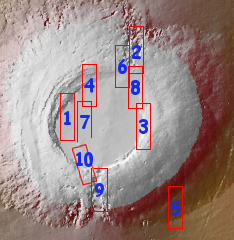
In November over a period of two weeks the Mars Odyssey team posted ten images of Pavonis Mons, the smallest of the aligned three giant volcanoes just to the east of Olympus Mons, the largest known volcano in the solar system. I then made all of those images available in a single link, with some analysis.

They have now done the same thing for the southernmost (and possibly the most interesting) of those three aligned volcanoes, Arsia Mons. From the first image below:

Arsia Mons is the southernmost of the Tharsis volcanoes. It is 270 miles (450km) in diameter, almost 12 miles (20km) high, and the summit caldera is 72 miles (120km) wide. For comparison, the largest volcano on Earth is Mauna Loa. From its base on the sea floor, Mauna Loa measures only 6.3 miles high and 75 miles in diameter. A large volcanic crater known as a caldera is located at the summit of all of the Tharsis volcanoes. These calderas are produced by massive volcanic explosions and collapse. The Arsia Mons summit caldera is larger than many volcanoes on Earth.

In other words, you could fit almost all of Mauna Loa entirely within the caldera of Arsia Mons.

The image on the right above is the master index, annotated by me to show the area covered by each image. The images can accessed individually below.
» Read more

0 comments

R.I.P. John Young 1930-2018

John Young, the ninth man to walk on the Moon and the only man to fly a Gemini capsule, an Apollo capsule, and the space shuttle, passed away yesterday at the age of 87.

Young was the only spaceman to span NASAโ€™s Gemini, Apollo and shuttle programs, and became the first person to rocket away from Earth six times. Counting his takeoff from the moon in 1972 as commander of Apollo 16, his blastoff tally stood at seven, for decades a world record.

He flew twice during the two-man Gemini missions of the mid-1960s, twice to the moon during NASAโ€™s Apollo program, and twice more aboard the new space shuttle Columbia in the early 1980s.

His NASA career lasted 42 years, longer than any other astronautโ€™s, and he was revered among his peers for his dogged dedication to keeping crews safe โ€” and his outspokenness in challenging the space agencyโ€™s status quo.

Young captained the first shuttle Gemini flight and the first space shuttle flight, and also flew twice to the Moon, landing once.

God speed.

4 comments

Atlas 5 man-rated upgrades approved by NASA for Starliner launches

Capitalism in space: ULA announced this week that its Atlas 5 rocket has passed a NASA review that now approves the design changes necessary to allow that rocket to launch Boeing’s Starliner manned capsule.

โ€œDesign Certification Review is a significant milestone that completes the design phase of the program, paving the way to operations,โ€ said Barb Egan, ULA Commercial Crew program manager. โ€œHardware and software final qualification tests are underway, as well as a major integrated test series, including structural loads. Future tests will involve launch vehicle hardware, such as jettison tests, acoustic tests, and, finally, a pad abort test in White Sands, New Mexico.โ€

Launch vehicle production is currently on track for an uncrewed August 2018 Orbital Flight Test (OFT).

The schedule to make that August flight happen still remains tight, but this approval brings it one step closer.

6 comments

Orbital ATK gets its second contract for its satellite repair robot

Capitalism in space: Orbital ATK has signed a second contract to build another Mission Extension Vehicle (MEV), designed to robotically extend the life of old but usable satellites.

The vehicle was ordered by Intelsat S.A. to provide life extension services for an Intelsat satellite. Orbital ATK is now producing MEV-1, the industryโ€™s first commercial in-space satellite servicing system, for Intelsat with launch scheduled for late 2018. Under this new agreement, Orbital ATK will manufacture, test and launch MEV-2 and begin mission extension services in mid-2020. The production of the second MEV is part of Orbital ATKโ€™s longer-range plan to establish a fleet of in-orbit servicing vehicles that can address diverse space logistics needs including repair, assembly, refueling and in-space transportation.

โ€œWork on MEV-1 is progressing rapidly toward a late 2018 launch with system-level testing beginning this spring,โ€ said Tom Wilson, President of Orbital ATKโ€™s Space Logistics, LLC subsidiary. โ€œWith the launch of MEV-2, Orbital ATK will continue to pioneer in-space satellite servicing for commercial operators. Intelsatโ€™s commitment to a second MEV demonstrates not only the market demand for our servicing vehicles, but also the customerโ€™s confidence in our product.โ€

Through its Space Logistics subsidiary, Orbital ATK will introduce in-orbit commercial satellite servicing with MEV-1 late this year. The MEV is based on the companyโ€™s GEOStarTM spacecraft platform, and controlled by the companyโ€™s satellite operations team. The MEV uses a reliable, low-risk docking system that attaches to existing features on a customerโ€™s satellite, and provides life-extending services by taking over the orbit maintenance and attitude control functions of the clientโ€™s spacecraft. Each MEV vehicle has a 15 year design life with the ability to perform numerous dockings and repositionings during its life span.

What Orbital ATK here is doing is creating a entirely new cottage industry with the satellite industry, providing satellite companies an inexpensive way to maintain their satellite networks without building and launching a whole new communications satellite. Once Orbital has placed a number of these in orbit, they will be available to move from satellite to satellite. Once their first repair job is finally finished, they will then move on to another at relatively little cost.

10 comments

Nigeria signs deal with China for two communications satellites

China has agreed to build for Nigeria two communications satellites, with the $550 million fee paid entirely for Nigeria through an arrangement with China’s EXIM Bank.

The China EXIM Bank and a Chinese firm, the China Great Walls, have agreed to pay the entire $550m to procure two new satellites for the Nigerian Communications Satellite Limited. The Minister of Communications, Adebayo Shittu, disclosed this in an interview with State House Correspondents on Wednesday shortly after a meeting he had with President Muhammadu Buhari at the Presidential Villa, Abuja.

Shittu explained that the initial arrangement was that Nigeria would provide 15 per cent counterpart funding for the two satellites, while the bank and the firm would provide the balance. He said Nigeria, however, decided to renegotiate the deal when it became obvious that the country could not afford the counterpart funding. The minister explained, โ€œBecause we could not afford this 15 per cent, we have renegotiated with the China EXIM Bank and the China Great Walls, who are the manufacturers, and they have happily agreed to pay the entire $550m to procure two new satellites.

Essentially, this is foreign aid from China to Nigeria, and follows a pattern China has used recently in providing space-related foreign aid in other circumstances.

2 comments

China aiming for more than 40 launches in 2018

The new colonial movement: As part of China’s continuing effort to establish itself as a major space power the country plans to launch more than 40 times in 2018, more than doubling its previous average yearly launch rate.

The China Aerospace Science and Technology Corporation (CASC), announced at a conference on January 2 that its 2018 work model includes 35 launches, underlining the return to flight of the heavy-lift Long March 5 rocket, the Chang’e-4 lunar far side mission and launches of Beidou navigation satellites as the major activities.

In addition CASIC, a defense contractor, missile maker and sister company of CASC, will carry out a number of missions through its subsidiary EXPACE, including launching four Kuaizhou-1A rockets within one week and the maiden flight of the larger Kuaizhou-11.

Landspace Technology, a Beijing-based private aerospace company, is also expected to debut its LandSpace-1 solid propellant rocket this year.

The existence of even one private rocket company in China surprises me.

1 comment

Sea Launch aims to resume flights by the end of 2019

Capitalism in space: S7 Group, the Russian company that now owns Sea Launch, has published a planned launch schedule beginning the end of 2019 with twelve launches planned through 2022.

They have also set up a permanent office in Long Beach, California, where the Sea Launch platform is based.

We shall see if this schedule holds. The successful launch last week of a Zenit rocket indicates that the company’s rocket is viable. The question is whether they have any customers yet.

0 comments

The state of the worldwide rocket industry at the start of 2018

In January 2017 I posted a graph that showed the total successful rocket launches, by company and nation, from the years 1998 through 2016. That graph allowed me to note some interesting trends, of which the following were the three most significant:

First, 2016 was the worst year for the Russian rocket industry in decades. In fact, their launch total of only 18 might be the fewest Russian launches in a year since the beginnings of the space race.

Second, China has been aggressively ramping up its launch rate, and in 2016 moved clearly into the top tier of space-faring nations. Their prediction that they are aiming for 30 launches in 2017 is further evidence that this effort is not a temporary thing.

Third, the United States is clearly transitioning away from a government owned and operated rocket industry to one owned and operated by the private sector. Since the retirement of the space shuttle, the federal government has not launched a single rocket that it designed, built, and owns. Instead, every payload put in space by the U.S. has been put there by a private sector rocket.

Below the fold is a new graph. It now includes 2017, but also goes back to 1980, which I think makes a good starting point for the true beginning of the modern the rocket industry. In December 1979 Arianespace successfully completed the first launch of Ariane 1, beginning its effort to build a commercial rocket that would capture market share in the communication satellite industry. In 1980 India launched its first rocket. And in 1981 the space shuttle began flying.
» Read more

27 comments
1 517 518 519 520 521 820