World View launches chicken sandwich in test ballon flight

Capitalism in space: The first test flight of World View’s stratospheric balloon has begun, carrying with it as well a KFC chicken sandwich.

The sandwich is scheduled to remain aloft for four days and maintain an altitude of about 50,000 to 80,000 feet (15,200 to 24,400 meters). During the flight, which is serving as an advertising campaign for Kentucky Fried Chicken (KFC), the company will execute various activities to engage the public over social media, including a coupon drop, in which a coupon will literally be dropped from the balloon down to Earth. “The team on the ground here is justifiably celebrating as they watch their months of hard work pay off,” the video announcer said. “This is the greatest achievement in chicken sandwich space travel history. In all my years in this business I’ve certainly never seen anything like it. What a time to be alive.”

The Zinger-1 mission will serve as a test flight for World View, which aims to make stratospheric balloons that can remain in flight for months at a time. The flight is scheduled to be the first “extended-duration development flight of [World View’s] high-altitude Stratollite vehicle,” according to a statement from the company.

The chicken sandwich stuff is pure pr, and completely silly. It helped pay for the mission, however, which is not so silly.

7 comments

Improved software uploaded to Curiosity to extend wheel life

Engineers have designed and uploaded new software to Curiosity to better protect and use the rover’s wheels as it travels over rough terrain.

The software, referred to as traction control, adjusts the speed of Curiosity’s wheels depending on the rocks it’s climbing. After 18 months of testing at NASA’s Jet Propulsion Laboratory in Pasadena, California, the software was uploaded to the rover on Mars in March. Mars Science Laboratory’s mission management approved it for use on June 8, after extensive testing at JPL and multiple tests on Mars.

The timing is important, because Curiosity is about to move into terrain that looks far rougher than the ground it has so far traversed.

1 comment

A river canyon on Mars

A river on Mars

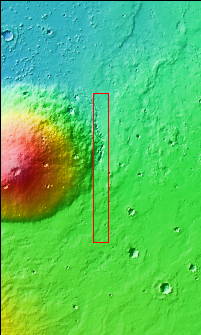
Cool image time! The image on the right, reduced in resolution significantly to show here, was taken by the Themis camera on Mars Odyssey, and shows an unnamed canyon on Mars. Be sure to click on the image to see the full resolution version.

This canyon of course no longer has anything flowing in it. Moreover, it is not clear whether this was formed by water or lava. Unfortunately, the image is part of a series of “Art images” from Mars Odyssey, where they pick an image and suggest it looks like something else. In this case, they are claiming this looks like a “snake, slithering down the image.” Cute, but not very helpful. And unfortunately, they don’t add any further details at all about the image or its location. The context image suggests this canyon is next to a volcano.

After doing further research at the Themis image site, I was able to locate this image on Mars (using latitude 32.0515 and longitude 152.236 given at the link) and look at the images surrounding this one. Further research identified the volcano as Hecates Tholus in the Elyesium Plantia region to the west of Mars’s giant volcanoes.

Looking at all the nearby Mars Odyssey images, it appears that there are a lot of flows like this in this area, and all of them appear to be lava flows, with this one being the largest. A close look at the area just to the south of where the deep canyon opens out shows that the small surface flow draining into the canyon also appears to sit on much larger surface flows (at least two) that left the surface higher than the surrounding terrain.

Elyesium Plantia itself is a plateau, somewhat close to the border between Mars’s southern highlands and the northern plains where some scientists think an ocean might have once existed. Thus, it makes sense that the canyon drains north, as it is following the dip down to those northern low plains.

1 comment

SpaceX expanding facilities in Florida for refurbishing used first stages

Capitalism in space: SpaceX is proposing to expand its facilities at Port Canaveral for refurbishing used first stages.

It appears they need the approval for the work from the port’s Board of Commissioners, though I suspect this board will rubber stamp its approval as quickly as it can.

One tidbit from the story. SpaceX has so far recovered 13 first stages and flown two again. One (the first) has been put on display, which leaves 10 available for reflight. They plan to use two on the first Falcon Heavy launch. The remaining 8 are likely for sale (maybe 10 if the two reflown fly a third time), which explains the negotiations going on with Iridium and others.

4 comments

New company formed to service satellites in-orbit

Capitalism in space: MDA and SSL Loral today announced the formation of a new company, Space Infrastructure Services (SIS), that will service satellites already in orbit.

This partnership is based on the engineering being developed by SSL Loral under a DARPA research project.

The most important part of the announcement however is that SIS has also signed up its first customer.

The company also announced that SES, a world leading satellite-enabled solutions provider, with more than 50 GEO satellites and 12 MEO satellites on orbit, has entered into an agreement for an initial life extension mission with options for further missions. Under this agreement, SES will be the first commercial customer to benefit from satellite refueling that can be called up as needed with minimal disruption to spacecraft operation.

As it did with SpaceX, SES is aggressively supporting this new technology that will revolutionize space operations. Here the technology will allow them to repair their satellites, thus saving them the cost of replacing them with new satellites.

9 comments

First test launches of commercial manned vehicles upcoming

The first unmanned test flights of the manned capsules being built by SpaceX and Boeing are moving forward and appear to be on schedule.

Currently, SpaceX is on track to be the first to perform their uncrewed flight, known as SpX Demo-1, with Dr. Donald McErlean reporting to the ASAP that the flight continues to target a launch later this year. Currently, both NASA and SpaceX hold that SpX Demo-1 will fly by the end of the year – though L2 level KSC scheduling claims the mission has potentially slipped to March 2018.

Regardless, SpX Demo-1 will be followed – under the current plan – by Boeing’s uncrewed OFT (Orbital Flight Test) in mid-2018.

The article is worth a careful read, as it describes in detail the political and bureaucratic maneuverings that are taking place to get the NASA bureaucracy to accept the work being done by these two private companies. Make sure especially that you read the section about NASA’s desire that the vehicles meet an imaginary safety standard where they will only lose a crew once every 270 flights. The NASA bureaucracy has claimed for the last few years that neither spacecraft is meeting this requirement, but according to this article it appears they are finally also admitting that the requirement has really little basis in reality.

According to the ASAP [Aerospace Safety Advisory Panel] meeting minutes, Dr. McErlean said that “While these LOC [Loss of Crew] numbers were known to be challenging, and both providers have been working toward meeting the challenge, it is conceivable that in both cases the number may not be met.”

However, Dr. McErlean cautioned the ASAP and NASA about rushing to judgement on the current and whatever the final LOC number for each vehicle is. “The ASAP is on record agreeing with the Program that one must be judicious in how one applies these statistical estimates. In the case of LOC, the numbers themselves depend very heavily on the orbital debris model used to develop the risk to the system [as] orbital debris is a driving factor in determining the potential for LOC. The orbital debris models have been used and validated to some degree, but they are not perfect. One must be wary of being too pernicious in the application of a specific number and must look at whether the providers have expended the necessary efforts and engineering activity to make the systems as safe as they can and still perform the mission.”

To that last point, Dr. McErlean reported that both providers indeed “expended the necessary efforts and engineering activity to make the systems as safe as they can.” Importantly, too, Dr. McErlean noted that there was no evidence that spending more money on closing the LOC gap for both providers “could [make] their systems considerably safer.”

The ASAP at large concurred with this finding and noted their pleasure at the progress made in closing the LOC gap for both Dragon and Starliner. [emphasis mine]

In other words, NASA’s safety panel is eventually going to sign off, no matter what. Note also that the GAO’s earlier complaints about Boeing’s parachute testing program have now apparently vanished.

5 comments

Blue Origin’s BE-4 rocket engine still leads race with Aerojet Rocketdyne

Capitalism in space: An independent assessment of the development work being done by Blue Origin and Aeroject Rocketdyne on their competing rocket engines says that Blue Origin is still in the lead by two years, despite a testing incident in May.

The article also outlines how the present Air Force budget includes language that would prevent the Air Force from financing any part of ULA’s Vulcan rocket, other than the money presently being spent to subsidize Aeroject Rocketdyne’s AR-4 engine.

0 comments

SpaceX to try another launch on Sunday

Capitalism in space: SpaceX is aiming for another launch on July 2 in Florida, only 9 days after their last launch there.

That will make three launches in nine days.

Meanwhile, in an interview on The Space Show with David Livingston, SpaceX President Gwynne Shotwell revealed that, after this year’s planned demo launch of the Falcon Heavy, they plan two commercial launches of the rocket in 2018.

That means the Falcon Heavy will have flown at least three times before SLS even comes close to its first test flight.

9 comments

US military tests laser weapon fired from helicopter

Life imitates science fiction: The U.S. Army and Raytheon have successfully tested the use of a laser weapon, fired from an Apache helicopter.

The U.S. Army and Raytheon have completed a flight test of a high-energy laser system on an AH-64 Apache attack helicopter that was deemed successful, according to a Raytheon statement Monday.

The recent test at White Sands Missile Range, New Mexico, “marks the first time that a fully integrated laser system successfully engaged and fired on a target from a rotary-wing aircraft over a wide variety of flight regimes, altitudes and air speeds,” the company said. Raytheon said the test achieved all primary and secondary goals that show a high-energy laser, or HEL, on an attack helicopter can provide high-resolution, multiband targeting sensor performance and beam propagation.

I especially like the name they have given the system: HEL.

10 comments

Luxembourg offers prizes for new space business proposals

Capitalism in space: Luxembourg yesterday announced that it will award two prizes, worth a total of 430,000 Euros, for new innovative space business ideas.

The call for submissions covers the full chain for exploiting space resources, from searching for minerals, mining and selling the processed product.The proposals should include a long-term view for developing space resources and be able to generate an economic return in the short and medium term.

The first award is a €400,000 prize to support a study under the Luxembourg national space program managed by the ESA. The second, for €30,000, is for early-stage projects and offers an investing campaign on www.spacestarters.com.

The ministry will support both award winners by offering workspace for the companies.

It sounds like they will entertain practically any ideas put forth. The deadline to submit is September 8, with the award announcement made in November.

2 comments

Success of test mission paves way for orbiting gravitational wave detector

The success of LISA Pathfinder during the past year to test the technology for building an orbiting gravitational wave detector has now made it possible for Europe to approve construction of the full scale telescope, set to launch in the 2030s.

The LISA Pathfinder mission, launched in late 2015, beat its precision target by a factor of 1,000 and quieted critics who have doubted its potential, says project scientist Paul McNamara, an astrophysicist at ESA in Noordwijk, the Netherlands. “This is not the impossible task that some people believed it was.”

Currently set to fly in 2034, the full-scale Laser Interferometer Space Antenna (LISA) will be the space analogue of the Laser Interfero-meter Gravitational-Wave Observatory (LIGO), two machines in the United States — each with a pair of 4-kilometre-long arms — that first detected the ripples by ‘hearing’ the merger of two black holes. LISA’s three probes will fly in a triangle, millions of kilometres apart, making the mission sensitive to much longer gravitational waves, such as the ripples produced by the collisions of even larger black holes.

The article also notes that the European Space Agency also approved two other large missions, one to launch in 2022 and go the moons of Jupiter, another an X-ray observatory that will launch in 2028.

1 comment

Japan’s next rocket on schedule for 2020 launch

A new Japanese rocket, the H3, being built by Mitsubishi and designed to cut launch costs by half, is presently on schedule for debut in 2020.

Key quote from the article:

JAXA has given MHI a greater level of influence on the H3 than it did with the H-2A. Ogasawara said whereas the total launch vehicle design for the H-2A was JAXA’s responsibility, MHI’s role as prime contractor and vehicle integrator gives the company more creative freedom. He stressed, however, that JAXA is still directly involved in the design and development for certain key components. “Therefore, we work together, JAXA and MHI, very closely,” he said.

I don’t know how much of that claim is true. That they are making it though suggests that they have been strongly influenced by the shift in the U.S. from NASA-run projects to commercially-run projects.

1 comment

Blue Origin to build its rocket engines in Alabama

Capitalism in space: Blue Origin announced today that it will build its BE-4 rocket engine factory in Alabama.

There is one caveat. They will only commit to the factory once they have won their contract to build the BE-4 engine for ULA’s Vulcan rocket. And that contract is not yet awarded.

Obviously, this decision has political components. By picking Alabama, Blue Origin hopes to blunt the political favoritism in Alabama to Aerojet Rocketdyne’s rocket engine, thus improving their chances of winning the ULA contract.

0 comments

SpaceX launches 10 Iridium satellites, lands first stage

Capitalism in space: SpaceX today successfully launched 10 Iridium satellites while also once again successfully landing the Falcon 9 first stage.

This gives them 9 launches for the year, more than any other company or country in the entire world.

One cool personal detail about today’s launch. Diane and I were doing a hike with two friends, and at about 1:20 pm I asked Brian if his Iphone might have signal and could we maybe then watch the launch. Lo and behold, he did have signal, and we were able to connect with SpaceX’s live stream, and were able to take a fifteen minute hiking break to watch the launch and first stage landing while sitting on a mountain trail in the Santa Catalina mountains north of Tucson.

Ain’t technology wonderful?

8 comments

SpaceX launches satellite with reused first stage, recovers stage

Capitalism in space: SpaceX has done it again. They have placed a Bulgarian television satellite into orbit, using a previously flown first stage.

The landing of the first stage had a moment of fear. Just before the stage was to land, as it was firing its engines during the landing burn, the video showed something hit the water next to the barge, then the image froze and was lost. For about fifteen seconds it appeared that possibly something had gone wrong during the burn. Then the image returned, showing the stage sitting neatly and upright and apparently unharmed, on the barge. Whether this stage will fly a third time will have to wait until they inspect it, but if it does, they will certainly prove without question that the decades of big space engineers telling us that such things were impossible was childish and narrow-minded hogwash.

Remember that the next time someone tells you something is too hard to try to do.

11 comments

Mars rover update: June 23, 2017

Summary: Curiosity continues up hill. Opportunity has wheel problems.

Curiosity

For the overall context of Curiosity’s travels, see Pinpointing Curiosity’s location in Gale Crater.

The march up Mt Sharp continues. Since my last update on May 15, Curiosity has continued working its way up towards what the science team has named Vera Rubin Ridge, the beginning of a lighter, yellowish layer of rock, dubbed the Hematite Unit, that sits higher up the mountain’s slope. They have been traveling on the Murray Formation now for more than a year, since March, 2016, so entering this new layer of geology is eagerly anticipated by the science team. (This October 3, 2016 press release. gives an overall picture of the geology Curiosity is traversing.)

Reader Phil Veerkamp sent me a beautiful panorama he stitched together from recent Curiosity images of Vera Rubin Ridge, directly to the south of the rover and higher up hill. Below is a reduced resolution version. Be sure you click on it to explore the full resolution image. This is a new type of terrain, significantly different than anything Curiosity has seen up to now. It also appears that the rover will see far less dust, and might be traveling mostly over solid boulders. Below I have cropped out a very small section of the ridge line near the center of the full image, just to illustrate this.
» Read more

6 comments

OneWeb wins FCC approval for 720 satellite internet constellation

Capitalism in space: The FCC has given unanimous approval to OneWeb to launch its 720 satellite constellation, designed to provide internet access worldwide.

They hope to launch the first 10 satellites in 2018 and begin service in 2019. The satellites will be put in orbit by a variety of launch companies, including Roscosmos, Arianespace, and Virgin Orbit.

This is only the beginning. SpaceX has its own internet competition planned, expected to begin launching in 2019.

0 comments

Bulgaria credits SpaceX’s low costs for making its satellite possible

Capitalism in space: The CEO of the Bulgarian company that built the television satellite that SpaceX plans to launch later today said that it was SpaceX’s low costs that made the satellite possible.

Maxim Zayakov, CEO of BulgariaSat and its affiliate television provider Bulsatcom, told Spacefight Now that SpaceX’s push to reduce the cost of space transportation has yielded tangible results for his country. “People don’t realize that, for small countries and small companies like us, without SpaceX, there was no way we would ever be able to even think about space,” Zayakov said. “With them, it was possible. We got a project. I think, in the future, it’s going to be even more affordable because of reusability.”

This is what I have been saying for more than a decade. You lower the costs, you make it possible for more customers to enter the market. This increase in customer base makes it possible for more launch companies to enter the market in response, and that forces the costs to drop further, which starts the whole cycle again. In the end we not only get a robust launch industry, the human race gets to settle the solar system.

The article also confirms that, at this time, SpaceX is only offering a 10% discount for the use of a reused first stage. They say this is because they wish to recoup their $1 billion investment to develop reusability. While this might be true, the real truth is that SpaceX doesn’t need to provide a larger discount. The discounted price of $55.8 million saves satellite companies another $6.2 million, which isn’t chicken feed, and offers them the cheapest launch price anywhere by far. SpaceX in turn makes more money per launch.

Should another company begin to challenge this launch price I would then expect SpaceX to lower the price further. They have the profit margin to do this.

Note that you can watch today’s Falcon 9 launch of the Bulgarian satellite at 2:10 pm Eastern at SpaceX’s website.

14 comments
1 541 542 543 544 545 820