SLS schedule changes impending

NASA’s refurbishment plans for the mobile launcher and SLS launchpad suggest that the first manned flight of SLS is increasingly likely to be delayed from its present 2021 launch date.

The situation is complicated. The SLS configuration that will launch an unmanned capsule in December 2018 will use a Delta rocket upper stage, and will only have the capability of launching about 70 metric tons into low Earth orbit. After this one flight NASA wants to begin using SLS’s own upper stage, which it calls the Exploration Upper Stage and which will raise the rocket’s payload capacity to 105 metric tons. Because these changes will make SLS taller, however, they have to refurbish both the mobile launcher that brings the rocket to the launchpad as well as the launch tower used to fuel the rocket during countdown. These changes, now scheduled, will shut down the launchpad from January 2019 until the end of 2020.

The problem with doing this is that SLS’s second flight, presently scheduled in 2021, is supposed to be manned. To use the Exploration Upper Stage untested on this manned flight is something NASA doesn’t really want to do. Flying another unmanned flight to test that upper stage however will require NASA to delay the first manned flight again, probably to 2023.

Based on the article at the link above, those delays now seem almost certain. Because NASA is moving to refurbish the launchpad right after that first unmanned flight in December 2018, this means all later SLS launches will use the Exploration Upper Stage. Since Congress has also ordered NASA to fly its upcoming Europa orbiter mission on SLS, it seems to me that NASA is now quietly moving to add a second unmanned SLS test flight between the rocket’s first flight in 2018 and the first manned flight and will use it to launch the Europa orbiter some time in 2021. This will in turn delay the launch of that first manned flight, probably until 2023, a date that is presently listed in many NASA documents as the latest SLS’s first manned mission will fly.

If this is the case, it means that it will have literally taken NASA two decades to build and fly a single manned Orion capsule, beginning when George Bush ordered the construction of the Crew Exploration Vehicle in January 2004.

Does no one but me see something wrong here?
5 comments

New Horizons returns the last data from Pluto fly-by

The New Horizons science team announced today that they have finally received the last bit of data obtained by the spacecraft during its July 14, 2015 fly-by of Pluto.

Having traveled from the New Horizons spacecraft over 3.1 billion miles (five hours, eight minutes at light speed), the final item – a segment of a Pluto-Charon observation sequence taken by the Ralph/LEISA imager – arrived at mission operations at the Johns Hopkins Applied Physics Laboratory (APL) in Laurel, Maryland, at 5:48 a.m. EDT on Oct. 25. The downlink came via NASA’s Deep Space Network station in Canberra, Australia. It was the last of the 50-plus total gigabits of Pluto system data transmitted to Earth by New Horizons over the past 15 months.

Once they have checked this data, they will wipe the spacecraft’s onboard hard drives to prepare for the January 1, 2019 fly-by of Kuiper Belt object 2014 MU69.

5 comments

New details emerge of Schiaparelli crash site

Schiaparelli crash site

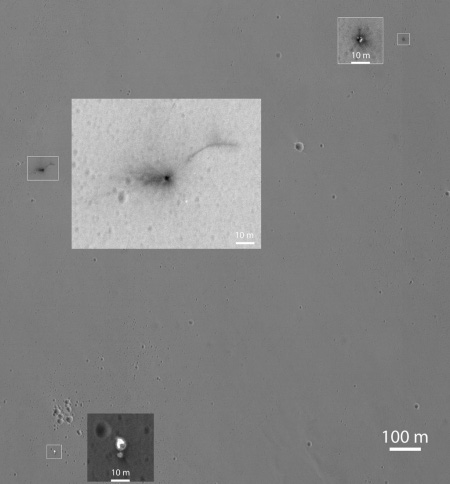
A new high resolution image from Mars Reconnaissance Orbiter’s HIRISE camera, reduced in resolution on the right, confirms that Schiaparelli crashed into the ground on October 19.

The scene shown by HiRISE includes three locations where hardware reached the ground. A dark, roughly circular feature is interpreted as where the lander itself struck. A pattern of rays extending from the circle suggests that a shallow crater was excavated by the impact, as expected given the premature engine shutdown. About 0.8 mile (1.4 kilometers) eastward, an object with several bright spots surrounded by darkened ground is likely the heat shield. About 0.8 mile (1.4 kilometers) south of the lander impact site, two features side-by-side are interpreted as the spacecraft’s parachute and the back shell to which the parachute was attached.

The center insert is a close-up of the impact site on the left, which clearly shows that the lander hit the ground hard, producing impact ejecta. That the rays are somewhat asymmetric also suggests that Schiaparellit hit the ground at an oblique angle.

12 comments

Spacesuit problem from January declared solved

NASA has completed its investigation into the spacesuit water leak that forced a January spacewalk to end two hours early by declaring the problem is not serious and needs no significant re-engineering.

However, thanks to the suit being returned to Earth on the Dragon, the problem with [astronaut Tim] Kopra’s suit was deemed to be more an unfortunate coincidence, as opposed to a wider issue with the EMUs [spacesuits] on Station. Mr. Shireman told the ASAP [Aerospace Safety Advisory Panel] that the conclusion reached was that the incident was not an example of the same failure as in the previous water-in-the-helmet instance. “In this case, the likely cause was a combination of both environmental and operational factors that blocked outlet port slurper holes. The finding was that the amount of water was considerably smaller than before, and the conclusion reached was that this was a non-hazardous occurrence, even if it occurs in the future.”

As a result, the NASA team recommended a “go” for nominal and planned EVAs. Two EVAs, with special contingency allowances, were conducted since EVA-35, both without issue.

The whole article reads like a government press release trying to paper over a problem. “Move along, nothing to see here!” While they might have located and solved the problem, this tone makes me very suspicious. They would be smarter to just tell us the story straight, rather acting like NASA cheerleaders

0 comments

Russia to test components of nuclear engine on ISS

The competition heats up: Roscosmos is planning this week to award a research grant for test flying components on ISS of a nuclear rocket engine Russia has been developing since 2009.

The small amount of money, about $4 million, likely means this will not be a full scale model. Moreover, that this research grant is only being awarded now, seven years after the program began, suggests to me that work is going very slowly. While the delays might be technical, I suspect it is more likely because of the underlying corruption that percolates throughout the government-run Russian system. The project is being slow-walked, so that the funds will be available to the one Russian company that is doing the work for as long as possible.

3 comments

Designing a propulsion system for cubesats

The competition heats up: Just like the Chinese tests of a smallsat propulsion system noted in my previous post, this U.S. company is designing a propulsion system for cubesats.

McDevitt’s propulsion system is deceptively simple. It combines rocket-fuel-grade hydrogen peroxide with a patented proprietary catalyst to create a chemical reaction that results in thrust channeled through tiny square nozzles incorporated into the small satellite. The system allows the satellites to be steered or stopped. The only byproduct of McDevitt’s tiny rocket motors is water vapor.

Except for this quote the article doesn’t provide much information about the design, probably because the builders didn’t reveal the details for proprietary reasons. They hope to launch a test satellite by 2018.

0 comments

Chinese smallsat snaps pictures of Chinese space station

One third of the way through their month long mission, on Sunday the two Chinese astronauts aboard Tiangong-2 released a smallsat designed to maneuver around the station and take images of it.

The cubical craft deployed from Tiangong 2 on Sunday is about the size of a printer, and it took sharp black-and-white pictures of the space lab and the Shenzhou 11 crew transport craft docked together around 235 miles (380 kilometers) above Earth. Fitted with a 25-megapixel camera and an ammonia-based propulsion system, the Banxing 2 satellite is expected to loiter around Tiangong 2 and Shenzhou 11, and eventually return to the vicinity of the complex to take pictures from above with Earth in the background, according to Chinese state media reports.

The first batch of photos from Banxing 2’s departure are looking up at the mini-space station complex, with the blackness of space as a backdrop. In addition to the imagery taken by the micro-satellite’s visible camera, Banxing 2 captured more than 300 infrared pictures during the flyaway sequence.

This is a neat idea, one that neither Russia nor the U.S. ever did on their stations. Moreover, to provide this smallsat a propulsion system is significant, since satellites this small have traditionally not had one. Testing that system is certainly one of the smallsats main purposes.

The image at the link of the station and capsule docked together reveals how relatively small Tiangong-2 really is, compared to the Shenzhou manned spacecraft as well as other Russian single module stations. Shenzhou is about as long as Tiangong, and though the Chinese have made their manned capsule bigger than the Soyuz spacecraft they based it on, it isn’t that much bigger. In fact, the article says that the combined station and spacecraft is about 60 feet long. Russia’s Salyut stations, which were also a single module like Tiangong-2, were about that long, before the Soyuz was added.

In other words, Tiangong-2, as was Tiangong-1, are exactly what the Chinese have said they are, prototype testbeds for testing the engineering needed for building a much bigger multi-module station in 2020. What is unclear is whether the modules of that bigger station will be bigger as well.

0 comments

The effect of weightlessness on the spine

New observations of astronauts before and after four to seven month long missions to ISS has found the back pain many astronauts experience appears to be caused by significant muscle atrophy.

The MRI scans indicated significant atrophy of the paraspinal lean muscle mass —which plays a critical role in spinal support and movement—during the astronauts’ time in space. The lean muscle, or “functional,” cross-sectional area of the lumbar paraspinal muscles decreased by an average of 19 percent from preflight to immediate postflight scans. A month or two later, only about two-thirds of the reduction had recovered. There was an even more dramatic reduction in the functional cross-sectional area of the paraspinal muscles relative to total paraspinal cross-sectional area. The ratio of lean muscle decreased from 86 percent preflight to 72 percent immediately postflight. At follow-up, the ratio recovered to 81 percent, but was still less than the preflight value.

In contrast, there was no consistent change in the height of the spinal intervertebral discs. Dr. Chang and coauthors write, “These measurements run counter to previous hypotheses about the effects of microgravity on disc swelling.” Further studies will be needed to clarify the effects on disc height, and whether they contribute to the increase in body height during space missions, and to the increased risk of herniated disc disease.

These results are very encouraging, because they indicate that the back problems seen are mostly attributable to weakened muscles, not actual spinal damage, and can therefore be more easily mitigated by new exercises while in orbit.

7 comments

Aggressive SETI observations of Tabby’s star upcoming

Breakthrough Listen, an effort to listen for radio signals from alien civilizations that, plans to devote significant time this year observing Tabby’s star to see if an alien mega-structures are causing that star’s unexplained dimming.

While Siemion and his colleagues are skeptical that the star’s unique behavior is a sign of an advanced civilization, they can’t not take a look. They’ve teamed up with UC Berkeley visiting astronomer Jason Wright and Tabetha Boyajian, the assistant professor of physics and astronomy at Louisiana State University for whom the star is named, to observe the star with state-of-the-art instruments the Breakthrough Listen team recently mounted on the 100-meter telescope. Wright is at the Center for Exoplanets and Habitable Worlds at Pennsylvania State University.

The observations are scheduled for eight hours per night for three nights over the next two months, starting Wednesday evening, Oct. 26. Siemion, Wright and Boyajian are traveling to the Green Bank Observatory in rural West Virginia to start the observations, and expect to gather around 1 petabyte of data over hundreds of millions of individual radio channels.

10 comments

Juno successfully completes engine burn with smaller thrusters

Having successfully left safe mode, engineers had Juno do a 31 minute engine burn on Tuesday to adjust its orbit using its smaller thrusters.

The burn, which lasted just over 31 minutes, changed Juno’s orbital velocity by about 5.8 mph (2.6 meters per second) and consumed about 8 pounds (3.6 kilograms) of propellant. Juno will perform its next science flyby of Jupiter on Dec. 11, with time of closest approach to the gas giant occurring at 9:03 a.m. PDT (12:03 p.m. EDT). The complete suite of Juno’s science instruments, as well as the JunoCam imager, will be collecting data during the upcoming flyby.

That they will definitely collect data during the December 11 flyby means that they are going to delay again the main engine burn that will reduce the spacecraft’s orbit to 14 days, its official science orbit. This also means that they are still uncomfortable firing that main engine. It is also not clear from the press release whether this burn was planned, or was added to compensate for the main engine issues.

The vagueness makes me think that Juno has some serious issues that they haven’t yet told us about.

0 comments

The storms of Jupiter’s south pole

storms on Jupiter

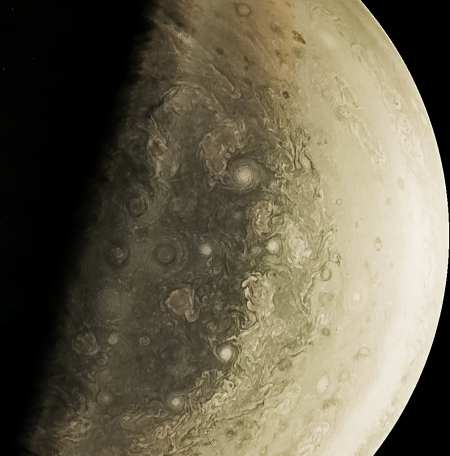
Cool image time! Even though Juno has been unable to gather any additional data since its first close approach of Jupiter in August because of technical problems, the science team has set up its website to allow the public to download the images produced so far, process those images, and then upload them to the site for the world to see.

The image to the right, reduced in resolution to show here, is one example of the many different processed images produced by interested members of the general public. It highlights the seemingly incoherent storms that are raging at Jupiter’s south pole.

close-up of storms

To the left is a cropped section of the full resolution image. It shows the complex transition zone between the darker polar regions and the brighter band that surrounds it. This chaotic atmospheric behavior is something that no climate scientist has ever seen before. It will take decades of research to untangle and even begin to understand what is happening.

1 comment

Schiaparelli failure focuses in on altimeter data

The investigation into the landing failure last week of the ExoMars 2016 lander, Schiaparelli, is now focusing on a failure in the spacecraft’s altitude software.

The most likely culprit is a flaw in the craft’s software or a problem in merging the data coming from different sensors, which may have led the craft to believe it was lower in altitude than it really was, says Andrea Accomazzo, ESA’s head of solar and planetary missions. Accomazzo says that this is a hunch; he is reluctant to diagnose the fault before a full post-mortem has been carried out. But if he is right, that is both bad and good news.

European-designed computing, software and sensors are among the elements of the lander that are to be reused on the ExoMars 2020 landing system, which, unlike Schiaparelli, will involve a mixture of European and Russian technology. But software glitches should be easier to fix than a fundamental problem with the landing hardware, which ESA scientists say seems to have passed its test with flying colours. “If we have a serious technological issue, then it’s different, then we have to re-evaluate carefully. But I don’t expect it to be the case,” says Accomazzo.

0 comments

Russia considers using Ukrainian rocket

For the first time since it annexed Crimea, Russia has opened negotiations with a Ukrainian company to possibly use its Zenit rocket to launch a Russian satellite.

RKK Energia of Korolev, Russia, entered negotiations with KB Yuzhnoe of Dnepropetrovsk, Ukraine, on a potential deal to launch a satellite for Angola on a Ukrainian-built Zenit rocket. Under the proposed plan, the Angosat-1 satellite would ride the last fully assembled Zenit rocket still remaining in Baikonur. The mission is seen by industry insiders as the first step in the resumption of Zenit missions, which if successful, will eventually shift from Baikonur to the Sea Launch ocean-going platform based in Long Beach, California.

The situation here is beyond complicated. Russia remains in many ways in a state of war with Ukraine. Yet, the Sea Launch platform, recently purchased by a Russian airline company, needs the Ukrainian Zenit rocket. It appears that this need is forcing the Russians to once again buy from the Ukraine. At the same time, Sea Launch remains parked in the U.S., and will likely not be available until Sea Launch and Russia settle the lawsuit Boeing has filed against the company. Meanwhile, the Zenit rocket in question however needs refurbishing and was originally built to launch a different satellite, which will have to agree to fly on a different launch vehicle.

0 comments

ISRO begins ground tests of its first lunar lander

The competition heats up: ISRO, India’s space agency, has begun testing the sensors its first lunar lander, Chandrayaan-2, will use to descend safely to the surface.

ISRO Satellite Centre or ISAC, which is the lead centre for the country’s second moon mission, has artificially created eight to ten craters to make the terrain resemble the lunar surface. This terrain is now the test bed for the lunar Lander’s sensors. Between Friday and Monday, a small ISRO-owned aircraft carrying equipment with the sensors flew a few times over these craters to see how well they performed.

0 comments

Musk answers questions on reddit

In a reddit Q&A session yesterday, Elon Musk answered a host of questions about his Mars mission plans.

Key takeaway: They are far away from actually flying this rocket. The engine needs tests, its giant tanks need a great deal of development, and they are only beginning the concept work for the ship itself.

His comments on Falcon 9 re-usability, however, were somewhat more interesting, and far more grounded in present reality.

Musk did not answer any questions submitted about the status of the company’s Falcon 9 rocket, grounded since a Sept. 1 explosion during preparations for a static-fire test destroyed a Falcon 9 and its Amos-6 satellite payload. He did, though, briefly address an upcoming, and “final,” version of the rocket, which he called Block 5, that is designed for frequent reusability. “Falcon 9 Block 5 — the final version in the series — is the one that has the most performance and is designed for easy reuse, so it just makes sense to focus on that long term and retire the earlier versions,” he wrote. That version includes many “minor refinements” but also increased thrust and improved landing legs, he said.

The first of the Block 5 Falcon 9 vehicles will begin production in three months, with an initial flight in six to eight months. With its entry into service, he said he doesn’t expect recovered first stages from the older Block 3 and Block 4 versions of the rocket to be reused more than a few times.

In a speech earlier this month, SpaceX President Gwynne Shotwell said she believed the updated version of the Falcon 9 could be reused up to 10 times. Musk, though, was more optimistic. “I think the F9 boosters could be used almost indefinitely, so long as there is scheduled maintenance and careful inspections,” he said.

11 comments

Changing seasons on Titan

Since entering Saturn orbit in 2004, Cassini has seen the seasons on Titan shift through half a Saturn year.

As Titan approaches its northern summer solstice, NASA’s Cassini spacecraft has revealed dramatic seasonal changes in the atmospheric temperature and composition of Saturn’s largest moon. Winter is taking a grip on the southern hemisphere and a strong vortex, enriched in trace gases, has developed in the upper atmosphere over the south pole. These observations show a polar reversal in Titan’s atmosphere since Cassini arrived at Saturn in 2004, when similar features were seen in the northern hemisphere.

Sadly, there will not be any spacecraft at Saturn during the second half of this Saturn year. After Cassini ends its mission in 2017 it will likely be many decades before another spacecraft arrives, since at this moment none has even been proposed.

9 comments

Saturn’s changing north pole

A comparison of images taken by Cassini in 2012 and then in 2016 of Saturn’s north polar region shows a significant change in color.

Scientists are investigating potential causes for the change in color of the region inside the north-polar hexagon on Saturn. The color change is thought to be an effect of Saturn’s seasons. In particular, the change from a bluish color to a more golden hue may be due to the increased production of photochemical hazes in the atmosphere as the north pole approaches summer solstice in May 2017.

0 comments
1 568 569 570 571 572 821