Musk: First unmanned Mars Starship targeting a ’26 launch

The prime and secondary Martian landing sites for Starship

According to a tweet yesterday by Elon Musk, SpaceX is aiming for a 2026 launch of its first unmanned Starship to Mars.

The first Starships to Mars will launch in 2 years when the next Earth-Mars transfer window opens. These will be uncrewed to test the reliability of landing intact on Mars. If those landings go well, then the first crewed flights to Mars will be in 4 years.

Flight rate will grow exponentially from there, with the goal of building a self-sustaining city in about 20 years.

The graphic to the right indicates the planned landing zone, with the four red dots the four prime locations. Three of the four are very flat, though they also appear to have a lot of very near-surface ice, accessible simply by digging a shovel into the ground. Attempting to land at any will definitely test Statship’s ability to land on Mars intact. A global map of Mars is shown below, showing the location of this landing zone. The map shows where researchers believe the saltiest water on Mars would be. According to this data, in the Starship landing zone some of that near-surface ice will turn to liquid brine a little less than one percent of each year. Otherwise it will be more easily processed for drinking and fuel.

As always with these ambitious predictions, Musk is aiming high, with the likelihood that this first mission will not make that ’26 date. At the same time, he is making it very clear that a first attempt will certainly happen by ’28.

I also think the timing of this announcement is intriguing, coming one day after NASA was forced to cancel the launch in October of two Mars orbiters because it could not be certain Blue Origin would have the New Glenn rocket ready on time. Musk’s response is to say that SpaceX is now about to begin regularly privately funded and privately built missions to Mars, on a schedule, essentially asking: “Which company would you choose to do things in space?”
» Read more

15 comments

NASA cancels launch of its two Escapade Mars Orbiters due to Blue Origin delays

After reviewing the status of launch preparations by Blue Origin of its New Glenn rocket, NASA today decided to cancel the launch because it appeared that Blue Origin would not be able to meet the October 13-21 launch window for sending the agency’s two Escapade orbiters to Mars.

NASA announced Friday it will not fuel the two ESCAPADE (Escape and Plasma Acceleration and Dynamics Explorers) spacecraft at this time, foregoing the mission’s upcoming October launch window. While future launch opportunities are under review, the next possible earliest launch date is spring 2025.

The agency’s decision to stand down was based on a review of launch preparations and discussions with Blue Origin, the Federal Aviation Administration, and Space Launch Delta 45 Range Safety Organization, as well as NASA’s Launch Services Program and Science Mission Directorate. The decision was made to avoid significant cost, schedule, and technical challenges associated with potentially removing fuel from the spacecraft in the event of a launch delay, which could be caused by a number of factors.

The press release of course is vague about why the launch has been canceled, but the reasons are obvious if you have been paying attention. Though Blue Origin has clearly been making progress towards the first launch of New Glenn, recent reports suggested strongly that it would be impossible for it to assemble the rocket, integrate the two orbiters, and get everything on the launchpad on time.

Rocket Lab, which built the orbiters, of course fully supported the decision, though that company very much wanted it to fly now to demonstrate its ability to make low cost smallsat planetary probes.

This failure of Blue Origin to meet this deadline speaks poorly of the company. To serve the satellite and especially the planetary research community rocket companies must be able to launch on schedule and on time. Blue Origin has failed to do so in this case. It appears Jeff Bezos needs to ramp up the pressure on his moribund company to finally get it to perform in the manner he desires, as described by Bezos himself recently.

3 comments

Curiosity takes another look south into Gediz Vallis

Looking south inside Gediz Vallis

Overview map
Click for interactive map.

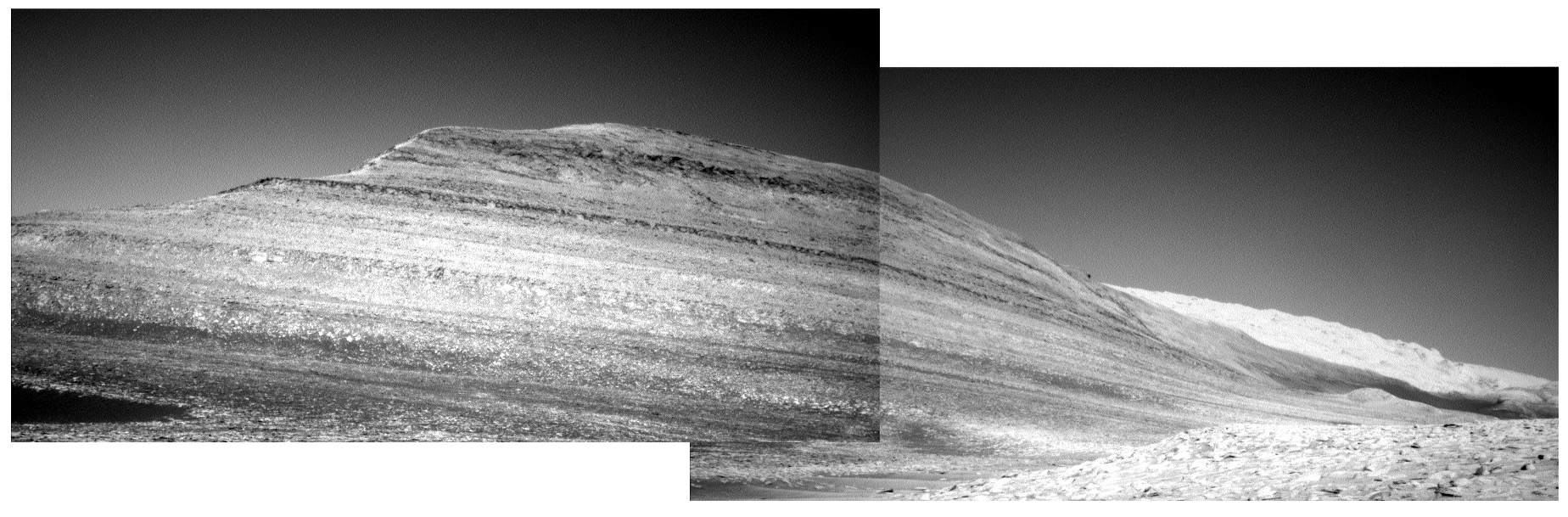
Cool image time! As it has been more than a month since I lasted posted a cool landscape image from the Mars rover Curiosity, it seemed time to upload the panorama above, changed not at all to post here and taken by the rover’s right navigation camera on September 4, 2024.

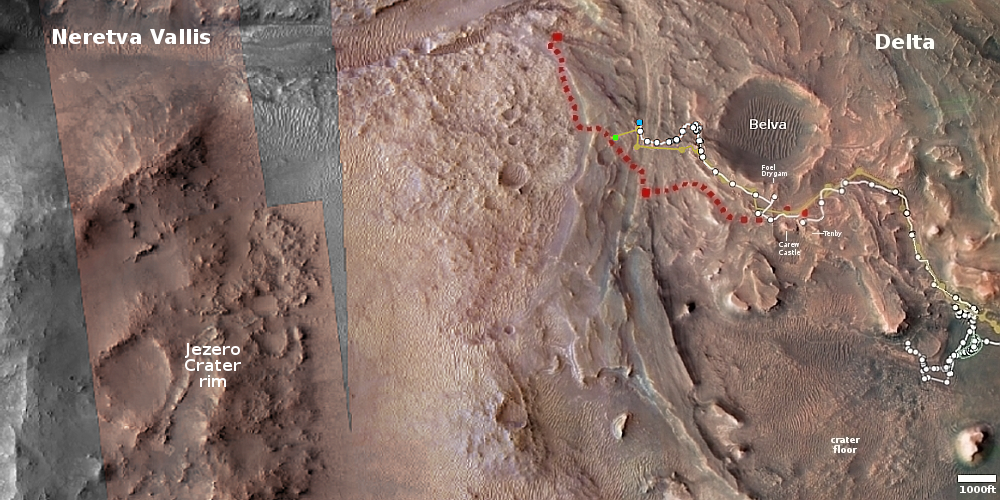
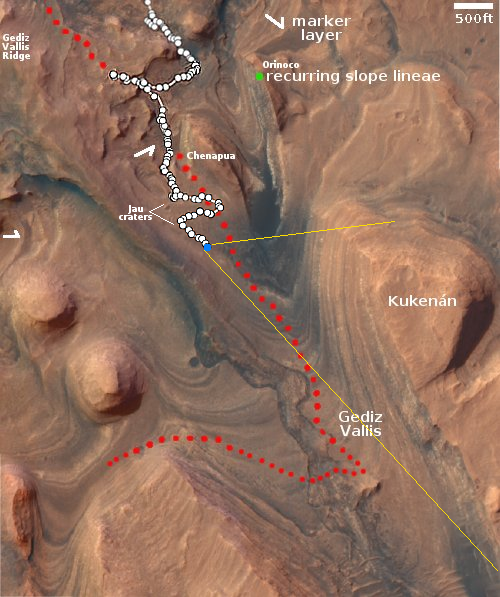
The blue dot on the overview map to the right marks Curiosity’s present position. The yellow lines indicate the approximate direction of the panorama’s view. The red dotted line indicates Curiosity’s planned route, with the white dotted line marking its actual path. After spending most of the last month on a drilling campaign at the southernmost point of its travels, the science team had Curiosity retreat northward, where it will eventually head uphill to the west to swing around that mountain to head south in a parallel canyon.

The panorama looks into the slot canyon Gediz Vallis that Curiosity has been exploring for a little more than a year. The light colored mountains are what the scientists call the sulfate-bearing unit, a region on the higher slopes of Mount Sharp that is likely to have a very alien geology and chemistry, when compared to what is seen on Earth. Mount Sharp itself is beyond these peaks, not visible because it is about 26 miles away and blocked by these lower mountains.

Since landing on Mars a dozen years ago, the rover has traveled 20 miles and climbed about 2,500 feet. Getting to the top of Mount Sharp will therefore probably take more than one or two decades more of travel.

0 comments

A channel of ice, water, or lava?

A channel of ice, water, or lava?
Click for original image.

Cool image time! The picture to the right, rotated, cropped, reduced, and sharpened to post here, was taken on July 16, 2024 by the high resolution camera on Mars Reconnaissance Orbiter (MRO). It shows one small section of a Martian canyon approximate 750 miles long and dubbed Elysium Fossae.

The canyon walls at this spot rise about 3,300 to 3,800 feet from the canyon floor. The canyon itself is thought to be what geologists call a graben, initially formed when the ground was pulled apart to form a large fissure.

That’s what happened at this location, at least to start. This canyon is on the lower western flank of the giant shield volcano Elysium Mons. The cracks, which radiate out outward from the volcano’s caldera, likely formed when pressure from magma below pushed upward, splitting the surface.

That formation process however does not fully explain everything.
» Read more

0 comments

A frozen Martian splash

A frozen Martian splash
Click for original image.

Cool image time! The picture to the right, rotated, cropped, and enhanced to post here, was taken on July 11, 2024 by the high resolution camera on Mars Reconnaissance Orbiter (MRO). It shows the southeast quadrant of a three-mile-wide unnamed crater that is surrounded on all sides by a dramatic but frozen splash apron of material, created when this impact occurred.

The rim rises between 200 to 400 feet from the surrounding plains, while the crater floor drops 700 feet to sit below those plains by 300 to 500 feet. In other words, that splash apron contains the material that was thrown up when the bolide drilled into the plain at impact, leaving behind this deep hole.

Why such a dramatic splash apron? Its existence suggests that the ground here was muddy, with a lot of water ice likely present. The location and wider context helps confirm this guess.
» Read more

0 comments

A cliff of ice on Mars

A cliff of ice on Mars
Click for original image.

Cool image time! The picture to the right, cropped to post here, was taken on April 10, 2024 by the high resolution camera on Mars Reconnaissance Orbiter (MRO). It shows the southern nose of a large plateau located in the deep south of Mars, at 63 degrees south latitude. This cliff is only about 20-25 feet high, but within that small distance orbital imagery as revealed what appears to be an underground layer of ice. When this photo was released in late June, it came with a short caption, which noted:

On these steep scarps, ice can still be seen on the south facing walls of the scarp towards the end of the Southern Hemisphere’s winter.

Note the white sections on that cliff wall, both inside and outside the color strip. The surrounding orange suggests dust and sand. This photo suggests that during the dark winter underground ice leaches out on these slopes, and is then sublimated away when the Sun returns in the spring. Since the south-facing walls remain in shadow the longest, the ice there lasts the longest, leaving behind these patches we see now.

It is also possible that this is not water ice and there is no underground ice layer. Instead, this might be the last leftover of the dry ice mantle that falls as snow and covers all of the Martian high latitudes during the winter, and then sublimates away come spring.
» Read more

0 comments

Changing Martian slope streaks

Changing slope streaks on Mars
Click here, here, and here for original images.

Overview map

Time for some cool images from Mars taken over a dozen years! The three pictures above were taken, from left to right, in 2012, 2020, and 2024 and show the same exact Martian terrain. The first two pictures were photographed by the lower resolution context camera on Mars Reconnaissance Orbiter (MRO). The rightmost picture was taken on May 20, 2024 by MRO’s high resolution camera.

The white dot on the overview map to the right marks the location, in the middle of the vast lava flood plains found between Mars’ giant volcanos and north of the Medusae Fossae Formation, the largest volcanic ash deposit on Mars. The 1,200-foot-high mesa pictured above, its peak indicated by the red dot, is part of a group of such mesas that either represent the peaks of a mountain range now mostly buried by lava, or volcanic vents pushed up when those eruptions were occurring more than a billion years ago.

The focus of these pictures however is not volcanism, but the numerous slope streaks seen on the mesa slopes. Note how the 2012 earliest streaks are still visible in 2024, but have faded. Note also how there appears to have been no new streaks since 2020.

Slope streaks are a geological feature unique to Mars that at the moment remain unexplained. At first glance they appear to be a landslide of some kind, but years of orbital study has shown they do not change the topography at all, they never have debris piles at their base, and the streaks even sometimes actually flow up and over small rises in the slopes. They occur randomly throughout the year, and as seen above, over time fade.

Recent research has suggested their formation is related to dust avalanches triggered by dust storms, conclusions that are strengthened by the fact that slope streaks are generally found on dusty slopes, which in this case makes sense as the location is in the dry Martian tropics. That these dust avalanches do not change the topography at all, merely staining it, while sometimes actually flowing up and over rises, illustrates how Mars’ one-third gravity and thin, cold atmosphere makes things happen that are impossible on Earth.

1 comment

Evidence of Martian near-surface ice in an unusual location

Evidence of Martian near-surface ice in an unusual location
Click for original image.

Cool image time! The picture to the right, cropped, reduced, and sharpened to post here, was taken on May 27, 2024 by the high resolution camera on Mars Reconnaissance Orbiter (MRO). Labeled merely as a terrain sample, it was likely taken not as part of any specific research request, but to fill a gap in the camera’s picture-taking schedule so as to maintain its proper temperature.

The picture however shows features that help confirm earlier research into the near-surface ice believed to permeate Mars’ middle latitudes. The knobby flat terrain both inside and outside of the crater resembles what scientists have labeled “brain terrain”, an as-yet unexplained geological feature unique to Mars and usually associated with near-surface ice and the glacial features found above 30 degrees latitude.

This 1.4-mile-wide unnamed crater is located at 40 degrees north latitude, so expecting near-surface ice or glacial features here is not unreasonable. The location however is different for other reasons, that make this data more intriguing.
» Read more

0 comments

A real whirlpool in space

A real whirlpool in space
Click for original image.
Cool image time! The picture above, cropped to post here, was taken by the Hubble Space Telescope as part of a survey of nearby galaxies that have what astronomers call an Active Galactic Nuclei (AGN), because the supermassive black hole at the center is devouring nearby material at a great rate and thus producing high energy emissions as it does so.

Many active galaxies are known to astronomers at vast distances from Earth, thanks to the great brightness of their nuclei highlighting them next to other, dimmer galaxies. At 128 million light-years from Earth, UGC 3478 is positively neighbourly to us. The data used to make this image comes from a Hubble survey of nearby powerful AGNs found in relatively high-energy X-rays, like this one, which it is hoped can help astronomers to understand how the galaxies interact with the supermassive black holes at their hearts.

The bottom line is that this spiral galaxy literally is a whirlpool, the entire galaxy spiralling down into that massive black hole in its center. One cannot help wondering why such galaxies don’t end up eventually getting completely swallowed by that black hole.

Or maybe they do, and we don’t see such things because all that is left is a supermassive black hole that emits no light or energy at all, a dark silent ghost traveling between the galaxies unseen and undetectable.

8 comments

Finding beauty on Mars in all the strange places

Overview map

Beauty on Mars
Click for original image.

Cool image time! The picture to the right, cropped to post here, was taken on May 23, 2024 by the high resolution camera on Mars Reconnaissance Orbiter (MRO).

The white dot in the inset of the overview map above indicates the location on Mars, smack dab in the middle of the 2,000-mile-long mid-latitude strip that I call glacier country, because practically every close-up image of this region shows glacial features.

This picture is no exception. The arrows in the inset show the downhill grade, falling about 1,700 feet across the entire inset. That grade is a reflection of the transition that takes place in this glacier country from the cratered southern highlands to the northern lowland plains.

I decided to crop the image at full resolution — showing only a tiny portion — because to my eye these curving linear grooves, produced naturally as Mars’ climate cycles cause glaciers to shrink and then grow repeatedly so that each cycle lays down a new line while squeezing the previous lines, are almost like a work of art. This might be nothing more than a glacier on an alien planet, but nature has caused it to form a very beautiful picture.

2 comments

The massive scale of Mars’ biggest canyon

Overview map

The south rim of Valles Marineris
Click for original image.

Cool image time! The picture to the right, rotated, cropped, reduced, and sharpened to post here, was taken on May 24, 2024 by the high resolution camera on Mars Reconnaissance Orbiter (MRO). Labeled merely a “terrain sample” by the camera team, it was likely taken not as part of any particular research project, but to fill a gap in the picture-taking schedule in order to maintain the camera’s proper temperature.

When the camera team needs to do this, they try to pick interesting targets within the required timeframe. Sometimes they succeed, sometimes not. In today’s example, they succeeded quite well. As shown by the overview map above, this picture captures (as indicated by the rectangle) the top of the southern rim of Valles Marineris, the biggest canyon on Mars and quite possibly the biggest in the entire solar system.

For scale, the drop from the rim to the low point in this picture is about 9,000 feet. That’s a 1,000 feet more than the drop from the north rim of the Grand Canyon to the canyon bottom at the Colorado River. In Valles Marineris however our descent has barely begun. To get to the bottom of the southern canyon here you still need to drop 15,000 more feet, for a total descent of 24,000 feet, an elevation change similar to most of the mountains in the Himalayas.

Nor are you yet at the bottom. If you climb over the ridge of 18,000-foot-high mountains that bisect Valles Marineris at this point, you can drop down even further, to a depth 31,000 feet below the southern rim.

Mount Everest is just over 29,000 feet high, which means if placed inside Valles Marineris is peak would still sit 2,000 feet below the rim.

The photo itself highlights part of the erosion process that formed Valles Marineris. This is the dry tropics, so no water was involved in shaping this terrain for many eons. Instead, what appear to be flows within the hollows is alluvial fill, material that over time breaks off and rolls downhill, filling the slopes below. Erosion will grind this material into smaller particles, so given enough time it flows almost like sand.

0 comments

The North Star has spots!

The spoted surface of Polaris
Click for original image.

Astronomers using an array of six ground-based telescopes have obtained best new data of Polaris, the North Star, including the first rough image of its surface, and discovered sunspots on its surface.

You can read the paper here [pdf]. The image to the right, taken from figure 4 of the paper, shows the surface as seen by the telescopes over two nights in April 2021. Polaris is what astronomers call a Cepheid variable star, which changes brightness on a very precise schedule as its diameter grows and shrinks. In the case of Polaris, that variation is four days long. The star’s brightness itself varies only slightly, and over the decades has even at times appeared to cease its variations.

As the true brightness of Cepheids is very predictable based on their pulse rate, these stars are one of the main tools astronomers use to determine distances to other galaxies. Knowing more about them thus has great importance to cosmological research.

The orbital motion showed that Polaris has a mass five times larger than that of the Sun. The images of Polaris showed that it has a diameter 46 times the size of the Sun.

The biggest surprise was the appearance of Polaris in close-up images. The CHARA observations provided the first glimpse of what the surface of a Cepheid variable looks like. “The CHARA images revealed large bright and dark spots on the surface of Polaris that changed over time,” said Gail Schaefer, director of the CHARA Array. The presence of spots and the rotation of the star might be linked to a 120-day variation in measured velocity.

The researchers plan to take regular images again of Polaris to better track the changes to its surface.

4 comments
1 38 39 40 41 42 89