Webb: Carbon monoxide detected on surface of Uranus’s moon Ariel suggests an underground ocean

The best image of Ariel, as seen by Voyager-2, January 24, 1986
Voyager-2’s best image of Ariel during the
January 24, 1986 fly-by. Click for original.

By doing infrared spectroscopy using the Webb Space Telescope, scientists have detected carbon monoxide (CO) and confirmed extensive carbon dioxide (CO2) deposits on the surface of Uranus’s moon Ariel, with the carbon monoxide suggesting the moon has an underground ocean.

Using NASA’s James Webb Space Telescope to collect chemical spectra of the moon and then comparing them with spectra of simulated chemical mixtures in the lab, a research team led by Richard Cartwright from the Johns Hopkins Applied Physics Laboratory (APL) in Laurel, Maryland, found that Ariel has some of the most carbon dioxide-rich deposits in the solar system, adding up to an estimated 10 millimeters (0.4 inches) or more thickness on the moon’s trailing hemisphere. Among those deposits was another puzzling finding: the first clear signals of carbon monoxide.

“It just shouldn’t be there. You’ve got to get down to 30 kelvins [minus 405 degrees Fahrenheit] before carbon monoxide’s stable,” Cartwright said. Ariel’s surface temperature, meanwhile, averages around 65 F warmer. “The carbon monoxide would have to be actively replenished, no question.”

You can read the peer-reviewed paper here [pdf]. Though there are a number of ways in which the carbon monoxide can be replenished, the scientists think it is coming from an underground ocean. From the paper’s abstract:

The evidence for thick CO 2 ice deposits and the possible presence of carbonates on both hemispheres suggests that some carbon oxides could be sourced from Ariel’s interior, with their surface distributions modified by charged particle bombardment, sublimation, and seasonal migration of CO and CO 2 from high to low latitudes.

This theory however has not been confirmed, and the scientists admit it will take a probe making close observations of Ariel to find out for sure.

Hat tip to stringer Jay for this story.

0 comments

More great hiking on Mars

More great hiking on Mars
Click for original image.

Today’s cool image takes us to another place on Mars where future colonizers will find the hiking breath-taking. The picture to the right, rotated, cropped, reduced, and sharpened to post here, was taken on April 18, 2024 by the high resolution camera on Mars Reconnaissance Orbiter (MRO). The camera team labeled it merely as a “terrain sample,” indicating it was not taken as part of any specific research project request, but to fill a gap in the schedule in order to maintain the camera’s proper temperature. When the MRO team does this, they try to pick interesting sites, sometimes successfully, sometimes not.

In this case the image captured the sharp nose of a 2,100-foot-high mesa which to my eye immedately said, “I want to hike a trail that switchbacks up that nose!” Ideally, the trail would then skirt the edge of the mesa, then head up to the top of that small knoll on the plateau. Though only another 200 feet higher or so, the peak would provide an amazing 360 degree view of the surrounding terrrain.
» Read more

4 comments

A classic spiral galaxy

A classic spiral galaxy
Click for original image.

Monday is always a slow news day in space, so we start the day with a cool image. The picture to the right, reduced and sharpened to post here, was taken by the Hubble Space Telescope of a spiral galaxy about 100 million light years from Earth.

That NGC 3430 is such a fine example of a galactic spiral may be why it ended up as part of the sample that Edwin Hubble used to define his classification of galaxies. Namesake of the Hubble Space Telescope, in 1926 he authored a paper which classified some four hundred galaxies by their appearance — as either spiral, barred spiral, lenticular, elliptical or irregular. This straightforward typology proved immensely influential, and the modern, more detailed schemes that astronomers use today are still based on it. NGC 3430 itself is an SAc galaxy, a spiral lacking a central bar with open, clearly-defined arms.

The bright blue indicates areas of star formation, while the reddish streaks indicates dust. The orange/reddish dots above and below the galaxy are distant background galaxies whose light has been shifted to the red because they appear to be moving away from us due to the expansion rate of the universe.

0 comments

Curiosity looks up Gediz Vallis as it starts its journey out

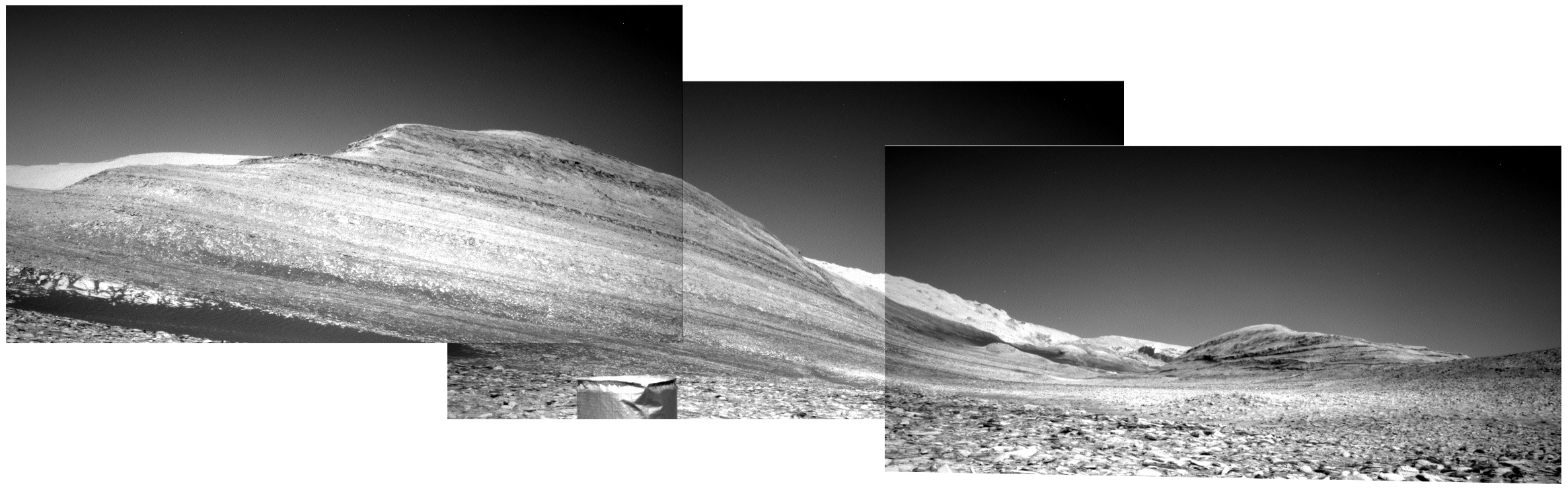
Curiosity panorama looking south on July 16, 2024Curiosity panorama looking south on July 16, 2024. Click for high resolution. Go here, here, here, and here
for original images.

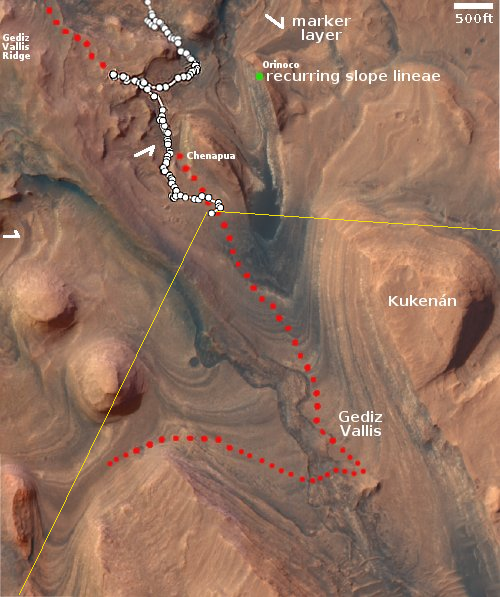
Overview map
Click for interactive map.

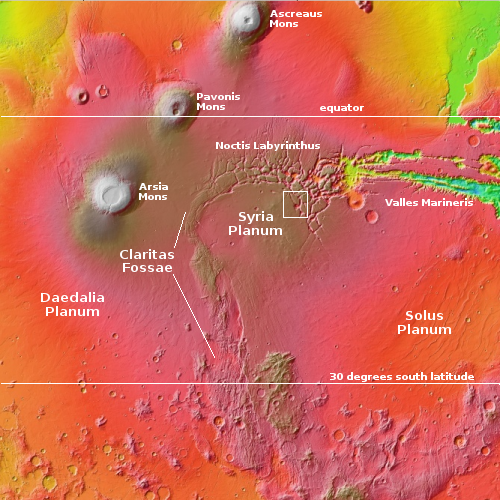
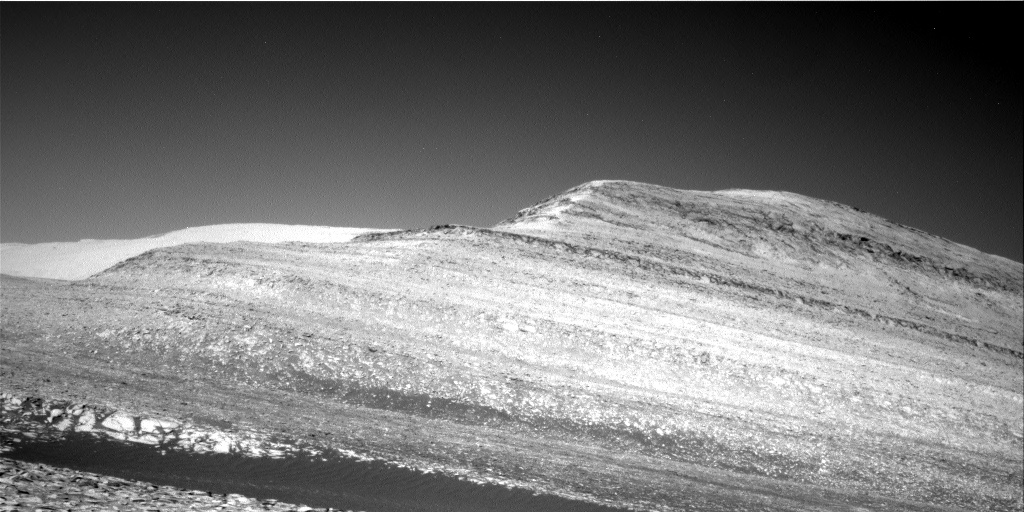
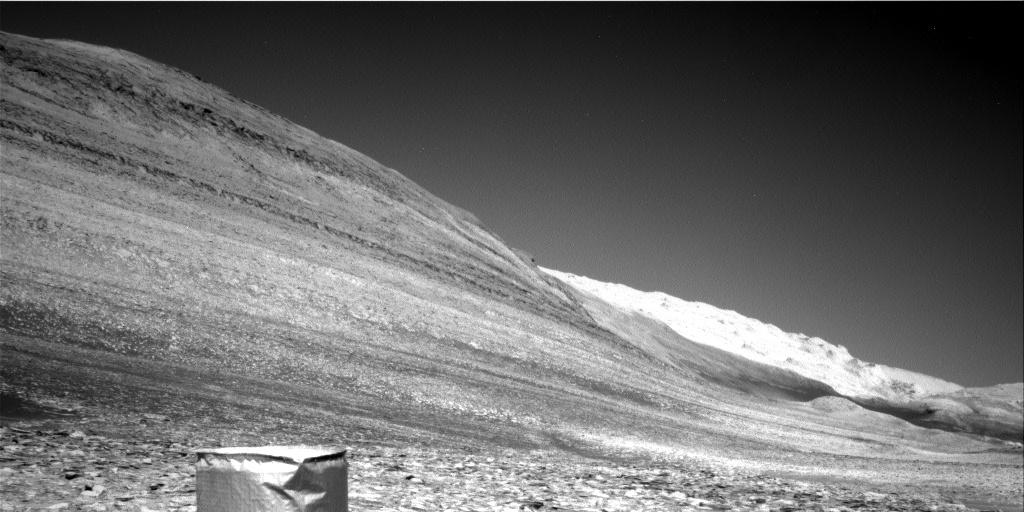
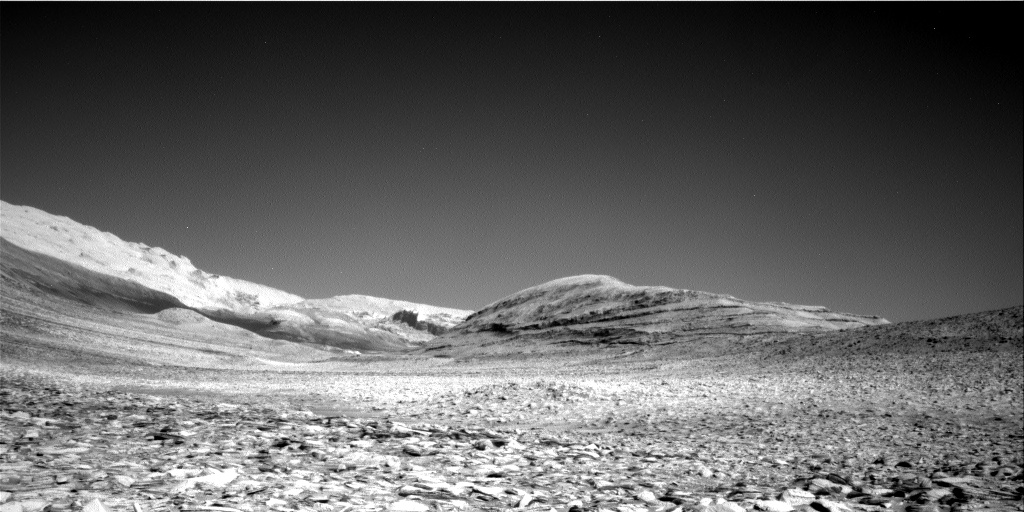
Even as the Curiosity science team is beginning the rover’s journey out of the giant Martian slot canyon Gediz Vallis, they have on July 16, 2024 used its high resolution camera to gather a new mosaic of the surrounding terrain. I have used four of those images (available here, here, here, and here) to create a panorama, as shown above, focusing on the view looking south up into Gediz Vallis. Make sure you click on the image to see the full resolution version.

The overview map to the right provides the context. The blue dot marks Curiousity’s present position. The yellow lines indicate the approximate area covered by the panorama. The white dotted line indicates Curiosity’s actual traveled route, while the red dotted line the planned route.

The peak of Mount Sharp is directly ahead in this panorama, out of sight and about 26 miles away and 16,000 feet higher up. To get a sense of how far away that remains, note that Curiosity in its dozen years of exploration on Mars has so far traveled just under 20 miles and climbed about 2,500 feet.

The plan is to back track downhill and circle around the nose of the western wall of Gediz Vallis and head south in a parallel canyon that is believed to provide easier traveling for Curiosity’s damaged wheels.

0 comments

Layered Martian mesa inside crater

Layered mesa on Mars
Click for original image.

Cool image time! The picture to the right, cropped, reduced, and enhanced to post here, was taken on May 14, 2024 by the high resolution camera on Mars Reconnaissance Orbiter (MRO). It shows what the scientists label as a “layered butte inside small crater.”

The crater is only about 1.8 miles across, and is only a couple of hundred feet deep, at the most. Because this crater sits on a large slope rising to the southwest, the mesa’s peak is actually about thirty feet higher than the crater’s northern rim, but is still below the southern rim by about 70 feet.

A close look at the mesa’s slopes suggests about a dozen obvious layers, though based on data from the rovers Curiosity and Perseverance, those obvious layers are probably divided into many hundreds of thinner layers in between.

What caused these layers? And how did such a small crater get such a relatively large mesa in its center? As always, the overview map provides some clues, but as always it does not provide a definitive answer.
» Read more

2 comments

Martian taffy terrain

Martian taffy terrain
Click for original image.

Cool image time! The picture to the right, rotated, cropped, reduced, and enhanced to post here, was taken on April 11, 2024 by the high resolution camera on Mars Reconnaissance Orbiter (MRO). It shows a typical area of what scientists have labeled “taffy terrain,” a landscape made up of strangely twisted bands that look like someone was pulling the ground repeatedly, just like taffy.

Based on the lower crater count found here, taffy terrain is thought to be relative young, formed around three billion years ago. While the exact formation process is not yet understood, scientists theorize that it was caused by some type of “viscous fluid” that settled into localized depressions.

The location is 40 degrees south latitude, so it is entirely possible we are seeing some form of glacial material, ice in these low spots that has no place to go but is warped over time by the same kind of tidal and rotational planetary effects that cause waves and tides in the oceans on Earth.
» Read more

0 comments

A ridge that runs right over a Martian mesa

A dike in a mesa
Click for original image.

Cool image time! The picture to the right, cropped, reduced, and sharpened to post here, was taken on April 5, 2024 by the high resolution camera on Mars Reconnaissance Orbiter (MRO). I have cropped it to focus on the geological feature that likely attracted the interest of the scientists who requested this photo, the mesa that has a ridgeline running over it as if the mesa was not even there.

The mesa is about 80 feet high on its west side, but on its east the ground continues to drop away more than 500 feet as you move 2.5 miles to the east. Based on how the MRO science team interprets the colors [pdf] in the color strip, the orange areas are likely dust while the greenish surface suggests coarser sand and boulders. This conclusion is reinforced if you look at the parallel dunes south of the mesa. The dunes are yellow-orange (dust) while the ground between is yellow-green (sand), exactly what you expect with the larger coarser material settling in lower elevations.

The overview map provides the context, which might help explain the ridgeline.
» Read more

0 comments

A jumble of blocks in the middle of a Martian flood lava plain

A jumble of blocks on Mars
Click for original image.

Cool image time! The picture to the right, cropped, reduced, and sharpened to post here, was taken on March 18, 2024 by the high resolution camera on Mars Reconnaissance Orbiter (MRO).

This is one of what I like to call “What the heck?” images. The broken up blocks resemble ice floes on the edge of the Arctic ice cap that have broken off and have begun floating away.

The problem with this theory is many fold. First, this is on Mars and not on Earth. Second the “sea” these blocks are supposedly “floating” in is actual solid lava. There is no water or ice here, on the surface or even underground. This is in the dry tropics of Mars, where little or no near-surface ice has so far been detected.

The overview map below provides some context, and possibly an explanation.
» Read more

3 comments

A drainage gully on Mars?

A drainage gully on Mars?
Click for original image.

Overview map

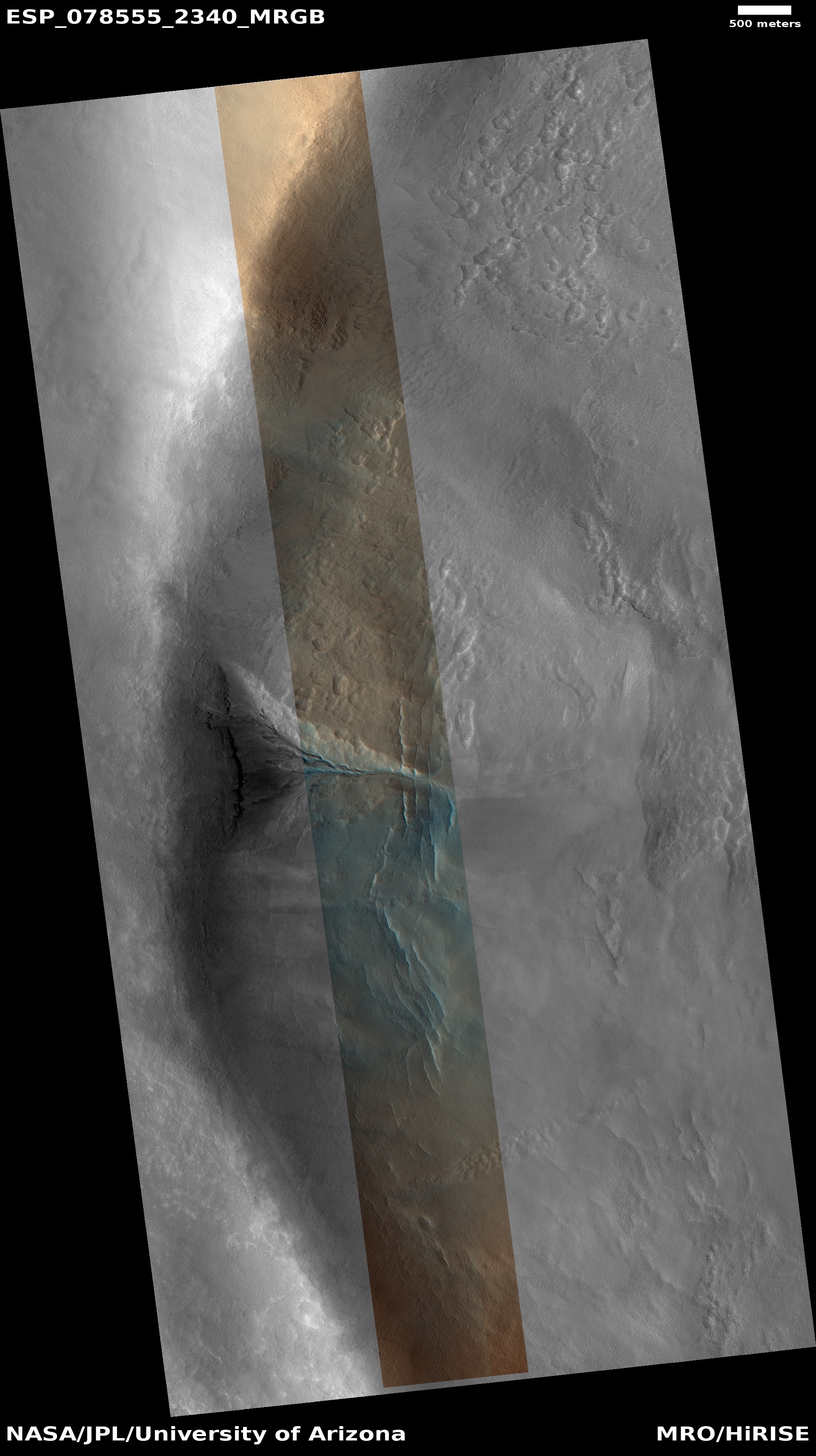
Cool image time! The picture above, cropped, reduced, and sharpened to post here, was taken on April 18, 2024 by the high resolution camera on Mars Reconnaissance Orbiter (MRO). It shows a gully that cuts down from the western rim of a 21-mile-wide unnamed crater in the southern cratered highlands of Mars.

The small rectangle on the overview map to the right marks the location, with the inset providing a close-up of this crater, with the white bar indicating the area covered by the photo above. The overall elevation loss from the rim on the left down to the crater floor on the right is about 3,800 feet.

The first high resolution picture of this gully was taken in 2016, with subsequent pictures taken in 2021 and 2022. In comparing the newest picture above with the 2016 photo I can detect no changes, but I am not looking a the highest resolution available. In addition, both of these pictures were taken during the Martian spring. The 2021 and 2022 pictures were taken during the Martian summer, and in both the north-facing wall where the gully is beginning to narrow seemed brighter.

It is likely the researchers are looking to see if any frost — either ice or dry ice — appeared during the winter and then sublimated away in the summer. Such a change could cause some of the erosion that produced this gully.

0 comments

Centrifuge research on ISS suggests some artificial gravity can mitigate negative effects of weightlessness

Two of the three centrifuges on ISS

When I appeared on the Space Show last month I stated something about centrifuge research that was wrong. I had been under the false impression that no such research had yet been done on ISS, and our only data came from one experiment performed by the Soviets on one of their early space stations decades ago.

Charles Lurio, who writes the very respected Lurio Report newsletter on space matters, called me afterward to correct me, and then followed up by sending me a link to a paper describing research on ISS in the past few years using rats inside three different small centrifuges (two of which are shown in the picture to the right). For this information I thank him.

You can download the paper here [pdf]. The research is significant because it suggests that the medical problems of weightlessness can be solved by creating an artificial gravity far less the Earth’s 1g environment. From the paper’s abstract:
» Read more

13 comments

Geology on Mars is not always what you think it is

The Martian tropics versus the Martian south pole
For the original images go here and here.

Today’s cool image is actually a comparison of two different high resolution images from Mars Reconnaissance Orbiter (MRO), both of which illustrate why it is very dangerous to come to any conclusions about such images without knowing a lot more about them.

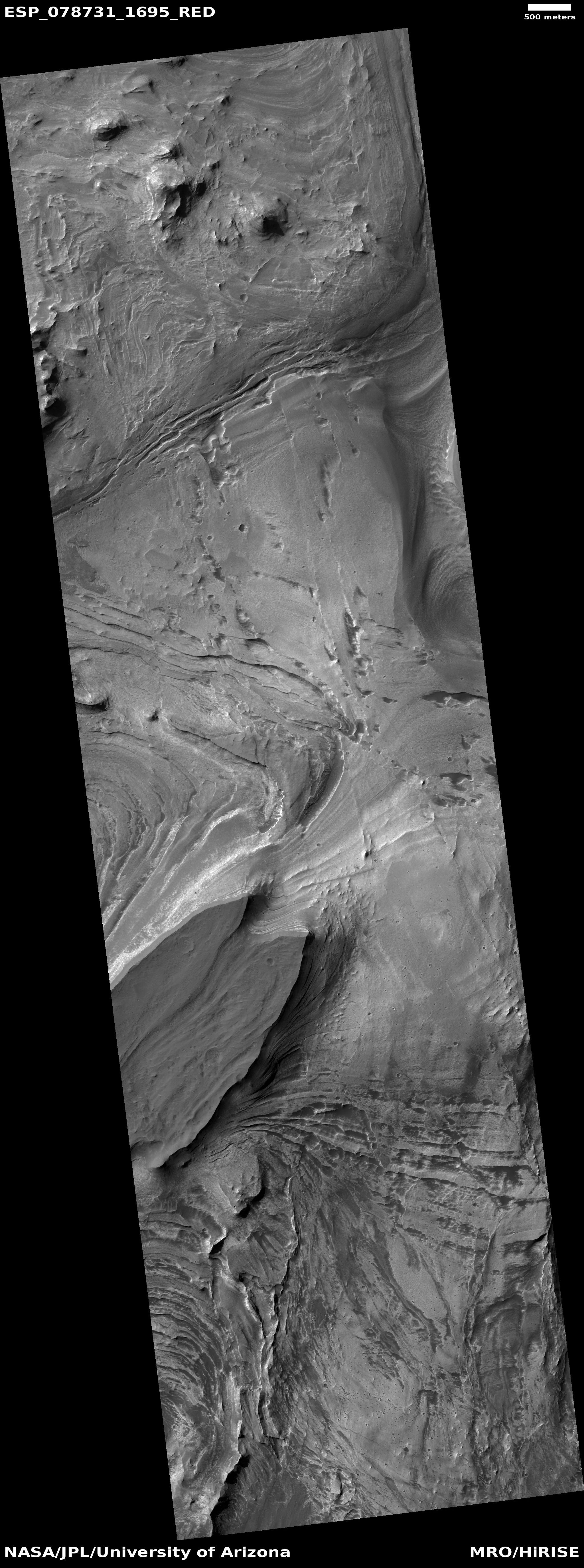
The top image to the right, cropped to post here, was a terrain sample image taken on March 30, 2024. Such images are usually taken not to complete any particular research project, but are taken to fill a gap in the schedule in order to maintain the camera’s proper temperature. When the camera team has to do this, they attempt to pick a spot that might have some geological interest. Sometimes they get something surprising. Often however the features in the picture are boring.

In this case they spotted a place where the ground appears appears to be eroding away in a random pattern.

The bottom image, cropped, reduced, and enhanced to post here, was taken on March 24, 2024 and was part of planned research. It shows a section of the Martian south ice cap, specifically the area where scientists believe there is a residual permanent small cap of dry ice on top of a thick underlying water ice cap.

Like the top image, the features here suggest some sort of erosion process eating away randomly at the ground’s upper layers.

The two images illustrate the difficulty of interpreting orbital images. At first glance the geological features of both appear very similar. Yet the top image is located in the very dry equatorial regions of Mars, and in fact is inside the Medusae Fossae Formation, the largest field of volcanic ash on the red planet. The layers here are likely ash, and the erosion that carved out the hollows likely came from wind. If there ever was near-surface ice at this location, it was many eons ago.

The bottom image however likely shows the sublimation process that is slowly eating away at the residual dry ice cap at the south pole. The Martian north pole does not have residual permanent cap of frozen carbon dioxide, and the reasons why the two caps are different in this way are complex and not completely understood.

Both images show erosion that produces features that look similar. But the materials involved and the causes are completely different.

Remember this when you look at any orbital picture taken of Mars, or any other planetary object. Without the larger context (location, make-up, known history), any guess about the nature of the features there is nothing more than a wild guess, no different than throwing darts at a wall while wearing a blindfold.

2 comments

An island of hundreds of scour pits in Mars’ largest volcanic ash field

An island of scour pits
Click for original image.

Cool image time! The picture to the left, cropped, reduced, and sharpened to post here, was taken on April 25, 2024 by the high resolution camera on Mars Reconnaissance Orbiter (MRO).

It shows what the science team labels a “scour pit island,” an area about 13 miles long and 3.5 miles wide where the ground is covered by these pits.

Your eye may play tricks on you, reversing the elevations. These are all pits, with most having a central peak or ridgeline. To help, note that the sunlight is coming from the west. The arrow on the center left of the picture sits on a plateau above these pits.

According to this paper [pdf], the pits are slowly dug out by the wind coming from the southeast blowing to the northwest, as indicated by the arrows. The central peaks or ridges are thought to be a hint of the original topography, with the wind only able to pull ash from the terrain around these peaks.
» Read more

0 comments
1 40 41 42 43 44 89