Ice-filled fissure on Mars?

Ice-filled fissure on Mars?
Click for original image.

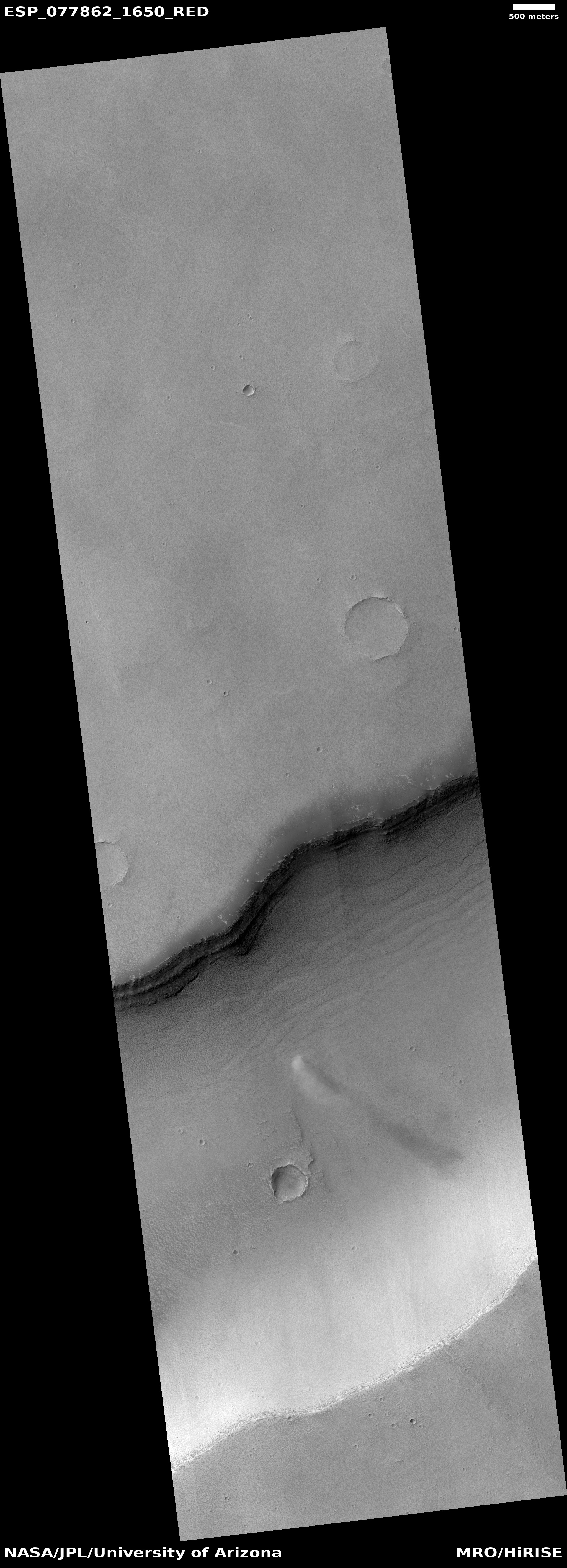
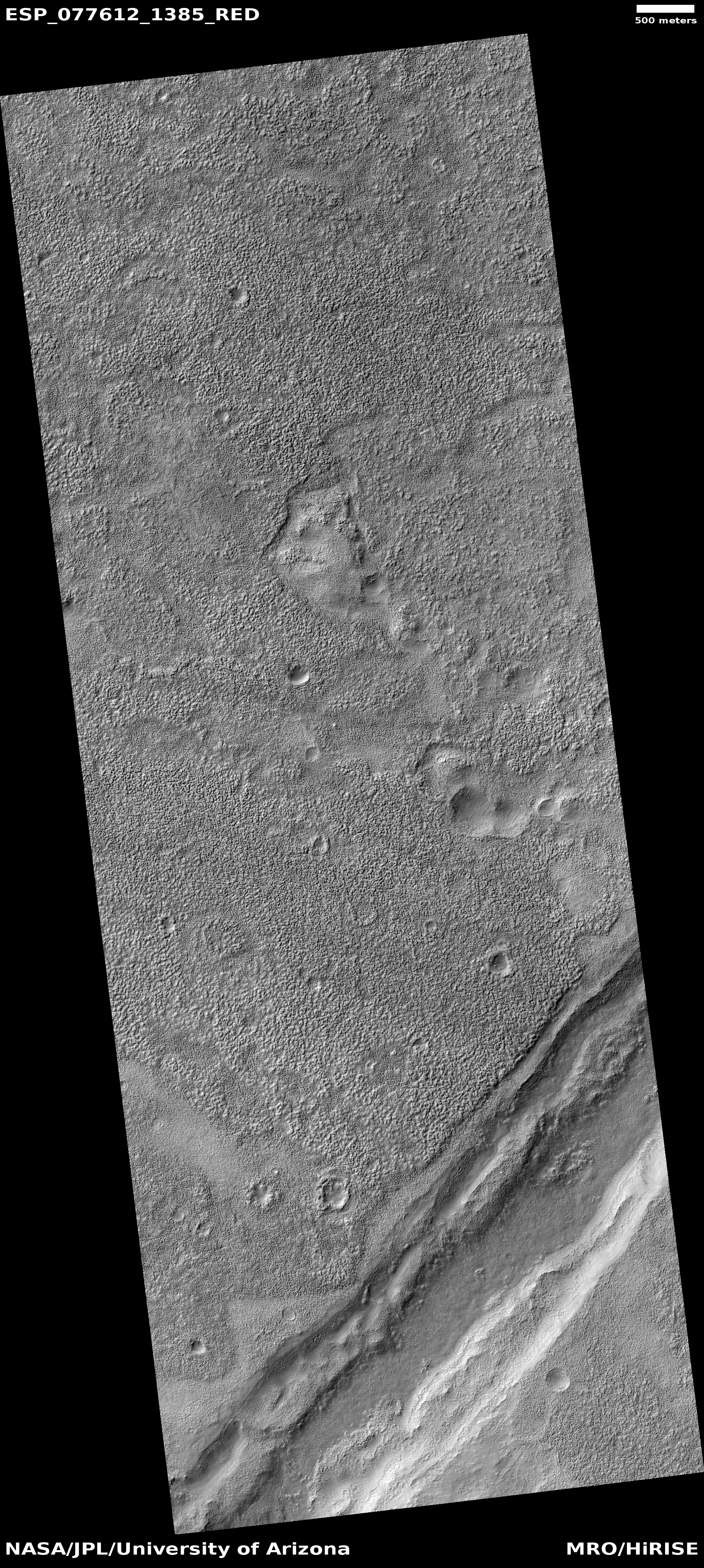
Cool image time! The picture to the right, cropped, reduced, and sharpened to post here, was taken on February 15, 2023 by the high resolution camera on Mars Reconnaissance Orbiter (MRO). The science team labeled this a “Terrain Sample”, which suggests but doesn’t guarantee that it was to fill a gap in the camera’s schedule in order to maintain that camera’s proper temperature, and therefore was targeted at a relatively random but potentially interesting location.

What we see is a fissure canyon, about 250 to 300 feet deep with cliffs about 125 high, that appears surrounded and even filled with icelike features. Even the craters on the plateau above the canyon appear like they either impacted in ice, or have since been filled and eroded by that ice.

But is it ice?
» Read more
0 comments

Distorted floor of a Martian crater

Overview map

Distorted floor of a Martian crater
Click for original image.

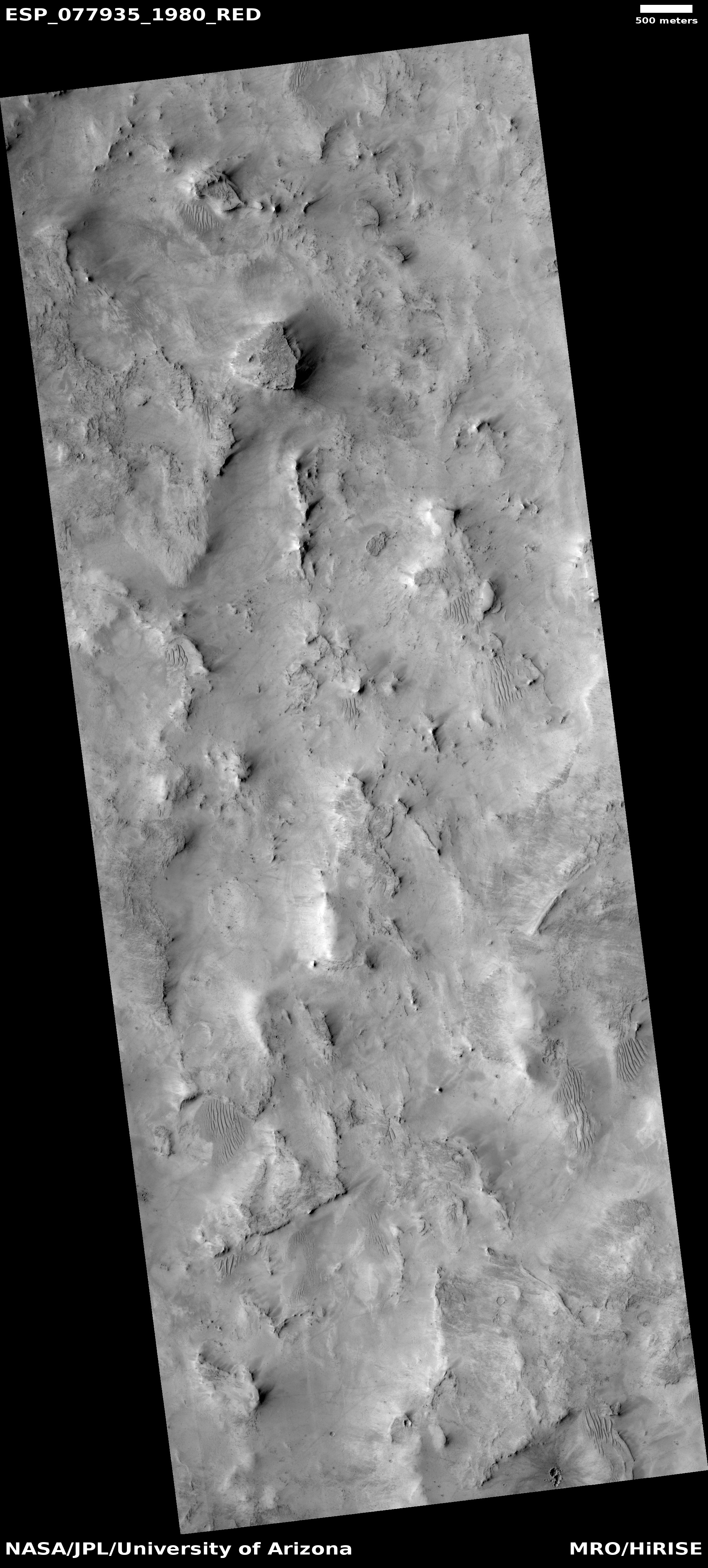
Cool image time! The picture to the right, rotated, cropped, reduced, and sharpened to post here, was taken on February 18, 2023 by the high resolution camera on Mars Reconnaissance Orbiter (MRO). It shows what the science team labels “Mantle Layers in Southern Mid-Latitudes.”

I would be less vague. These strangely shaped features invoke the typical glacial features seen throughout the mid-latitudes of Mars. The knobs and outcrops suggest some underlying breakdown that the top layers of glacial material has covered. They also suggest some form of sublimation or erosion process to the glacier itself.

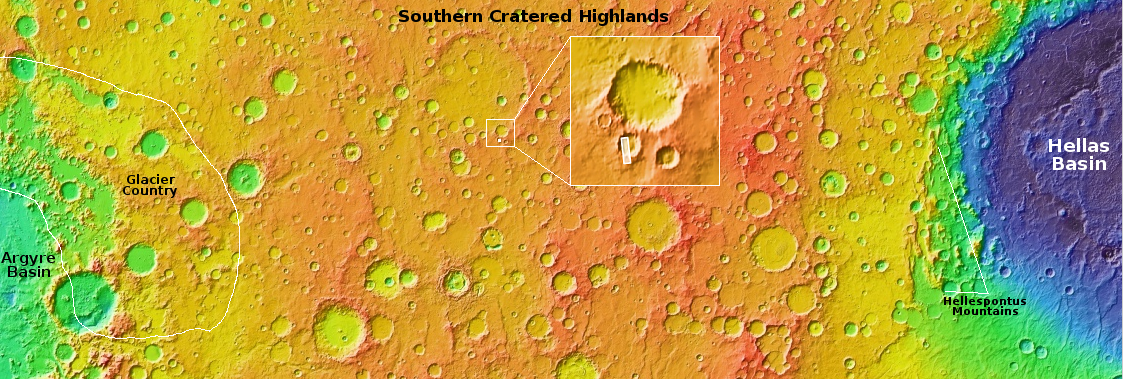
The white rectangle inside the inset on the overview map above marks this location, covering the floor of an unnamed 10-mile-wide crater in the cratered southern highlands at 41 degrees south. In this region all the craters show some evidence of this sublimation, all suggesting that there is a near-surface underlying ice layer that when exposed vanishes to leave depressions or hollows. Here however it appears that ice layer is mostly intact, the knobs and ridges indicating the shape of the bedrock and large breakdown below.

0 comments

Martian dust devil where none had been before

Dust devil on Mars
Click for original image.

Today’s cool Mars image is especially cool because it is of the exact same place on Mars I had featured in a picture only a little more than one month ago. I return to this spot only a month later because the location was yesterday’s featured captioned image from the high resolution camera team of Mars Reconnaissance Orbiter (MRO). The difference is that this time the camera captured a dust devil there that wasn’t there previously. From the caption:

The dust devil is casting a shadow, which can be used to estimate its height. This image is part of ongoing monitoring activities by HiRISE of seasonal activities on Mars.

Over the years, HiRISE has observed many dust devils. Just like on Earth, dust devils develop when the Sun heats up the ground such that it warms the air directly above it. When air heats up its density decreases causing it to rise up while colder air sinks down driving local convection.

If the region is windy, the wind my end up rotating the “convection cells” caused by the vertical motion of air leading to development of a dust devil. Since the main requirements for development of such features are the presence of dust and a warm ground, we focus our monitoring of dust devils in regions on Mars that are known to be dusty (like Syria Planum), and during the late spring and summer time, when we expect the ground to be warm.

» Read more

2 comments

Hubble snaps picture of another jellyfish galaxy

Another jellyfish galaxy
Click for original image.

Astronomers today released another picture of a jellyfish galaxy taken by the Hubble Space Telescope, with that picture to the right, cropped, reduced, and sharpened to post here. From the caption:

The jellyfish galaxy JO206 trails across this image from the NASA/ESA Hubble Space Telescope, showcasing a colourful star-forming disc surrounded by a pale, luminous cloud of dust. A handful of bright stars with criss-cross diffraction spikes stand out against an inky black backdrop at the bottom of the image. JO206 lies over 700 million light-years from Earth in the constellation Aquarius.

This image is the sixth and final such photograph in this survey. You can view all of these images here. The study has found that star formation does not seem to be significantly different inside the galaxy versus the tentacles that stretch out beyond due to pressure from the intergalactic material. This suggests that the influence of this intergalactic material on the formation of stars is relatively minor.

0 comments

Tianzhou unmanned freighter completes month-long free flight, re-docks with Tiangong-3

Engineers today successfully re-docked a Tianzhou unmanned freighter to China’s Tiangong-3 space station after 33 days flying in formation with the station.

As is usual, China released no information about the reasoning behind this free flight, though some reasons are obvious. The station has two docking ports, and during that 33-day time period the station also completed a crew swap, with one Shenzhou capsule docking with three new astronauts while the previous crew and its Shenzhou capsule was still docked. The Tianzhou freighter had to undock to provide a port during this time period for the two manned capsules.

This formation free flight and docking was also likely testing the kind of routine maneuvers China plans to do when it launches its Hubble-class optical space telescope next year. That telescope will fly freely near the station during most of its operations. For maintenance and repair however it is my understanding that it will be brought back to the station and docked with it. The just completed independent flight of the Tianzhou freighter demonstrated this capability.

2 comments

Russia to launch Luna-25 on August 11, 2023


Click for interactive map.

According to reports in Russia’s state run press, the new launch date for its Luna-25 lander to the Moon has now been scheduled for August 11, 2023.

The launch of an automatic space probe to the Moon, the Luna-25, is scheduled for August 11 this year, the tour operator RocketTrip has said on its website. “August 11 is the launch date,” the website says in the section devoted to the tour to the Vostochny spaceport for the launch of the Luna-25.

The launch had been scheduled for July. The one month delay was announced last week, with no explanation.

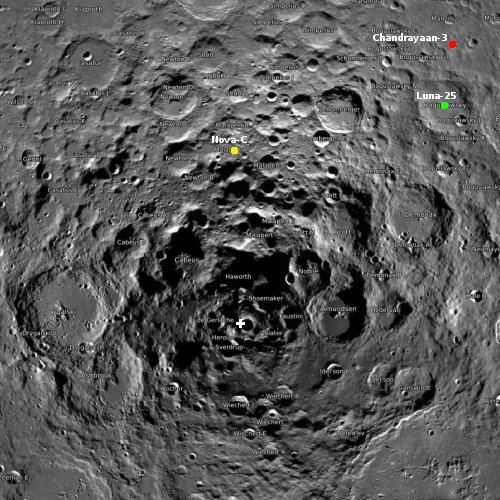
The map shows landing locations of three landers that are all scheduled for launch in the next four months. All are targeting spots near the Moon’s south pole (the white cross).

6 comments

Barren land on Mars

Barren land on Mars
Click for original image.

It might seem strange to call any particular place on Mars “barren” when the entire planet has no visible signs of life anywhere. However, much of the surface of Mars involves wind and ice features that show evidence of change and evolution over time. The presence of apparent near-surface ice and glacial features in almost every image located above 30 degrees latitude emphasizes this sense of potential life, even if that life will only be transported from Earth and established there someday by humans.

Today’s cool image to the right, cropped and reduced to post here, has none of these features. It is dry barren bedrock, with only a faint scattering of Martian dust indicated by many faint dust devil tracks.

The picture was taken on March 13, 2023 by the high resolution camera on Mars Reconnaissance Orbiter (MRO). The largest and most distinct flat-topped mesa in the image is only about 100 feet high, with the north-south ridgeline to the south about 20 feet high.
» Read more

0 comments

Astronomers think they have completed the census of Near Earth asteroids

Astronomers in a new paper [pdf] have concluded that the census of Near Earth asteroids is largely now complete, and have begun focusing their effort on narrowing down the list of potentially dangerous asteroids in that census. From the press release:

Researchers from CU Boulder and NASA have completed a census of hundreds of large asteroids orbiting near Earth—gauging which ones could come precariously close to our planet over the next thousand years. The researchers identified at least 20 asteroids that scientists may want to study more to make certain they pose no threat to life on Earth in the next millennium.

To be clear, the researchers say the odds of any of these rocky bodies striking the planet are extremely low, and are next to zero for the coming century. But because the fallout from such an impact would be catastrophic, it’s important to be sure, said Oscar Fuentes-Muñoz, lead author of the study. “We don’t want to alarm people, because the results are not alarming,” said Fuentes-Muñoz, a doctoral student in the Ann and H.J. Smead Department of Aerospace Engineering Sciences. “But there are a lot of uncertainties in predicting so far into the future.”

To sum up, none of those 20 asteroids has any chance of hitting the Earth in the next few hundred years. Beyond that the uncertainties make it difficult to predict. Reducing those uncertainities is now the focus of their work.

2 comments

Avalanche to the east of Gale Crater on Mars

Landslide on Mars
Click for original picture.

Cool image time! The picture to the right, cropped, reduced, and sharpened to post here, was taken on February 19, 2023 by the high resolution camera on Mars Reconnaissance Orbiter (MRO). It shows an avalanche that slumped downward out of the material that forms the interior western wall of an unnamed 25-mile-wide crater about 100 miles east of Gale Crater, where Curiosity has been roving for more than a decade.

The scientists call these types of Martian avalanches “mass-wasting events”, since the entire mass of the cliff moves downhill in a chunk, rather than as a pile of rocks that grows in size and strength as it picks up material on its way down.

It is not clear how old this slide is. A lot of the material on this slope appears to be Martian dust, some of which has flowed into the avalanche material after it had slide downhill.
» Read more

1 comment

Shadowcam on South Korea’s Danuri lunar orbiter sees no obvious ice in the permanently shadowed interior of Spudis crater

Overview map

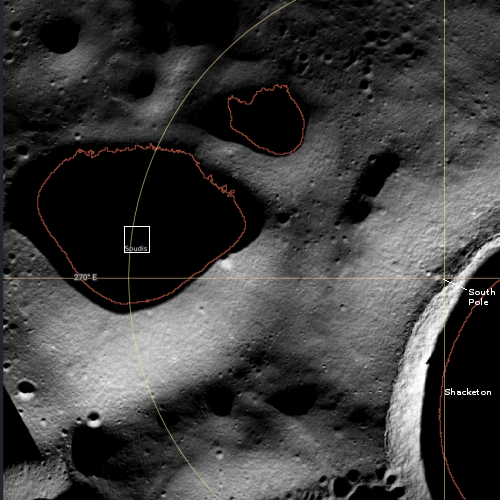
Using Shadowcam, a camera built by Arizona State University that is on South Korea’s Danuri lunar orbiter and is designed to see into very dark regions of little light, scientists have obtained optical images showing the permanently shadowed interior of Spudis Crater, located only about ten miles from the Moon’s south pole.

That picture is below. To the left is an annotated overview created from Lunar Reconnaissance Orbiter (LRO) high resolution images. The white box inside Spudis Crater indicates the area covered by the section of the Shadowcam image I have focused on. The red outlines indicate areas that are thought to be permanently shadowed. The relatively flat ridgeline between Shackleton and Spudis is one of the prime future landing sites for NASA’s Artemis program.
» Read more

5 comments

Martian rootless cones

Rootless cones
Click for original image.

Cool image time! The picture to the right, cropped, reduced, and sharpened to post here, was taken on March 8, 2023 by the high resolution camera on Mars Reconnaissance Orbiter (MRO).

The camera team labeled this picture simply “Rootless Cones,” which is a feature that is created when the lava that covers the surface is thin, allowing the heated material below (which is not lava) to burst upward, producing the cone and caldera. If you look at the full image you will see other similar clusters of cones scattered about on this very flat and featureless plain. Apparently, the material that this lava plain covered had several similar bursts in a number of areas.

Such cones in this particular lava field are not rare, and in fact are evidence that this particular field is young.
» Read more

0 comments

ESA to live-stream image downloads from Mars Express

To celebrate Mars Express’s 20th year in orbit around Mars, the European Space Agency (ESA) has announced that tomorrow it will for one hour live-stream the image downloads coming from the orbiter.

I have embedded that live stream below. According to the press release, new images will arrive about once every 50 seconds. The camera that will be taking the pictures however is not one of Mars Express’s main instruments, but designed instead to simply monitor the separation of the Beagle-2 lander from the orbiter in 2003. Since 2007 however the science team has used its low resolution global images of Mars for public relations, education, and even some science research.

That the science team is not providing the live feed from its high resolution camera however illustrates why Mars Express gets so little press coverage, compared to Mars Reconnaissance Orbiter (MRO). All MRO images are released to the public, usually only a month or so after they reach Earth. The ESA however has never made the archive of Mars Express accessible, as far as I have been able to discover. All it does is periodically issue a press release about once every few months touting one new image, even though the spacecraft is taking dozens daily.
» Read more

0 comments
1 67 68 69 70 71 89