
Craters, cones, pits, amid endless plains

Pits, cones, and craters

Cool image time! Buried in the catalog of recent high resolution images from Mars Reconnaissance Orbiter are places on Mars that are inexplicable and fascinating, while also indicative of its vastness. The image on the right, reduced in resolution and cropped to post here, shows us one such place. If you click on the image you can see the full image at high resolution.

The archive posting of this image is titled “Cones near Pits.” As you can see, to the north and east of the pits are some mesas (why they call them cones I do not know).

The pits are unusual, and appear to be some form of collapse. In the larger image several additional mesas can be seen at farther distances, but most of the overall terrain is remarkably flat and featureless, except for numerous small craters that appear either partly buried by dust or significantly eroded.

I am not going to guess at the geology that caused the pits and mesas. What I do want to focus on is the vastness of Mars. This location is on the southern edge of Utopia Basin, the second deepest basin on Mars. It is part of the planet’s endless northern plains, an immense region covering almost half the planet that tends to be at a lower elevation, is relatively smooth, and is thought by some scientists to be evidence of what was once an intermittent ocean. The global map of Mars below indicates the location of the above image with a black cross.
» Read more
16 comments

Canyoneering in Death Valley

Slabby Acres

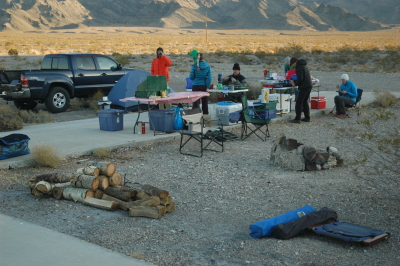
This past Thanksgiving weekend I joined some caving and canyoneering friends in Death Valley to celebrate the holiday in the great outdoors as well as explore some of the park’s more inaccessible canyons. We did not camp in the park, since campfires are not allowed and the park has a size limit for groups. Instead, we camped on BLM land just outside the park, in what appeared to be an abandoned RV trailer park that canyoneerers call Slabby Acres.

First a primer. Regular readers will know that I have been doing cave exploration and mapping now for about thirty years. This recreational activity not only involves knowing how to use survey instruments in a cave, you need also to be trained in the vertical rope techniques required to reach some remote places underground, sometimes dropping multiple pits on the way in and climbing those same domes on the way out.

Canyoneering is somewhat similar to caving. Just like caving you need to know how to travel over boulders and rough terrain and also know how to rappel and climb ropes. Unlike caving the canyons are open to the sky, and you rarely climb the ropes to travel up the canyon. In canyoneering the goal is to find the head of the canyon and travel down its many drops to come out at the bottom safely, all the while getting to see some wild, majestic, and rarely seen places. In addition, modern canyoneering rarely involves virgin exploration. Most canyoneerers visit already explored canyons whose details are well documented so that they know what ropes to bring as well as how to find the canyons.

This was our goal this past weekend. Some of the western cavers who have joined my survey projects and learned how to cave survey are also active canyoneerers. While none of us had ever visited the canyons on our trip list, several were very experienced with finding and traversing places they had never been before. My plan was to follow them and enjoy the experience. Below are my pictures during one of this weekend’s canyoneering trips. The canyon is Scorpion Canyon. It was the first we visited and was relatively easy to do, only 4.6 miles long with only six rappels and only an 1,800 foot elevation drop. It would take us over one of the mountain ranges that form the eastern wall of Death Valley. In fact, this was how I was going to enter Death Valley for the first time. Rather than drive in, like most tourists, I would rappel in.
» Read more

14 comments

Back from a weekend underground

Bob Zimmerman underground

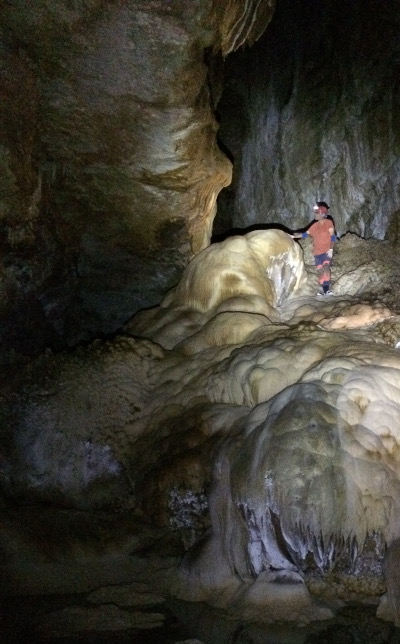
The picture on the right will explain why I have been silent posting since Friday. I have just returned with five friends from three days of caving in New Mexico, doing some wild caving plus my first visit to Carlsbad Caverns since 1992, guided by a local caver who has been helping me with my cave survey project in Arizona.

New Mexico probably has the largest concentration of truly large and spectacularly decorated caves in the entire world. I’ve caved there previously, but this was my first trip driving from Arizona. We went to two wild caves, one of which I had never visited before and a second that I had seen during my 1992 trip. The picture shows me in the latter, standing above a large clear pool near the back of the cave with some giant flowstone speleothems all around me.

The new cave contained a room dubbed Speleogasm, because every formation there, of which there are too many to count, is completely festooned with helectites and sodastraws in a mad protrusion that no geologist can as yet explain. Nor is there any way to describe it adequately or photograph it successfully. To witness it you need to go, requiring the specialized caving skills that include the techniques and equipment required to rappel and climb a 40 foot rope.

As always, the advantages of learning how to do this successfully is the reward of seeing things that few ever see. It is why engineers and scientists strive so hard to get planetary probes to distant planets. And why humans want to travel to the planets. For me, getting inside a remote and beautifully decorated cave will just have to do.

1 comment

Worlds without end

Last week’s fly-by of Pluto by New Horizons illustrated forcefully once again the power of exploration on the human mind, and how that exploration always carries surprises that delight and invigorate us.

First of all, the images from that fly-by demonstrated clearly that the decision by the International Astronomical Union (IAU) to declare Pluto a non-planet was very much premature. Even project scientist Alan Stern himself enthusiastically noted at the start of Friday press conference that Pluto-Charon was a โ€œdouble planet systemโ€.

The IAU definition itself was faulty and difficult to apply. The clause that required a planet to have “cleared the neighborhood around its orbit” made little sense in the real universe, as even the Earth has not successfully cleared its orbit after several billion years. Was the IAU suggesting the Earth was not a planet?

New Horizons’s discovery last week that even a small object like Pluto, orbiting the Sun on its own with no gas giant nearby to provide tidal heating, can still exhibit significant and on-going geological activity, shows that our understanding of what defines a planet is at this time quite limited. We simply don’t know enough about planetary evolution and formation to definitively define the term. Nor do we have enough knowledge to determine if Pluto falls into that category, though the data strongly suggests that it does.

Are planets made up of only gas giants, rocky terrestrial planets like the Earth, and dwarf planets like Ceres and Pluto? Or are there numerous other as yet unknown categories?
» Read more

2 comments

China heads for the Moon and Mars.

The competition heats up: In several different news stories today China touted its future plans in space.

The landing test described in the first story above will also be the first test flight of China’s new heavy lift rocket, Long March 5.

That China is both politically and culturally serious about this effort can be seen by the nationalistic enthusiasm for this space effort that permeates these stories. They also can’t help comparing their plans to U.S. efforts.
» Read more

3 comments

There is an ongoing rescue of a caver in one of Europe’s deepest cave.

Breaking: There is an ongoing rescue of a caver in one of Europe’s deepest cave.

A team is trying to rescue a 52-year-old man injured in a rock fall in a 1,000m-deep (3,280ft) cave in Germany, in an operation that could take days. The Riesending cave is Germany’s deepest and it took one of the man’s companions up to 12 hours to return to the surface to raise the alarm. Some 200 people are involved in the operation, near Berchtesgaden in southern Germany. The first rescuers reached the man in the vertical cave on Monday.

0 comments

The first person to cycle to the South Pole.

The first person to cycle to the South Pole.

Leijerstam used a modified version of the commercially-available Sprint trike, made by recumbent tricycle manufacturer Inspired Cycle Engineering (ICE). She chose to go with a recumbent trike because it would allow her to maintain stability in the often very-high winds. This allowed her to concentrate simply on moving forward, instead of having to waste time and effort keeping her balance. The strategy paid off, as she not only made it, but also beat two other cyclists who had set out for the Pole on two-wheelers, days before her Dec. 17th start date.

0 comments

The oldest globe to show the New World may have been discovered.

The oldest globe to show the New World may have been discovered.

The globe, about the size of a grapefruit, is labeled in Latin and includes what were considered exotic territories such as Japan, Brazil and Arabia. North America is depicted as a group of scattered islands. The globeโ€™s lone sentence, above the coast of Southeast Asia, is โ€œHic Sunt Dracones.โ€

Those words mean, of all things, “Here be dragons.” The globe is dated from 1504, only a dozen years after Columbus’s first voyage.

0 comments
1 82 83 84 85 86 89