House hearing on Artemis yesterday signals strong doubts about the program in Congress

Artemis logo

The space subcommittee of the House Science, Space, and Technology Committee yesterday held a hearing on space, one day after the Senate held its own hearing on the nomination of Jared Isaacman as NASA administrator.

The House hearing however was not about Isaacman, but was apparently staged to highlight what appears to be strong reservations within Congress about NASA’s Artemis program, as presently structured. Its timing, just after the Isaacman hearing, was clearly aimed at garnering as much publicity as possible.

Video of the hearing can be seen here.

The focus of the hearing was also on China, and how there is real fear in Congress that its space program is outstripping NASA’s. Both the Republican committee chairman and the ranking Democrat stressed these concerns, and the need to beat China to the Moon and beyond.

More important, all four witnesses pushed the same point.

The rallying cry at this hearing as well as yesterday’s is the “race” with China.

…Foushee asked each of the witnesses for one-word answers to the question: is NASA on track to get back to the Moon before Chinese taikonauts arrive?

Not all succeeded with one word, but their sentiment was similar. Cheng replied “no, I am very pessimistic.” Swope: “worried.” Besha: “maybe.” Griffin: “no possible way…with the present plan.”

Former NASA administrator Mike Griffin was the most blunt in his criticism of NASA.
» Read more

21 comments

SpaceX launches 28 Starlink satellites

SpaceX today successfully launched another 28 Starlink satellites, its Falcon 9 rocket lifting off from Vandenberg Space Force Base in California.

The first stage completed its 4th flight, landing on a drone ship in the Pacific.

The leaders in the 2025 launch race:

159 SpaceX (a new record)
75 China
15 Rocket Lab
15 Russia

SpaceX now leads the rest of the world in successful launches, 159 to 127.

2 comments

Yesterday’s Senate nomination hearing for Jared Isaacman was irrelevant; America’s real space “program” is happening elsewhere

Jared Isaacman
Billionaire Jared Isaacman

Nothing that happened at yesterday’s Senate hearing of Jared Isaacman’s nomination to be NASA’s next administrator was a surprise, or very significant, even if most media reports attempted to imply what happened had some importance. Here are just a small sampling:

To be fair, all of these reports focused on simply reporting what happened during the hearing, and the headlines above actually provide a good summary. Isaacman committed to the Artemis program, touted SLS and Orion as the fastest way to get Americans back to the Moon ahead of the Chinese, and dotted all the “i”s and crossed all the “t”s required to convince the senators he will continue the pork projects they so dearly love. He also dodged efforts by several partisan Democrats to imply Isaacman’s past business dealings with Musk and SpaceX posed some sort of conflict of interest.

What none of the news reports did — and I am going to do now — is take a deeper look. Did anything Isaacman promise in connection with NASA and its Artemis program mean anything in the long run? Is the race to get back to the Moon ahead of China of any importance?

I say without fear that all of this is blather, and means nothing in the long run. The American space program is no longer being run by NASA, and all of NASA’s present plans with Artemis, using SLS, Orion, and the Lunar Gateway station, are ephemeral, transitory, and will by history be seen as inconsequential by future space historians.
» Read more

16 comments

France’s space agency CNES found liable for environmental damage at French Guiana spaceport

French Guiana spaceport
The French Guiana spaceport. The Diamant launchsite is labeled “B.”
Click for full resolution image. (Note: The Ariane-5 pad is now the
Ariane-6 pad.)

France’s space agency CNES, which has taken back management from Arianespace of the French Guiana spaceport it owns, has now been found liable for destroying a protected habitat as it began construction to upgrade the old abandoned Diamant rocket launch site into a pad for several of Europe’s new commercial rocket startups.

In March 2022, the regional environmental authority of French Guiana (DGTM) formally informed CNES that it could not begin demolition or earthworks at the Diamant site without first securing the legally required species and water-law authorisations. Despite this, the agency leveled the area in the preceding weeks, with the environmental NGO CERATO discovering the destruction in April 2022.

In August 2022, the DGTM carried out an unannounced inspection of the Diamant site and found further destruction of protected habitats linked to the agency’s PV2 solar farm project. In October 2022, the PV2 project manager informed DGTM that CNES had known about the presence of protected species on the PV2 site since 1 July 2022, yet began earthworks anyway.

In response to repeated flouting of DGTM procedures, the Prefect of French Guiana, the top regional authority, issued a stop-work order requiring CNES to halt all works at both sites.

It appears this stop-work order has contributed to delays in construction. The news now is that the case appears to have been settled.

The agency has been ordered to repair the damage within three years or face a fine of €50,000. It will also be required to finance ecological compensation actions elsewhere on the grounds of the Guiana Space Centre. The conclusion of the lawsuit will allow the agency to fully resume construction at the site, which it had been ordered to stop in late 2022.

In other words, CNES has been told to spend money elsewhere at the spaceport to make the local environmental authorities happy. It remains unclear how these delays have or even will impact the plans of the Spanish rocket startup PLD, which hopes to do the first orbital launch of its Miura-5 rocket from this site in 2026. PLD expects the first flight-worthy Miura-5 to be delivered to French Guiana early next year, so the delays in French Guiana have not yet effected its plans. That might now change if the site won’t be ready as planned.

This whole story however does indicate a fundamental problem within all of Europe’s space regulatory infrastructure that in the future is likely to hinder the development of its new commercial space industry. Europe’s leadership likes its red tape, and has done nothing to reduce it as it has shifted from the government-run model (where it controls and owns everything) to the capitalism model (where it buys what it needs from an independent competing private sector).

2 comments

SpaceX launches 29 more Starlink satellites

SpaceX today successfully launched another 29 Starlink satellites, its Falcon 9 rocket lifting off from Cape Canaveral in Florida.

The first stage completed its 25th flight, landing on a drone ship in the Atlantic. With this flight, this booster, B1077, has now tied the space shuttle Endeavour in reuses, and is only three behind the Columbia shuttle.

The leaders in the 2025 launch race:

158 SpaceX (a new record)
74 China
15 Rocket Lab
15 Russia

SpaceX now leads the rest of the world in successful launches, 158 to 126.

3 comments

Blue Origin faces opposition renewing its permit to dump waste water at Florida launch facility

Chicken Little strikes again!

It appears several local politicians as well as the typical anti-everything activists are expressing opposition to Blue Origin’s request to renew its permit to dump waste water at its Florida launch facility.

Some county commissioners have concerns about the proposal because of how much money and effort has gone to cleaning up the Indian River. “That’s really troubling to me especially when we are spending so much money as a community on the half-cent sales tax and the save the Indian River Lagoon tax,” said Brevard County Commissioner Katie Delaney.

Space experts say large-scale companies don’t necessarily follow rules and regulations put on them. “There has been all sorts of industrial waste issues associated with the aerospace industry not just here in Florida but all across the country,” Florida Tech space professor, Don Platt, said.

The water is likely that used during launches to dampen the shock produced by the rocket’s engines, and like SpaceX’s systems, is almost certainly potable and harmless. This is also a permit that Blue Origin obtained five years ago and has used without harm during all its launchpad tests and launches.

None of this whining really matters, as it appears the county commission has no authority over the matter. The permit was issued by the state’s environmental department which will almost certainly approve the renewal. It is just unfortunate that these whiners almost always get positive coverage from our propaganda press. In this case the local Fox affiliate that reported the story clearly made no effort to research anything. It just simply spouted back the grumbles of these politicians and activists.

2 comments

German rocket startup Isar gets launch contract from ESA

The German rocket startup Isar Aerospace yesterday announced it has won a launch contract from the European Space Agency (ESA) to place a satellite carrying a number of experimental payloads into orbit before the end of 2026.

Satellite launch service company Isar Aerospace has signed a contract with the European Space Agency (ESA) to launch the ΣYNDEO-3 mission under the European Union’s In-Orbit Demonstration and In-Orbit Validation Programme (IOD/IOV). The launch will be carried out from Isar Aerospace’s dedicated launch complex at Andøya Space in Norway from Q4 2026.

…Redwire is the prime contractor for the ΣYNDEO-3 mission and will be delivering its Hammerhead spacecraft for a launch onboard Isar Aerospace’s launch vehicle Spectrum to a low Earth orbit (LEO). The spacecraft was built and integrated at Redwire’s state-of-the-art satellite processing facility in Belgium. The spacecraft aggregates 10 innovative payloads from six countries and institutions: Spain, France, Germany, Italy, Luxembourg and the EC.

Isar has yet to reach orbit with its Spectrum rocket. The first launch failed in March only seconds after launch. A second attempt is presently scheduled for sometime prior to December 21, 2025, lifting off from Andoya.

This is the second new launch contract Isar has announced in the past two weeks, and the third since September. At the moment it appears it is gaining momentum pending that first launch later this month, especially because a successful December launch would make it the first European rocket startup to successfully reach orbit.

0 comments

Senate Commerce committee to move up its vote on Isaacman’s nomination as NASA administrator

Jared Isaacman
Billionaire Jared Isaacman

Today Senator Ted Cruz (R-Texas) announced that the Commerce committee he heads will vote on the re-nomination of Jared Isaacman for NASA administration on December 8, 2025, only five days after tomorrow’s renomination hearing.

It appears Cruz and his committee is pushing to get Isaacman approved as quickly as possible. At least one Republican senator, John Cornyn (R-Texas) has met with Isaacman again and gotten his commitment to move the space shuttle Discovery to Texas, as mandated by the budget bill passed several months ago. That commitment was likely a quid pro quo by Cornyn to get his vote for Isaacman.

Once Isaacman is approved by Cruz’s committee, the Senate could vote at any time. Whether it will do so before the end of the year remains unknown, as it would likely require a special session as the Senate is expected to be in recess until after the new year.

If it does not, it will likely give Isaacman very little time to review the next Artemis mission, tentatively schedule for launch as early as February 2026, carrying four astronauts around the Moon on a Orion capsule with a questionable heat shield and an untested environmental system.

1 comment

SpaceX gets Air Force approval to launch and land Starship/Superheavy at Cape Canaveral

Cape Canaveral

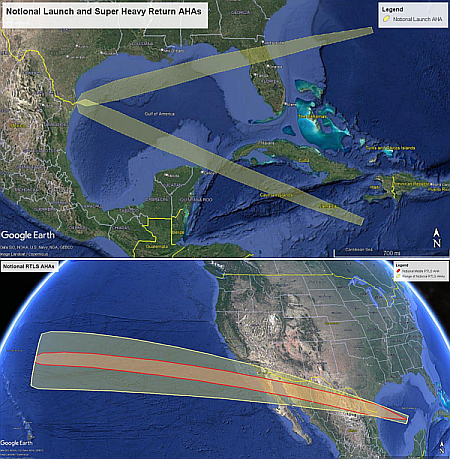
The Air Force announced late yesterday [pdf] that it will now allow SpaceX to launch its Starship/Superheavy rocket at Space Launch Complex 37 (SLC-37) at Cape Canaveral in Florida (as shown on the map to the right) as many as 76 times per year, with twice that number of landings.

The DAF [Department of Air Force] decision authorizes SpaceX to use SLC-37 at CCSFS [Cape Canaveral Space Force Station] to support Starship-Super Heavy launch and landing operations, including the redevelopment of SLC-37 and the other infrastructure improvements required and analyzed in the FEIS [Final Environmental Impact Statement]. Under this ROD [record of decision], upon execution of the real property agreement and associated documentation, and as analyzed in the FEIS while adhering to the mitigation measures specified in Appendix A to this ROD, SpaceX is authorized to: (1) undertake construction activities necessary to re-develop SLC-37 and associated infrastructure for Starship Super Heavy operations; (2) conduct prelaunch operations, including the transportation of launch vehicle components and static fire tests; and (3) conduct up to 76 launches and 152 landings annually once a supplemental analysis of airspace impacts by the Federal Aviation Administration (FAA) is completed. [emphasi mine]

The deal also requires SpaceX to do some road upgrades in order to transport the rocket from its Gigabay to the launch tower. The company immediately announced on X yesterday that it has already begun construction, and expects to have three pads in Florida before all is done.

The final environmental impact statement [pdf] was released on November 20, 2025, and concluded in more than 200 pages that there will be no significant impact from these launch operations, something that should be self-evident after more than three-quarters of century of rocketry at the Cape. The existence of the spaceport acts to protect wildlife, because it limits development across a wide area.

The report suggested that some turtle species and one mouse specie might “affected adversely”, but it it also appears that risk was considered minor and not enough to block development. To deal with this however the impact statement requires SpaceX to do a number of mitigation actions, similar to what it is required to do at Boca Chica.

One fact must be recognized, based on the red tape and delays experienced by SpaceX during the Biden administration. Had Kamala Harris and the cadre that ran the White House under Biden had been in office now, this approval would almost certainly have not happened, or if it did, it would have likely been delayed for a considerable amount of time, into next year at the earliest. It is certain that Trump is clearing the path to prevent red tape and the administrative state from slowing things down unnecessarily.

This announcement also strengthens the likelihood that SpaceX will do at least one launch of Starship/Superheavy from Florida in 2026. And if not then, by 2027 for sure.

10 comments

Two launches today, by Arianespace and SpaceX

Today there were two launches worldwide, one from South America and the second from the U.S.

First, Arianespace launched a South Korea imaging satellite from French Guiana, using the Vega-C rocket built and owned by the Italian rocket company Avio. Based on the July 2024 agreement, this is the next-to-last Vega-C flight that Arianespace will manage. After the next flight, Avio will take over management of its own rocket, cutting out this government middle man, though that agreement also allowed customers who had previously signed with Arianespace for later flights to stay with it as the managing organization.

Either way, Arianespace’s responsibilities will soon be limited solely to the Ariane-6 rocket, which itself has a limited future, being expendable and too expensive to compete in the present launch market.

Next SpaceX launched another 27 Starlink satellites into orbit, its Falcon 9 lifting off from Vandenberg Space Force Base in California. The first stage completed its 20th flight, landing on a drone ship in the Pacific.

As the Vega-C launch was only the sixth for Europe in 2025, it remains off the leader board for the 2025 launch race:

157 SpaceX (a new record)
74 China
15 Rocket Lab
15 Russia

SpaceX now leads the rest of the world in successful launches, 157 to 126.

0 comments

A detailed look at Europe’s $1 billion commitment to its nascent commercial rocket industry

The European Space Agency

Link here. In announcing last week the European Space Agency’s (ESA) budget for the next three years, along with its general overall goals, the European council (dubbed CM-25) also apparently committed about $1.45 billion to its “European Launcher Challenge”, a program created in 2023 and designed to encourage the development of new European rockets, owned and operated by independent competing startups.

The article at the link provides a good overall summary of major increase in funding for this program, including which ESA countries are contributing the most and why. The key quote however is this:

In July 2025, ESA shortlisted Isar Aerospace, Rocket Factory Augsburg, PLD Space, MaiaSpace, and Orbex to proceed to the initiative’s next phase. It then began discussions with the host country of each company to assess its willingness to contribute to that company’s participation in the European Launcher Challenge.

During his post-CM25 address, ESA Director General Josef Aschbacher revealed that Member States had committed double the anticipated amount for the European Launcher Challenge, with the final figure exceeding €900 million. While the funding model’s structure suggests that only the UK, Spain, France, and Germany contributed, post-CM25 disclosures have indicated that a few additional countries also committed funds to the programme.

Germany appears to be the biggest contributor, supplying more than a third of the total fund ($422 million). This isn’t surprising, since Germany also has the most rocket startups, three, two of which are on that shortlist (Rocket Factory and Isar). Spain is next with a contribution of $196 million, aimed helping the rocket startup PLD. The UK is next, also contributing $196 million, likely to be used to support its Orbex startup that wants to launch from its Saxavord spaceport in the Shetland Islands.

A variety of other ESA nations, the Czech Republic, the Netherlands, and Norway, have also outlined their contributions, for a variety of space-related startups unrelated to rockets.

France also appears to have donated a significant amount, but has not made that number public. Its MaiaSpace startup is one on that shortlist above, but France also has one or two other rocket startups that might eventually qualify for aid.

The bottom line is that ESA here is committing funding to aid the development of rockets and space infrastructure that it won’t own or control, a major shift from its past policy of owning and controlling everything through its Arianespace pseudo-commercial company, what I call the Soviet- or government-run model. Instead, these ESA nations are going to help fund a range of competing private rockets, which will own the rockets and operate them for profit. ESA will simply become one of their customers, following the capitalism model that the U.S. switched to in the previous decade.

This increased commitment to capitalism in the ESA suggests that we should see some real progress by these startups in the next three years.

If you think the launch records being set this year are breath-taking, you ain’t seen nothin’ yet.

3 comments

Russia still using black market Starlink terminals on its drones

In its war with the Ukraine, it appears Russia is still managing to obtain black market Starlink mini-terminals for use on its drones, despite an effort since 2024 to block access.

According to Defense Express on November 30, imagery has emerged showing what appears to be a Russian “Molniya”-type drone fitted with a mini-Starlink unit, reportedly observed near the Pokrovsk sector in eastern Ukraine. The configuration—an off-the-shelf satellite internet terminal strapped to a drone—suggests improvised but functional integration, consistent with past sightings. The drone’s design and power unit indicate it is of Russian origin, likely a variation of the Molniya unmanned aerial vehicle, which is known for its low-cost, modular construction.

The use of Starlink terminals on Russian drones was first publicly reported in early 2024. Since then, Ukrainian forces have documented multiple instances of their use, including on Shahed-136 drones and larger UAVs such as the RD-8 “mothership” drone, which is reportedly capable of controlling other loitering munitions using satellite connectivity. The main concern raised by Ukrainian defense observers is that Starlink-based control enables extended-range communications, allowing Russian drones to conduct reconnaissance or strike missions far from ground-based operators.

SpaceX has made no comment on this issue. According to the article, the Ukraine is “exploring alternative European satellite providers in response, seeking more secure and controllable communications infrastructure for military operations.” While switching to another satellite provider might allow the Ukraine to shut Starlink down and prevent the Russians from using it within its territory, doing so would likely do more harm to the Ukraine’s military effort than Russia’s. There isn’t really any other service comparable at this time. And when Amazon’s Leo system comes on line it will face the same black market issues. I doubt it will have any more success than SpaceX in preventing Russia from obtaining its terminals.

Overall this issue is probably not a serious one militarily, however. Russia is not likely capable of obtaining enough black market terminals to make any significant difference on the battlefield.

This story however highlights a positive aspect of these new constellations. Just as Russia can’t be prevented from obtaining black market terminals, neither can the oppressed citizens in totalitarian nations like Russia and China be blocked as well. These constellations as designed act to defeat the censorship and information control of such nations, a very good thing.

11 comments
1 31 32 33 34 35 684